
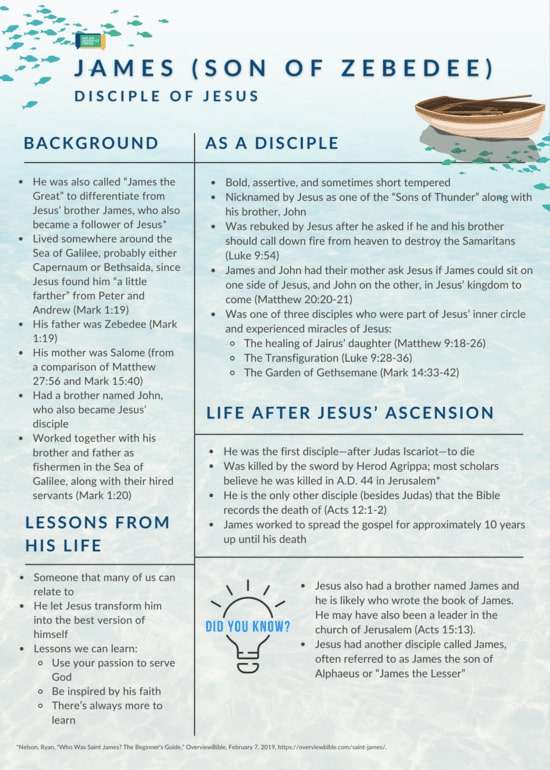
As Jesus Christ ministered on earth, His twelve disciples were some of His closest companions. Three of those 12 were said to be His “inner circle.”
One of them was James, the son of Zebedee. He was the older brother of John, another disciple.
James was a fisherman until he was called to become one of Jesus’ closest disciples. After Jesus’ ascension, he played an important role in the early church before becoming the first apostle to be martyred.
Though you might know this disciple by name, there’s more to his story than you might realize. So let’s look at:
James’ background
There isn’t a large list of confirmed facts about James the son of Zebedee, but we know that he was also called James the Great. (This was likely to differentiate between him and another disciple named James who was called James the Younger).1
James lived somewhere around the Sea of Galilee, probably either Capernaum or Bethsaida, since Jesus found him “a little farther” from Simon Peter and Andrew (Mark 1:19).
He had a brother named John, who also became Jesus’ disciple. The Bible tells us their father was Zebedee (Mark 1:19), and we can infer that their mother was Salome from a comparison of Matthew 27:56 and Mark 15:40.
James, John, and their father all worked together as fishermen on the Sea of Galilee, along with their hired servants (Mark 1:20).
While several Jameses are mentioned in the New Testament, they’re several different people. Jesus had a brother James (how’s that for confusing!), and this brother likely wrote the book of James.2 He may have also been a leader in the church of Jerusalem (Acts 15:13).
Jesus had another disciple called James, often referred to as James the son of Alphaeus or James the Less.
But let’s focus on James the Greater, the brother of John.
His story with Jesus began when Jesus was preaching in Nazareth. Jesus had just called Peter and Andrew to be His disciples. Then, He noticed a few others:
“He saw two other brothers, James the son of Zebedee, and John his brother, in the boat with Zebedee their father, mending their nets. He called them, and immediately they left the boat and their father, and followed Him” (Matthew 4:21-22, NKJV).
Mark’s account adds that they left their father with the hired servants so that their father wouldn’t have to continue the family business alone (Mark 1:20).
The book of Luke tells a slightly different story, indicating that perhaps James and John were not full-time disciples until a little later. Luke 5 says Peter, Andrew, James, and John had partnered in fishing, but had brought back nothing after a whole night. Jesus told them to cast their nets down again (Luke 5:4).
When they did so, they brought back so many fish that the nets were breaking (Luke 5:6)!
Jesus told them,
“‘Do not fear; from now on you will be catching people’” (Luke 5:10, NASB).
Or, as Mark 1:17 puts it,
“Then Jesus said to them, ‘Follow Me, and I will make you become fishers of men’” (NKJV).
On land, the disciples abandoned their fishing nets and followed Jesus.
James as a disciple
Like all of Jesus’ disciples, and like any of us, James had both good qualities and troublesome qualities. But regardless of his qualities, he began a strong and unwavering relationship with his Savior. He was regarded as one of Jesus’ closest disciples, along with John and Peter.
James’ character
The parts of the New Testament that talk about James and his brother John describe them as bold, assertive, and sometimes short-tempered men.
Because of this, Jesus nicknamed the two brothers the “Sons of Thunder,” or “Boanerges” in Aramaic (Mark 3:17).
We can see this trait of James in a story in Luke, when Jesus and His disciples were traveling to Jerusalem. They sent messengers ahead to a Samaritan village, but the Samaritans refused to accept Jesus because He was going to Jerusalem, a Jewish city. The Samaritans and the Jews had long been rivals.
This response riled up James and John. They said to Jesus,
“‘Lord, do You want us to command fire to come down from heaven and consume them, just as Elijah did?’” (Luke 9:54, NKJV)
Their temper had definitely gotten the better of them. Jesus chastised them for thinking this way:
“‘You do not know what manner of spirit you are of. For the Son of Man did not come to destroy men’s lives but to save them’” (Luke 9:55-56, NKJV).
These Samaritans were people Jesus had come to minister to.
Another time, the brothers were so sure of their honorable position that they had their mother ask Jesus if James could sit on one side of Jesus and John on the other in Jesus’ future kingdom (Matthew 20:20-21).
(According to Mark’s account, the brothers do the asking themselves.)
Sitting beside the king was about the next-best thing to being king themselves.
Jesus replied,
“You do not know what you ask. Are you able to drink the cup that I drink, and be baptized with the baptism that I am baptized with?” (Mark 10:38, NKJV)
The brothers foolishly said they could do it, though they had no idea what it actually meant to drink from Jesus’ cup of suffering and death.
Jesus said,
“You will indeed drink My cup, and be baptized with the baptism that I am baptized with; but to sit on My right hand and on My left is not Mine to give, but it is for those for whom it is prepared by My Father” (Matthew 20:23, NKJV).
James and John may have thought this was a wonderful thing. But they would understand the true and full meaning of this when Jesus died and rose again.
But before we get there, let’s look at James’ role among the other disciples.
One of Jesus’ closest companions
Since James was part of Jesus’ “inner circle,” he sometimes got to witness situations that the other disciples didn’t. Here are a few stories to illustrate this.
The healing of Jairus’ daughter

Photo by cottonbro studio
This story is recorded in all the Gospel accounts except for John’s.3 A Jewish ruler named Jairus approached Jesus, begging Him to come heal his dying daughter. Jesus took all His disciples with Him to the man’s home, but only Peter, James, and John were allowed to enter the house with Jesus (Mark 5:37).
By the time Jesus arrived, the girl had died and mourners had arrived, so Jesus had to send all the mourners out. Then, before the eyes of the girl’s parents, He raised her back to life.
So James was privy to the raising of Jairus’ daughter, one of Jesus’ most precious miracles, and saw for himself Jesus’ loving power.
The Transfiguration 4
Jesus took Peter, James, and John atop a mountain, where He became “transfigured”—His face and clothes shone white (Matthew 17:2). Then Elijah and Moses appeared and talked with Jesus.
While Peter attempted to respond to the situation (Matthew 17:4), James and John were notably silent. It is likely that James was in shock, trying to process the appearance of a legendary prophet and patriarch.
And when he heard a voice from heaven, declaring Jesus as the true Son of God, James finally became overwhelmed by this miraculous experience. He fell down and hid his face in fear with the other disciples (Matthew 17:6).
But Jesus reassured him as he experienced these powerful signs (Matthew 17:7).
We can only imagine how this experience must have strengthened James’ faith in Jesus as the Son of God.
The Garden of Gethsemane
James and the other two disciples also accompanied Jesus in the Garden of Gethsemane, the night He was arrested.5 But their response to this privilege was lacking.
Three different times Jesus asked James, John, and Peter to watch and pray while He went on a little farther to pray alone. All the while, Jesus experienced deep spiritual agony in the garden as he prayed about his coming fate on the Cross (Luke 22:44). And three times, Jesus’ closest companions, who were supposed to be His best friends, fell asleep.
Soon after, Judas, another disciple of Jesus, came to betray Him, bringing a group of soldiers to arrest Him.
Though James had an insider’s view of Jesus’s ministry, he still had plenty to learn. It took seeing Jesus crucified to help him understand His true purpose and ministry.
And the few encounters the disciples had with Jesus before He ascended back into heaven solidified Jesus’ true mission in James’ mind, fueling his passion to be a witness for Him.
So let’s look at James’ life after Jesus’ time on earth ended.
James’ life after Jesus’ ascension

Photo by Ricardo Cruz on Unsplash
The only thing the Bible tells us about James’ life after the ascension of Jesus is that he was the first disciple—after Judas Iscariot—to die.
He’s also the only apostle the Bible records the death of. Acts 12:1-2 gives us a brief insight:
“Now about this time Herod the king stretched out his hand to harass some from the church. Then he killed James the brother of John with the sword” (NKJV).
This Herod was King Herod Agrippa, and most scholars believe James was killed in AD 44 in Jerusalem.6 Some Spanish legends suggest his body was brought to Santiago de Compostela, whose basilica became an important Christian landmark in the Middle Ages.7
Christian Church historian Eusebius of Caesarea, living in the third and fourth centuries AD, added this anecdote about James’ death:
“It appears that the guard who brought him [James] into court was so moved when he saw him testify that he confessed that he, too, was a Christian. So they were both taken away together, and on the way he asked James to forgive him. James thought for a moment, then he said ‘I wish you peace,’ and kissed him. So both were beheaded at the same time.”8
There isn’t any validation from Scripture that this actually happened, but we do know James worked to spread the Gospel for approximately 10 years up until his death. Otherwise Herod wouldn’t have targeted him over other important apostles like Peter or John.
A popular legend has it that he worked as an evangelist, spreading the Gospel in Spain before he died.9 But no proof exists for this endeavor except a text written hundreds of years later, the Breviary of the Apostles.10 And it is unlikely that James would have done all this and come back to Jerusalem to be killed in AD 44.
Paul also said in Romans that he wanted to preach “not where Christ was named” (Romans 15:20, NKJV) and speaks of going to Spain in the next few verses (Romans 15:24). If James had already started a church there, Paul likely wouldn’t have said that Christ wasn’t named there.
But while James’ life was short compared to the other apostles, we can still learn a lot from it.
Takeaways from James’ life

Photo by Joshua Earle on Unsplash
James is an apostle many of us can relate to. He could be emotional, hasty, and prideful. But he also let Jesus transform him into the best version of himself.
James served God with his whole heart
James had a lot of zeal and passion—hence the nickname Son of Thunder. In his early days as a disciple, he held a shortsighted view of Jesus’ ministry although he was very committed to Jesus.
Afterward, when he figured out what Jesus’ true purpose was on earth and what He had accomplished in His death, James recommitted himself as an apostle—but this time, spreading the truth of Jesus to all around him.
As followers of Jesus, we can use our love for Him to guide our interactions with others. We can share Jesus with those around us by the way we act, how we treat people, and what we say.
His faith is inspiring
James’ zeal was a little misdirected early on as a disciple. But his heart was in the right place, and when the time came to pick a side, James chose Jesus.
He turned this enthusiasm into a force hard to reckon with, spreading the Gospel to those in Jerusalem and perhaps the surrounding areas. He understood Jesus’ true purpose now, and he had the faith in Him to match it.
He was even willing to risk his life for Jesus. King Herod Agrippa I had his eye on James, and one day he came for him. James’ faith stood strong, even when he was threatened with a sword (Acts 12:2).
And he died for his faith.
This can be an inspiration to us. No matter what happens to us, in the end, it’s our faith that matters most. We know that Jesus will be waiting to welcome us at His return.
There’s always more to learn

Photo by Sincerely Media on Unsplash
Even though he was one of Jesus’ closest apostles, James was far from a perfect or mature man. He thought he was one of the best and deserved a special place next to Jesus. He still had to learn that the best way to serve Jesus was by serving others.
This was the example Jesus set on earth, and James had to make some mistakes before learning this truth.
Since we are human, we will make mistakes in our lives and even in our relationship with Jesus. But we can still learn, and we can still grow, no matter how old we already are. There will always be opportunities to serve others, just as James learned.
James led an exciting life, one that involved fishing and traveling about Judea as Jesus’ disciple. He witnessed things not all the 12 apostles had the privilege to see, and he became a faithful servant of God.
He would become a martyr, as Jesus predicted (Matthew 20:23). While James didn’t know that’s what Jesus meant when He told him, he grew in faith and conviction nonetheless. He didn’t live a long life, but he became an inspiring servant of God. And that’s one of the most important things about his Apostolic legacy.
Curious about the other disciples? Read about them on our main page about the disciples.
Related Articles





- “James,” ATS Bible Dictionary, Bible Hub. [↵]
- “Introduction,” Holy Bible, English Standard Version, Crossway, 2007. [↵]
- Matthew 9:18-26; Mark 5:21-43; Luke 8:40-56. [↵]
- Matthew 17:1-8; Mark 9:2-8; Luke 9:28-36. [↵]
- Matthew 26:37-46; Mark 14:33-42. [↵]
- Nelson. [↵]
- “St.James,” Britannica. [↵]
- Nelson.[↵]
- Ibid. [↵]
- Ibid. [↵]
More Answers

Quem Foram os Juízes de Israel no Antigo Testamento?
Quem Foram os Juízes de Israel no Antigo Testamento?Tempos de crise exigem homens e mulheres de ação. Os israelitas, recém-estabelecidos na Terra Prometida, encontraram-se nesses tempos. À medida que nações inimigas atacavam e oprimiam as tribos, eles clamavam a Deus...

¿En qué se diferencian los Adventistas del Séptimo Día de otros protestantes?
¿En qué se diferencian los Adventistas del Séptimo Día de otros protestantes?Como denominación cristiana protestante, la Iglesia Adventista del Séptimo Día considera la Biblia como la regla suprema de fe y a Jesucristo como el único camino a la salvación. Tenemos...
Como os Adventistas do Sétimo Dia São Diferentes de Outros Protestantes?
Como os Adventistas do Sétimo Dia São Diferentes de Outros Protestantes?Como uma denominação cristã protestante, a Igreja Adventista do Sétimo Dia considera a Bíblia como o guia supremo e vê Jesus Cristo como o único caminho para a salvação. Temos algumas diferenças...

O que é ASI (Associação de Empresários e Profissionais Adventistas)?
O que é ASI (Associação de Empresários e Profissionais Adventistas)?ASI, que significa Associação de Empresários e Profissionais Adventistas (tradução adaptada), é uma organização baseada em associação que oferece apoio aos membros adventistas (profissionais...
Jesús y la Mujer en el Pozo: Derribando Barreras
El encuentro de Jesús con la mujer en el pozo revela su sentir por las personas heridas y su deseo de derribar prejuicios. Esta página analiza cómo Jesús se acercó a ella.

Revealing The True Meaning of The Parable of The Rich Man & Lazarus
Learn the real point behind one of Jesus’ most vivid parables.
O que são as Bem-Aventuranças (E o que significam)?
O que são as Bem-Aventuranças (E o que significam)?As Bem-Aventuranças, encontradas no início do Sermão da Montanha de Jesus no Evangelho de Mateus, são o manifesto do reino de Jesus. Elas descrevem a maneira como Seu reino funciona e o que significa ser um de Seus...

Líderes de la iglesia: ¿Cuál es el rol de un pastor Adventista?
Líderes de la iglesia: ¿Cuál es el rol de un pastor Adventista?¿Cuál es el rol de un pastor en la iglesia Adventista? La posición en sí misma, al menos en lo que respecta a una congregación local, no es muy diferente de la de los pastores en otras denominaciones...
ASI ni Nini (Huduma na Viwanda vya Waadventista vya Kibinafsi)?
ASI ni Nini (Huduma na Viwanda vya Waadventista vya Kibinafsi)?ASI, ambayo inayofupisha maneno (Huduma na Viwanda vya Waadventista vya Kibinafsi), ni shirika la uanachama linalotoa msaada kwa wainjilisti wa Kiadventista (wataalamu wa Kanisa la Waadventista wa Sabato...

Ellen White Alisema Nini Kuhusu Unabii wa Nyakati za Mwisho?
Tunaweza kusoma katika Maandiko kuhusu mfululizo wa matukio na dalili zinazoongoza hadi Ujio wa Pili wa Yesu Kristo.

Safari na Utume wa Ellen G. White Ulimwenguni
Safari na Utume wa Ellen G. White UlimwenguniIngawa Ellen White, mwanzilishi mwenza wa Kanisa la Waadventista wa Sabato, anajulikana zaidi kwa huduma yake nchini Marekani, pia alisafiri kwenda nchi nyingine kumi na mbili katika maisha yake—hili lilikuwa jambo kubwa...

Yote Kuhusu Wainjilisti wa Vitabu wa Kiadventista
Kanisa la Waadventista wa Sabato hutumia mbinu mbalimbali kusambaza tumaini la injili duniani.
¿Qué es ASI (Servicios e Industrias de Laicos Adventistas)?
¿Qué es ASI (Servicios e Industrias de Laicos Adventistas)?ASI, que significa Servicios e Industrias de Laicos Adventistas, es una organización basada en membresía que brinda apoyo a los laicos adventistas (profesionales Adventistas del Séptimo Día que no son...
¿Qué dijo Elena G. de White sobre la profecía de los últimos tiempos?
¿Qué dijo Elena G. de White sobre la profecía de los últimos tiempos?Podemos leer en las Escrituras acerca de la serie de eventos y señales que conducen a la segunda venida de Jesucristo. Y suena bastante intenso, por decir lo menos. La naturaleza simbólica del...
O que Ellen White disse sobre a profecia dos tempos finais?
O que Ellen White disse sobre a profecia dos tempos finais?Podemos ler nas Escrituras sobre a série de eventos e sinais que antecedem a segunda vinda de Jesus Cristo. E, para dizer o mínimo, isso soa bastante intenso. A natureza simbólica da linguagem da profecia...

Meaning of the Parable of the Two Sons in Matthew 21
Meaning of the Parable of the Two Sons in Matthew 21The parable of the two sons in Matthew 21:28-32 is about a father who instructs his sons to work in the family vineyard. The first son refuses to work but later has a change of heart and obeys. The second son says...
Viagens e Missão Mundial de Ellen G. White
Viagens e Missão Mundial de Ellen G. WhiteEmbora Ellen White, cofundadora da Igreja Adventista do Sétimo Dia, seja mais conhecida por seu ministério nos Estados Unidos, ela também viajou para outros doze países durante sua vida — uma grande conquista no século XIX,...
Joseph Bates na Nafasi Yake katika Kanisa la Waadventista
Joseph Bates na Nafasi Yake katika Kanisa la WaadventistaJoseph Bates alikuwa baharia aliyegeuka kuwa mhubiri ambaye alijiunga na Harakati ya Miller na kusubiri Ujio wa Pili wa Yesu kutokea mwaka 1844. Licha ya kukatishwa tamaa wakati hili halikutokea, Bates...

Je, Wasabato Husherehekea Sikukuu?
Je, Wasabato Husherehekea Sikukuu?Je unajiuliza ikiwa mwanafunzi mwenzako au mfanyakazi mwenzako Mwadventista husherehekea sikukuu kama wewe? Labda ungependa kumshirikisha kwenye sherehe fulani, lakini pia unataka kuheshimu imani yake. Kwa hiyo, huna uhakika wa jinsi...

O Que a Bíblia Diz Sobre a Segunda Vinda de Jesus Cristo
Curioso para saber o que a Bíblia diz sobre a Segunda Vinda de Jesus Cristo? Vamos abordar os versículos-chave e o que eles significam.

Waadventista Wanaamini Nini Kuhusu Imani na Matendo?
Waadventista Wanaamini Nini Kuhusu Imani na Matendo?Waadventista wanaamini tunaokolewa kwa imani, ambayo ni imani na tumaini tulilonalo kwa Yesu Kristo kutuokoa kutoka dhambini. Yesu, basi, anatupa uwezo wa kuishi kwa utii wa amri za Mungu na kuwahudumia wengine kwa...
Todo sobre los colportores Adventistas del Séptimo Día
Todo sobre los colportores Adventistas del Séptimo DíaLa Iglesia Adventista del Séptimo Día utiliza una variedad de métodos para difundir la esperanza del evangelio al mundo. Una de estas formas es a través del colportaje, también llamado “venta puerta a puerta” o...
Tudo Sobre Colportores Adventistas do Sétimo Dia
A Igreja Adventista do Sétimo Dia usa uma variedade de métodos para espalhar a esperança do evangelho ao mundo.
Los viajes y la misión mundial de Elena G. de White
Los viajes y la misión mundial de Elena G. de WhiteAunque Elena G. de White, cofundadora de la Iglesia Adventista del Séptimo Día, es más conocida por su ministerio en los Estados Unidos, también viajó a otros doce países durante su vida, un gran logro en el siglo XIX...

Mikutano ya Injili ya Waadventista ni Nini?
Kanisa la Waadventista wa Sabato linaweka mkazo mkubwa katika kushiriki injili kupitia uinjilisti, yaani kushiriki injili kupitia mahubiri, mafundisho, na ushuhuda.
Joseph Bates y su papel en la Iglesia Adventista del Séptimo Día
Joseph Bates y su papel en la Iglesia Adventista del Séptimo DíaJoseph Bates fue un marinero que se convirtió en predicador, se unió al Movimiento Millerita y esperó que ocurriera la Segunda Venida de Jesús en 1844. A pesar de sentirse decepcionado cuando esto no...
Joseph Bates e Seu Papel na Igreja Adventista do Sétimo Dia
Joseph Bates foi um marinheiro que se tornou pregador, juntou-se ao Movimento Millerita e esperou pela Segunda Vinda de Jesus em 1844.
¿Los Adventistas del Séptimo Día celebran las fiestas?
¿Los Adventistas del Séptimo Día celebran las fiestas?¿Te preguntas si tu compañero de clase o de trabajo adventista celebra las mismas fiestas que tú? Tal vez quieres incluirlo en algunas festividades, pero también deseas respetar sus creencias. Entonces, no estás...
Os Adventistas do Sétimo Dia Celebram Feriados?
Está se perguntando se seu colega de classe ou de trabalho adventista celebra os mesmos feriados que você?
Didn’t find your answer? Ask us!
We understand your concern of having questions but not knowing who to ask—we’ve felt it ourselves. When you’re ready to learn more about Adventists, send us a question! We know a thing or two about Adventists.