
The Book of Acts: A Simple Guide
The book of Acts is the fifth book in the New Testament. It’s a continuation of one of the Gospel accounts and an intimate look into the eventful early history of the Christian church.
The four accounts of the Gospel (Matthew, Mark, Luke, and John) talk about Jesus’ life and ministry on earth. But Acts is the only book of the Bible that talks in detail about the ministry of Jesus’ apostles after He returned to heaven and “passed the torch” of ministry to them (Acts 1:1-4).
In fact, the traditional title of Acts is “The Acts of the Apostles,” and it includes important biblical figures and lessons for us today. It’s got some great stories, too.
To help us better understand the book of Acts, we’ll talk about:
Let’s start with who wrote it.
The author of Acts

Photo by Esther Vexler on Unsplash
The book of Acts was written by Luke, who also wrote the third book of the New Testament, the Gospel according to Luke. Scholars haven’t come to a consensus on the date, but possibilities range from AD 62 to the early second century.1
Luke makes it pretty clear right from the beginning of Acts that this book was meant to be a continuation of his account of the Gospel:
“In the first book [the Gospel of Luke], O Theophilus, I have dealt with all that Jesus began to do and teach, until the day when He was taken up, after He had given commands through the Holy Spirit to the apostles whom He had chosen” (Acts 1:1-2, ESV).
Luke wrote his account of the Gospel to talk about what Jesus, the Messiah, did during His ministry. And he wrote Acts to discuss what happened after Jesus ascended to heaven.
So Luke uses Acts chapter 1 as a bridge that connects Luke (what Jesus did) and Acts (what Jesus’ followers did).
Simply put, Acts is Luke’s part two:
- Written by the same person (Luke)
- To the same person (Theophilus)
- Continuing the same theme (the effects of Jesus’ ministry)
In fact, some scholars call the books Luke-Acts.2
Since Luke gives a detailed account of the early Christian church, Acts is considered a historical book. He addresses both Luke and Acts to “most excellent Theophilus, that you may have certainty concerning the things you have been taught” (Luke 1:3-4, ESV).
It almost sounds like Luke wrote Luke-Acts so Theophilus could use it as a devotional. We read devotionals today for the same reason—to dig deeper into the meaning and application of spiritual truths.
Theophilus is a Greek name, and since Luke addressed him as “most excellent,” scholars think he was a Greek official of high social standing,3 but not much else is known about him.
Not much is known about Luke himself either, but he is mentioned in three different places in the New Testament:
1. Colossians 4:14 mentions that Luke is a physician
2. 2 Timothy 4:11 says that Luke is traveling with Paul (the author of 2 Timothy)
3. Philemon 24 also says that Luke is working with Paul (the author of Philemon)
So we know that Luke was a physician and Paul’s companion. Luke is a Greek name, and he shows an understanding of the Old Testament in his writing, so scholars believe he was either a converted Gentile who attended a Jewish synagogue, or he was a Jewish convert.4
Significant events in the book of Acts
Luke’s account of early Christian church history in the book of Acts includes notable people and events that we can still learn from today:
- Jesus’ ascension
- The Holy Spirit at Pentecost
- The stoning of Stephen
- Saul’s conversion to Paul
- Paul’s missionary journeys
Let’s start by talking about what happened at the beginning of Acts, setting the stage for the groundbreaking events that followed: the ascension of Jesus.
Jesus ascends back to heaven
Luke’s Gospel account ends with Jesus ascending into heaven (Luke 24:51), and that’s the same way Acts begins, but with a bit more detail and a wonderful promise that we still cling to today.
After Jesus rose from the dead, He appeared to many of His followers over a 40-day period (Acts 1:1-4) before returning to heaven. Jesus told His disciples to stay in Jerusalem and wait for the Holy Spirit, who would come to them “not many days from now” (Acts 1:5, NKJV).
Then, once they received power from the Holy Spirit, He gave them clear instructions to spread the good news about Him and carry on His ministry to the rest of the world.
Then, Jesus rose into the clouds until the disciples couldn’t see Him anymore (Acts 1:9). But suddenly, two men in white robes appeared in front of them. And they gave the disciples a promise that we’re all waiting to be fulfilled.
“Men of Galilee, why do you stand looking up into heaven? This same Jesus, who has been taken from you into heaven, will come in the same way that you have seen Him going into heaven” (Acts 1:11, CSB).
This is the promise of the Second Coming of Jesus! Just like He rose into the clouds, He will come back in the clouds (Revelation 1:7).
The two men said, “this same Jesus,” meaning the same exact person the disciples had seen teaching, preaching, and healing. This promise is why many Christians live with so much hope—they know Jesus will keep His promise and return to make all things right.
Until then, Jesus left instructions for His followers to wait for the Holy Spirit and then spread the Gospel “in Jerusalem and in all Judea and Samaria, and to the end of the earth” (Acts 1:8, ESV).
Talking to people about Jesus in Jerusalem, Judea, and Samaria makes sense. Jesus, along with many of His followers, had been to these places during His ministry.
But to the ends of the earth?
How would it possible to spread the gospel everywhere when people are from different cultures and speak different languages?
Receiving the Holy Spirit at Pentecost
A major theme of Acts is revealed in chapter 2: Followers of Christ are empowered through the Holy Spirit to spread the good news of Jesus to anyone and everyone who will listen. This action created and sustained the early first-century Christian church—and it still fuels Christianity today.
At the end of Pentecost (a Jewish festival also called the Feast of Weeks or Shavuot5), the disciples and other followers of Jesus were gathered together in a house praying when the promised Holy Spirit showed up in a miraculous way.
“Suddenly a sound like that of a violent rushing wind came from heaven, and it filled the whole house where they were staying. They saw tongues like flames of fire that separated and rested on each one of them. Then they were all filled with the Holy Spirit and began to speak in different tongues, as the Spirit enabled them” (Acts 2:2-4, CSB).
So wait…a rushing wind? Fire shaped like tongues? Speaking in multiple languages? How is any of this going to help Jesus’ apostles spread the good news?
The Holy Spirit is a person in the Godhead, but the power of the Holy Spirit is often described by comparing it to things of nature.
Throughout the Bible, the Holy Spirit is described as:
- Wind or breath (John 3:8; John 20:22)
- Fire (Ezekiel 8:1-4; Revelation 4:5)
- A dove (Matthew 3:16; Mark 1:10; Luke 3:22; John 1:32)
- Oil for anointing (Exodus 29:7; Isaiah 61:1; Luke 4:18; Acts 10:38
So it’s no surprise that in Acts, the presence of the Holy Spirit shows up as wind and fire, and His power gives the apostles mastery of languages that none of them knew before.
The Holy Spirit’s timing wasn’t an accident. His arrival on the last day of Pentecost was perfect because hundreds of thousands of Jews “from every nation under heaven” (Acts 2:5, NKJV) were in Jerusalem for the festival. And now that the apostles could speak in different languages, they had the ability to communicate with all of them (Acts 2:6-11)!
This could be an interesting reminder of what happened at the Tower of Babel (Genesis 11:1-9), when there was only one language (verse 1). The people were united and resourceful, but pride caused them to rebel against God (verse 4). So He confused their languages to halt their self-centered city-building, and then they spread out to settle across the earth (verses 7-9).
So while the Lord used different languages to divide people because of their pride in the Old Testament, here in Acts, the Holy Spirit gives the ability of language to bring people back together in building up the kingdom of God.
All the ingredients were in place for the Gospel to spread worldwide.
But opposition wasn’t close behind.
The stoning of Stephen

Photo by Sebastian Schuster on Unsplash
Though a sad and appalling event, the stoning of Stephen—one of Jesus’ devoted followers and a man “full of grace and power” (Acts 6:8, CSB)—was a catalyst for the Gospel spreading to the rest of the earth.
But wait, how did we get from being filled with the Holy Spirit to stoning a member of Christ’s family? What exactly happened?
Let’s rewind for a moment.
After the apostles received the power of the Holy Spirit, more and more people were believing in Jesus and “the disciples were increasing in number” (Acts 6:1, ESV). But there were also those who saw this as a threat to order, power, or maintaining the status quo.
Additionally, more people joining into one family also meant that cultures were colliding.
At one point, Greek-speaking Jews, also called Hellenists, started to complain because their widows weren’t receiving the food that was being shared on a daily basis, but the Hebrew widows were. Part of the reason for this neglect was that the Hebrews spoke Aramaic and the Hellenists spoke Greek,6 so although the apostles were able to speak different languages, there were still organizational issues to address.
So the twelve disciples had a meeting to appoint seven deacons who could devote their time and energy to local problems like this, such as widows being neglected or overlooked.
Stephen was one of those seven, chosen because he was “full of faith and of the Holy Spirit” (Acts 6:5, ESV).
Moses did something similar in the Old Testament when he appointed trustworthy judges to share his responsibilities over the Israelites so that he wouldn’t be overloaded with work (Exodus 18:21-22). And a good boss will do the same thing today, delegating work to trustworthy people who are dedicated to the cause.
Stephen took to his new role as administrator over food distribution quite well and was a huge help to the people (Acts 6:8). He was also a gifted speaker. And soon he was confronted with opposition because of his preaching.
Antagonistic Jewish groups started to attack his character because “they could not withstand the wisdom and the Spirit with which he [Stephen] was speaking” (Acts 6:10, ESV). So they brought Stephen to the Sanhedrin (Jewish high council) and accused him of blasphemy—an act they deemed punishable by death (Leviticus 24:16).
Stephen stood before the Sanhedrin, speaking with conviction about the Jews’ own history with Christ (Acts 7:1-53).
His speech sent them into a frenzy of fury! They rushed at him, dragged him out of the city, and stoned him to death.
Never had Stephen’s love for and dependence upon Jesus been more evident than when he was being wrongfully killed: “Lord, do not hold this sin against them” (Acts 7:60, ESV).
He demonstrated a true hope that every single human could someday come to know and accept the Gospel message. So, as he died, he prayed for the forgiveness of those who killed him. Just like Jesus did on the Cross (Luke 23:34).
And with that, Stephen became the first Christian martyr for the Gospel of Jesus.
After that, what’s described as “severe persecution” broke out against the Christians in Jerusalem, so everyone scattered to find safety “throughout the regions of Judea and Samaria” (Acts 8:1, ESV).
(And didn’t Jesus say something about Judea and Samaria before He ascended to heaven?)
“But you will receive power when the Holy Spirit has come on you, and you will be my witnesses in Jerusalem, in all Judea and Samaria, and to the ends of the earth” (Acts 1:8, CSB).
And that’s exactly what unfolded. It started in Jerusalem, then spread to Judea and Samaria.
So in hindsight, what the people did to Stephen in order to stop the spread of the Gospel ended up kicking it into high gear.
And interestingly enough, it’s at Stephen’s stoning that we meet a major enemy of the Christian church…but also became the biggest contributor to the New Testament and helped spread the Gospel far and wide.
Saul’s conversion to Paul
When the mob was stoning Stephen, the Bible says, “And the witnesses laid down their garments at the feet of a young man named Saul” (Acts 7:58, ESV).
Taking your cloak off was typical behavior for a stoning. It’s a lot easier to throw rocks when your arms are free. And the garments being laid at Saul’s feet meant he was a respected member of the community—a strict Pharisee with authority—and he approved of Stephen’s public death (Acts 8:1).7
He continued persecuting the new Christian church—called “the Way” (Acts 9:2)—even going so far as to drag members of the church out of their houses so they could be arrested (Acts 8:3).
But on his way to Damascus to arrest and bring more Christians to prisons in Jerusalem, a blinding light from heaven surrounded him and he collapsed to the ground. He suddenly heard the voice of Jesus asking him, “Saul, Saul, why are you persecuting Me?” (Acts 9:4, ESV)
Startled, Saul couldn’t even focus on the question. And when he asked whose voice he heard, Jesus replied, “I am Jesus, whom you are persecuting. But rise and enter the city, and you will be told what you are to do” (verses 5-6, ESV).
The people traveling with Saul were quite disturbed because they, too, saw the light (though they did not hear the voice), but didn’t see anyone (Acts 22:9). Saul was blinded by this incident, so after the short conversation, his companions helped him get to Damascus. Saul couldn’t see for three whole days, and he went into a time of fasting and prayer.
Ananias, a disciple in Damascus, had received instructions from God on where and how to find Saul. And while Saul had been fasting and praying, he had also received a vision of Ananias (Acts 9:10-12).
So when Ananias showed up where Saul was staying, he was welcomed in. Ananias laid his hands on Saul and blessed him. Immediately, his sight returned. He was baptized, took some time to regain his strength, and started preaching the good news of Jesus in Damascus and then in Jerusalem (verses 14-19).
And he spent the rest of his life traveling and preaching about Jesus.
Through the saving power of Jesus, Saul used the same fervor he once had for arresting the followers of Jesus Christ to instead preach and teach about Jesus Christ.
He not only had a change in identity and mission, but eventually he had a change in name, too.
While he was preaching in Jerusalem he was called by his Hebrew name, Saul. But when his travels took him into Gentile territory, he started going by Paul, his Roman name.8
And now historically, he is known as the Apostle Paul. He’s the author of 13 of the 27 books in the New Testament. These books, which were originally written as letters to different churches, are traditionally called the Pauline Epistles.
Paul’s preaching took him to many locations throughout the Roman Empire, which we’ll look at next.
Paul’s missionary journeys
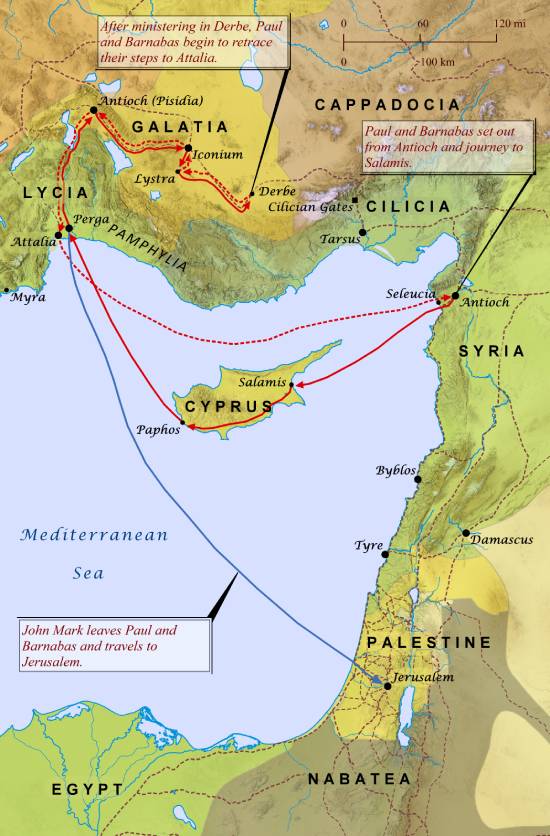
A Map of Paul’s First Missionary Journey. Photo courtesy of biblemapper.com
Paul went on three major missionary journeys during his lifetime.
His first missionary journey (Acts 13-14) lasted about one and a half years.9 He traveled to cities in modern-day Syria, Turkey, and Greece.10
During his travels, he dealt with opposition from Jewish religious leaders, major disagreements with his traveling companions, and physical attacks. At one point, he was even stoned and left for dead (Acts 14:19-20)!
Paul’s second missionary journey (Acts 15-18) lasted about two and a half years.11 He traveled to some of the places as before, also visiting cities in modern-day Syria, Turkey, Greece, and Israel.12 He faced some of the same challenges and was also arrested and sent to prison for casting a demon out of a slave girl (Acts 16:16-24). But God rescued him and his friends from prison through an earthquake and the help of one of the jailers (verse 25-40).
Paul’s third and longest missionary journey (Acts 18-21) lasted about five years.13 He again traveled to cities in modern-day Syria, Turkey, Greece, and Israel.14 And yet again he faced opposition, including a riot (Acts 19:21-41) and another arrest and imprisonment (Acts 21-22).
But he never stopped preaching.
Bible scholar Tim Mackie, PhD, observes that wherever Paul went, he received a strong response from the community because they felt like he was threatening their way of life, personally and politically.15
Each of his missionary journeys came with significant challenges. In Paul’s own words, he says,
“Three times I was beaten with rods. Once I received a stoning. Three times I was shipwrecked. I have spent a night and a day in the open sea. On frequent journeys, I faced dangers from rivers, dangers from robbers, dangers from my own people, dangers from Gentiles, dangers in the city, dangers in the wilderness, dangers at sea, and dangers among false brothers; toil and hardship, many sleepless nights, hunger and thirst, often without food, cold, and without clothing” (2 Corinthians 11:25-27, CSB).
Wow. Jesus wasn’t kidding when He said to Ananias, “…this man is my chosen instrument to take my name to Gentiles, kings, and Israelites. I will show him how much he must suffer for my name” (Acts 9:15-16, CSB).
Even though Paul suffered quite a bit during his almost decade-long missionary travels, he was still triumphant.16 He preached with energy and conviction, baptized many, healed the sick and lame, cast out demons, and performed many other miracles by the power of the Holy Spirit.
During this time, he also wrote Romans, 1st and 2nd Corinthians, Galatians, Ephesians, Philippians, Colossians, 1st and 2nd Thessalonians, 1st and 2nd Timothy, Titus, and Philemon.
By the end of his life, Paul had preached in cities in modern-day Syria, Turkey, Greece, Israel, Cyprus, Italy, and possibly Spain (Romans 15:24). Acts ends with Paul in Rome under house arrest, but still preaching.
Luke goes into a lot of detail when he writes about Paul’s missionary journeys, but Paul isn’t the only apostle that Luke mentions. He also writes about Philip, Peter, John, Barnabas, and others who spread the Gospel and did miraculous things in Christ’s name.
But what benefits and lessons can we get from something that happened centuries ago? And how can we apply it to our lives today?
Messages about worship, culture, and class
Worshipping God isn’t just a theme in Acts…it’s a theme throughout the entire Bible. The Old Testament focuses on how God’s chosen people, the Israelites, were to worship Him and represent Him to the world. But Acts discusses the worship of God as if it’s for all people everywhere—because it is! Jesus’ death and resurrection made sure of that.
So how is worship different in Acts than in other parts of the Bible?
Worship and community
“Different” is one way to describe the kind of worship we see in Acts, but “evolved” or “upgraded” might describe it better.
In the Old Testament, gathering to worship God typically occurred in a tent. As time went on, it was upgraded to temples. By the time we get to the New Testament, we see worship gatherings happening in synagogues.
But when Jesus came, He declared that the new place of worship wasn’t in a temple or a synagogue…it was in God’s people. Everywhere.
The love of God was alive and active in people’s hearts and actions, and it wasn’t confined to reciting the Mosaic Law in a particular building.
So when Jesus said He came to fulfill the law (Matthew 5:17), one of the things He meant was that He came to show everyone how to worship God by actively loving people. The idea that the new temple was God’s people was revolutionary at the time.17
And since the church was actually the people, worship happened wherever the people were, whether a formal setting like a synagogue or temple, or an informal setting like at someone’s home or while traveling. God’s people were “mobile temples where God dwells.”18
We see the early Christian community in Acts worshiping in familiar ways, with prayer, singing, Bible study, baptism, or commemorating the Lord’s Supper. But we also see them demonstrating their love for God by hanging out together and sharing resources (Acts 2:44-45).
Acts 2:42 introduces us to a Greek term, koinōnia, which means fellowship and communal sharing.19 Many of these early Christians became like family, pooling their resources and caring for one another so that “there was not a needy person among them” (Acts 4:34, ESV).
Worship in Acts is not limited to a specific time or place. Worship is shown to be a lifestyle that spreads from person to person and from community to community.
Culture and class
Remember what happened in Acts 6? Even though the church was growing, the Hellenistic widows were being overlooked because of a language and cultural barrier. Culture and class collided, and it caused conflict among the people of Christ.
And how did the disciples fix it? They appointed deacons from the group that was being oppressed. This is significant because “elites often repressed complaining minorities; here the apostles graciously put trustworthy members of the offended minority into leadership roles.”20
This is such a counter-cultural solution to a common problem that unfortunately still exists within some Christian communities.
The Christian church began on the basis of Jesus’ gift of salvation being for all people (not just the Jews) and for all classes (not just the rich or educated). The same is true of the church today—it’s multiethnic, multiclass, and multigenerational.
The church is the body of Christ, or people of Christ, and the body is not relegated to a location or even one specific Christian denomination. Acts shows us how those who believe in Jesus and accept Him as their Lord and Savior all belong to the new church—the family of Christ (1 Corinthians 12:12-13).
That includes you. You are part of the body of Christ—the church. You are a mobile temple. And you have something to contribute to the kingdom of God as an active member (1 Corinthians 12:4-11) because “there are many members, yet one body” (verse 20, NKJV).
But what does that really mean? How is this information useful for us today?
Modern-day relevance of the book of Acts
Not only does Acts show the church as multiethnic and multigenerational, it also shows it as counter-cultural and full of humanity. And the same is still true of the church today.
The church was counter-cultural from the beginning
The audience in Luke’s time struggled with the message that God is for everyone, not just a specific set of people (the Jews). This fact alone made the early Christian church counter-cultural…it had no borders or a checklist of requirements. Mackie says, “People were captivated by the story of Jesus and how His love created communities where all people were treated as equals, regardless of ethnicity, gender, or economic status.”21
This same fact makes the Christian lifestyle counter-cultural today…a person’s ethnicity, age, class, or status doesn’t matter. The only thing that matters is that they accept Jesus into their heart (John 3:16; Romans 10:9-10).
And the love of Jesus still leads the way. When we love Him “with all your heart and with all your soul and with all your mind” (Matthew 22:37, ESV), we can expect to have a strong desire to live selflessly, which goes against the grain of the naturally self-centered culture we live in.
We can live triumphantly knowing that nothing can separate us from the love of Christ (Romans 8:35-39). And thank goodness, because the more we get to know Him, the more we realize we need Him.
The church uses structure to serve the mission
There were some particular procedures that happened in the early church that we can learn from today. As John Nixon II, DMin, puts it, “They [the apostles] created enough structure to serve the mission.”
Initially, the mission was suffering because of a lack of structure. Things were so chaotic that entire groups were being neglected, and the disciples couldn’t even write sermons because they didn’t have time for prayer and Bible study (Acts 6:1-2, 4).
But notice two things: They went about creating structure in a very spiritual way (verses 5-6), and they didn’t create so much structure that the mission was lost in procedure and policy. Instead, they created just enough structure to serve the mission (verse 7).
The church today has the same mission it’s always had—to minister to people and spread the Gospel of Christ. Any structure that gets in the way of that mission should be revisited, and any structure that serves that mission should be celebrated.
The church is full of humanity
The Christian church in Acts reminds us that the body of Christ is still full of human people with human tendencies and human problems. Throughout Acts, we see people accepting Jesus into their hearts but then slipping back into old habits.
Accepting Jesus doesn’t mean we suddenly become perfect and will never make a mistake again. But it does mean that, through the power of the Holy Spirit, we can become victorious over our struggles.
It’s encouraging to see that even though Acts is full of human beings who messed up when they depended on themselves, they saw victory when they depended on Jesus.
That sounds just like us today. Humans have always been humans and will continue to be humans. And it’s our humanity that helps us remember that we have a Savior who took on our condition and died for us, paving the way for a closer relationship with God.
The church is full of fellowship
Koinōnia, or fellowship, is still a really important part of the church today. It can happen anytime, anywhere there are members of the body of Christ, just like Jesus said back in Matthew 18:20.
This can certainly include a church building, but it also includes a small group in someone’s home, or a team of friends on a badminton court, or on a hiking trail that ends with a nice picnic, or even a quiet, prayerful lunch break with a couple of coworkers.
Just like how the people of the early church were “fiercely, doggedly protective of fellowship,” as Pastor Nixon says, we can still protect that familial bond among believers today.
The Holy Spirit is just as active now as He was on the day of Pentecost, and we can do amazing things together when we attune to His influence. The book of Acts shows us both the blessing and the importance of joining together, united in Christ, and not letting the things of the world divide us.



- Keener, Craig S., PhD., “Notes on Acts,” NIV Cultural Study Bible, 2016, p. 1865. [↵]
- Mackie, Tim, PhD., and Collins, Jon, “To the Ends of the Earth,” BibleProject Podcast, 2019. [↵]
- Grudem, Wayne and Thomas Schreiner, “Notes from Luke,” ESV Study Bible, 2008, p. 1942. [↵]
- Polhill, John B., “Notes from Acts,” ESV Study Bible, 2008, p. 2073. [↵]
- “Shavuot,” Encylopedia Britannica; “Pentecost,” Encylopedia Britannica. [↵]
- Polhill, John B., “Notes from Acts,” ESV Study Bible, 2008, p. 2092. [↵]
- “Acts 7:58,” Ellicott’s Commentary for English Readers, Biblehub. [↵]
- Polhill, John B., “Notes from Acts,” ESV Study Bible, 2008, p. 2109. [↵]
- “Chart: Major Events in the Life of the Apostle Paul,” ESV Study Bible, 2008, p. 2100. [↵]
- “Map: Paul’s First Missionary Journey,” NIV Cultural Study Bible, 2016, p. 1900. [↵]
- “Chart: Major Events in the Life of the Apostle Paul,” ESV Study Bible, 2008, p. 2100. [↵]
- “Map: Paul’s Second Missionary Journey,” NIV Cultural Study Bible, 2016, p. 1908. [↵]
- “Chart: Major Events in the Life of the Apostle Paul,” ESV Study Bible, 2008, p. 2100. [↵]
- “Map: Paul’s Third Missionary Journey,” NIV Cultural Study Bible, 2016, p. 1921. [↵]
- Mackie, Tim and Collins, Jon, “Paul’s Missionary Journeys: Acts 13-20,” BibleProject, 2019. [↵]
- “The Missionary Journeys of Paul,” Jesus Film Project, 2019. [↵]
- Rodriguez, Angel Manuel, ThD. “Christ and the Law,” Ministry Magazine, 1995. [↵]
- Mackie, Tim, PhD, and Collins, Jon, “What Happened at Pentecost and Why It’s Important,” BibleProject, 2018. [↵]
- “2842: koinónia,” Strong’s Concordance. [↵]
- Keener, Craig S., PhD, “Notes on Acts,” NIV Cultural Study Bible, 2016, p. 1878. [↵]
- Mackie, Tim, PhD, and Collins, Jon., “Paul’s Missionary Journeys: Acts 13-20,” BibleProject, 2019. [↵]
More Answers

Revealing The True Meaning of The Parable of The Rich Man & Lazarus
Learn the real point behind one of Jesus’ most vivid parables.

Meaning of the Parable of the Two Sons in Matthew 21
Meaning of the Parable of the Two Sons in Matthew 21The parable of the two sons in Matthew 21:28-32 is about a father who instructs his sons to work in the family vineyard. The first son refuses to work but later has a change of heart and obeys. The second son says...

The Barren Fig Tree Parable: What It Means to Bear Fruit
Find out what the Parable of the Barren Fig Tree really means.
2 Corinthians: An Overview of Paul’s Most Personal Letter
Discover Paul’s lessons on forgiveness, reconciliation, generosity, and more. It’s all in the book of 2 Corinthians!
The Pharisee and the Tax Collector Parable: Its Meaning Made Simple
The Meaning of the Pharisee and the Tax Collector ParableIn Luke 18:9-14, Jesus told a parable about two men who went to the temple to pray. One was a Pharisee and the other a tax collector. The Pharisee prayed (well, bragged) about his own good works compared to the...

The Story of the Widow’s Mite—What It Really Means
The Story of the Widow’s Mite—What It Really MeansPeople often assume bigger is better, but the Bible turns this concept on its head with the story of the Widow’s Mite. Of all the donations Jesus sees at the temple, the gift that draws His attention is not the...

Every Bible Verse About Hell in the Bible
Find out where and how often the Bible talks about hell.

The Book of 1 Corinthians: A Topical Breakdown
Learn about the book of 1 Corinthians to support your Bible study.

Parable of the Wedding Feast: Lessons From a Royal Invitation
Discover the beautiful Gospel invitation behind this parable of Jesus.

The Lamp on a Stand Parable—What Does it Mean?
Going through the main points, major themes, and takeaways for this parable.

Bible Verses That Mention “Heaven” (and How to Tell What They Mean)
Here’s every occurrence of the word “heaven” in the Bible, as well as the root words and original definitions.

Understanding the Parable of the Hidden Treasure (Matthew 13:44)
Here’s what the “Hidden Treasure” parables shows us about God’s love.

The Parable of the Persistent Widow—What it Means for Your Prayer Life
Find out what the Persistent Widow parable actually means.

What the Parable of the Mustard Seed is All About
This parable shows us how God is always at work, even if we can’t always see it.

The True Meaning of the Friend at Midnight Parable
Uncovering the real message at the heart of the Parable of the Friend at Midnight

The Parable of the Lost Coin—How God Feels About Each of Us
Learn what the Parable of the Lost Coin teaches us about God’s love for each one of us.

What the Two Builders Parable Actually Means
A walkthrough and breakdown of the Parable of the Wise and Foolish Builders.

What Does the Parable of the Dishonest Manager Really Mean?
Here’s a breakdown of what the “Parable of the Dishonest Manager” actually means.

Parable of the Rich Fool (Luke 12)—A Walkthrough
Here’s what the Parable of the Rich Fool in the Bible really means.
A Guide to the Book of Galatians
A walkthrough and breakdown of Paul’s letter to the Galatian churches.

What the Good Samaritan Parable Really Teaches Us
The parable of the good Samaritan is a story familiar to religious and secular audiences alike.

What Does the Parable of the 10 Virgins Teach Us?
The story of the 10 virgins found in Matthew 25:1-13 is a well-recognized parable of Jesus, and one with a profoundly important message for all of humanity.

The Parable of the Unforgiving Servant—A Walk-through
Through this somewhat alarming story, Jesus teaches us about forgiveness, mercy, and human nature.

What Does the Parable of the Pearl of Great Price Mean?
Here’s what Jesus taught about the kingdom of heaven through this short parable about a merchant who finds a priceless pearl.

Understanding the Book of Mark (An Overview)
A walkthrough of the Gospel according to Mark, including background information and references.

An Overview of Romans: Faith, Righteousness, and Relationships
Here’s a breakdown and background of Paul’s longest epistle.
The Book of John: An Overview
Here’s a study companion for the Gospel according to John.

What is Jesus’ Parable of the Sower About?
The parable of the sower is ultimately about how people responded to Jesus Christ and His message of the kingdom of God—the Gospel.

What Are the Synoptic Gospels? What About John?
What Are the Synoptic Gospels? What About John?The term “Synoptic Gospels” refers to the accounts of the Gospel story—the story of Jesus Christ’s earthly ministry and how it paved the way for salvation—written by Matthew, Mark, and Luke in the New Testament. The word...