
Oats, avocados, lentils, tofu—probably not what you first think of in a standard American diet. But if you show up at the home of an Adventist, chances are you may be served one of these staples.
Out of a desire to care for the bodies God gave us, many Adventists eat a diet rich in fruit, vegetables, grains, legumes, and nuts. Some of us are vegetarian, others may be vegan, and others may follow a whole-food, plant-based diet.
And the benefits are huge! A typical Adventist diet is one of the reasons Loma Linda, California—an area with about 9,000 Adventists—is one of the world’s “blue zones,” a region where “people reach age 100 at 10 times greater rates than the rest of the United States.”
You might be wondering why we eat this way and what makes our diet so healthful. And do Adventists have to eat this way?
Here’s everything you need to know about the Adventist diet:
What is the Adventist diet?

Photo by Zlatko Đurić on Unsplash
The Adventist diet is a plant-heavy diet. Some Adventists are vegetarian, eating only small amounts of dairy products and eggs. About 8% eat no animal products whatsoever. Those who do eat meat—about half—stick to biblical principles for meat consumption (Leviticus 11), excluding pork and shellfish.
In addition, Adventists emphasize whole foods and try to avoid highly processed food and sweets. We also abstain from alcohol and tobacco.
When it comes to beverages, we generally opt for water, herbal teas, and natural fruit and vegetable juices rather than sugary drinks or addictive caffeinated beverages.
These decisions stem from the Adventist health message, which includes nutrition as one of its eight health principles.
Where does the Adventist diet come from?
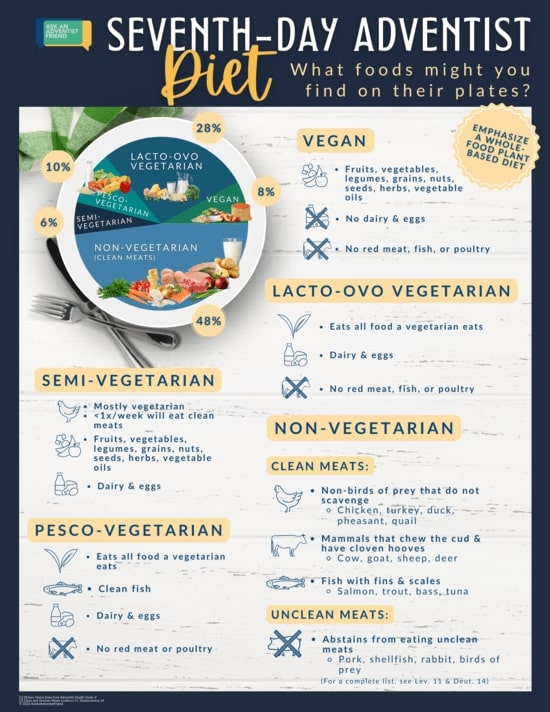
The Adventist diet is the product of our belief that our bodies belong to God and we should honor Him in the way we care for them (1 Corinthians 6:19–20). Eating healthfully is one way we do that. In our food choices, we follow some basic dietary principles from the Bible. We also refer to the writings of Ellen White, a key leader in the Seventh-day Adventist Church, who wrote a lot about how to practically apply these practical principles.
We don’t, however, see a healthy diet as a means of salvation. Rather, it is an outflow of our relationship with God.
It allows us to live our best and healthiest lives so that we can serve Him more effectively. And it helps us create a culture of whole health where physical, mental, and spiritual needs matter.
This means that the Church doesn’t prescribe a specific diet plan for its members. Instead, applying the principles is a personal choice that we make based on conscience and circumstance.
Let’s look at these health principles in more detail.
Biblical principles that promote a healthy diet
When God first created humans, He gave them a diet of fruit, grains, and seeds (Genesis 1:29). Later, He provided them with vegetables from the ground (Genesis 3:18).
But when a worldwide flood wiped out the earth’s vegetation, God permitted Noah and his family to eat meat (Genesis 9:3–4).
Leviticus 11 and Deuteronomy 14 outline more specifics about what kind of meat God advised humans to eat. He divided animals into categories of clean and unclean.
Clean meat comes from…
- Grazing animals that have a split hoof and chew the cud (beef, lamb, venison)
- Fish with scales
- Certain birds (chicken, turkey, etc.)
Scavenger-type animals are the ones considered not clean. These would be animals that eat dead animals or waste (such as pigs or birds of prey) or animals that clean the bottom of the ocean (such as shellfish).
Though Adventists don’t follow the Old Testament ceremonial laws, we see the principle of clean and unclean animals as a health matter rather than a ritual. And it existed even before God gave it to the Israelites. It’s the reason why, many hundreds of years before, God told Noah to bring seven pairs of every clean animal and only two of each unclean animal into the ark (Genesis 7:1–3, 8–9).
He knew that unclean animals aren’t ideal for human health. If you’ve spent any time around pigs, you’ll know the truth of this. They aren’t the cleanest of animals—and they’ll eat anything!
Not surprisingly, researchers found bacteria that cause food poisoning in 90% of pork samples. They’ve also discovered tapeworms that can lead to neurological infections.1
God’s not about making arbitrary rules. He gave the dietary guidelines to protect us and help us have the best health possible.
Ellen White’s counsel
In the mid-1800s as the Adventist Church was growing, Ellen White—one of its leaders—was led by the Holy Spirit to write about healthy living. She discussed the impact of physical health on spiritual health and why it’s important to care for the whole person.
Her recommendations were far ahead of their time when most people didn’t know that eating fried pork and doughnuts would affect their health.2
Here are some nutrition snippets from her books:

Photo by Alexandra Andersson on Unsplash
Plant-based diet: “Grains, fruits, nuts, and vegetables constitute the diet chosen for us by our Creator. These foods, prepared in as simple and natural a manner as possible, are the most healthful and nourishing.”3
Temperance: “True temperance teaches us to dispense entirely with everything hurtful, and to use judiciously that which is healthful.”4
Pork: “God never designed the swine to be eaten under any circumstances.” God actually made swine to be “useful.”… “In a fruitful country, where there was much to decay upon the ground, which would poison the atmosphere, herds of swine were permitted to run free, and devoured the decaying substances, which was a means of preserving health.”5
Sickness in animals used for meat: “There are but a few animals that are free from disease.”6
Moderation in eating sugary foods: “Far too much sugar is ordinarily used in food…. The free use of milk and sugar taken together should be avoided.”7
Avoidance of stimulating (caffeinated) beverages: “Tea and coffee are stimulating. Their effects are similar to those of tobacco; but they affect in a less degree…. Why they suffer when they discontinue the use of these stimulants, is because they have been breaking down nature in her work of preserving the entire system in harmony and in health. They will be troubled with dizziness, headache, numbness, nervousness, and irritability.”8
What are the benefits of the Adventist diet?
Modern science has helped validate the Bible’s and Ellen White’s counsel on diet. It has shown how the Adventist diet:
- Increases lifespan
- Decreases the risk of chronic disease
- Helps with weight loss
- Improves the mind’s ability to function
Longevity

Photo by Gustavo Fring
Adventists have a life expectancy up to ten years longer than the average population. Their diet may be the reason, according to Dan Buettner, who labeled the Adventist hub of Loma Linda as one of the five longevity hotspots in the world.
Indeed, Adventist men who ate a vegetarian diet lived an average of 9.5 years longer than the general Californian population. And Adventist women, 6.1 years longer.
Less chronic disease
Our diet helps prevent chronic conditions, such as cancer, cardiovascular disease, obesity, type 2 diabetes, and high blood pressure.
The Adventist Health Study, conducted by researchers from Loma Linda University, is an ongoing study that has looked at lifestyle and health patterns in over 96,000 Adventists in North America. It revealed that:
- Adventists have less of certain cancers (such as colon cancer) than the general population. Vegetarians had an even lower risk than non-vegetarians.
- A vegan diet led to lower cholesterol levels, blood pressure, and incidence of diabetes.
- Adventists that ate nuts more than five times per week lowered their risk of coronary heart disease and heart attacks.
A healthy weight
The Adventist Health Study also showed connections between diet and weight. It found that vegan Adventists are about 30 pounds lighter than non-vegetarians of similar height.
Eating like an Adventist can help you achieve a healthy weight too, even without restricting portions or calories.9
A sharper mind
Whole plant foods are one of the keys to a sharper mind. More and more research is showing that eating this way can decrease the risk of cognitive decline.10
The Brain Health Guide was developed by experts at the Centre for Aging and Brain Health Innovation to outline what diet helps “prevent cognitive decline in adults over 50.”
Their discovery?
A varied, plant-centered diet that included leafy greens, berries, nuts, legumes, and some fish, but minimal amounts of animal protein—not much different from how Adventists eat!
How can you eat like an Adventist?
You don’t have to be an Adventist to eat like one! And it doesn’t have to be hard—simply start by focusing your diet around plants and whole foods.
Pick a couple of these ideas to try:
- Look at the list of common foods that Adventists eat and see what you can incorporate into your diet. Maybe add some steamed broccoli to a meal. Or replace beef with beans in a taco.
- Decide to leave out all animal products for one meal a day.
- Choose one new plant-based recipe to try each week.
- Fill half your plate with fresh fruits and vegetables, one quarter with a protein source (plant-based if you choose), and one quarter with whole grains. Keep oil, fat, and sugar to a minimum.
A balanced vegetarian diet is adequate for meeting all nutrition requirements—protein, omega-3 fatty acids, zinc, iron, calcium, etc. But people who leave out all animal products need to make sure they’re getting enough vitamin D and B-12. Consult with your doctor or a registered dietitian.
Check out these resources to learn more about the Adventist diet and try it out for yourself:
- Lifestyle Matters
- Vibrant Life
- Pivio—The Complete Health Improvement Project
- CREATION Life
- Life and Health Network

Photo by Tristan Le
It’s more than just a diet. It’s about whole health.
A plant centered diet is an important factor in the physical, mental, and spiritual health of Adventists.
But following dietary guidelines doesn’t earn our salvation or make us more “holy” or “good” than any other human being. It only enhances the life that God wants for us (John 10:10; 3 John 2) promoting wellness.
We also recognize that diet is a personal choice and a matter of conscience. All of us must decide what is best for our well-being and our situation
- M. Greger, “Yersinia in Pork,” NutritionFacts.org, Nov 28, 2012 (volume 11); “Pork Tapeworms on the Brain,” NutritionFacts.org, Sept 4, 2011 (volume 5).[↵]
- Robinson, Doris, The Story of Our Health Message (Southern Publishing Association, Nashville, TN, 1965), p. 20, 24.[↵]
- White, Ellen G., The Ministry of Healing (Pacific Press, Mountain View, CA, 1905), p. 296. [↵]
- White, Ellen G., Patriarchs and Prophets (Review and Herald, Washington, D.C., 1890), p. 562.[↵]
- White, Ellen G., Spiritual Gifts, vol. 4a (Seventh-day Adventist Publishing Association, Battle Creek, MI, 1864), p. 124.[↵]
- Ibid., p. 146[↵]
- White, Ellen G., The Ministry of Healing, p. 302.[↵]
- White, Ellen G., Counsels on Diet and Foods (Review and Herald, Washington, D.C., 1938), p. 425.[↵]
- Barnard, et. al., “The Effects of a Low-Fat, Plant-Based Dietary Intervention,” American Journal of Medicine 118(9), Sept. 2005, pp. 991–997; Turner-McGrievy, et. al., “A Two-Year Randomized Weight Loss Trial,” Obesity (Silver Springs) 15(9), Sept. 2007, pp. 2276–81.[↵]
- Sandoiu, Ana, “Plant-Based Diet May Prevent Cognitive Decline,” MedicalNewsToday, Nov. 18, 2019.[↵]
Want to learn more about Adventists and healthy living?


More Answers

Quem Foram os Juízes de Israel no Antigo Testamento?
Quem Foram os Juízes de Israel no Antigo Testamento?Tempos de crise exigem homens e mulheres de ação. Os israelitas, recém-estabelecidos na Terra Prometida, encontraram-se nesses tempos. À medida que nações inimigas atacavam e oprimiam as tribos, eles clamavam a Deus...
¿En qué se diferencian los Adventistas del Séptimo Día de otros protestantes?
¿En qué se diferencian los Adventistas del Séptimo Día de otros protestantes?Como denominación cristiana protestante, la Iglesia Adventista del Séptimo Día considera la Biblia como la regla suprema de fe y a Jesucristo como el único camino a la salvación. Tenemos...
Como os Adventistas do Sétimo Dia São Diferentes de Outros Protestantes?
Como os Adventistas do Sétimo Dia São Diferentes de Outros Protestantes?Como uma denominação cristã protestante, a Igreja Adventista do Sétimo Dia considera a Bíblia como o guia supremo e vê Jesus Cristo como o único caminho para a salvação. Temos algumas diferenças...

O que é ASI (Associação de Empresários e Profissionais Adventistas)?
O que é ASI (Associação de Empresários e Profissionais Adventistas)?ASI, que significa Associação de Empresários e Profissionais Adventistas (tradução adaptada), é uma organização baseada em associação que oferece apoio aos membros adventistas (profissionais...

Jesús y la Mujer en el Pozo: Derribando Barreras
El encuentro de Jesús con la mujer en el pozo revela su sentir por las personas heridas y su deseo de derribar prejuicios. Esta página analiza cómo Jesús se acercó a ella.

Revealing The True Meaning of The Parable of The Rich Man & Lazarus
Learn the real point behind one of Jesus’ most vivid parables.
O que são as Bem-Aventuranças (E o que significam)?
O que são as Bem-Aventuranças (E o que significam)?As Bem-Aventuranças, encontradas no início do Sermão da Montanha de Jesus no Evangelho de Mateus, são o manifesto do reino de Jesus. Elas descrevem a maneira como Seu reino funciona e o que significa ser um de Seus...

Líderes de la iglesia: ¿Cuál es el rol de un pastor Adventista?
Líderes de la iglesia: ¿Cuál es el rol de un pastor Adventista?¿Cuál es el rol de un pastor en la iglesia Adventista? La posición en sí misma, al menos en lo que respecta a una congregación local, no es muy diferente de la de los pastores en otras denominaciones...
ASI ni Nini (Huduma na Viwanda vya Waadventista vya Kibinafsi)?
ASI ni Nini (Huduma na Viwanda vya Waadventista vya Kibinafsi)?ASI, ambayo inayofupisha maneno (Huduma na Viwanda vya Waadventista vya Kibinafsi), ni shirika la uanachama linalotoa msaada kwa wainjilisti wa Kiadventista (wataalamu wa Kanisa la Waadventista wa Sabato...

Ellen White Alisema Nini Kuhusu Unabii wa Nyakati za Mwisho?
Tunaweza kusoma katika Maandiko kuhusu mfululizo wa matukio na dalili zinazoongoza hadi Ujio wa Pili wa Yesu Kristo.

Safari na Utume wa Ellen G. White Ulimwenguni
Safari na Utume wa Ellen G. White UlimwenguniIngawa Ellen White, mwanzilishi mwenza wa Kanisa la Waadventista wa Sabato, anajulikana zaidi kwa huduma yake nchini Marekani, pia alisafiri kwenda nchi nyingine kumi na mbili katika maisha yake—hili lilikuwa jambo kubwa...

Yote Kuhusu Wainjilisti wa Vitabu wa Kiadventista
Kanisa la Waadventista wa Sabato hutumia mbinu mbalimbali kusambaza tumaini la injili duniani.
¿Qué es ASI (Servicios e Industrias de Laicos Adventistas)?
¿Qué es ASI (Servicios e Industrias de Laicos Adventistas)?ASI, que significa Servicios e Industrias de Laicos Adventistas, es una organización basada en membresía que brinda apoyo a los laicos adventistas (profesionales Adventistas del Séptimo Día que no son...
¿Qué dijo Elena G. de White sobre la profecía de los últimos tiempos?
¿Qué dijo Elena G. de White sobre la profecía de los últimos tiempos?Podemos leer en las Escrituras acerca de la serie de eventos y señales que conducen a la segunda venida de Jesucristo. Y suena bastante intenso, por decir lo menos. La naturaleza simbólica del...
O que Ellen White disse sobre a profecia dos tempos finais?
O que Ellen White disse sobre a profecia dos tempos finais?Podemos ler nas Escrituras sobre a série de eventos e sinais que antecedem a segunda vinda de Jesus Cristo. E, para dizer o mínimo, isso soa bastante intenso. A natureza simbólica da linguagem da profecia...

Meaning of the Parable of the Two Sons in Matthew 21
Meaning of the Parable of the Two Sons in Matthew 21The parable of the two sons in Matthew 21:28-32 is about a father who instructs his sons to work in the family vineyard. The first son refuses to work but later has a change of heart and obeys. The second son says...
Viagens e Missão Mundial de Ellen G. White
Viagens e Missão Mundial de Ellen G. WhiteEmbora Ellen White, cofundadora da Igreja Adventista do Sétimo Dia, seja mais conhecida por seu ministério nos Estados Unidos, ela também viajou para outros doze países durante sua vida — uma grande conquista no século XIX,...
Joseph Bates na Nafasi Yake katika Kanisa la Waadventista
Joseph Bates na Nafasi Yake katika Kanisa la WaadventistaJoseph Bates alikuwa baharia aliyegeuka kuwa mhubiri ambaye alijiunga na Harakati ya Miller na kusubiri Ujio wa Pili wa Yesu kutokea mwaka 1844. Licha ya kukatishwa tamaa wakati hili halikutokea, Bates...

Je, Wasabato Husherehekea Sikukuu?
Je, Wasabato Husherehekea Sikukuu?Je unajiuliza ikiwa mwanafunzi mwenzako au mfanyakazi mwenzako Mwadventista husherehekea sikukuu kama wewe? Labda ungependa kumshirikisha kwenye sherehe fulani, lakini pia unataka kuheshimu imani yake. Kwa hiyo, huna uhakika wa jinsi...

O Que a Bíblia Diz Sobre a Segunda Vinda de Jesus Cristo
Curioso para saber o que a Bíblia diz sobre a Segunda Vinda de Jesus Cristo? Vamos abordar os versículos-chave e o que eles significam.

Waadventista Wanaamini Nini Kuhusu Imani na Matendo?
Waadventista Wanaamini Nini Kuhusu Imani na Matendo?Waadventista wanaamini tunaokolewa kwa imani, ambayo ni imani na tumaini tulilonalo kwa Yesu Kristo kutuokoa kutoka dhambini. Yesu, basi, anatupa uwezo wa kuishi kwa utii wa amri za Mungu na kuwahudumia wengine kwa...
Todo sobre los colportores Adventistas del Séptimo Día
Todo sobre los colportores Adventistas del Séptimo DíaLa Iglesia Adventista del Séptimo Día utiliza una variedad de métodos para difundir la esperanza del evangelio al mundo. Una de estas formas es a través del colportaje, también llamado “venta puerta a puerta” o...
Tudo Sobre Colportores Adventistas do Sétimo Dia
A Igreja Adventista do Sétimo Dia usa uma variedade de métodos para espalhar a esperança do evangelho ao mundo.
Los viajes y la misión mundial de Elena G. de White
Los viajes y la misión mundial de Elena G. de WhiteAunque Elena G. de White, cofundadora de la Iglesia Adventista del Séptimo Día, es más conocida por su ministerio en los Estados Unidos, también viajó a otros doce países durante su vida, un gran logro en el siglo XIX...

Mikutano ya Injili ya Waadventista ni Nini?
Kanisa la Waadventista wa Sabato linaweka mkazo mkubwa katika kushiriki injili kupitia uinjilisti, yaani kushiriki injili kupitia mahubiri, mafundisho, na ushuhuda.
Joseph Bates y su papel en la Iglesia Adventista del Séptimo Día
Joseph Bates y su papel en la Iglesia Adventista del Séptimo DíaJoseph Bates fue un marinero que se convirtió en predicador, se unió al Movimiento Millerita y esperó que ocurriera la Segunda Venida de Jesús en 1844. A pesar de sentirse decepcionado cuando esto no...
Joseph Bates e Seu Papel na Igreja Adventista do Sétimo Dia
Joseph Bates foi um marinheiro que se tornou pregador, juntou-se ao Movimento Millerita e esperou pela Segunda Vinda de Jesus em 1844.
¿Los Adventistas del Séptimo Día celebran las fiestas?
¿Los Adventistas del Séptimo Día celebran las fiestas?¿Te preguntas si tu compañero de clase o de trabajo adventista celebra las mismas fiestas que tú? Tal vez quieres incluirlo en algunas festividades, pero también deseas respetar sus creencias. Entonces, no estás...
Os Adventistas do Sétimo Dia Celebram Feriados?
Está se perguntando se seu colega de classe ou de trabalho adventista celebra os mesmos feriados que você?
Didn’t find your answer? Ask us!
We understand your concern of having questions but not knowing who to ask—we’ve felt it ourselves. When you’re ready to learn more about Adventists, send us a question! We know a thing or two about Adventists.