
Not to mention that she was also helping guide the Adventist Church in the United States and writing thousands of pages of material!1
To give you an idea of how far-reaching her ministry was, we’ll take a look at:
- Why Ellen White traveled so much
- The different places she went and what she did there:
- The results of her travels
But before we list all the places she visited, lets’ first look at why she ended up traveling so much in the first place.
Why did Ellen White travel so much?
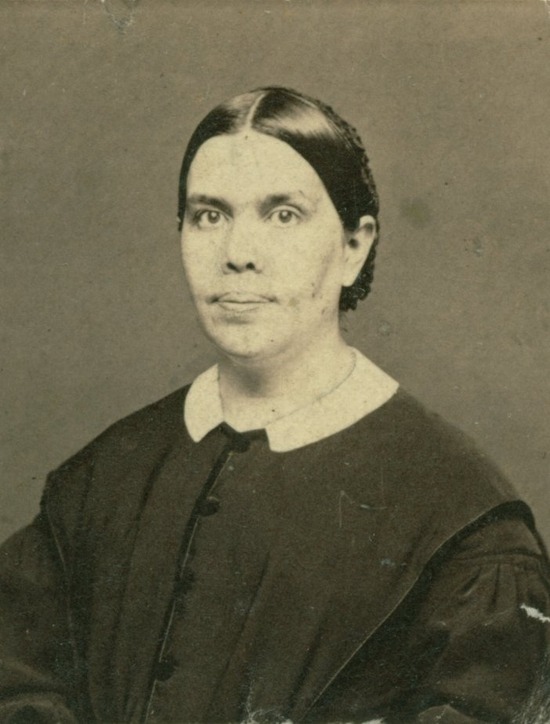
“Courtesy of the Ellen G. White Estate, Inc.”
Ellen White visited specific international locations simply because God called her to. The growing Adventist Church knew that the Advent message wasn’t just for their own communities, or even their own country. It was for all God’s children!
So to help establish a global ministry, she visited various places to meet people, offer guidance, attend camp meetings, support fellow missionaries, and assist in establishing educational and health institutions.
At first, she often felt unsure of going so far away from home, but the Holy Spirit’s promptings reassured her that she would be safe, and that her services would further the spread of the gospel.
And because Adventism spread so quickly, she didn’t stop after one or two countries. By the end of her life, she had ministered in 13 countries, including several locations across the United States.2
Of course, she was no stranger to missionary work.
She had already called for a worldwide publishing ministry.3 It all began in 1848 when she was impressed by the Holy Spirit that the Adventist Church should start its own paper. She told her husband about this vision she received from God, encouraging him and others to start publishing Adventist literature (books, magazines, and tracts) that would eventually circulate throughout the world.4
But ministry efforts weren’t supposed to stop there, either. Many Adventists were convicted that it was also time to put significant effort into missionary work.
In 1874, Ellen White had a vision in which God showed her that the Adventist Church must spread the gospel everywhere—not just the United States:
“You must take broader views. Your light must not be put under a bushel or under a bed, but on a candlestick, that it may give light to all that are in the house. Your house is the world.”5
This counsel led to the Church’s very first missionary program. And eventually, Ellen White herself felt the call to visit Adventist conferences and churches in various international locations.6
While most missionaries were reaching out to non-Adventists, Ellen White’s ministry work was largely among Adventist church members. She spoke to large groups and also met with smaller church groups and ministry leaders, offering counsel and encouragement as directed by the Holy Spirit.
Along the way, she met many people and helped establish multiple Adventist schools and sanitariums (later hospitals).
She accomplished these groundbreaking achievements despite several obstacles and dangers.
Unlike the relative smoothness and speed of travel today, travel back then was riskier and took longer. Whether by boat, train, or horse and buggy, the ride was always rough and usually exhausting. And sickness spread quickly, especially when the weather was cold or damp.
But her efforts were well worth it.
Today, there are more than 9,000 Adventist schools and 230 hospitals established partly because of the tireless missionary efforts of Ellen White.7 While she didn’t personally oversee the creation of each institution, she did help select the location for several schools and health centers. She also helped lay the foundation for operating these institutions—the success of which we still see today.
Her travels began in North America, so we’ll start there.
Travels in North America

Photo by Greg Rosenke on Unsplash
As the Adventist Church grew, Ellen White received invitations to churches across the United States, and even in Canada. She frequently traveled to the New England states near her but also ventured to the South and the distant West.
Most of the time, church leaders asked her to speak for their camp meetings, which were weekend or week-long meetings often held in tents. And as she traveled, she continued to write articles for the church paper, the Review and Herald.8
On other occasions, Ellen White received visions telling her to travel. Some of these visions involved the Holy Spirit calling her to go somewhere to speak to specific people, and others asked her to show the church where they should plant new Adventist institutions.
While in North America, she mainly traveled with her husband, James White. And for some trips, she had to leave her young sons to stay with family friends. But as they got older, she frequently brought Willie with her on her travels.
They traveled to many beautiful places, but their trips were anything but easy. They often suffered from poor travel conditions—anything from biting cold to rough roads.9
Sometimes, their travels could be dangerous. One time, Ellen was thrown off her horse.10 On another trip, James was run over by carriage wheels. He had been trying to keep the carriage from flipping when the horse suddenly stopped while going up an embankment.11
But probably their most horrific travel experience was when they were on a train that crashed. Several passengers were killed, but Ellen White and her husband were uninjured. They believed it was because an angel of God intervened to protect them.12
But despite the significant risks, their travels allowed them to accomplish many amazing things and see some amazing places.
While on one of her trips, Ellen White wrote a letter to her children about a mechanical bird she came across:
“And the little feathers would move on the little bird, and it would twirl its pretty little head this way and that, flap its little wings, move its tail and fly about and act just as pretty as though the noise came from its tiny little throat.”13
Along her journey, she saw many strange and wonderful things, especially for the time she lived in. She made note of seeing a hot air balloon,14 a goat pulling a carriage,15 and the beautiful Rocky Mountain range.16 She even had a chance to visit Hawaii while on her way to Australia.
Here’s a list of the many states she visited (in no particular order):
- California:17 Ellen White spent many years in this state during the 1870s-80s, helping the church advance in its educational and medical outreach. In 1901, after her time in Australia, she settled at “Elmshaven” in St. Helena, where she spent the rest of her life.
- Michigan: The White family lived in this state from 1855 until moving to California in the 1870s. But in later years, she would often return to Battle Creek, where the church was headquartered, for meetings with church leaders.
- Texas:18 Her travels took her to this state in 1878 and 1879 to speak at camp meetings and several other events or gatherings.
- Colorado:19 Ellen White enjoyed vacations here in the late 1870s and early 80s. While there, she supported her husband in writing several manuscripts that encouraged the church to translate Adventist literature into other languages and urged the Adventists of Battle Creek, Michigan, to start a school and further expand their health institute.
- Maine:20 Ellen White was born in Portland, Maine, and raised in the state when she was still known by her maiden name, Ellen Harmon. She spent a portion of her early adulthood there and returned for speaking engagements as late as 1909.
She also went to the following states, mainly for the sake of attending camp meetings and speaking at local churches:21
- Kansas
- Missouri
- Wisconsin
- Ohio
- Vermont
- Massachusetts
- New York
- Indiana
- Illinois
As she continued to travel, she brought companions with her—often her husband, older family members, or friends. And when James White passed away in 1881, Ellen White’s son Willie became her full-time travel companion and assistant.22
While living at “Elmshaven” in California, Ellen White led the effort to establish a sanitarium in Southern California. This sanitarium later became Loma Linda University Health and Loma Linda University.
Here’s the story:
At Ellen White’s urging, a church member named John Burden had purchased the property, which she then came to see. When she arrived, she felt she must have seen the land before. Her son reminded her she had never been there, and she realized the land was familiar because she had seen it in a prophetic dream.23
Her realization cemented the church’s decision to use the land. And it paid off. Today, Loma Linda is one of the only faith-based university hospitals in the US.
But her journey didn’t stop there.
God was about to send her on an even farther journey—an overseas journey to the sprawling cities of Europe.
Travels in Europe
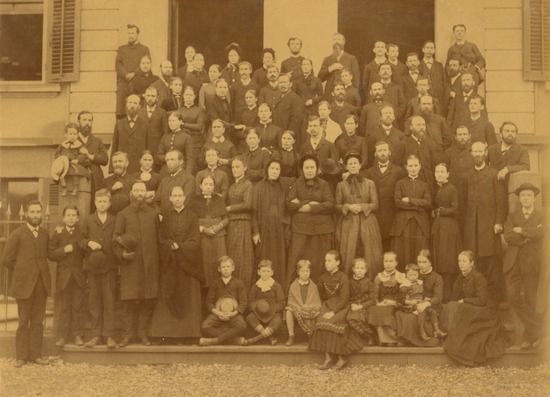
Ellen G white at the Swiss conference Meeting, Sept 1885.
“Courtesy of the Ellen G. White Estate, Inc.”
The Adventist Central European Mission invited Ellen White to come to Europe and speak at different European conferences and churches. The leaders also wanted her guidance in their publishing ministries.24
This was only a few years after her husband, James, had died. So at first, she wasn’t sure she would be able to go because traveling would be difficult for her health at her age. But God strengthened her until she was able to safely travel overseas.25
She left America for Europe in 1885 with her son Willie. By the time she boarded the ship, she felt confident that God would lead her, saying:
“The Lord seems very near and I feel peaceful and restful.”26
Even so, the travels were just as harsh as those in America. Ellen White and her family continued to suffer from periodic sickness and harsh weather.27
But despite her circumstances, she was still determined to help. She went from church to church, preaching the Bible and speaking about its truths both to Adventists and the general public.
During her time in Europe, she traveled to:
- England:28 This was the country she arrived in. She spoke at many gatherings about the gospel and about how and why the Adventist Church began.
- Switzerland:29 Switzerland became Ellen White’s home base while she was in Europe, and the place where she focused on her publishing work.
- France:30 She spoke at tent meetings and encouraged a young man she had seen in her visions to accept Christ.
- Italy:31 She offered counsel to several evangelists and encouraged them to be honest and humble in their mission to reach others.
- Germany:32 She preached several sermons to German congregations. One particular congregation was struggling with unity, so she suggested a social meeting to help build connections among the members and bring them into harmony.
- Norway:33 She came here to offer guidance to the church at Christiania. It had been struggling with fanaticism (religious extremism), which resulted in many of its members becoming strict and judgmental. In response, she encouraged them to adopt Christ’s attitude of mercy and humility.
- Denmark:34 While making the rounds to speak at several different churches, she also encouraged young people to get involved in ministry.
- Sweden:35 She toured the Swedish churches and attended a large gathering of Swedish Adventists in 1886.
Throughout Ellen White’s time in Europe, she was also able to work on her books. The one she spent the most time on was The Great Controversy, a book that discusses the backdrop of the whole Bible—the spiritual conflict between Satan and Jesus.
Europe was the perfect place for her to work on this book, which covered a lot of the history of the Christian Church through the Dark Ages and the Protestant Reformation.
She was able to visit the places she mentioned in her book and get a deeper glimpse into the history beyond what she had read about or learned about through the Holy Spirit’s guidance.
She left Europe in 1887, but as it turns out, her overseas work was still not complete. She would be called to service in yet another continent—this time to Australia.
Travels in Australia
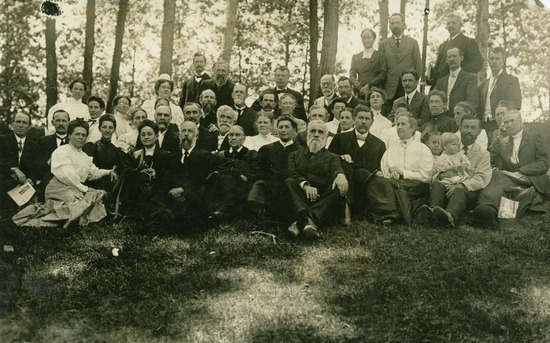
Ellen G. White with Australian workers, 1909.
“Courtesy of the Ellen G. White Estate, Inc.”
Church leaders asked Ellen White to go to Australia to help guide the developing Adventist churches there, and to assist in furthering education and health care efforts.
She left for Australia in 1891 with her son, Willie.
At first, she was hesitant to go because she didn’t feel convicted that God was the one telling her to go.36 She was also aware that it could be risky to attempt so much travel at her age, and with her health concerns. She would turn 64 that year.
But eventually, she concluded that the people in Australia needed her. And since God hadn’t impressed her not to go to Australia, she stepped forward in faith and accepted the General Conference’s suggestion to spend two years there.37
Once she stepped foot in Australia, she came to better understand what God wanted her to do there.
While there, she spoke at many camp meetings and published several books, including her classic on the life of Christ, The Desire of Ages.38
One of the most notable things she did was to help establish Avondale College.
The Adventist leaders had wanted to begin a school in Australia but struggled to find a location. This was partly because they were looking for land during an economic depression,39 and partly because they had a hard time finding land that could sustain a school-run farm.
So the leaders asked a land surveyor to look at the land they wanted to buy. Unfortunately, he reported that it was too poor to sustain good crops. Ellen White, on the other hand, had a vision telling her that the land was good and should be bought.40
The leaders followed her guidance and secured the property. And true to her vision, the land produced a bountiful harvest. The college was successful and still exists today—now known as Avondale University.41
Ellen White ended up extending her stay in Australia for nearly a decade. The Australian people were sad to see her go back to the US in 1900. She had helped advance the church in many ways, both in the establishment of Adventist institutions and through her personal, humanitarian efforts for the locals.42 Her influence lived on even after she left.
The result of Ellen White’s travels

Loma Linda University
“Courtesy of the Ellen G. White Estate, Inc.”
Much like leaders in the early Christian church in the Bible, Ellen White was sent by God to spread His message to the world.
According to Tim Poirier, the vice-director of the Ellen G. White Estate, Ellen White’s mission work was important because:
“Her traveling to Europe and Australia helped to get the beginning work of the Church in those areas on a strong footing—this included the launching of new schools, medical institutions, and support for the Church’s publishing houses.”
By the end of her ministry, she had played a role in the prophecy God gave years earlier to travel to different parts of the earth, spreading the gospel message:
“The message will go in power to all parts of the world, to Oregon, to Europe, to Australia, to the islands of the sea, to all nations, tongues, and peoples.”43
In many different ways during her travels, she actively served the communities she met—and she left a legacy of community service by helping start Adventist institutions like schools and health centers. After she left, these organizations continued to reach out in practical ways.
Interested in learning how the Adventist Church serves the community through its schooling system? We’ve got something on that too!
Related Articles


- Douglass, Herbert, Messenger of the Lord, p. 108 [↵]
- Delafield, A. D, Ellen G. White in Europe, p. 5 [↵]
- Pfandl, Gerhard, “Ellen G. White’s Contributions to the Seventh-day Adventist Church,” Ministry Magazine, June 2015. [↵]
- Ibid. [↵]
- White, Ellen G., Life Sketches of Ellen G. White, p. 208 [↵]
- Ibid., p. 196 [↵]
- “Quick Statistics on the Seventh-day Adventist Church,” Office of Archives, Statistics, and Research. [↵]
- White, Arthur, Ellen G. White: The Lonely Years: 1876–1891, p. 39 [↵]
- White, Ellen G., I’d Like to Ask Sister White, p. 113 [↵]
- Ibid., p. 74 [↵]
- Ibid., p. 75 [↵]
- White, Arthur, Ellen G. White: The Early Years: 1827–1862, pp. 295–296 [↵]
- White, Ellen G., I’d Like to Ask, p. 105 [↵]
- Ibid., p. 104 [↵]
- Ibid., p. 105 [↵]
- White, Arthur, Ellen G. White: The Progressive Years: 1862–1876, p. 347 [↵]
- Ibid., p. 357 [↵]
- White, Arthur, The Lonely Years, p. 98 [↵]
- White, Arthur, The Progressive Years, pp. 389–393 [↵]
- White, Arthur, The Lonely Years, p. 38 [↵]
- Ibid. [↵]
- “James S. White,” Adventist Pioneer Library. [↵]
- Molivarez, “This is the Very Place,” Loma Linda University Library News. May 27, 2014. [↵]
- White, Arthur, The Lonely Years, p. 287 [↵]
- Ibid. [↵]
- Delafield, Ellen G. White in Europe, p. 23 [↵]
- Ibid., p. 188 [↵]
- Ibid., pp. 40–42 [↵]
- Ibid., pp. 211–212 [↵]
- Ibid., pp. 232–234 [↵]
- Ibid., pp. 135–136 [↵]
- Ibid., p. 279 [↵]
- Ibid., pp. 199–201 [↵]
- Ibid., pp. 95–96 [↵]
- Ibid., pp.192–193 [↵]
- White, Arthur, Ellen G. White: The Australian Years: 1891–1900, pp. 15–16 [↵]
- Ibid. [↵]
- Skrzypaszek, John, “Ellen G. White’s Ministry in the South Pacific,” Encyclopedia of Seventh-day Adventists. [↵]
- “Avondale College,” Lineage Journey. [↵]
- Ibid. [↵]
- Ibid. [↵]
- Skrzypaszek, “Ellen G. White’s Ministry in the South Pacific,” Encyclopedia of Seventh-day Adventists. [↵]
- White, Ellen G., Life Sketches, p. 209 [↵]
More Answers

What Does the Bible Mean When It Calls Jesus the Son of God?
When the Bible calls Jesus the Son of God it’s referring to His divinity. Learn what makes this so significant and what it has to do with salvation.

How Adventists View the End of the World
The end of the world is no fun to think about. But here’s how we can actually find hope and comfort in what’s to come.

What Is an Adventist Medical Missionary?
A medical missionary in the Adventist Church is someone who cares for the medical needs of people as a way of showing the love of Jesus. They may travel to another country, or even just serve in their hometown.

Is the Seventh-day Adventist Church Protestant?
With so many Christian denominations, it can be hard to keep track of which ones share which beliefs. Let’s look at the core Protestant beliefs of Adventism.

The True Events Surrounding the Birth of Jesus
Jesus’ birth involved many strange events: a pregnant virgin, a stable birth, angels appearing to shepherds, and wealthy visitors. These help us understand His supernatural yet incredibly humble life.

Are Seventh-day Adventists Evangelicals?
According to its origins and definition, evangelicalism is about following Jesus and the Bible and sharing the Gospel through the way we live our lives. Adventists wholeheartedly harmonize with these principles.

Could Anything Keep Me from Becoming an Adventist?
We are each saved through Christ. But when it comes to church membership, are there certain beliefs or expectations to become an Adventist?

Do Seventh-day Adventists Have “Rules”?
We uphold principles we believe will help us maintain a closer relationship with Jesus and His Word. Learn how these principles guide Adventist lifestyles.

Your Comprehensive List of Ellen G. White’s Visions
Ellen White—an author, health-reform advocate, Bible scholar, and one of the most influential founding figures of the Seventh-day Adventist Church—was blessed by the Holy Spirit with the spiritual gift of prophecy (1 Corinthians 14; Romans 12:6-8). During her lifetime, she received direct guidance and inspiration from God in several different ways.

Do Seventh-day Adventists Have “Rules” For Marriage?
Around the world, many cultures and religions have various marriage traditions, expectations, or even rules when it comes to choosing a partner, planning the wedding, extended family logistics, or a number of other things.

An In-Depth List of the Prophecies About Jesus
How many prophecies of Jesus are in the Old Testament?

Can a Seventh-day Adventist Marry a Non-Adventist?
Yes. Seventh-day Adventists are not under any official rules that dictate who they can or cannot marry. This is a personal, life-altering decision between the couple and God.

What Adventists Believe About Alcohol and Tobacco Use
The Seventh-day Adventist Church has historically discouraged the use of alcohol and tobacco. Even before the church started in 1863, its leaders were realizing the negative effects of these substances.

What Does the Bible Say About Aliens and UFOs?
In 1938, aliens and UFOs were the subject of a mass prank. Around Halloween, Orson Welles performed a radio adaptation of H.G. Wells’ War of the Worlds. This ended up causing a panic throughout the United States—many people took it to mean that aliens had really attacked New Jersey.

What Do Adventists Believe About the Authority of the Bible?
Learn how one really old book (the Bible) is the sole foundation for all Seventh-day Adventist beliefs.

Is the Soul Immortal? Exploring What Adventists Believe
Based on the way the Bible describes humanity in comparison to God and angels, Seventh-day Adventists believe souls are not something you have, but something you are.

Jewelry—Why Do Many Seventh-day Adventists Choose Not to Wear It?
If you walk into a Seventh-day Adventist church service, you might notice that many people aren’t wearing earrings, bracelets, necklaces, or sometimes even wedding rings.

How the Bible Defines Love
Everyone talks about it, but do we really know what it means?

Why Does God Allow Suffering?
Poverty, genocide, a school shooting. A tsunami or earthquake that wipes out thousands of lives and leaves behind mourning family members.

International Pathfinder Camporee
Youth aged 10-15 in the Adventist Church’s global Pathfinder program look forward to the International Camporee every 5 years. This event brings together Pathfinders from around the world for exciting activities.

What Is Peter’s Ladder of Virtues, and How Does It Work?
Peter’s ladder of virtues is a phrase that refers to eight characteristics to be developed as a person grows in their relationship with Jesus Christ. It can be found in 2 Peter 1.

How Adventists interpret Bible prophecy
Bible prophecy conjures up a variety of emotions in people. For some, it feels exciting or mysterious.

What Counts as “Work” on the Sabbath?
God designed the Sabbath day to be a 24-hour period when we could pause and enjoy the goodness of His creation. We do this by putting aside our regular work so we can focus on spending time with Him and appreciating what He’s created (Exodus 20:8-11).

Moviegoers’ Guide to The Hopeful: The Facts Behind the Film
Learn where and when you can watch The Hopeful and how to get tickets. Already seen it? We’ll uncover the real story that inspired this film.

Protestant Reformation
Martin Luther. The 95 Theses. The Reformation. The Protest. Maybe you’ve heard these terms and wondered, What’s the big deal?
Ellen G. White’s Lasting Legacy
Ellen G. White is a well-known name among Seventh-day Adventists, but she also made an impact in many other parts of history, aside from being a co-founder of the Adventist Church.

Ellen G. White’s Challenging Health Journey
When it comes to lifelong struggles with health, Ellen White is no stranger. In fact, health challenges set the tone for her life early on—years before she was involved in co-founding the Seventh-day Adventist Church.
“What Was Ellen and James White’s Marriage Like?”
Ellen and James White, cofounders of the Seventh-day Adventist Church, met and married under somewhat unusual circumstances. But it’s a sweet story of partners in ministry becoming partners in life. And their married life continued to center on furthering the spread of the gospel together.

What Do Adventists Believe About the Mark of the Beast and 666?
It’s a popular topic, especially during tumultuous times. When everything around you feels chaotic, it’s easy to wonder about the end of the world, and topics like the mark of the beast, as mentioned in Revelation 13, can stir up uneasiness.
Didn’t find your answer? Ask us!
We understand your concern of having questions but not knowing who to ask—we’ve felt it ourselves. When you’re ready to learn more about Adventists, send us a question! We know a thing or two about Adventists.