
Ellen G. White’s contributions to the formation and growth of the Seventh-day Adventist Church are an integral part of its history. As a significant co-founder of the denomination, her writings provided millions of people with practical and spiritual counsel. So to preserve and manage this literary legacy, the Ellen G. White Estate was established as outlined in her last will.
But this organization is more than just an archive or a library. The White Estate also serves as a place of learning about the early history of the Adventist Church. So if you’re ever in Silver Spring, Maryland, you can even stop by to tour the museum inside the Ellen G. White Visitor Center.
A big part of the White Estate’s mission is to be a helpful resource for anyone who wants to understand more about Adventist history, Ellen White, and her extensive, widely-influential ministry.
Let’s learn more about how the White Estate operates and why it’s so highly valued by Adventists. We will cover:
Let’s start with some historical background.
How was the Ellen G. White Estate established?

Photo by Debby Hudson on Unsplash
As she faced the later years of her life, Ellen White considered what might be the best way to manage the preservation of her written works. So when she established her will in 1912, she also laid out the framework for this estate. As specified in her will, the organization would have a four-part purpose:
- Acting as her legal agent by holding custody and copyright of her writings
- Conducting any business related to her writings
- Securing the printing of new translations, whether modernizations of wording or translations into other languages like Spanish, Portuguese, or French
- Printing of compilations from [her] manuscripts, such as books like The Adventist Home1
Ellen White also listed the names of those she wished to be on the first board of trustees: Arthur G. Daniells, William C. White (her son), Clarence C. Crisler, Charles H. Jones, and Francis M. Wilcox.2
When she passed away in 1915, the Estate was established.3
It had its beginnings at Ellen White’s final home, known as “Elmshaven,” in St. Helena, California. The first trustees rented an office building on the grounds to conduct any business.4
The purpose and mission of the White Estate
 Ellen White wanted to be clear that the establishment of this estate was not because of any personal pride, or simply due to familial sentiment. The Estate’s mission statement reflects the true purpose for its existence:
“The Ellen G. White Estate supports the mission of the Seventh-day Adventist Church in uplifting Jesus Christ and His Word by sharing Ellen White’s prophetic ministry and writings throughout the world.”5
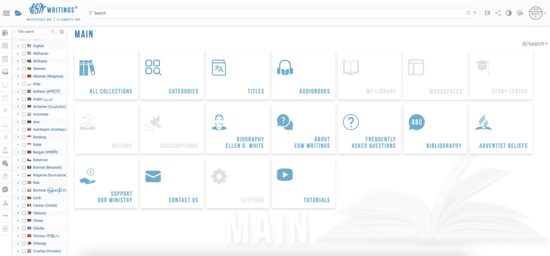
To do that, the White Estate provides digital access to all the published writings of Ellen G. White, as well as some additional letters and manuscripts meant for sharing. These writings, be they books, letters, articles, or pamphlets, can be searched through at egwwritings.org, which is operated by the White Estate. These writings have also been translated into more than 140 languages, and those translations are available on that site as well.
They’ve also developed apps for iOS and Android for users to read on mobile, or listen to as audiobooks.
All of this is in addition to the White Estate’s website, which has several articles that address different aspects of her ministry within the Adventist Church, and how she always sought to point people toward the Bible, the one authoritative standard of all truth.
They also have a question-and-answer section. People have submitted questions about what Ellen White wrote about a certain subject, or if she provided counsel in applying a particular biblical principle to modern life. Then her writings, along with the Bible, are used to answer those questions.
History
Soon after Ellen White passed away, the original five trustees began the work of indexing and publishing compilations of her writings. They also laid the groundwork for keeping the trusteeship self-perpetuating, as she had directed in her will.
This led the trustees to form a corporation to manage the Estate. The corporation would then be the entity that had the legal responsibility of carrying out the provisions of the charitable trust that was also created by Ellen White’s last will and testament.
Additionally, even though the White Estate is a separate entity from the General Conference, the world headquarters of the Seventh-day Adventist Church, they formed a mutually beneficial alliance early on. The General Conference provides financial support for the ministry of the White Estate.
In January 1938, the White Estate moved its office to Washington, DC to be more closely connected to the work of the General Conference.
As the church grew, it became apparent that the White Estate would also have to grow to meet the needs. So in 1950, it increased its number of board members. Although the number has fluctuated over the years, there are currently five lifetime trustees and 10 term-based board members.
Today, the Ellen G. White Estate continues to serve the Adventist Church from its main office in Silver Spring, Maryland.
Operation
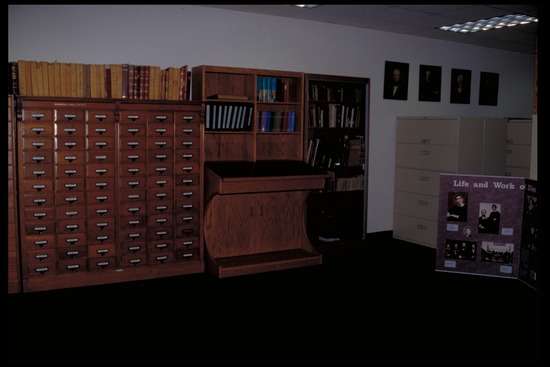
“Courtesy of the Ellen G. White Estate, Inc.”
In addition to the trustees who compose the White Estate board, the day-to-day work of the Estate is managed by several staff members who work at General Conference headquarters. These staff members are in charge of:
- Maintaining the records and indexes entrusted to the Estate
- Handling copyrights for Ellen White’s works
- Researching her works and related historical material when needed
- Answering questions regarding Ellen White’s writings and ministry
- Assembling material for compilations of Ellen White’s writings
- Coordinating the translation of her writings, as well as preparing adaptations or abridgments
- Presentations at churches, events, and ministry offices
- Conducting tours of historical Adventist sites, especially in New England
- Preparing articles, text, and correspondence lessons6
While its main office is in Maryland, the White Estate operates branch offices and research centers all over the world. Its four branch offices are located at:
- Loma Linda University, Loma Linda, California
- Andrews University, Berrien Springs, Michigan
- Adventist University of Africa, Nairobi, Kenya
- Adventist International Institute of Advanced Studies, Cavite, Philippines
Each branch office and research center contains copies of all Ellen White’s letters and manuscripts.
In addition to the branch offices, the White Estate maintains more than 20 research centers at Adventist universities around the world for public use. These centers will gladly assist people who are visiting or looking for information about Ellen White and Adventist history.
These branch offices and research centers are just one more way the White Estate works to fulfill the mission of Ellen G. White and the founders of the Adventist Church.
The Holy Spirit worked through Ellen White in extraordinary ways, primarily through the gift of prophecy (Romans 12:6; 1 Corinthians 12:28). From its inception, the White Estate has sought to continue the blessing of that ministry, seeking to glorify God with the resources they have been tasked to manage.
Related Articles





- “Origins of the White Estate,” [↵]
- Ibid. [↵]
- Ibid. [↵]
- “Organizations of the White Estate,” [↵]
- “Our Mission,” [↵]
- “The Work of the White Estate,” [↵]
More Answers

What Does the Parable of the 10 Virgins Teach Us?
The story of the 10 virgins found in Matthew 25:1-13 is a well-recognized parable of Jesus, and one with a profoundly important message for all of humanity.

Sabato katika Maisha na Mafundisho ya Ellen White
Sabato katika Maisha na Mafundisho ya Ellen WhiteSabato ni mada muhimu katika Kanisa la Waadventista wa Sabato. Sio jambo la kushangaza, basi, kwamba Ellen G. White, mwanzilishi mwenza wa kanisa, alisoma mafundisho ya Biblia kuhusu Sabato na akaandika kiasi kikubwa...

Una visión general de la educación superior Adventista del Séptimo Día
Una visión general de la educación superior Adventista del Séptimo DíaLa Iglesia Adventista del Séptimo Día tiene alrededor de 118 instituciones de educación superior en todo el mundo.1 Aunque muchas de ellas se encuentran en América del Norte, también encontrarás...
Uma Visão Geral da Educação Superior Adventista do Sétimo Dia
Uma Visão Geral da Educação Superior Adventista do Sétimo DiaA Igreja Adventista do Sétimo Dia tem cerca de 118 escolas terciárias ao redor do mundo.1 Embora muitas delas estejam localizadas na América do Norte, você também encontrará universidades Adventistas em...
Jesús y Juan el Bautista: Su relación y ministerio
Juan el Bautista y Jesús eran primos, amigos y colaboradores cercanos en el ministerio. Aprende la significancia duradera de su relación.

The Parable of the Unforgiving Servant—A Walk-through
Through this somewhat alarming story, Jesus teaches us about forgiveness, mercy, and human nature.

Comprendiendo la vida y el ministerio de Elena G. de White
Comprendiendo la vida y el ministerio de Elena G. de White Ellen Gould White fue una de las cofundadoras de la Iglesia Adventista del Séptimo Día. Y aunque vivió la mayor parte de su vida en el siglo XIX, el impacto de su vida y ministerio continúa hoy. Viviendo su...
Compreendendo a Vida e o Ministério de Ellen G. White
Saiba quem Ellen G. White realmente foi e o papel que desempenhou ao guiar a Igreja Adventista do Sétimo Dia primitiva por meio de seu ministério e escritos inspirados.

Explorando la profecía de las 2300 tardes y mañanas y el juicio investigador
¿De qué se trata la profecía de las 2300 tardes y mañanas? Nos enfocaremos especialmente en qué eventos marcaron su cumplimiento y en qué tiene que ver con el juicio investigador.
Explorando a Profecia dos 2300 Dias e o Juízo Investigativo
Sobre o que se trata a profecia dos 2300 dias? Vamos analisar especialmente quais eventos marcaram o seu cumprimento e qual a sua relação com o Juízo Investigativo.
El sábado en la vida y enseñanzas de Elena de White
El sábado es un tema importante en la Iglesia Adventista del Séptimo Día.
O Sábado na Vida e Ensinos de Ellen White
O Sábado na Vida e Ensinos de Ellen WhiteO sábado é um tópico importante na Igreja Adventista do Sétimo Dia. Não deve surpreender você, então, que Ellen G. White, uma co-fundadora da igreja, tenha estudado os ensinamentos bíblicos sobre o sábado e escrito extensamente...

La armadura de Dios como se describe en Efesios 6
La armadura de Dios como se describe en Efesios 6En Efesios 6, el Apóstol Pablo estaba ayudando a las personas a entender lo que significa defenderse en una guerra espiritual (Efesios 6:10-18). ¿Qué significa eso? Al hacer referencia a la armadura de Dios, Pablo no...

Todo lo que necesitas saber sobre las comidas del Sábado.
Para los Adventistas del Séptimo Día, compartir una comida en sábado con amigos y familiares es una de las partes más especiales y memorables de este día.

What Does the Parable of the Pearl of Great Price Mean?
Here’s what Jesus taught about the kingdom of heaven through this short parable about a merchant who finds a priceless pearl.

¿Qué significa “Adventista”?
¿Qué significa "Adventista"?Los Adventistas del Séptimo Día son una denominación cristiana protestante que sostiene el sábado bíblico que es el séptimo día. De esta creencia, obtienen la primera parte de su nombre. Pero, ¿qué hay de la segunda parte, "Adventista"?...

Ujumbe wa Malaika Watatu Katika Ufunuo 14 Ni Upi?
Ujumbe wa malaika watatu katika Ufunuo 14 unawaonya ulimwengu kuabudu Mungu, kuacha mchafuko wa kidini, na kuepuka ibada za tamaduni za kibinadamu badala ya amri za Mungu.
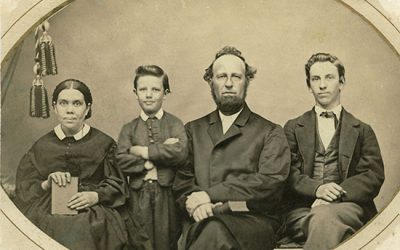
¿Quiénes fueron los hijos de Elena G. de White?
Elena G. de White, probablemente la cofundadora más conocida de la Iglesia Adventista del Séptimo Día, tuvo cuatro hijos con su esposo, James: Henry Nichols, James Edson, William Clarence y John Herbert.

Kwa nini Wadventista wa Sabato Wengi wanachagua Lishe Inayotokana na Mimea?
Ingawa siyo kila Mwadventista anatumia vyakula vya mimea pekee, wengi hujiepusha kabisa na nyama ili kuishi maisha yenye afya katika juhudi za kumheshimu Mungu, kimwili, kiroho, na kiakili.
![Understanding the Book of Mark [An Overview]](https://devsite.askanadventistfriend.com/wp-content/uploads/2026/02/bible-open-to-mark-400x250.jpg)
Understanding the Book of Mark [An Overview]
Understanding the Book of Mark [An Overview]The Book of Mark is one of the four Gospel accounts that begin the New Testament, and its author is widely believed to be John Mark, a relative of Barnabas who worked with both Peter and Paul. It’s the shortest Gospel...

An Overview of Romans: Faith, Righteousness, and Relationships
Here’s a breakdown and background of Paul’s longest epistle.
Tudo o que você precisa saber sobre as refeições do Sábado
Tudo o que você precisa saber sobre as refeições do Sábado.Para os Adventistas do Sétimo Dia, compartilhar uma refeição de sábado com amigos e família é uma das partes mais especiais e memoráveis do sábado. É por isso que queremos compartilhar com você tudo sobre as...
Yesu na Yohana Mbaptisti: Uhusiano Wao na Huduma
Yohana Mbatizaji na Yesu walikuwa ndugu wa damu, marafiki, na wafanyakazi wa karibu katika huduma. Jifunze umuhimu wa kudumu wa uhusiano wao.
Muhtasari wa Elimu ya Juu ya WaAdventista wa Sabato
Muhtasari wa Elimu ya Juu ya WaAdventista wa SabatoKanisa la WaAdventista Wasabato lina takribani shule za sekondari 118 ulimwenguni kote.1 Ingawa nyingi zipo ndani ya Amerika Kaskazini, pia utapata vyuo vikuu vya WaAdventista katika nchi mbalimbali duniani—mahali...
The Book of John: An Overview
Here’s a study companion for the Gospel according to John.

Waadventista wa Sabato Wanaamini Nini Kuhusu Pambano Kuu (Wema na Uovu)?
Pambano Kuu” ni msemo ambao Waadventista wa Sabato kawaida huutumia kuelezea mgogoro wa kiroho wa ulimwengu kati ya nguvu za mema (Mungu) na nguvu za uovu au dhambi (Shetani/iblis).
Silaha Zote za Mungu Kama Ilivyoelezwa Katika Waefeso 6
Katika Waefeso 6, Mtume Paulo alikuwa akisaidia watu kuelewa maana ya kujilinda katika vita vya kiroho (Waefeso 6:10-18).
A Armadura de Deus conforme Descrita em Efésios 6
Em Efésios 6, o Apóstolo Paulo estava ajudando as pessoas a entender o que significa se defender em uma guerra espiritual (Efésios 6:10-18).
¿Qué creen los Adventistas del Séptimo Día sobre el gran conflicto (bien vs. mal)?
El “gran conflicto” es la frase que los Adventistas del Séptimo Día suelen usar para describir el conflicto espiritual cósmico entre las fuerzas del bien (Dios) y las fuerzas del mal o del pecado (Satanás/el diablo).
Didn’t find your answer? Ask us!
We understand your concern of having questions but not knowing who to ask—we’ve felt it ourselves. When you’re ready to learn more about Adventists, send us a question! We know a thing or two about Adventists.