
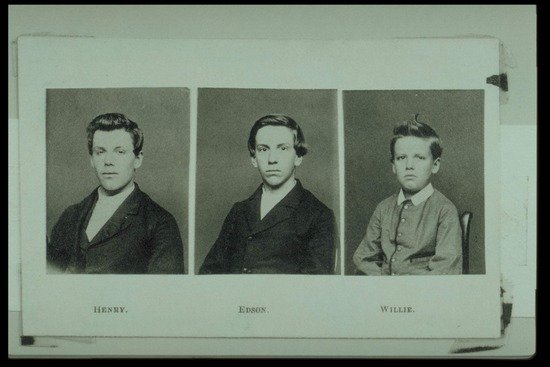
Ellen White, who is likely the most well-known co-founder of the Seventh-day Adventist Church, had four children with her husband, James: Henry Nichols, James Edson, William Clarence, and John Herbert. Henry died from pneumonia at the age of 16, and John only lived for 3 months. But both Edson and William—Willie for short—became involved in the work of the Adventist Church.
Being the children of a woman with a prophetic calling from God had its blessings and its challenges.
In this overview, we’ll look at the highlights of the lives of Ellen White’s sons during her many years of ministry, as well as the ways each of them decided to serve Jesus Christ:
- Henry Nichols White
- James Edson White
- William Clarence White
- John Herbert White
- Lessons from their lives
Let’s begin with Henry, their firstborn.
Henry Nichols White (1847-1863)
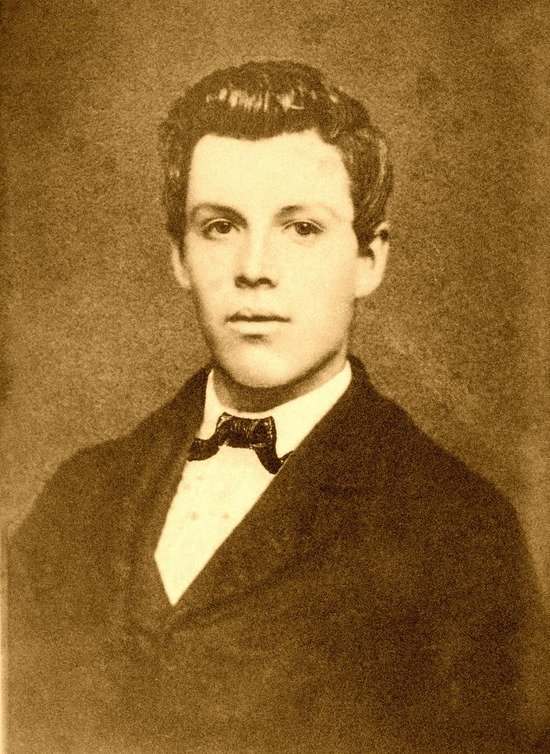
Ellen and James White had their first child, Henry, on August 26, 1847—less than a year after their marriage. He was born in Gorham, Maine.
Due to their constant ministry-related travels, Ellen White had to make a very tough decision when Henry was one year old. She was called to many places, but she knew the travel wouldn’t be easy for such a young boy. So she and James ended up entrusting him in the care of close family friends, the Howland family. He lived in their home until he was six years old, with his parents keeping up regular communication with him as much as they could.
Henry grew into an intelligent young man. He earnestly pursued his studies—and may have spent some late nights doing so!1
He also had a love for singing, and in her writings, Ellen White called him “our sweet singer.” He also learned how to play the melodeon, an instrument similar to an organ.2
Henry attended the Battle Creek public school, and in his teens, he went to work at the Review and Herald, the Adventist printing office that his father had established.3
All seemed to be well.
But one day, after swimming in the river, Henry caught a cold that quickly turned into pneumonia.4
A doctor came and treated him with the conventional “drugs” of the time. But day by day, he grew worse.
Henry spent time in bed thinking through his life and asking God and his family for forgiveness. He “often requested his parents to pray for him, not that he might get well, but that he might feel his acceptance with God every moment.”5
Peace came over him, and he held onto the hope of the resurrection morning when Jesus would return. His last words before dying on December 8, 1863, were “Heaven is sweet.” Though he died in Topsham, Maine, he was buried in Battle Creek next to his baby brother, John Herbert White.
Henry’s life may have been cut short, but his legacy lives on through the advice he gave to young people on his deathbed. We’ll explore that further down.
James Edson White (1849-1928)
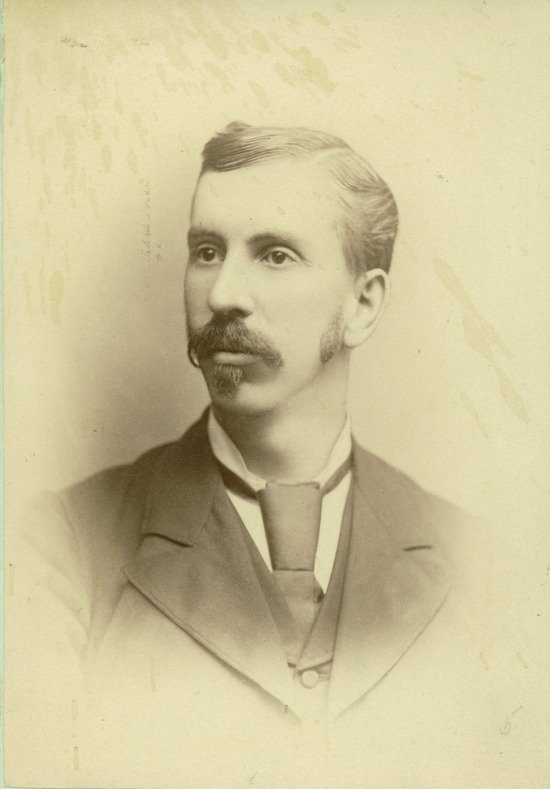
James Edson White, known as Edson, came into the world on July 28, 1849, while the White family was in Rocky Hill, Massachusetts.
Because of his parents’ travels, Edson spent his early years in the care of Clarissa Bonfoey, who would later become one of the nannies in the White home.6
Edson’s early schooling happened at the Battle Creek public school. In his teen years, he also gained a practical education working at the Review and Herald with his brother. By age 15, he was a full-time employee there and well-trained in the printing business. He would finish off his education at Battle Creek College.
Edson also had a fiery personality and a spark of rebelliousness. Arthur Spalding, a Seventh-day Adventist educator, writes that he was “resourceful, energetic, inventive, and he had a good deal of executive ability; but he was sometimes flighty and erratic.”7
And being the son of Ellen and James White seemed to have been a pressure he shied away from. At times, he intentionally went against his parents’ beliefs with careless behavior, buying expensive clothing, and reading “unwholesome” fiction storybooks.8 His noncompliance created a strain in his relationship with his parents, particularly his father.
In 1870, Edson married Emma McDearmon at 21 years old—though his parents seemed to have felt he wasn’t quite ready because of his lack of self-control and maturity.9
At the time, he was involved in the church’s publishing houses and Sabbath School work.
But despite his abilities, he struggled with managing finances and taking responsibility for his mistakes.
For example, while he oversaw the Pacific Press publishing house in California, it went into a financial crisis. Ellen White responded by counseling him to allow Willie to take its leadership. When Edson refused, she strongly suggested that he resign from his position.10
Edson’s struggles came to a head when, in 1893, he was working at a printing business in Chicago and dealing with more debt. And in a letter to his mother he admitted, “I am not at all religiously inclined.”11
Receiving this message, his mother wrote him a letter, pleading with him to turn to God.
Her pleas and prayers made a difference.
Not long after, Edson found long-searched-for freedom in a personal relationship with Jesus. And with this freedom came a new opportunity.
In an abandoned room in the Review and Herald publishing house, Edson discovered counsels his mother had written about reaching out to African Americans in the southern United States.12
Reading this counsel led him to build a steamboat called the Morning Star and sail it down the Mississippi River. This boat became the base for ministry and publishing work in the South, where he helped start churches and schools.
He had found his unique place in God’s work, and even found joy in his work.
And his efforts would eventually result in the Southern Missionary Society and the Southern Publishing Association.
He died on May 30, 1928, in Otsego, Michigan. Though he did not leave behind any biological children, he left behind a legacy of children in the faith. As Adventist theologian Denis Fortin writes,
“Many Black Adventist ministers and teachers traced their first contacts with Seventh-day Adventists to the Morning Star and the schools that its crew founded.”13
William Clarence White (1854–1937)
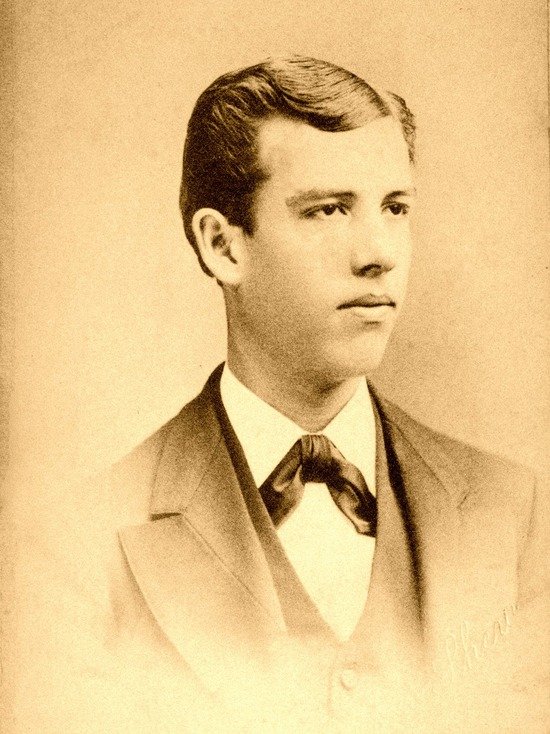
William Clarence White, known as Willie by his mother, was born on August 29, 1854, in Rochester, New York.
By this time, Ellen and James White had their own home, though they continued to travel and leave their children in the care of nannies while they were away. But sometimes, they would take Willie with them on their travels.
Willie was a contrast to his older brother Edson. He had a much gentler personality. Adventist historian Jerry Moon describes him as “frugal, conservative, hard working, dependable, and seemed generally to comply with his parents’ wishes.”14
Because he was very similar to his mother, he had a close relationship with her. And early on, she saw spiritual maturity and great promise in him.15
As the younger of his brothers, Willie would tag along with Henry and Edson when they went and worked at the Review and Herald office. It wasn’t long before he was working alongside them and did so into his teens.
Willie’s education consisted of attending public schools in both Battle Creek and Greenville. Later on, he attended Battle Creek College. In 1872, he also took a six-month course in medicine at Dr. R. T. Trall’s Hygeo-Therapeutic College in New York.16
His goal?
To continue to medical school at the University of Michigan.
But his life ended up taking a different turn—into church ministry.17
Already quite involved with church leadership, the change was quite natural. That year, he went and helped with the Signs of the Times magazine in Oakland, California. His responsibilities grew quickly and included:
- Managing the Pacific Press Publishing Association
- Working as the treasurer for the California conference of the Adventist Church
- Joining the General Conference committee—a role he’d hold throughout most of his lifetime.
In 1876, Willie married Mary Kelsey, and they would have two daughters, Ella and Mabel.
After being involved with publishing, Sabbath School, and health work in Battle Creek, Willie and Mary returned to the West where they continued their ministry.
Following the death of his father in 1881, Willie took a more active role in assisting his mother. He and Mary traveled to Europe with her to help with the administrative and publishing work of the church.
While there, Mary developed tuberculosis and died in 1890 at 33 years of age.18
Willie coped with this tragedy by immersing himself in his work.
By this point, Willie’s mother had come to depend heavily on him. He was her “counselor and helper”19—someone who understood her work better than anyone else and someone with whom she could bounce ideas and process her thoughts. He also served as her editorial assistant, publishing manager, and travel companion.
Their next trip found him in Australia, spending nine years there and once again taking administrative roles in the church.
While there, Willie met May Lacey, whom he married on May 9, 1895. The couple had five children: Henry and Herbert (twins), Evelyn Grace, Arthur, and Francis.
After his mother died, Willie became the director of the Ellen G. White Estate, taking an active part in preserving Ellen White’s books and other writings. He published ten compilations of his mother’s writings and an index for all her works. He also published a series of 64 articles called “Sketches and Memories of James and Ellen G. White” in the Review and Herald.20
He died on September 1, 1937, in St. Helena, California, and was buried with his parents, brothers, and first wife in Oak Hill Cemetery in Battle Creek, Michigan.21
Willie left behind a rich legacy of helping the Adventist Church grow and supporting the pivotal work of his mother, Ellen White.
John Herbert White (1860)
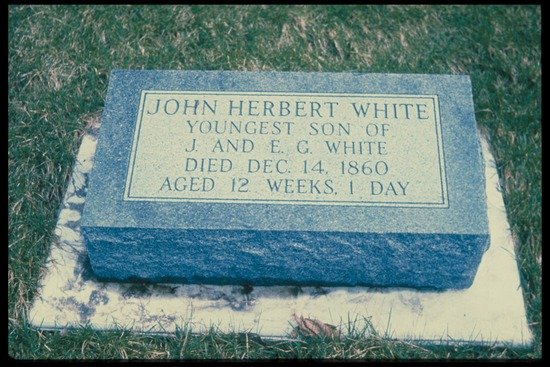
John Herbert White, the last of the White children, was born on September 20, 1860, in Battle Creek, Michigan.
The family’s delight was crushed, however, when at three months he came down with erysipelas, a contagious skin disease.
Ellen White writes of John’s illness:
“My dear babe was a great sufferer. Twenty-four days and nights we anxiously watched over him, using all the remedies we could for his recovery, and earnestly presenting his case to the Lord. At times I could not control my feelings as I witnessed his sufferings. Much of my time was spent in tears, and humble supplication to God.”22
He died on December 14, 1860, leaving a hole in the hearts of his parents.23 They buried him in Oak Hill Cemetery in Battle Creek.
What we can learn from Ellen White’s children
The lives of Ellen White’s children teach some important lessons for young people and adults alike. Through them, we see that Ellen White, though living out her special calling from God, was also human and had to grow as a parent. She made mistakes and struggled as a parent, leaving us her experiences to learn from.
Let’s look at some of those lessons:
Henry’s last words
While on his deathbed, 16-year-old Henry White struggled with some regrets. He wished he’d been more faithful in his walk with God and in following the advice of his parents.
From his own experience, he left some important wisdom for young people:
“I would appeal to all my young friends, not to let the pleasures or accomplishments of the world eclipse the loveliness of the Savior. Remember that the deathbed is a poor place to prepare for an inheritance in the second life. Spend the best of your days in serving the Lord. Farewell.”24
Still today, those words encourage young people to live with a purpose to seek God and make a difference in the lives of others.
Ellen White’s growth in parenting
Being a messenger for God didn’t make Ellen White perfect. Like the prophets in the Bible, she was human and had to grow in knowledge and experience. Her parenting is an example of this development.
She was a loving parent who cared deeply about her children, making her absence from her children during her travels very difficult. While away, she wrote many letters to them with motherly advice to be faithful to God.25
However, out of fear for her children’s salvation, she felt she may have leaned toward being too strict—a mistake God helped her to recognize:
“We have been in danger of expecting our children to have a more perfect experience than their age warrants us to expect.”26
She also realized she had made a regrettable mistake in comparing the impulsive and flighty Edson with the gentle and obedient Willie—something that very well may have created resentment in Edson.
But as Ellen White realized her deficiencies as a parent, she was open to becoming who God wanted her to be.
And just as God never gave up on her, she never gave up on her children—especially Edson.27
Edson’s struggles
As we saw in our brief look at his life, Edson wrestled with his parents’ value system and religion. His life illustrates the fact that having godly parents doesn’t mean a child will automatically choose to be a Christian or live a virtuous life. Everyone ultimately has to make a personal decision about what they believe and how they want to (or need to) live.
But even as Edson struggled to find his identity and made many mistakes along the way, his mother never gave up on him. She continued to encourage him, pray for him, and, sometimes, give him tough love.
And eventually, her efforts bore fruit in his own surrender to God and the unique ministry he pioneered.
Ellen White’s children give us another perspective on her heart

Though Ellen White left a legacy through her writings, she also left a legacy through her children and the ministry they carried on after her death—particularly Willie’s integral involvement with the church and his mother’s writings; and Edson’s ministry among African Americans in the South.
Though the White family faced struggles, these young men both eventually embraced the ministry of their mother and the teachings of Adventism, throwing themselves wholeheartedly into the movement.
The Adventist Church owes them gratitude for all they spearheaded and accomplished in their lifetimes.
But through them, we also get a different perspective of Ellen White: the tender mother, the parent that longed for her children to love God but was also learning as she went—just like any of us.
Ellen White’s children help us to see the human side of her and the ways she developed as she applied the things she taught.
We can also learn from this family that God has a unique purpose for everyone, and sometimes it’s not what we expect, or even think we want, for our children. But in letting God lead, and nurturing the unique creation that is every child, we open our hearts up to possibilities we may never have dreamed of.
Related Articles


- Patten, Adelia P., “Brief Narrative of the Life, Experience, and Last Sickness of Henry N. White,” An Appeal to the Youth, p. 20 [↵]
- White, Ellen, Testimonies for the Church, vol. 1, p. 103 [↵]
- Moon, Jerry, William Clarence (W.C.) White: His Relationship to Ellen G. White and Her Work, p. 7 [↵]
- Fortin and Moon, The Ellen G. White Encyclopedia, p. 1275 [↵]
- Ibid. [↵]
- White, Ellen, Life Sketches of Ellen G. White, p. 131 [↵]
- Arthur Whitefield Spalding, Origin and History of Seventh-day Adventists, vol. 2, p. 344. Quoted in Moon, p. 44 [↵]
- Moon, p. 50 [↵]
- Douglass, Herbert, Messenger of the Lord, p. 114-115 [↵]
- Moon, p. 27; White, Ellen G., “Letter 3a, 1880,” Letters and Manuscripts, vol. 3 [↵]
- White, A. L., Ellen G. White: The Australian Years: 1891–1900, vol. 4, p. 94 [↵]
- “Edson White: His Conversion and Work,” Lineagejourney.com [↵]
- Fortin and Moon, p. 1281 [↵]
- Moon, p. 50 [↵]
- Ibid., p. 57 [↵]
- Ibid., p. 16 [↵]
- Ibid., p. 20 [↵]
- Ibid., p. 23 [↵]
- Ibid., p. 113 [↵]
- Douglass, p. 48 [↵]
- Moon, p. 456 [↵]
- White, Ellen, Spiritual Gifts, vol. 2, p. 296 [↵]
- White, A. L., Ellen G. White: The Early Years: 1827–1862, vol. 1, p. 431 [↵]
- White, Ellen, Life Sketches of James White and Ellen G. White, p. 347 [↵]
- Patten, An Appeal to the Youth, pp. 18–20 [↵]
- White, Ellen, Manuscript 8, 1862. [↵]
- Douglass, p. 50 [↵]
More Answers

Where Do We Go When We Die?
For those of us who’ve lost loved ones or faced serious health issues, we can’t help but wonder about life after death.

What is the Difference Between Grace and Mercy in the Bible?
Even in day-to-day life, we can see glimpses of grace and mercy—like when someone offers an angry, impatient person their spot in a line or when a parent hugs their child after a heated argument.

Waadventista Wasabato Wanatafsiri Vipi Unabii wa Biblia?
Jifunze zaidi kuhusu jinsi Waadventista wanavyotafsiri unabii katika Biblia—hasa katika vitabu kama Danieli na Ufunuo.
Urithi wa Kudumu wa Ellen G. White
Urithi wa Kudumu wa Ellen G. WhiteEllen G. White ni jina linalojulikana sana miongoni mwa Waadventista wa Sabato, lakini pia aliathiri sehemu nyingi za historia, mbali na kuwa mwanzilishi wa Kanisa la Waadventista wa Sabato. Ndiyo maana Jarida la Smithsonian...

¿Cómo interpretan la profecía bíblica los Adventistas del Séptimo Día?
Aprende más sobre cómo los Adventistas interpretan la profecía en la Biblia, especialmente en libros como Daniel y Apocalipsis.
Como os Adventistas do Sétimo Dia interpretam a profecia bíblica?
Saiba mais sobre como os Adventistas abordam a interpretação da profecia na Bíblia—especialmente nos livros como Daniel e Apocalipse.

Lo que necesitas saber sobre la tentación y cómo resistirla
¿Alguna vez has sentido que enfrentas la misma tentación día tras día? ¿La tentación que siempre parece resurgir?
What Jesus Meant by “Take Up Your Cross”
Whether you’ve spent a day or a decade around Christian circles, you’ve probably heard the phrase, “Pick up your cross.”

Je, Waadventista Wasabato Wana “Sheria”?
Tunashikilia kanuni tunazoamini zitasaidia kuweka uhusiano wa karibu na Yesu na Neno lake. Jifunze jinsi kanuni hizi zinavyo-ongoza mtindo wa maisha wa Waadventista.
El legado de Elena G. de White
El legado de Elena G. de WhiteyElena G. de White es un nombre muy conocido entre los Adventistas del Séptimo Día, pero también tuvo un impacto en muchas otras partes de la historia, además de ser cofundadora de la Iglesia Adventista. Por eso, la revista Smithsonian la...

All of Jesus’ Warnings and Encouragements in the Bible
Here’s a comprehensive list of every warning and encouragement from the words of Jesus, as well as how they can benefit our lives today.
¿Los Adventistas del Séptimo Día tienen “reglas”?
Sostenemos principios que creemos que nos ayudarán a mantener una relación más cercana con Jesús y su Palabra. Aprende cómo estos principios guían los estilos de vida adventistas.
Os Adventistas do Sétimo Dia têm “regras”?
Defendemos princípios que acreditamos nos ajudar a manter um relacionamento mais próximo com Jesus e com Sua Palavra. Saiba como esses princípios orientam o estilo de vida adventista.

Películas Adventistas: donde la fe y el cine se encuentran
La misión de la Iglesia Adventista del Séptimo Día desde el principio ha sido compartir la verdad de Dios en la Biblia.
Filmes Adventistas: Onde a Fé e o Cinema se Encontram
A missão da Igreja Adventista do Sétimo Dia desde o início tem sido compartilhar a verdade de Deus na Bíblia.

¿Por qué algunas Biblias tienen más libros que otras?
Los cristianos consideran la Biblia como sus escrituras sagradas. Pero dentro del cristianismo, diferentes denominaciones utilizan Biblias con cantidades diferentes de libros.
Por que algumas Bíblias têm mais livros do que outras?
Os cristãos consideram a Bíblia como suas escrituras sagradas. Mas dentro do Cristianismo, diferentes denominações usam Bíblias com números diferentes de livros.
O que você precisa saber sobre a tentação e como resistir a ela
Já se sentiu como se enfrentasse a mesma tentação dia após dia? Aquela tentação que sempre parece ressurgir?
O que os Adventistas do Sétimo Dia acreditam sobre a Bíblia?
A Bíblia forma a base de tudo o que os Adventistas do Sétimo Dia acreditam e ensinam.

Waadventista Wa Sabato wanaamini nini kuhusu Ubatizo?
Kama Wakristo wengi wa Kiprotestanti ulimwenguni kote na katika historia, Kanisa la Waadventista wa Sabato linaamini katika ubatizo, sherehe ambapo watu huzamishwa ndani ya maji kudhihirisha hadharani “kufa kwa maisha ya zamani” na “kuanza kwa maisha mapya katika Kristo”.

Jinsi Waadventista Wanavyoshughulikia Kifo na Mazishi
Mazishi mengi ya Waadventista wa Sabato yanafanana na yale ya madhehebu mengine ya Kiprotestanti, kama vile Wamethodisti, Wabatisti, au Wapresbiteri, lakini unaweza kupata tofauti chache au taratibu za pekee.
O que os Adventistas do Sétimo Dia acreditam sobre o batismo?
Assim como muitos cristãos protestantes em todo o mundo e ao longo da história, a Igreja Adventista do Sétimo Dia crê no batismo por imersão
¿Qué creen los Adventistas del Séptimo Día sobre el bautismo?
Al igual que muchos cristianos protestantes en todo el mundo y a lo largo de la historia, la Iglesia Adventista del Séptimo Día cree en el bautismo por inmersión

Does Jesus Really Care About Me?
Does Jesus Really Care About Me?Short answer: yes, Jesus really does care about you, specifically (1 Peter 5:7, ESV). But if you’re wondering whether Jesus Christ really, truly cares about you, you aren’t alone. Gideon, Abraham and Sarah, Job, Jeremiah, Elijah, even...
Filamu za Kiadventista: Mahali Imani na Filamu Zinapokutana
Tangu mwanzo, lengo la Kanisa la Waadventista wa Sabato limekuwa kueneza kweli ya Mungu katika Biblia.
Kwanini Baadhi ya Biblia Zina Vitabu Vingi Kuliko Zingine?
Wakristo wanachukulia Biblia kama maandiko yao matakatifu. Lakini ndani ya Ukristo, madhehebu tofauti hutumia Biblia zenye idadi tofauti ya vitabu.
Fe y obras: ¿Importan ambas en la vida de un cristiano?
En tantas religiones a lo largo del tiempo, los individuos trabajan hacia la iluminación, la salvación o el favor de una deidad.
Cómo los Adventistas manejan la muerte y los funerales
La mayoría de los servicios funerarios Adventistas del Séptimo Día son similares a los de otras denominaciones protestantes, como los metodistas, bautistas y presbiterianos, pero podrías encontrar algunas diferencias o matices únicos.
Didn’t find your answer? Ask us!
We understand your concern of having questions but not knowing who to ask—we’ve felt it ourselves. When you’re ready to learn more about Adventists, send us a question! We know a thing or two about Adventists.