
The most accurate Bible possible would be one that’s printed in its original languages—Hebrew and Greek. But since most of us are not Hebrew or Greek scholars, the next best option is an English Bible translation that most closely reflects the original language and intent while also presenting these ideas in a practical and understandable way.
You might feel overwhelmed with all the options out there—about 900 in the English language.1 That’s almost like a GPS giving you hundreds of routes to choose from!
But the process doesn’t have to be difficult. By understanding the three main categories of Bibles, you’ll find a version that suits your needs and helps you come to know Jesus better.
Here, we’ll cover:
- Why are there so many Bible versions?
- What are the different types of Bible translations?
- How to choose the best Bible version for you
Let’s first touch on why we have so many versions in the first place.
Why are there so many Bible versions?

Photo by Tim Wildsmith on Unsplash
The number of different Scripture translations has mushroomed in the past centuries as original manuscripts have been discovered and repeatedly translated.
The Old Testament was written in Hebrew, and the New Testament in Greek and Aramaic. After the first century, these languages became less and less common because Latin was the primary language of the Roman Empire.
And with the spread of Christianity to different countries, the Hebrew and Greek texts soon needed to be translated into those languages as well.
The result was many different manuscripts that have been used in recent centuries for modern translations.
As we’ll see next, those versions are divided into three main categories. The most accurate ones will be those translated from the original Hebrew and Greek manuscripts.
What are the different types of Bible translations?
Bible translations fall into three categories based on how closely they reflect the original wording of Greek and Hebrew manuscripts. They are:
1. Literal translations
2. Dynamic equivalents
3. Paraphrases
Literal translations
Literal, or word-for-word, translations seek to translate each Hebrew and Greek word in as literal a manner as possible. They are also called formal equivalents.
This can result in text that’s a little more clunky or difficult for modern readers to understand.
The reason for this is the differences between the Bible’s original languages and English. Sometimes, Greek and Hebrew words have multiple meanings in English, making it challenging for translators to know which English word to use.
And there are more than just word differences between these languages. There are variations in sentence structure, emphasis, and punctuation, too.
Even so, literal translations are the most accurate Bibles for in-depth study. Having additional resources on hand can also help with understanding what the original Bible writers meant. Try out a Strong’s Exhaustive Concordance of the Bible or Hebrew-English and Greek-English lexicons.
The following are some of the most popular translations in this category.
The King James Version (KJV)

Photo by Humble Lamb on Unsplash
Date translated: 1611
- Translated/produced by: Bible scholars of the Church of England; commissioned by King James
- Pros:
- Poetic writing style
- Traditional Bible for centuries
- Most popular Bible in use today
- Considered the most accurate translation for its time
- Cons:
- An old English version with archaic language. Some words had very different connotations back then.
- Harder to understand
The Revised Standard Version (RSV)
- Date published: 1952
- Translated/produced by: National Council of the Churches of Christ
- Pros:
- First translation to use the Dead Sea Scrolls
- Updated language
- Cons:
- Possible concerns about the theological viewpoints of the translators and bias in the text
- Can be hard to find printed copies
The New American Standard Bible (NASB)
- Date published: 1963
- Translated/produced by: The Lockman Foundation
- Pros:
- Highly accurate
- Contemporary English
- Translation notes with literal meanings of words and other possible translations
- Con:
- More literal wording that may not flow like modern wording
- Read the NASB for free.
The Amplified Bible (AMP)
- Date published: 1965
- Translated/produced by: Zondervan and the Lockman Foundation
- Pros:
- Additional meanings of words and phrases within the text to enhance the understanding
- One of the most easy-to-understand literal translations
- Con:
- The extra phrasing in brackets and parentheses can make the text feel cluttered, especially when reading out loud
The New King James Version (NKJV)
- Date published: 1982
- Translated/produced by: 130 Bible scholars, pastors, and theologians; published by Thomas Nelson
- Pros:
- Updated version of the KJV (updated grammar and wording while retaining the traditional poetic beauty of the KJV)
- Easier read with the older style
- Con:
- Still contains many archaic phrases
The English Standard Version (ESV)
- Date published: 2001
- Translated/produced by: Crossway; over 100 scholars and pastors
- Pros:
- More modern wording
- Keeps some of the most-loved verses close to the KJV translation
- Cons:
- Some hard-to-read sentence structure
- Concerns about possible theological bias (since the RSV was referenced in translations)
Dynamic equivalents
Dynamic equivalents, or thought-for-thought translations, convey the message of the Bible’s text rather than the exact words. Scholars have sought to use cultural, linguistic, and historical background to express in modern language what the original author intended.
While these translations are generally easier to read and understand, they’re not perfect. Every scholar comes to their work with a theological bias, so these translations may potentially express more bias than word-for-word translations.
But this fact doesn’t mean we should avoid dynamic equivalents.
Instead, they can make for enjoyable devotional reading in conjunction with other Bible study tools and more literal translations.
Check out these ones:
The New International Version (NIV)
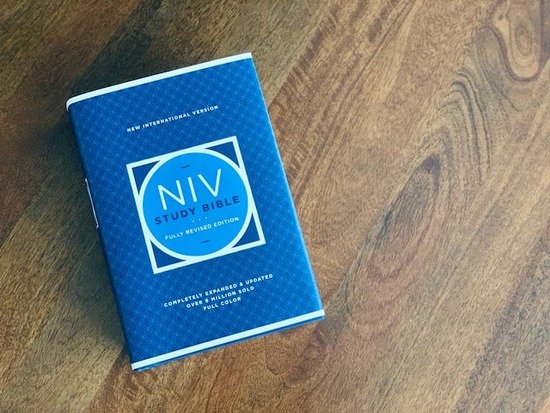
Photo by Tim Wildsmith on Unsplash
Date published: 1978
- Translated/produced by: Biblica (International Bible Society)
- Pros:
- One of the most popular, easy-to-read, modern versions of the Bible
- Uses word-for-word and thought-for-thought translation, striking a balance between
- Cons:
- Wording isn’t always the most poetic
- Translators sometimes added words that weren’t original, making it seem interpreted rather than translated
The New Living Translation (NLT)
- Date published: 1996
- Translated/produced by: Tyndale House Publishers
- Pros:
- A highly accessible version
- Changes traditional metaphors or terms to modern-day equivalents for easier understanding
- Cons:
- The colloquial language can make it seem far away from the original text
- Its use of modern terms and metaphors may change the originally intended meaning
God’s Word Translation (GW)
- Date published: 1995
- Translated/produced by: God’s Word to the Nations Society
- Pros:
- Printed in a single-column format for easy reading.
- Displays the reading in the way the Bible writers would speak if they lived today
- Con:
- Sometimes interprets phrases instead of translating them
- Read the GW translation for free.
The Christian Standard Bible (CSB)
- Date published: 2017
- Translated/produced by: Holman Bible Publishers
- Pros:
- An updated version of the Holman Christian Standard Bible, which is known as an “optimal equivalence” because it contains both word-for-word and thought-for-thought translation throughout
- Uses gender-neutral terms when the original language would also refer to both genders
- Easy-to-read text
- Con:
- Uses some unconventional translating ideas, like translating “beer” for “strong drink”
Paraphrases
Paraphrases are not translations in the strictest sense. Rather, they involve interpretation, rewording, and expanding upon the original text of the Bible to make it more understandable.
Paraphrases tend to have a greater potential for bias, particularly since they’re often the work of one individual rather than a committee of Bible scholars.
For these reasons, they work best when combined with more literal translations. But they can be a great addition to a devotional routine or study.
Here are four common paraphrases:
The Living Bible (TLB)
- Date published: 1971
- Produced by: Kenneth Taylor
- Pro:
- Seeks to communicate the meaning of each passage in as simple a way as possible
- Cons:
- Less poetic
- Potential bias and interpretation that may not be accurate to the originally-intended meaning
Good News Translation (GNT)
- Date published: 1976
- Produced by: Dr. Robert Bratcher together with a committee appointed by the American Bible Society
- Pros:
- Accessible to non-native English speakers
- Easy to read and understand
- Con:
- Potentially strays too far from the original meaning of the text
The Clear Word
- Date published: 1994
- Produced by: Jack J. Blanco
- Pro:
- A devotional paraphrase from an Adventist perspective
- Con:
- Not an actual Bible
- Learn more about the Clear Word.
The Message (MSG)
- Date published: 2002
- Produced by: Eugene H. Peterson
- Pros:
- Easy-to-read, colloquial language
- Can give a different perspective to verses
- Cons:
- A very loose translation of the original with heavy interpretation
- Some of the idioms used are American
How to choose the best Bible version for you

Photo by Kelly Sikkema on Unsplash
As we’ve already mentioned, the best Bible translation will be as close as possible to the originally intended meaning of its authors. Generally, word-for-word translations fit this criterion best.
Your purpose will also affect which one you should choose.
Let’s go through a few different purposes and the Bible versions that might work best for you:
- Bible study. If you are looking to dig deep into the Bible, a word-for-word translation (such as the NASB or the KJV) is ideal since it sticks closest to the original language. Though not always the easiest to read, Bible dictionaries and concordances can help remedy that challenge.
- Devotional reading. When looking for simple encouragement for your day and ways to connect with God, pick a Bible you can easily understand. Depending on what you are most used to hearing, this version could be a word-for-word translation or a dynamic equivalent.
- Memorization. Remember Psalm 23’s classic “thy rod and thy staff they comfort me”? Some versions are written very poetically and are the standard you hear quoted. The King James Version is one of the most famous.
- Reading aloud. Choose a translation that allows the words to easily roll off your tongue and that is easy for listeners to understand. Thought-for-thought translations usually fit this bill because they are written in modern English.
- Secondary Bible. You may already have a favorite Bible but want another for comparison. A good way to balance your selection is to pick the opposite type of Bible from the one you have now. If you use a thought-for-thought version, pick a word-for-word translation and vice versa.
- Children’s Bible. A thought-for-thought version with simpler language may be the best for children who might struggle with more literal wording.
The key is getting to know the ultimate author of the Bible
Due to the challenges of translating from language to language, no Bible translation will ever be able to fully convey the originally intended meaning of all its passages.
After all, Scripture was written by finite humans about an infinite God. So there’s always more to learn.
But the good news is that this fact hasn’t obscured the message in the Word of God. Through the years, God has used His people to preserve this valuable book so that it could continue to be transformative in the lives of many.
So instead of getting hung up on the details, use the principles listed here to pick an accurate and readable Bible.
Then, focus on what’s most important: getting to know the author of the Bible. He has promised to give us the Holy Spirit to guide us to all truth (John 16:13).
- “Number of English Translations of the Bible,” American Bible Society. [↵]
Related Articles


More Answers

Is the Old Testament Important for Christians Today?
Yes, the Old Testament is important because it kicks off the story that is continued by the New Testament. Without it, we wouldn’t have the vital background to Jesus’ first coming and the other accounts of the New Testament.
![The Early Christian Church [Overview]](https://devsite.askanadventistfriend.com/wp-content/uploads/2023/01/old-temple-400x250.jpg)
The Early Christian Church [Overview]
The Early Christian Church describes the faith community that developed from followers of Jesus after He returned to heaven (Acts 1) in A.D. 31. Their purpose was to be witnesses of the life, death, and resurrection of Jesus and grow their faith community into a worldwide movement.

Individual or Group Bible Study—Which Is Better?
They’re both great, of course! But depending on where you’re at and what your goals are, it’s worth looking into the different benefits of each.

How Do Adventists Do Baby Dedications?
For Christians, dedication ceremonies for babies, also for older children, are an important time for parents and the church. It’s a special part of the worship service when parents present their young children to God and the church family. Both parents, along with the congregation, regard this as a solemn promise to be a Christ-like example to the child.

What You Need to Know About Temptation and How to Resist It
Ever felt like you face the same temptation day after day? The one temptation that always seems to resurface?
It can be frustrating, yes. But be encouraged—being tempted doesn’t mean you have done anything wrong! And even if you give in to temptation, you are never too imperfect to come before God.

All About the 2300-Day Prophecy and the Investigative Judgment
This page will explain what the 2300-day prophecy is about. We’ll especially be looking at what events marked its fulfillment and what it has to do with the Investigative Judgment.

Was Ellen G. White Really a Prophet?
If you look at what Scripture provides as tests for a true prophet, Ellen White meets all the criteria.

Do Adventists Celebrate Communion and Foot Washing?
Like many Christian denominations, Adventists regularly participate in communion, also referred to as the “Lord’s Supper” or the “Last Supper.” They also practice foot washing (John 13:1-20), or the “ordinance of humility,” during the service—which isn’t as common.

Faith and Works—Do Both Matter in the Christian Life?
In so many religions all throughout time, individuals work toward enlightenment, salvation, or the favor of a deity. People are taught subtly—or not so subtly—that if you only do enough good deeds, you’ll be worthy/ascended/redeemed/approved, etc.

What is the Concept of “Present Truth” and Why is it Important?
Present truth is the principle that certain biblical truths are relevant to God’s people at specific times in history. God sends the Holy Spirit to reveal truths that help us better understand how to interpret and apply His Word in a present moment.

What is the Spirit of Prophecy (Books 1–4) by Ellen G. White?
Applying biblical prophecy to history, recent events, and especially the future, can be a daunting task. Even a little scary for some. But even so, we can’t help but want to know more. We want to be prepared—to feel like we know how to weather the storm.

Do Seventh-day Adventists Celebrate Easter
Yes, many Seventh-day Adventists do celebrate Easter.

Ellen G. White’s Counsel on Christian Education
Ellen White, a co-founder of the Seventh-day Adventist Church, saw that the U.S. educational system during her time was lacking. And as part of her life of ministry, she sought out practical ways to be better stewards of our minds, bodies, and the lives we’re given.

What Does Ellen White Say About Prayer?
Have you ever had a burden you just had to tell someone, but you were afraid of being judged if you did? Ellen G. White, an important figure in the Seventh-day Adventist Church and a prolific writer, described prayer as talking to God in a personal way—He’s the friend we can tell everything to.

Were All Ellen White’s Visions About the Future?
While the visions God gave Ellen White were often about the distant future or last-day events, she had many others that addressed different topics. They may not be discussed as much as her visions about the Second Coming or the End Times, but they tackled some timely topics for her day.

What Did Ellen White Say About End-Time Prophecy?
We can read in Scripture about the series of events and signs that lead up to the second coming of Jesus Christ. And it sounds pretty intense, to say the least. The symbolic nature of the language of prophecy also can make things tricky to understand at first.

Does the Adventist Church Have Youth Ministry Programs?
The Seventh-day Adventist Church has been organizing and operating youth ministry programs since 1879.
In our opinion, youth ministry is one of the most important ministries a church can have.

Were All Ellen White’s Books Inspired?
As the most translated female author in the world, Ellen White wrote numerous books, articles, pamphlets, and more. These writings focused on developing Christian character, emphasizing Bible truth, practical tips for living well and staying healthy, and discussing effective methods of delivering the gospel message to the world.

Do Adventists Celebrate Birthdays?
Yes, most Seventh-day Adventists do celebrate birthdays because we see them as excellent reminders of the life God has blessed us with. And we celebrate them the same way everyone else does—with friends, family, presents, and a special meal.

The Ultimate Guide to Personal Bible Study
Ever felt that studying the Bible is challenging, and you’re just not sure where to start? Or looking for fresh ideas to improve your current Bible study habits? We’ve got you covered with simple techniques and plans to improve your Bible study experience.

What Is Salvation, and How Do I Get Saved?
Salvation, or being saved, is what God wants for all of us. And since God created us with free will, this salvation is ultimately our choice. We become “saved” by accepting that Jesus Christ died on the cross, taking the punishment meant for sinners upon Himself.

What Is the 70-Week Prophecy in Daniel 9
Could a prophecy accurately predict an event over 500 years before it was supposed to happen?
The 70-week prophecy of Daniel 9 did, culminating in one of the most important events in earth’s history: Jesus’ sacrifice for us on the cross.

Do Seventh-day Adventists Believe in Hell?
Seventh-day Adventists believe that any human being who accepts God’s free gift of salvation through Jesus will be given eternal life. But what about the eternal fate of those who choose not to accept Jesus?
Sola Scriptura—What It Means and Why It Matters
Sola scriptura is a term that originated during the Protestant Reformation. It represents the way many Christians view the Bible and its authority. While the idea is simple enough, there is so much more to sola scriptura than its basic definition.

What Do Adventists Offer for Young Adults?
In recent years, the age group often classified as “young adults” has been trickier to engage. It’s been a significant concern for Christian churches around the world. Though interestingly enough, similar observations regarding young adults have been coming up in conversations about the economy, the entertainment industry, politics, and more.

King David: How Was He a Man After God’s Own Heart?
War, bloodshed, murder, adultery—all of these crimes overshadowed the life of a biblical Old Testament man named David. Yet he was called a man after God’s own heart, not to mention one of Israel’s greatest heroes and kings.

Do Seventh-day Adventists Believe in the Secret Rapture
The secret rapture belief asserts that the followers of Jesus will be suddenly and stealthily “raptured” from earth and taken to heaven. Then, any people left on earth will face a period of great difficulty—before Christ’s second coming actually happens.

Do I Need to be an Adventist to be Saved?
The answer to this question is simply, “no.”
When it comes to salvation in Jesus Christ, all that is required of a person is to acknowledge Jesus’ sacrifice for us, believe that He has saved us, and claim the free gift of salvation that is always available to us. Salvation is not based on denomination.

Do You Have to Be Vegetarian to Be Adventist?
Of course not. Membership in the Seventh-day Adventist Church has never included any dietary requirements. However, there might be some reasons people might think that. So many Adventists are vegetarians or even vegan, and a plant-based lifestyle has many health benefits.
Didn’t find your answer? Ask us!
We understand your concern of having questions but not knowing who to ask—we’ve felt it ourselves. When you’re ready to learn more about Adventists, send us a question! We know a thing or two about Adventists.