
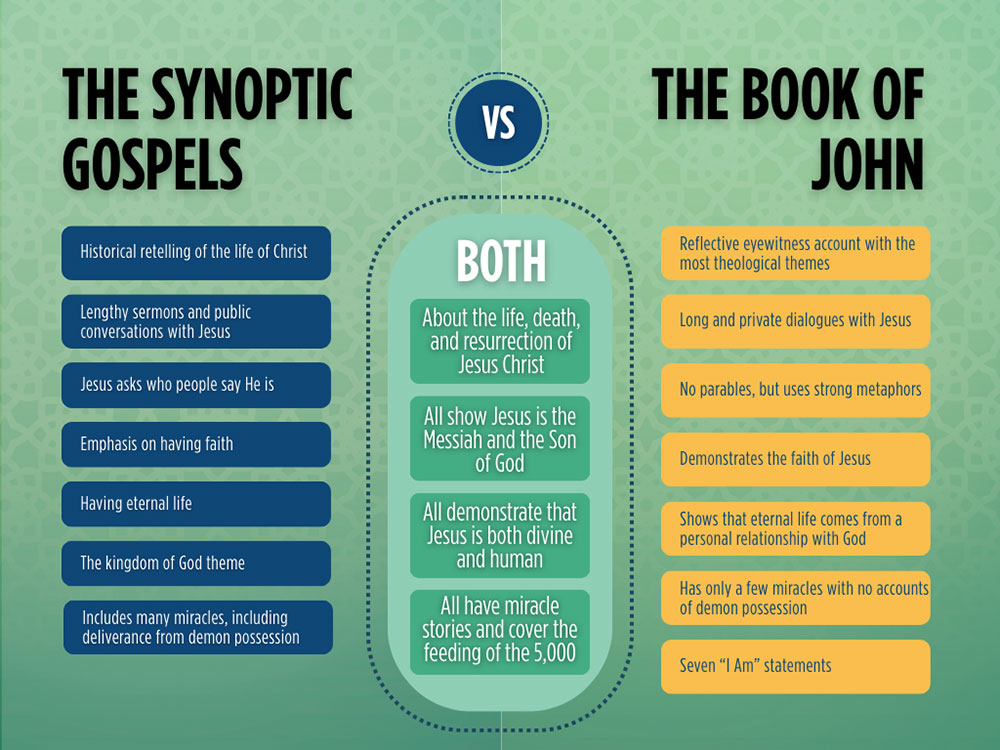
 The term “Synoptic Gospels” refers to the accounts of the Gospel story—the story of Jesus Christ’s earthly ministry and how it paved the way for salvation—written by Matthew, Mark, and Luke in the New Testament.
The word “synoptic” means “viewed together,” which means Matthew, Mark, and Luke have similar content, structure, and perspectives on Jesus’s life. And “Gospel” means “good news,” specifically about what Jesus did for us through His life, death, and resurrection.
John’s account isn’t considered synoptic because of its significant differences in theme and focus.
This doesn’t mean the Bible has different Gospel stories, but four accounts of the one Gospel of Jesus Christ.1 That’s why they’re sometimes called the “four Gospels.”
But why does any of this matter? How could this enhance our experience as believers?
We’re going to find out as we explore:
- The similarities and differences of the Synoptic Gospels
- What makes John’s account unique
- How understanding them helps us
Let’s start with the similarities
What makes the Synoptics similar?
Matthew, Mark, and Luke are called the Synoptic Gospels because of their similarities in how they write about Jesus, plot out His life, and include content on Jesus parables and miracles.2
We’ll quickly look at the similarities in
- How they portrayed Jesus
- Their plot outlines
- Their content
Let’s start by looking at how they wrote about Jesus.
Overall picture of Jesus

Photo by Rodolfo Clix
All three Synoptic Gospels depict Jesus as the Messiah (Christ), who didn’t meet people’s expectations because so many misunderstood His mission. His work baffled many because it went against the popular beliefs of that time.
Jesus lived in a region under Roman authority. The Jewish nation resented this, and their desire for independence led to political and social tension. As a result, people developed an “us vs. them” mentality.
It also affected their interpretation of the Messianic prophecies in the Old Testament. They believed the Messiah would establish a kingdom on earth and overthrow the Roman government.3
So you can imagine their shock when Jesus entered the scene and taught about a spiritual kingdom where love is the rule of life!
As Mark L. Strauss, Ph.D, put it, “His messiahship is revealed through self-sacrificial love and service, not conquest.”4
All three Synoptic Gospels also call Jesus the Son of God, Son of Man, Son of David, Lord, Master, Teacher, and King.
They portray Him as an unstoppable force who can overcome any obstacle His opponents put in His way.
And they show Him as a suffering servant willing to give up everything—even His own life—to save His people and the world. This surprised His audience, and many of His own people turned against Him because He didn’t match their image of the Messiah.
Each writer gave us insights into what Jesus was like based on their audience.
Matthew wrote for a primarily Jewish audience, emphasizing Jesus’s fulfillment of Old Testament prophecy.
Mark likely wrote for Christians suffering persecution, so he highlighted Jesus’s role as a suffering servant-king to encourage his readers.
And Luke wrote for a Gentile (non-Jewish) official, and he focused on Jesus being the Savior for all people.
Their unique takes on the life of Jesus create a multifaceted picture of who He is and what His mission is about. When compared together, the Synoptic Gospels give us a consistent, yet multifaceted, portrayal of Jesus and His story.
General outline of the plot
Matthew, Mark, and Luke follow the same general outline of Jesus’s life:
- His ministry begins after His baptism and temptation in the wilderness.
- He teaches and heals throughout Galilee and other regions.
- He enters Jerusalem and clears the temple.
- He’s betrayed, arrested, put on trial, crucified, and buried.
- He resurrects, commissions His disciples, and goes back up into heaven.
And in the plot, we see similar content.
Content
The content in the Synoptics shares many similarities. We see retellings of parables and events, including:
- The parable of the sower (Matthew 13:3-23; Mark 4:1-20; Luke 8:4-15).
- Jesus casting out a legion of demons (Matthew 8:28-34; Mark 5:1-20; Luke 8:26-39).
- John the Baptist’s death (Matthew 14:1-12; Mark 6:14-29; Luke 9:7-9).
- Jesus’s message about end-time events (Matthew 24; Mark 13:1-37; Luke 21:5-36).
- The Lord’s Supper (Matthew 26:26-29; Mark 14:22-25; Luke 22:17-20).
But you may be thinking, “Aren’t there four Gospels accounts in the Bible? Why are only three called synoptic?”
Which Gospel Account is not synoptic?

Photo by Travis Emmett on Unsplash
The Gospel according to John is not synoptic because of its stark differences in content. While it documents the same story of Jesus’s life, death, and resurrection, it has a noticeably different outline, doesn’t share many of the stories found in the Synoptics, and has unique material. It was written for the second generation of Christians who would have to learn to live out their faith without the original apostles.
Its general outline has a different structure from Matthew, Mark, and Luke. It also leaves out many, events and dialogues that the Synoptic Gospels share, such as Jesus’s baptism, temptation, and the end-time discourse on the Mount of Olives.
On the other hand, it has stories and events that the Synoptic Gospels don’t record, such as Jesus’ encounters with Nicodemus and the woman at the well, His “I am” statements, and His conversations with His disciples in John 14-17.
It also has a perspective of Jesus and themes that the other accounts don’t explore as much.
How does John compare with the Synoptics?
Matthew, Mark, and Luke take a journalistic approach to the Gospel (the who, what, when, where, etc.) while the Gospel according to John is more like a feature story from someone who shared in the experience. John was one of Jesus’ closest disciples and often referred to himself as the “disciple whom Jesus loved” (John 21:7, ESV).
His account complements the others by adding clarity and context to the Gospel account as well as by emphasizing the personal experience of faith in Christ.
Like the Synoptic Gospels, John presents a narrative about the life and ministry of Jesus, arguing that He is the Son of God and the Messiah. He also wrote his account so others would believe in the Lord and have a saving relationship with Him:
“But these are written so that you may believe that Jesus is the Christ, the Son of God, and that by believing you may have life in His name” (John 20:31, ESV).
What makes John’s account of the Gospel stand out from the others is its perspective on eternal life, salvation, and faith. Matthew, Mark, and Luke focus on eternal life as more of a future promise. But John reveals we can start living like we’re part of the kingdom of heaven now! It begins with putting our faith in Jesus and getting to know God the Father through Him (John 17:3).
The Synoptic Gospels focus on the kingdom of God (or “heaven” in Matthew). They teach that salvation comes from accepting the rule of God in one’s life (Matthew 12:28; Mark 10:15; Luke 11:20; Luke 17:20-21).5 But John focuses on the faith aspect of God’s rule—what it really means to believe in Jesus:
“Then they said to Him, ‘What shall we do, that we may work the works of God?’ Jesus answered and said to them, ‘This is the work of God, that you believe in Him whom He sent’” (John 6:28-29, NKJV).
John’s account also highlights the close relationship between God the Father and God the Son, which is the kind of connection Jesus wants with His followers (John 15:9-11). The Synoptics record Jesus teaching the importance of having faith, and John demonstrates how Jesus lived out faith through His relationship with His Father.
So that’s how the four Gospels accounts compare. Let’s do a quick review.
We understand that Matthew, Mark, and Luke are called the Synoptic Gospels because readers can put them together and see their similarities. But they still have features that make them each distinctive. And while John’s Gospel is accepted as true, it still stands out from the others as not being synoptic.
But there’s a question that begs to be answered: Why should we care about the similarities and differences of the Gospels accounts? How does it benefit us as Christians?
What difference does it make to know?

Photo by Alabaster Co on Unsplash
While knowing about the four accounts of the Gospel doesn’t give us bonus points, it can deepen our understanding of Jesus, help us apply the lessons from each account, and help us make sense of the differences that appear to contradict each other.
Knowing about the different accounts of the Gospels expands our perception of Jesus. While we see He is Lord, the Son of God, the Savior, and the Messiah, we also see how the writers emphasize different traits. The Gospels accounts help us see Jesus in multiple ways, like a diamond.
- Matthew’s portrait of Jesus confirms that God keeps His promises to save His people.
- Mark’s portrait shows that Jesus overpowers evil through self-sacrifice.
- Luke’s portrait shows that Jesus cares more about our salvation than our background.
- John’s portrait shows that Jesus is God in the flesh who wants to be with us.
Knowing who Jesus was would have strengthened the faith of the writers’ intended audiences. We live in a different time with different challenges, but the Gospels accounts are no less relevant today.
They all call us to put our faith in Jesus and live out that faith. They all remind us that God’s kingdom functions differently from the world. They prepare us for hardships. They all give us lessons about prayer. They call for us to live a life of selfless love.
But each account gives us distinct applications:
- The Gospel of Matthew shows that we can trust God’s promises because they’re fulfilled in Jesus.
- The Gospel of Mark reminds us that God is greater than any force in this world. We don’t have to live in worry.
- The Gospel of Luke encourages us to guard ourselves against bias and prejudice.
- The Gospel of John reminds us that our faith journey is personal and doesn’t require a spiritual role model other than Jesus to thrive.
But what about the differences that might seem contradictory?
You may have noticed that the Synoptics will cover similar events but record them differently. And that has led some to raise questions about the accuracy of these narratives.
But Thomas Shepherd uses a courtroom illustration to explain why their differences prove the validity of the Gospel accounts. If multiple witnesses of an event report the exact same story, they would appear suspicious, like they had planned their stories ahead of time.6 The minor differences make each witness’s account genuine.
It’s also like the classic story about the blind men feeling different parts of an elephant and coming to different conclusions. Getting a feel of the entire animal would have given them the whole picture.
So the distinctions in the four Gospels accounts don’t invalidate their authenticity but give us more insights and perspectives.
There was so much to Jesus’s life that it took four tellings of His story. The Gospels accounts are valuable for Bible study because of the lessons and applications of truth that are packed into them. They also give us a deeper understanding of who God is.
If you’re interested in further study, we have a page offering Bible study methods.
Click on either of the links to get you started on the next step of your journey.


- Shepherd, Thomas, (Ph.D.), Episode 18: The Gospels (Part 2), “Faithful to the Scriptures,” Adventist… [↵]
- Ibid. [↵]
- Nichol, Francis D., Seventh-day Adventist Bible Commentary And Bible Students’ Source Book, Vol. 5 , Review and Herald Publishing Association (1978), p. 272. [↵]
- Strauss, Mark L., (Ph.D.), Four Portraits, One Jesus: A Survey of Jesus and the Gospels, 1st ed., Zondervan Academic, (2007), p. 239. [↵]
- NKJV Andrews Study Bible, Andrews University Press (2010), p.1376. [↵]
- Thomas Shepherd, Ph.D. “Faithful to the Scriptures, Episode 17: The Gospels (Part 1)” [↵]
More Answers
![Understanding the Book of Mark [An Overview]](https://devsite.askanadventistfriend.com/wp-content/uploads/2026/02/bible-open-to-mark-400x250.jpg)
Understanding the Book of Mark [An Overview]
Understanding the Book of Mark [An Overview]The Book of Mark is one of the four Gospel accounts that begin the New Testament, and its author is widely believed to be John Mark, a relative of Barnabas who worked with both Peter and Paul. It’s the shortest Gospel...

An Overview of Romans: Faith, Righteousness, and Relationships
Here’s a breakdown and background of Paul’s longest epistle.
The Book of John: An Overview
Here’s a study companion for the Gospel according to John.
The Book of Luke’s Message: Jesus’ Love for All
Learn all about the book of Luke—context, themes, differences, and takeaways.

The Book of Acts: A Simple Guide
The book of Acts is the fifth book in the New Testament. It’s a continuation of one of the Gospel accounts and an intimate look into the eventful early history of the Christian church.

All About the Gospel of Matthew
The Book of Matthew is one of the four Gospel narratives in the Bible

13 Bible Study Tools to Boost Your Daily Bible Reading
Bible study tools come in all types, including concordances, encyclopedias, downloadables, journaling, atlases, and more. Use these tools to enrich your study for a fuller understanding God’s Word.

What Does God Look Like According to the Bible?
What Does God Look Like According to the Bible?As human beings, it’s natural for us to wonder about God’s appearance. But the Bible says very little about it. It’s not hard to understand why, though. As the Creator of the entire universe, His existence transcends our...

How to Really Read and Understand the Bible
If you’re new to the Bible or haven’t picked it up in a while, how do you start? Find out 6 basic steps to read the Bible, plus some helpful reading plans to try.

Why Do Some Bibles Have More Books Than Others?
Christians consider the Bible as their sacred writings. But within Christianity, different denominations use Bibles with different numbers of books.

Bible Translations
Bible Translations—Which Version is “Best”?The most accurate Bible possible would be one that’s printed in its original languages—Hebrew and Greek. But since most of us are not Hebrew or Greek scholars, the next best option is an English Bible translation that most...

Is the Old Testament Important for Christians Today?
Yes, the Old Testament is important because it kicks off the story that is continued by the New Testament. Without it, we wouldn’t have the vital background to Jesus’ first coming and the other accounts of the New Testament.

Individual or Group Bible Study—Which Is Better?
They’re both great, of course! But depending on where you’re at and what your goals are, it’s worth looking into the different benefits of each.

The Ultimate Guide to Personal Bible Study
Ever felt that studying the Bible is challenging, and you’re just not sure where to start? Or looking for fresh ideas to improve your current Bible study habits? We’ve got you covered with simple techniques and plans to improve your Bible study experience.

What’s the History of the Bible?
The Bible is the number one bestseller in the world of all time.1 It’s translated into thousands of languages, read by people of all ages and backgrounds.
![What is the New Testament? [About Each Book and Key Lessons]](https://devsite.askanadventistfriend.com/wp-content/uploads/2022/02/new-testament-400x250.jpg)
What is the New Testament? [About Each Book and Key Lessons]
The New Testament is the second section of the Bible, describing Jesus and how He came to this world to reveal the love of God. It tells about His ministry, His death and resurrection, and the church that resulted.

All about the prophets in the Bible
Prophets were individuals in the Bible who received messages from God and communicated those messages to the recipients—whether through speaking or writing. Their writings, known as prophetic books, comprise a huge part of the Bible.

Understanding Prophecy in the Bible
Seventh-day Adventists have emphasized Bible prophecy from the beginning. We have our roots in the study of God’s Word, especially the prophecies that have to do with the future.

All About the Old Testament
The Old Testament is the first section of the Bible and makes up about three-quarters of its material. It lays out the story of Creation, humanity’s fall into sin, and God’s promise to rescue us from sin.