
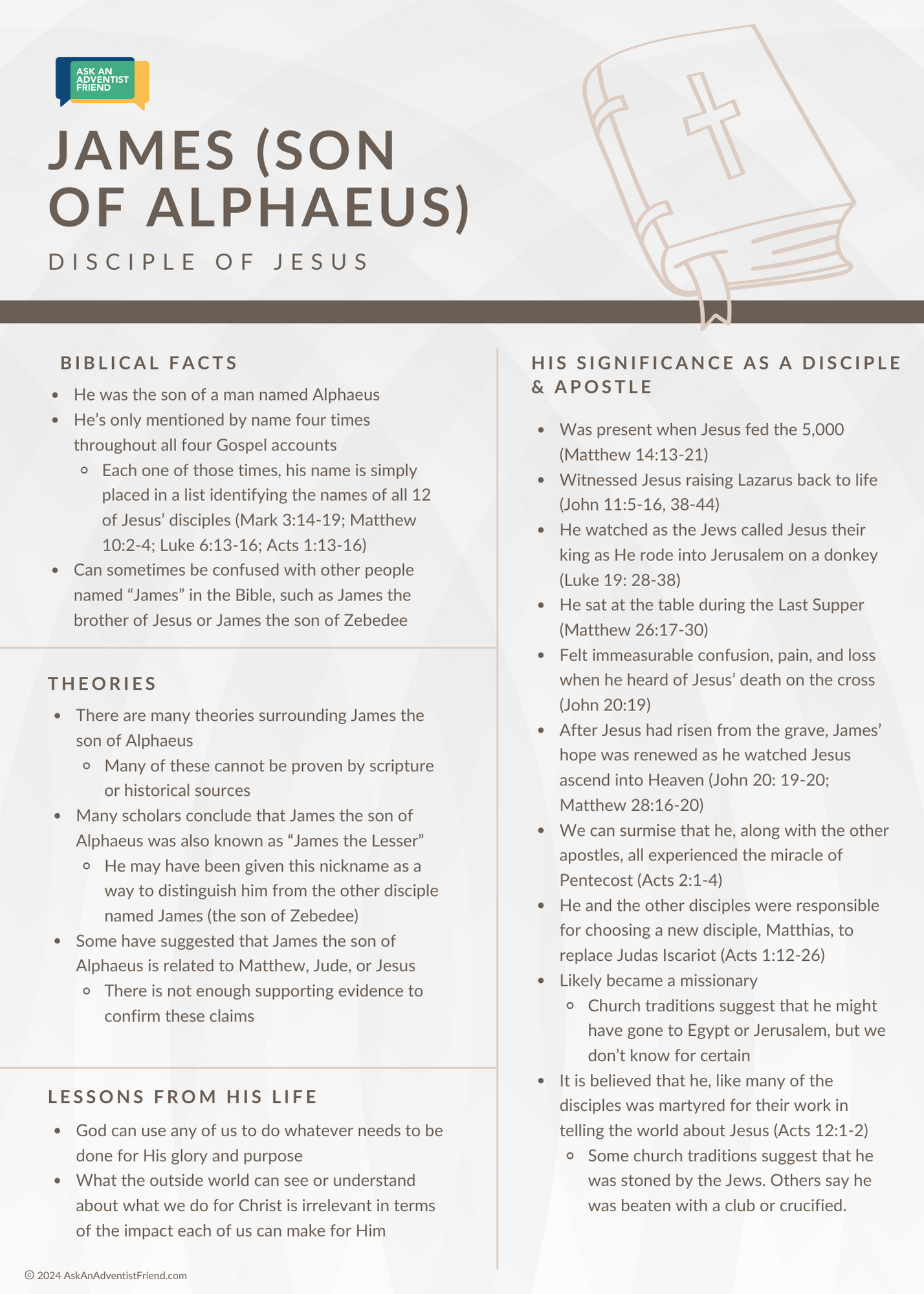
 Two of Jesus Christ’s 12 disciples were named James. While more is known about James the son of Zebedee and brother of John, let’s see what there is to know about the other James, known as James the son of Alphaeus—also sometimes referred to as “James the Lesser.”
Strictly looking at Scripture, this James is only mentioned a handful of times.
So we’ll go through these mentions in the Bible and also take a look at other historical accounts to see what we can find out about this son of Alphaeus. We’ll also determine which details are true and which are likely based on speculation.
We’ll cover:
- Biblical facts about James, the son of Alphaeus
- Theories about James, the son of Alphaeus
- The significance of James as a disciple and apostle
Let’s start by examining what the Bible does tell us about this man; then we’ll look at what else we can determine through additional sources.
Biblical facts about James, the son of Alphaeus

Photo by Priscilla Du Preez 🇨🇦 on Unsplash
Well, based on New Testament mentions, the only things we know for sure about this specific James is that he was indeed one of Jesus’ disciples, and he was the son of a man named Alphaeus.
He’s only mentioned by the name four times throughout the New Testament.
And each one of those times, his name is simply placed in a list identifying the names of all 12 of Jesus’ disciples (Mark 3:14-19; Matthew 10:2-4; Luke 6:13-16; Acts 1:13-16).
Even so, Christian scholars have done their best to fill in the gaps and have provided a few theories on who James was.
Theories about James, the son of Alphaeus
Some of these theories are based on connections scholars believe they’ve found between other significant people of the time who may have interacted with James and the other disciples.
Others come from extrabiblical sources that have to do with history, pop culture, and art.
Like references from the TV show, The Chosen, for example.
This series portrays James, son of Alphaeus as a man with a disability. While this certainly is possible, neither Scripture nor other historical sources provide any details that would confirm or deny this.
And this turns out to be the case for many of the theories surrounding James, son of Alphaeus, even from some of the more scholarly sources.
But some of the details in these theories can be muddied by the fact that there are a lot of Jameses in the Bible. For one, there’s James, the brother of Jesus. There’s also James, son of Zebedee, who was another disciple alongside James, son of Alphaeus. So at times, it can be tricky to distinguish who’s who.
However, most mentions of the name “James” in the Gospel accounts are referring to either the brother of Jesus or the son of Zebedee. You can usually tell which one by looking at the setting in which one of these Jameses is mentioned.
Most of the time, when Jesus is talking with His disciples, it’s James the son of Zebedee who gets more of the spotlight, especially because he is often mentioned alongside his brother John, a very well-known member of the 12 disciples.
James the brother of Jesus is usually mentioned in a listing of Jesus’ family members, or is identified specifically as Jesus’ brother or Mary’s son (Matthew 13:55-56; 27:56).
And in addition to the issue of multiple Jameses, it was common in those times for people to go by multiple names. Take Simon, for instance, who also goes by Peter (though not to be confused with another disciple, Simon the Zealot).
This situation with naming has also led many scholars to consider that James, the son of Alphaeus might have gone by other names too, or had certain identifiers included with his name, such as James the Lesser, or James the Younger.1
James the Lesser

Photo by Kelly Sikkema on Unsplash
Many scholars conclude that James, the son of Alphaeus is the same as “James the Less” or “James the Lesser.”2
This makes sense, considering that James, the son of Zebedee, was known as James the Elder or James the Greater.
The disciples might have given the two Jameses these nicknames as a way to distinguish them from each other.
Though there are other possible reasons James, the son of Alphaeus could have been called James the Lesser. Maybe he was shorter, younger, or more soft-spoken than the bold son of Zebedee who, along with his brother, had earned the nickname, “son of thunder” (Mark 3:17).3
And some theorize that James, the son of Alphaeus is called James the Lesser because he might have been related to other notable figures in Scripture.4
James’ connection to others in the Bible

Photo by Ioann-Mark Kuznietsov on Unsplash
Though we don’t have a lot of information on James’ life and ministry as a disciple, there are multiple theories about James’ connection to the other people mentioned in the Bible.
Was James related to Jesus?
If we assume James, the son of Alphaeus to be the one referred to as James the Younger, that would mean he is the son of a woman named Mary, who was the wife of “Clopas” which might have been another name for Alphaeus (Matthew 27:55-56; Mark 15:40; John 19:25).5
Many take John 19:25 to mean that Mary of Clopas was the sister of Mary, the mother of Jesus. This has led some to believe that James and Jesus were cousins.6
Others still associate James, the son of Alphaeus with James, the half-brother of Christ, whom Paul speaks about in Galatians 1:19.7
But the doubts of these theories outweigh their support, especially that James, the son of Alphaeus could be Jesus’ brother.
Was James related to Matthew?
There are some who have also attempted to connect James, the son of Alphaeus with the disciple Matthew.8
Scripture says that Matthew, known in some accounts as Levi, was the son of a man named Alphaeus (Mark 2:14).
Because James and Matthew had a father with the same name, some Bible scholars believe that James was Matthew’s brother.9
But a lot of scholars deny this theory because many people could have been named Alphaeus (just like many people were named James).10 There’s also the fact that the Bible has a convention of mentioning brothers in pairs, but Matthew and James are never mentioned together.11
Was James related to Jude?
Most scholars believe James was related to Jude, otherwise known as Judas the Zealot (not Judas Iscariot).
However, there is some confusion as to how they were related.
When James and Jude are listed among the disciples, Jude is sometimes referred to as “the son of James,” although other translations like the King James Version, refer to Jude as James’ brother.12
“And when it was day, he called unto him his disciples: and of them he chose twelve, whom also he named apostles; Simon, (whom he also named Peter,) and Andrew his brother, James and John, Philip and Bartholomew, Matthew and Thomas, James the son of Alphaeus, and Simon called Zelotes, and Judas the brother of James, and Judas Iscariot, which also was the traitor.” (Luke 6:13-16, KJV).
Some of this confusion might come back to the fact that the original Greek suggests he is Jude of James, which could suggest either relation.13
However, the book of Jude reasserts that James was Jude’s brother.
“Jude, a bondservant of Jesus Christ, and brother of James…” (Jude 1:1, NKJV).
James’ significance as a disciple of Jesus

Photo by Corinna Widmer
While we don’t know any significant specifics about James’ relationship with Christ or the other disciples, we do know that James wasn’t as prominent as the other 12.
But even though we don’t hear much about who James was or what he did, that doesn’t mean he didn’t do amazing things for Christ. After all, each disciple was chosen specifically by Jesus. James, the son of Alphaeus was selected by the Son of God to learn from Him, minister with Him, and represent Him to the world.
James remained by Jesus’ side throughout His earthly ministry and experienced a lot of the same events the other disciples did.
He witnessed Jesus perform countless miracles. He was there when Jesus fed the 5,000 (Matthew 14:13-21). He was there when Jesus raised Lazarus back to life (John 11:5-16, 38-44).
He and the rest of the 12 had a unique opportunity to walk alongside Christ. They traveled together, ate together, served together.
That means James got to experience some of the most pivotal events in Jesus’ ministry.
He watched as the Jews called Jesus their king as He rode into Jerusalem on a donkey (Luke 19:28-38).
He sat at the table during the Last Supper (Matthew 26:17-30).
And he, along with the other disciples, felt immeasurable confusion, pain, and loss when he heard of Jesus’ death on the Cross (John 20:19).
And after Jesus had risen from the grave, James’ hope was renewed as he watched Him ascend into heaven (John 20:19-20; Matthew 28:16-20).
Though James didn’t have a starring role in any of these events, he witnessed them all the same. And in witnessing the life and character of Christ, he was opened up to an entirely new way of thinking and living.
His time with Jesus likely challenged his cultural worldview. There might have been times when he, like the other disciples, wondered why Jesus did things the way He did.
He may have wondered why Jesus would show kindness to Romans, the Jews’ enemy (Luke 7:1-10). He might have wondered why Jesus reached out to outcasts when no one else would (Matthew 15:21-28; Luke 14:12-14). Or why Jesus would take on a tax collector as His disciple (Mark 2:13-17).
Slowly but surely, James’ experiences with Jesus shaped him into the apostle he was meant to be—one who would go on to share the gospel with others until his passing.
James as an apostle

Photo by Hector John Periquin on Unsplash
Similar to James, son of Alphaeus’ discipleship, what we know about his life after Christ’s death and resurrection comes from what we know about the apostles as a group.
For one, we can surmise that he, along with the other apostles, all experienced the miracle of Pentecost (Acts 2:1-4).
We also know that he and the others were responsible for choosing a new disciple, Matthias, to replace Judas Iscariot (Acts 1:12-26).
James’ role in these pivotal events demonstrates his significance as a church leader. He might not have been as well-known as Peter or John, but the early Christian church would still regard him as one they could turn to for guidance.
It’s also likely that James was a missionary.
We can assume that he, like many of the disciples, traveled to far-away lands to share the gospel.
Church traditions suggest that he might have gone to Egypt or Jerusalem.14 But we don’t know for certain where he might have gone.
But no matter where he went, we can safely assume that James was driven by the Great Commission Jesus had given all of the disciples. He wanted to tell the world about his Savior and friend.
Sadly, it is believed that he, like many of the disciples, was martyred for his work in telling the world about Jesus (Acts 12:1-2).
Some church traditions suggest that he was stoned by the Jews.15 Others say he was beaten with a club or crucified.16
While we can’t say for certain exactly what his life and death entailed, we can say that it matters to be a disciple of Christ.
The measure of discipleship is not by how many people know your name, or how often you’re mentioned throughout the history books.
God chose each of His disciples intentionally. So just because the deeds of James, son of Alphaeus didn’t end up getting recorded doesn’t mean he was any less useful or valuable. He may have touched the lives of many people in subtle yet significant ways. Or he may have exalted Jesus and supported the other disciples in ways that were meaningful, but not obvious or describable to observers.
After all, John plainly stated that the works of Jesus while He was on earth were too numerous to write them all down (John 21:25). That could include several more stories that involved His disciples as well.
Today, we can consider James, the son of Alphaeus as a behind-the-scenes disciple who had a role to play that was God-ordained, even if we don’t know exactly what it was.
And that can help us remember that God can use any of us to do whatever needs to be done for His glory and purpose. What the outside world can see or understand about what we do for Christ is irrelevant in terms of the impact each of us can make for Him.
Want to learn about another little-known disciple?
Find out more about the other disciple named Judas.
Related pages



- Nelson, Ryan, “Who Was James Son of Alphaeus? The Beginner’s Guide,” Overview Bible. [↵]
- Ibid. [↵]
- Ibid.[ ↵]
- Ibid. [↵]
- Rodríguez, Ángel Manuel, “Were the brothers of Jesus mentioned in the Bible sons of Joseph and Mary?” General Conference of Seventh-day Adventist Church. [↵]
- Ibid. [↵]
- Nelson, Overviewbible.com [↵]
- Ibid. [↵]
- Ibid. [↵]
- Ibid. [↵]
- Ibid. [↵]
- Regan, David,“‘Brother of’ or ‘Son of’ James,” Learn the Bible. [↵]
- Ibid. [↵]
- Nelson. [↵]
- James,” Bible Gateway. [↵]
- Nelson. [↵]
More Answers

What Does the Bible Mean When It Calls Jesus the Son of God?
When the Bible calls Jesus the Son of God it’s referring to His divinity. Learn what makes this so significant and what it has to do with salvation.

How Adventists View the End of the World
The end of the world is no fun to think about. But here’s how we can actually find hope and comfort in what’s to come.

What Is an Adventist Medical Missionary?
A medical missionary in the Adventist Church is someone who cares for the medical needs of people as a way of showing the love of Jesus. They may travel to another country, or even just serve in their hometown.

Is the Seventh-day Adventist Church Protestant?
With so many Christian denominations, it can be hard to keep track of which ones share which beliefs. Let’s look at the core Protestant beliefs of Adventism.

The True Events Surrounding the Birth of Jesus
Jesus’ birth involved many strange events: a pregnant virgin, a stable birth, angels appearing to shepherds, and wealthy visitors. These help us understand His supernatural yet incredibly humble life.

Are Seventh-day Adventists Evangelicals?
According to its origins and definition, evangelicalism is about following Jesus and the Bible and sharing the Gospel through the way we live our lives. Adventists wholeheartedly harmonize with these principles.

Could Anything Keep Me from Becoming an Adventist?
We are each saved through Christ. But when it comes to church membership, are there certain beliefs or expectations to become an Adventist?

Do Seventh-day Adventists Have “Rules”?
We uphold principles we believe will help us maintain a closer relationship with Jesus and His Word. Learn how these principles guide Adventist lifestyles.

Your Comprehensive List of Ellen G. White’s Visions
Ellen White—an author, health-reform advocate, Bible scholar, and one of the most influential founding figures of the Seventh-day Adventist Church—was blessed by the Holy Spirit with the spiritual gift of prophecy (1 Corinthians 14; Romans 12:6-8). During her lifetime, she received direct guidance and inspiration from God in several different ways.

Do Seventh-day Adventists Have “Rules” For Marriage?
Around the world, many cultures and religions have various marriage traditions, expectations, or even rules when it comes to choosing a partner, planning the wedding, extended family logistics, or a number of other things.

An In-Depth List of the Prophecies About Jesus
How many prophecies of Jesus are in the Old Testament?

Can a Seventh-day Adventist Marry a Non-Adventist?
Yes. Seventh-day Adventists are not under any official rules that dictate who they can or cannot marry. This is a personal, life-altering decision between the couple and God.

What Adventists Believe About Alcohol and Tobacco Use
The Seventh-day Adventist Church has historically discouraged the use of alcohol and tobacco. Even before the church started in 1863, its leaders were realizing the negative effects of these substances.

What Does the Bible Say About Aliens and UFOs?
In 1938, aliens and UFOs were the subject of a mass prank. Around Halloween, Orson Welles performed a radio adaptation of H.G. Wells’ War of the Worlds. This ended up causing a panic throughout the United States—many people took it to mean that aliens had really attacked New Jersey.

What Do Adventists Believe About the Authority of the Bible?
Learn how one really old book (the Bible) is the sole foundation for all Seventh-day Adventist beliefs.

Is the Soul Immortal? Exploring What Adventists Believe
Based on the way the Bible describes humanity in comparison to God and angels, Seventh-day Adventists believe souls are not something you have, but something you are.

Jewelry—Why Do Many Seventh-day Adventists Choose Not to Wear It?
If you walk into a Seventh-day Adventist church service, you might notice that many people aren’t wearing earrings, bracelets, necklaces, or sometimes even wedding rings.

How the Bible Defines Love
Everyone talks about it, but do we really know what it means?

Why Does God Allow Suffering?
Poverty, genocide, a school shooting. A tsunami or earthquake that wipes out thousands of lives and leaves behind mourning family members.

International Pathfinder Camporee
Youth aged 10-15 in the Adventist Church’s global Pathfinder program look forward to the International Camporee every 5 years. This event brings together Pathfinders from around the world for exciting activities.

What Is Peter’s Ladder of Virtues, and How Does It Work?
Peter’s ladder of virtues is a phrase that refers to eight characteristics to be developed as a person grows in their relationship with Jesus Christ. It can be found in 2 Peter 1.

How Adventists interpret Bible prophecy
Bible prophecy conjures up a variety of emotions in people. For some, it feels exciting or mysterious.

What Counts as “Work” on the Sabbath?
God designed the Sabbath day to be a 24-hour period when we could pause and enjoy the goodness of His creation. We do this by putting aside our regular work so we can focus on spending time with Him and appreciating what He’s created (Exodus 20:8-11).

Moviegoers’ Guide to The Hopeful: The Facts Behind the Film
Learn where and when you can watch The Hopeful and how to get tickets. Already seen it? We’ll uncover the real story that inspired this film.

Protestant Reformation
Martin Luther. The 95 Theses. The Reformation. The Protest. Maybe you’ve heard these terms and wondered, What’s the big deal?

Ellen G. White’s Lasting Legacy
Ellen G. White is a well-known name among Seventh-day Adventists, but she also made an impact in many other parts of history, aside from being a co-founder of the Adventist Church.

Ellen G. White’s Challenging Health Journey
When it comes to lifelong struggles with health, Ellen White is no stranger. In fact, health challenges set the tone for her life early on—years before she was involved in co-founding the Seventh-day Adventist Church.

“What Was Ellen and James White’s Marriage Like?”
Ellen and James White, cofounders of the Seventh-day Adventist Church, met and married under somewhat unusual circumstances. But it’s a sweet story of partners in ministry becoming partners in life. And their married life continued to center on furthering the spread of the gospel together.

What Do Adventists Believe About the Mark of the Beast and 666?
It’s a popular topic, especially during tumultuous times. When everything around you feels chaotic, it’s easy to wonder about the end of the world, and topics like the mark of the beast, as mentioned in Revelation 13, can stir up uneasiness.
Didn’t find your answer? Ask us!
We understand your concern of having questions but not knowing who to ask—we’ve felt it ourselves. When you’re ready to learn more about Adventists, send us a question! We know a thing or two about Adventists.