
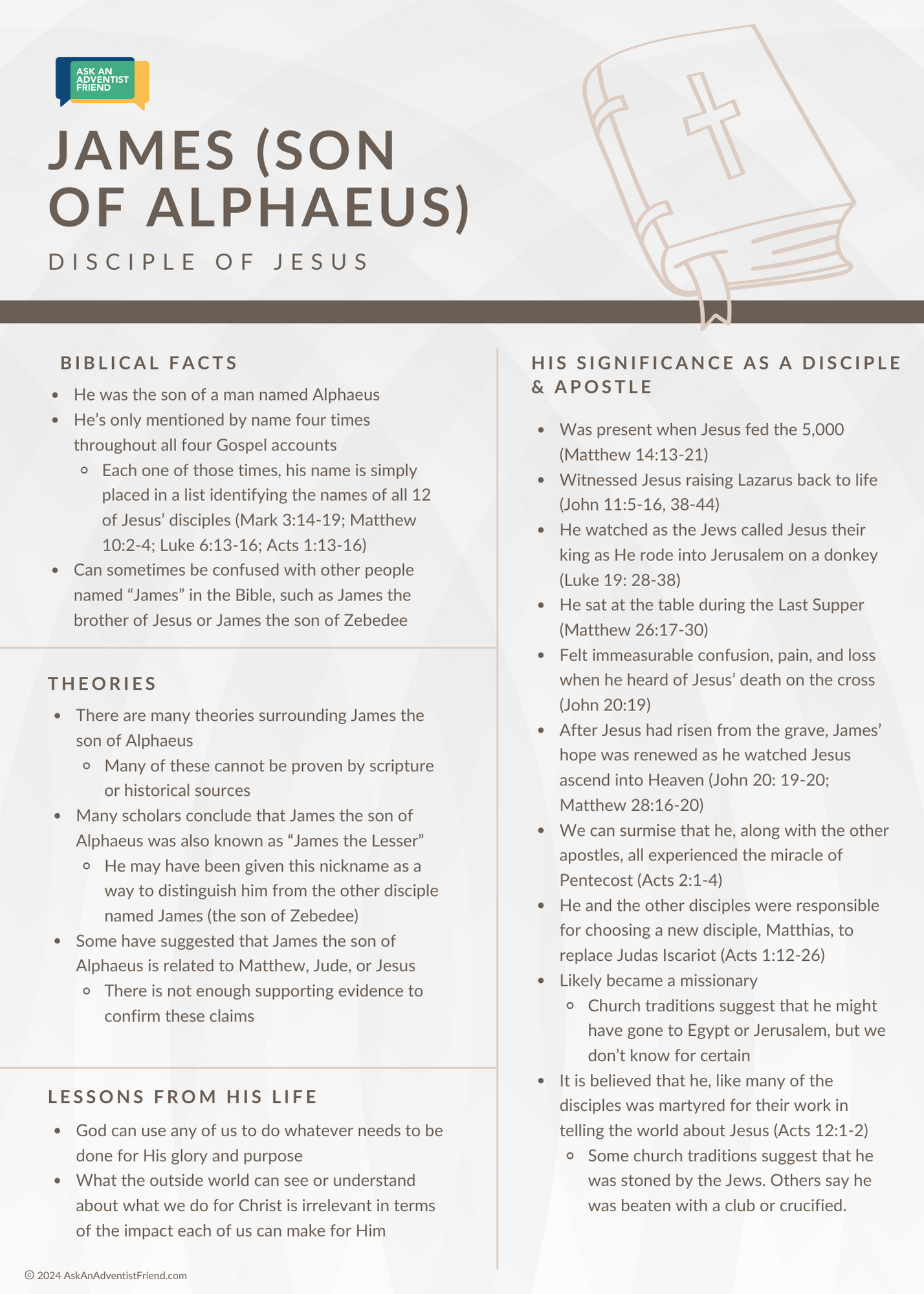
 Two of Jesus Christ’s 12 disciples were named James. While more is known about James the son of Zebedee and brother of John, let’s see what there is to know about the other James, known as James the son of Alphaeus—also sometimes referred to as “James the Lesser.”
Strictly looking at Scripture, this James is only mentioned a handful of times.
So we’ll go through these mentions in the Bible and also take a look at other historical accounts to see what we can find out about this son of Alphaeus. We’ll also determine which details are true and which are likely based on speculation.
We’ll cover:
- Biblical facts about James, the son of Alphaeus
- Theories about James, the son of Alphaeus
- The significance of James as a disciple and apostle
Let’s start by examining what the Bible does tell us about this man; then we’ll look at what else we can determine through additional sources.
Biblical facts about James, the son of Alphaeus

Photo by Priscilla Du Preez 🇨🇦 on Unsplash
Well, based on New Testament mentions, the only things we know for sure about this specific James is that he was indeed one of Jesus’ disciples, and he was the son of a man named Alphaeus.
He’s only mentioned by the name four times throughout the New Testament.
And each one of those times, his name is simply placed in a list identifying the names of all 12 of Jesus’ disciples (Mark 3:14-19; Matthew 10:2-4; Luke 6:13-16; Acts 1:13-16).
Even so, Christian scholars have done their best to fill in the gaps and have provided a few theories on who James was.
Theories about James, the son of Alphaeus
Some of these theories are based on connections scholars believe they’ve found between other significant people of the time who may have interacted with James and the other disciples.
Others come from extrabiblical sources that have to do with history, pop culture, and art.
Like references from the TV show, The Chosen, for example.
This series portrays James, son of Alphaeus as a man with a disability. While this certainly is possible, neither Scripture nor other historical sources provide any details that would confirm or deny this.
And this turns out to be the case for many of the theories surrounding James, son of Alphaeus, even from some of the more scholarly sources.
But some of the details in these theories can be muddied by the fact that there are a lot of Jameses in the Bible. For one, there’s James, the brother of Jesus. There’s also James, son of Zebedee, who was another disciple alongside James, son of Alphaeus. So at times, it can be tricky to distinguish who’s who.
However, most mentions of the name “James” in the Gospel accounts are referring to either the brother of Jesus or the son of Zebedee. You can usually tell which one by looking at the setting in which one of these Jameses is mentioned.
Most of the time, when Jesus is talking with His disciples, it’s James the son of Zebedee who gets more of the spotlight, especially because he is often mentioned alongside his brother John, a very well-known member of the 12 disciples.
James the brother of Jesus is usually mentioned in a listing of Jesus’ family members, or is identified specifically as Jesus’ brother or Mary’s son (Matthew 13:55-56; 27:56).
And in addition to the issue of multiple Jameses, it was common in those times for people to go by multiple names. Take Simon, for instance, who also goes by Peter (though not to be confused with another disciple, Simon the Zealot).
This situation with naming has also led many scholars to consider that James, the son of Alphaeus might have gone by other names too, or had certain identifiers included with his name, such as James the Lesser, or James the Younger.1
James the Lesser

Photo by Kelly Sikkema on Unsplash
Many scholars conclude that James, the son of Alphaeus is the same as “James the Less” or “James the Lesser.”2
This makes sense, considering that James, the son of Zebedee, was known as James the Elder or James the Greater.
The disciples might have given the two Jameses these nicknames as a way to distinguish them from each other.
Though there are other possible reasons James, the son of Alphaeus could have been called James the Lesser. Maybe he was shorter, younger, or more soft-spoken than the bold son of Zebedee who, along with his brother, had earned the nickname, “son of thunder” (Mark 3:17).3
And some theorize that James, the son of Alphaeus is called James the Lesser because he might have been related to other notable figures in Scripture.4
James’ connection to others in the Bible

Photo by Ioann-Mark Kuznietsov on Unsplash
Though we don’t have a lot of information on James’ life and ministry as a disciple, there are multiple theories about James’ connection to the other people mentioned in the Bible.
Was James related to Jesus?
If we assume James, the son of Alphaeus to be the one referred to as James the Younger, that would mean he is the son of a woman named Mary, who was the wife of “Clopas” which might have been another name for Alphaeus (Matthew 27:55-56; Mark 15:40; John 19:25).5
Many take John 19:25 to mean that Mary of Clopas was the sister of Mary, the mother of Jesus. This has led some to believe that James and Jesus were cousins.6
Others still associate James, the son of Alphaeus with James, the half-brother of Christ, whom Paul speaks about in Galatians 1:19.7
But the doubts of these theories outweigh their support, especially that James, the son of Alphaeus could be Jesus’ brother.
Was James related to Matthew?
There are some who have also attempted to connect James, the son of Alphaeus with the disciple Matthew.8
Scripture says that Matthew, known in some accounts as Levi, was the son of a man named Alphaeus (Mark 2:14).
Because James and Matthew had a father with the same name, some Bible scholars believe that James was Matthew’s brother.9
But a lot of scholars deny this theory because many people could have been named Alphaeus (just like many people were named James).10 There’s also the fact that the Bible has a convention of mentioning brothers in pairs, but Matthew and James are never mentioned together.11
Was James related to Jude?
Most scholars believe James was related to Jude, otherwise known as Judas the Zealot (not Judas Iscariot).
However, there is some confusion as to how they were related.
When James and Jude are listed among the disciples, Jude is sometimes referred to as “the son of James,” although other translations like the King James Version, refer to Jude as James’ brother.12
“And when it was day, he called unto him his disciples: and of them he chose twelve, whom also he named apostles; Simon, (whom he also named Peter,) and Andrew his brother, James and John, Philip and Bartholomew, Matthew and Thomas, James the son of Alphaeus, and Simon called Zelotes, and Judas the brother of James, and Judas Iscariot, which also was the traitor.” (Luke 6:13-16, KJV).
Some of this confusion might come back to the fact that the original Greek suggests he is Jude of James, which could suggest either relation.13
However, the book of Jude reasserts that James was Jude’s brother.
“Jude, a bondservant of Jesus Christ, and brother of James…” (Jude 1:1, NKJV).
James’ significance as a disciple of Jesus

Photo by Corinna Widmer
While we don’t know any significant specifics about James’ relationship with Christ or the other disciples, we do know that James wasn’t as prominent as the other 12.
But even though we don’t hear much about who James was or what he did, that doesn’t mean he didn’t do amazing things for Christ. After all, each disciple was chosen specifically by Jesus. James, the son of Alphaeus was selected by the Son of God to learn from Him, minister with Him, and represent Him to the world.
James remained by Jesus’ side throughout His earthly ministry and experienced a lot of the same events the other disciples did.
He witnessed Jesus perform countless miracles. He was there when Jesus fed the 5,000 (Matthew 14:13-21). He was there when Jesus raised Lazarus back to life (John 11:5-16, 38-44).
He and the rest of the 12 had a unique opportunity to walk alongside Christ. They traveled together, ate together, served together.
That means James got to experience some of the most pivotal events in Jesus’ ministry.
He watched as the Jews called Jesus their king as He rode into Jerusalem on a donkey (Luke 19:28-38).
He sat at the table during the Last Supper (Matthew 26:17-30).
And he, along with the other disciples, felt immeasurable confusion, pain, and loss when he heard of Jesus’ death on the Cross (John 20:19).
And after Jesus had risen from the grave, James’ hope was renewed as he watched Him ascend into heaven (John 20:19-20; Matthew 28:16-20).
Though James didn’t have a starring role in any of these events, he witnessed them all the same. And in witnessing the life and character of Christ, he was opened up to an entirely new way of thinking and living.
His time with Jesus likely challenged his cultural worldview. There might have been times when he, like the other disciples, wondered why Jesus did things the way He did.
He may have wondered why Jesus would show kindness to Romans, the Jews’ enemy (Luke 7:1-10). He might have wondered why Jesus reached out to outcasts when no one else would (Matthew 15:21-28; Luke 14:12-14). Or why Jesus would take on a tax collector as His disciple (Mark 2:13-17).
Slowly but surely, James’ experiences with Jesus shaped him into the apostle he was meant to be—one who would go on to share the gospel with others until his passing.
James as an apostle

Photo by Hector John Periquin on Unsplash
Similar to James, son of Alphaeus’ discipleship, what we know about his life after Christ’s death and resurrection comes from what we know about the apostles as a group.
For one, we can surmise that he, along with the other apostles, all experienced the miracle of Pentecost (Acts 2:1-4).
We also know that he and the others were responsible for choosing a new disciple, Matthias, to replace Judas Iscariot (Acts 1:12-26).
James’ role in these pivotal events demonstrates his significance as a church leader. He might not have been as well-known as Peter or John, but the early Christian church would still regard him as one they could turn to for guidance.
It’s also likely that James was a missionary.
We can assume that he, like many of the disciples, traveled to far-away lands to share the gospel.
Church traditions suggest that he might have gone to Egypt or Jerusalem.14 But we don’t know for certain where he might have gone.
But no matter where he went, we can safely assume that James was driven by the Great Commission Jesus had given all of the disciples. He wanted to tell the world about his Savior and friend.
Sadly, it is believed that he, like many of the disciples, was martyred for his work in telling the world about Jesus (Acts 12:1-2).
Some church traditions suggest that he was stoned by the Jews.15 Others say he was beaten with a club or crucified.16
While we can’t say for certain exactly what his life and death entailed, we can say that it matters to be a disciple of Christ.
The measure of discipleship is not by how many people know your name, or how often you’re mentioned throughout the history books.
God chose each of His disciples intentionally. So just because the deeds of James, son of Alphaeus didn’t end up getting recorded doesn’t mean he was any less useful or valuable. He may have touched the lives of many people in subtle yet significant ways. Or he may have exalted Jesus and supported the other disciples in ways that were meaningful, but not obvious or describable to observers.
After all, John plainly stated that the works of Jesus while He was on earth were too numerous to write them all down (John 21:25). That could include several more stories that involved His disciples as well.
Today, we can consider James, the son of Alphaeus as a behind-the-scenes disciple who had a role to play that was God-ordained, even if we don’t know exactly what it was.
And that can help us remember that God can use any of us to do whatever needs to be done for His glory and purpose. What the outside world can see or understand about what we do for Christ is irrelevant in terms of the impact each of us can make for Him.
Want to learn about another little-known disciple?
Find out more about the other disciple named Judas.
Related pages


- Nelson, Ryan, “Who Was James Son of Alphaeus? The Beginner’s Guide,” Overview Bible. [↵]
- Ibid. [↵]
- Ibid.[ ↵]
- Ibid. [↵]
- Rodríguez, Ángel Manuel, “Were the brothers of Jesus mentioned in the Bible sons of Joseph and Mary?” General Conference of Seventh-day Adventist Church. [↵]
- Ibid. [↵]
- Nelson, Overviewbible.com [↵]
- Ibid. [↵]
- Ibid. [↵]
- Ibid. [↵]
- Ibid. [↵]
- Regan, David,“‘Brother of’ or ‘Son of’ James,” Learn the Bible. [↵]
- Ibid. [↵]
- Nelson. [↵]
- James,” Bible Gateway. [↵]
- Nelson. [↵]
More Answers

Je, Mahubiri ya Waadventista wa Sabato Yako Namna Gani?
Karibu katika kila Kanisa la Waadventista wa Sabato, mahubiri ndiyo kitovu cha ibada kuu—kama ilivyo kwa madhehebu mengi ya Kikristo ya Kiprotestanti.

Por que Jesus tinha discípulos e quem eram eles?
Durante o ministério de Jesus na Terra, Ele selecionou certas pessoas para ajudar e continuar Sua obra. Naquela época, elas eram chamadas de Seus “discípulos”.
¿Por qué Jesús tenía discípulos y quiénes eran ellos?
During Jesus’ ministry on earth, He selected certain individuals to help with and continue His work. They would be referred to during that time as His “disciples.”
Kwa Nini Yesu Alikuwa na Wanafunzi na Walikuwa Akina Nani?
Wakati wa huduma ya Yesu duniani, Aliwachagua baadhi ya watu ili kusaidiana naye na kuendeleza kazi Yake. Walifahamika wakati huo kama “wanafunzi” Wake.

Igreja Adventista “Junta Panelas”: Onde Comida e Amizade se Encontram
De vez em quando, geralmente em um cronograma que varia de uma vez por semana a uma vez por mês a uma vez por trimestre, uma igreja adventista terá “almoços de confraternização”, frequentemente referidos casualmente como “junta panelas”.
Comidas comunitarias en la Iglesia Adventista: donde la comida y la amistad se encuentran
Una de las mejores partes de reunirse con la familia de la iglesia el sábado es la comunión que podemos experimentar.

¿Qué creen los Adventistas sobre la creación en la Biblia?
Los Adventistas del Séptimo Día creen que Dios es el Creador de nuestro mundo. Llegan a esta conclusión desde el primer libro de la Biblia, Génesis.
O que os Adventistas do Sétimo Dia acreditam sobre a Criação na Bíblia?
Os Adventistas do Sétimo Dia acreditam que Deus é o Criador do nosso mundo. Eles chegam a essa conclusão a partir do primeiro livro da Bíblia – Gênesis.

Como Ellen White Influenciou a Mensagem de Saúde Adventista
Os Adventistas do Sétimo Dia são conhecidos por sua ênfase em viver de forma saudável. E Ellen G. White foi uma influência significativa no desenvolvimento dessa prioridade e prática entre os Adventistas.

¿Quién cambió el sábado al domingo?
Si la Biblia nunca menciona el cambio del sábado, ¿por qué tantas personas hoy asisten a la iglesia el domingo?

What’s Vacation Bible School? (And Should I Enroll My Kids?)
Vacation Bible School (VBS) is a weekday summer program organized by churches to help kids make friends in a positive environment, participate in constructive activities, and learn more about Jesus and the Bible.
Quem Mudou o Sábado para o Domingo?
Se a Bíblia nunca menciona a mudança do Sábado, por que tantos hoje frequentam a igreja no domingo?

Elena G. de White o la Biblia: ¿Cuál es más importante para los Adventistas?
La Biblia, sin lugar a dudas, es el libro más importante. Es el estándar que usamos para probar todos los demás escritos, incluidos los de Elena G. de White.
Ellen G. White ou a Bíblia – Qual é mais importante para os Adventistas?
Ellen G. White ou a Bíblia - Qual é mais importante para os Adventistas?A Bíblia — sem sombra de dúvida — é o livro mais importante. É o padrão que usamos para testar todas as outras escrituras, incluindo as de Ellen White. A Igreja Adventista do Sétimo Dia acredita...
¿Cómo son los sermones Adventistas?
En casi todas las iglesias Adventistas del Séptimo Día, el sermón es el punto focal del servicio principal, similar a muchas denominaciones cristianas protestantes.
Como são os sermões adventistas?
Como são os sermões adventistas?Em quase todas as Igrejas Adventistas do Sétimo Dia, o sermão é o ponto focal do culto principal — semelhante a muitas denominações cristãs protestantes. É um momento de instrução bíblica pelo pastor, que compartilha o que tem estudado...

Tudo o que você precisa saber sobre a Escola Sabatina
A Escola Sabatina é o componente de estudo da Bíblia do programa da igreja na maioria das Igrejas Adventistas do Sétimo Dia. É um momento de estudo da Bíblia sobre um tópico ou lição específica.

¿Qué dice Elena G. de White sobre la oración?
¿Qué dice Elena G. de White sobre la oración?¿Alguna vez has tenido una carga que simplemente tenías que contarle a alguien, pero tenías miedo de ser juzgado si lo hacías? No tenemos que tener ese tipo de temor cuando se trata de hablar con Dios, una práctica...

12 formas prácticas de superar la preocupación
12 formas prácticas de superar la preocupaciónDESCARGO DE RESPONSABILIDAD: Este contenido es solo para fines informativos. No constituye ningún consejo médico profesional, y no está destinado a ser un sustituto de la terapia profesional de salud mental. Es fácil...
12 Maneiras Práticas de Superar a Preocupação
É difícil não se preocupar quando há tanta coisa para fazer. Mas há esperança! Aqui estão 12 maneiras realistas de lidar com pensamentos ansiosos e acalmar sua mente.

Ellen G. White Alisaidia Vipi Katika Kuanzisha Kanisa la Waadventista wa Sabato?
Ellen G. White, mwanamke mnyenyekevu kutoka Gorham, Maine, alikuwa mmoja wa waanzilishi wa Kanisa la Waadventista wa Sabato na kiongozi muhimu tangu mwanzo wake.
Kila kitu unachohitaji kujua kuhusu Shule ya Sabato
Kila kitu unachohitaji kujua kuhusu Shule ya SabatoShule ya Sabato ndio sehemu ya kujifunza Biblia ya programu za kanisa katika makanisa mengi ya Waadventista wa Sabato. Ni wakati wa kujifunza Biblia kuhusu mada au somo fulani. Badala ya kumsikiliza mhubiri, watu...
Njia 12 Halisi za Kukabiliana na Wasiwasi
Njia 12 Halisi za Kukabiliana na WasiwasiTAHADHARI: Maudhui haya ni kwa madhumuni ya taarifa tu. Hayawakilishi ushauri wa kitaalamu wa matibabu, na haikusudiwi kama mbadala wa matibabu ya kitaalamu ya afya ya akili. Ni rahisi kushikwa katika mzunguko wa wasiwasi. Hasa...

¿Qué dice la Biblia sobre la deuda?
¿Es pecado tener deudas? ¿Brinda la Biblia orientación con respecto a las deudas y préstamos de dinero? Echemos un vistazo.
O Que a Bíblia Diz Sobre Dívidas?
É pecado ter dívidas? A Bíblia fornece orientação sobre como tomar e emprestar dinheiro? Vamos dar uma olhada.
Biblia Inasema Nini Kuhusu Deni?
Kuwa na wasiwasi kuhusu deni la kifedha kunaweza kutufanya tuamke tukiwa na kijasho chembamba.

Wasimamizi wa Waumini Wana Nafasi Gani Ikilinganshwa na Wachungaji?
Neno “Usimamizi wa kidini” linatokana na neno la Kigiriki laikos, ambalo maana yake ni “wa watu.”
¿Cuál es el papel de los laicos frente al papel de los administradores eclesiásticos?
La palabra “laicado” proviene de la palabra griega laikos, que significa “del pueblo”. En un sentido general, un “laico” contrastaría con un profesional o experto.
Qual é o papel dos Leigos versus o papel do Clero?
A palavra “leigos” vem do termo grego laikos, que significa “do povo”. Em um sentido geral, um “leigo” contrastaria com um profissional ou especialista.
Didn’t find your answer? Ask us!
We understand your concern of having questions but not knowing who to ask—we’ve felt it ourselves. When you’re ready to learn more about Adventists, send us a question! We know a thing or two about Adventists.