
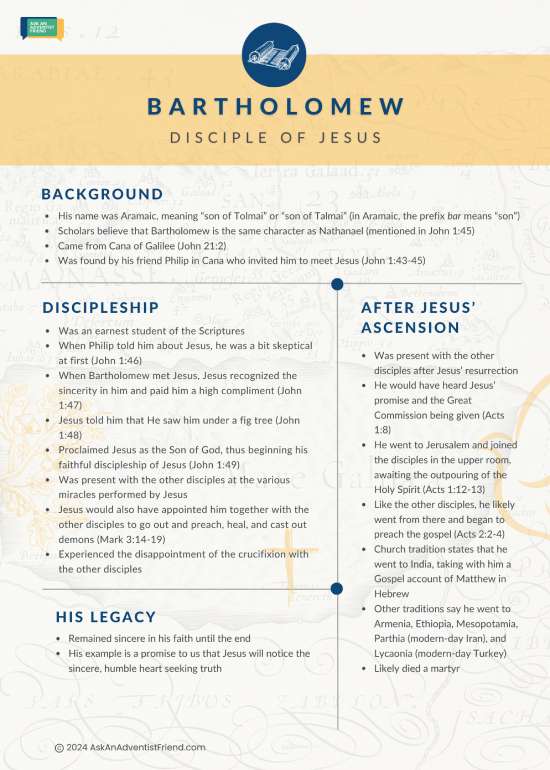
 Bartholomew is a lesser-known character in the New Testament who is mentioned in each of the lists of the twelve disciples of Jesus Christ (Matthew 10:2-4; Mark 3:14-19; Luke 6:13-16). He is most likely the same individual as Nathanael (see John 1), someone who was sincerely studying the Scriptures and waiting for the Messiah to come.
His wait was no doubt rewarded when Jesus appointed him as one of the twelve, and he had the opportunity to witness the Messiah’s healing, teaching, and preaching ministry. He also experienced the outpouring of the Holy Spirit at Pentecost, spurring his work as a missionary for Jesus.
So, let’s dig deeper into what the Bible and historical Christian traditions can teach us about Bartholomew. We’ll cover:
Bartholomew’s background
The first we read about Bartholomew is in Matthew 10:2-4:
“The names of the twelve apostles are these: first, Simon, who is called Peter, and Andrew his brother; James the son of Zebedee, and John his brother; Philip and Bartholomew; Thomas and Matthew the tax collector; James the son of Alphaeus, and Thaddaeus; Simon the Zealot, and Judas Iscariot, who betrayed him” (ESV).
The name Bartholomew gives us hints about his lineage. Bartholomew is Aramaic, meaning “son of Tolmai” or “son of Talmai” (in Aramaic, bar means “son”).1
Scholars believe that Bartholomew is the same character as Nathanael (mentioned in John 1:45). Here’s what Bible commentators say about it:
“Nathanael was probably his own personal name. The Synoptic Gospels [Matthew, Mark, and Luke] make no mention of Nathanael, and the Gospel of John says nothing of Bartholomew. John mentions Nathanael, together with others of the Twelve, in a setting where it seems that none but disciples of the inner circle of Twelve were present (see ch. 21:2). Thus there is no valid reason for doubting that the two names Bartholomew and Nathanael refer to the same person.”2
In this case, Bartholomew was likely his family name, and Nathanael, his first name. And this makes sense, since it wasn’t uncommon for Jews in the first century to have two names.
According to John 21:2, he came from Cana of Galilee. And it’s there that his friend Philip found him and invited him to meet Jesus (John 1:43-45).
Bartholomew’s discipleship
Image by Gerd Altmann from Pixabay
Bartholomew is mentioned only a handful of times in the Gospel accounts. Still, because he was part of the twelve disciples, he would’ve been with them through many key events of Jesus’ ministry, such as the feeding of the 5,000, Jesus’ healing miracles, and the crucifixion.
Jesus would also have appointed him together with the other disciples to go out and preach, heal, and cast out demons (Mark 3:14-19).
The most we know about Bartholomew, though, comes from his first encounter with Jesus.
The account gives us evidence of a close connection between Bartholomew and Philip, the disciple who invited him to meet Jesus. Interestingly, Bartholomew is also always listed right after Philip when the disciples are named in the Bible (Matthew 10:2-4; Mark 3:14-19; Luke 6:13-16).
When Philip found Bartholomew, he exclaimed:
“We have found him of whom Moses in the Law and also the prophets wrote, Jesus of Nazareth, the son of Joseph” (John 1:45, ESV).
This tells us that both Philip and Bartholomew were earnest students of the Scriptures. They were eager for the promised Messiah of the Old Testament.
And yet, Bartholomew was a bit skeptical: “Can anything good come out of Nazareth?” (John 1:46, ESV).
Rather than arguing with him, Philip simply invited him to come and see (John 1:47). And so, Bartholomew did.
He wasn’t disappointed.
When Jesus saw Bartholomew coming toward Him, He said, “Behold, an Israelite indeed, in whom there is no deceit!” (John 1:47, ESV).
What a high compliment! Jesus recognized the sincerity in him. Bible commentators note:
“Nathanael was one of that small but devout group who earnestly waited for ‘the consolation of Israel’ (see Luke 2:25) and aspired to the high ideals set before them by God.”3
Bartholomew was taken aback. “How do You know me?” he asked (John 1:48, NKJV).
Jesus responded, “Before Philip called you, when you were under the fig tree, I saw you” (John 1:48, NKJV).
Jesus had taken notice of Bartholomew’s sincere longing for the Messiah. He knew him inside and out. This realization made Bartholomew exclaim:
“Rabbi, You are the Son of God! You are the King of Israel” (John 1:49, ESV).
And so began his faithful discipleship with Jesus. Though he would experience the disappointment of the crucifixion with the other disciples, he would emerge courageous and hopeful, empowered by the Holy Spirit.
Bartholomew’s life after Jesus’ ascension

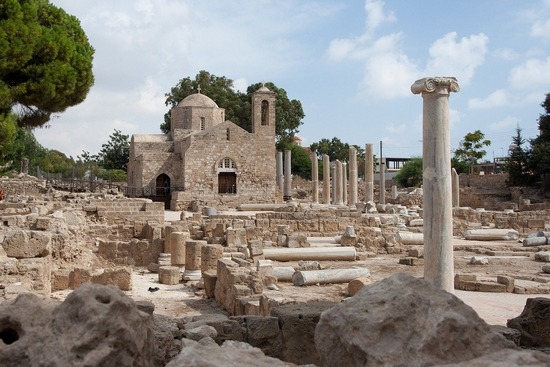
Photo by Amaury Gutierrez on Unsplash
Bartholomew was there with the other disciples (except Judas) after Jesus’ resurrection. He would’ve heard Jesus’ promise and commission: “But you will receive power when the Holy Spirit has come upon you, and you will be My witnesses in all Judea and Samaria, and to the end of the earth” (Acts 1:8, ESV).
Together with the other disciples, Bartholomew took those words to heart.
Acts 1:12-13 records that he went to Jerusalem and joined the disciples in the upper room. There, they prayed and waited for the outpouring of the Holy Spirit.
Acts 2 tells us the revolutionary results of those prayers. The disciples received the Holy Spirit “like a rushing mighty wind,” and began to preach the good news of Jesus (verse 1, NKJV). All their fears were quieted, and they boldly shared about the one they loved.
Though we don’t know the details, we can assume that Bartholomew, like the other disciples, went from there and began to preach the gospel.
According to a tradition taught by the church father Eusebius of Caesarea, Bartholomew went to India, taking with him a gospel account of Matthew in Hebrew.4
Other traditions say he went to Armenia, Ethiopia, Mesopotamia, Parthia (modern-day Iran), and Lycaonia (modern-day Turkey).5
Again, the Bible and history don’t tell us for sure, but it’s most likely that he died a martyr for his faith.
Here’s what Foxe’s Book of Martyrs says about Bartholomew’s death:
“Preached in several countries, and having translated the Gospel of Matthew into the language of India, he propagated it in that country. He was at length cruelly beaten and then crucified by the impatient idolaters.”6
Bartholomew remained sincere in his faith to the end—leaving an example for us.
Bartholomew’s legacy

Photo by Fa Barboza on Unsplash
We may not know much about Bartholomew—his life before following Christ, his time as a disciple, or his accomplishments as an apostle—but what we do know about him leaves us a beautiful legacy.
He shows us what it looks like to have a heart sincerely seeking truth.
Bartholomew was searching the Scriptures, wanting to be led by the Holy Spirit, wanting to see the Messiah. And Jesus took notice, commending him.
His simple faith guided his journey as a disciple and later a missionary sharing the gospel. And his possible martyrdom means that he was making enough of a difference for Jesus that people would have taken notice.
But above all, Bartholomew’s example is a promise to us that Jesus indeed notices those who seek Him in sincerity and humility.
Because in the end, regardless of our life accomplishments, it’s our relationship with Jesus that truly matters.
Want to learn more about the other disciples of Jesus? See what they were like and how Jesus led each one of them.
Related pages


- Metzger, Bruce, and Coogan, Michael, ed., The Oxford Companion to the Bible, pp. 75, 45. [↵]
- Seventh-day Adventist Bible Commentary, vol. 5, comment on Mark 3:18. [↵]
- Ibid., vol. 5, comment on John 1:47. [↵]
- “Saint Bartholomew,” Encyclopedia Britannica. [↵]
- Ibid. [↵]
- Foxe, John, Foxe’s Book of Martyrs, chapter 1. [↵]
More Answers

Where Do We Go When We Die?
For those of us who’ve lost loved ones or faced serious health issues, we can’t help but wonder about life after death.

What is the Difference Between Grace and Mercy in the Bible?
Even in day-to-day life, we can see glimpses of grace and mercy—like when someone offers an angry, impatient person their spot in a line or when a parent hugs their child after a heated argument.

Waadventista Wasabato Wanatafsiri Vipi Unabii wa Biblia?
Jifunze zaidi kuhusu jinsi Waadventista wanavyotafsiri unabii katika Biblia—hasa katika vitabu kama Danieli na Ufunuo.

Urithi wa Kudumu wa Ellen G. White
Urithi wa Kudumu wa Ellen G. WhiteEllen G. White ni jina linalojulikana sana miongoni mwa Waadventista wa Sabato, lakini pia aliathiri sehemu nyingi za historia, mbali na kuwa mwanzilishi wa Kanisa la Waadventista wa Sabato. Ndiyo maana Jarida la Smithsonian...

¿Cómo interpretan la profecía bíblica los Adventistas del Séptimo Día?
Aprende más sobre cómo los Adventistas interpretan la profecía en la Biblia, especialmente en libros como Daniel y Apocalipsis.
Como os Adventistas do Sétimo Dia interpretam a profecia bíblica?
Saiba mais sobre como os Adventistas abordam a interpretação da profecia na Bíblia—especialmente nos livros como Daniel e Apocalipse.

Lo que necesitas saber sobre la tentación y cómo resistirla
¿Alguna vez has sentido que enfrentas la misma tentación día tras día? ¿La tentación que siempre parece resurgir?
What Jesus Meant by “Take Up Your Cross”
Whether you’ve spent a day or a decade around Christian circles, you’ve probably heard the phrase, “Pick up your cross.”

Je, Waadventista Wasabato Wana “Sheria”?
Tunashikilia kanuni tunazoamini zitasaidia kuweka uhusiano wa karibu na Yesu na Neno lake. Jifunze jinsi kanuni hizi zinavyo-ongoza mtindo wa maisha wa Waadventista.
El legado de Elena G. de White
El legado de Elena G. de WhiteyElena G. de White es un nombre muy conocido entre los Adventistas del Séptimo Día, pero también tuvo un impacto en muchas otras partes de la historia, además de ser cofundadora de la Iglesia Adventista. Por eso, la revista Smithsonian la...

All of Jesus’ Warnings and Encouragements in the Bible
Here’s a comprehensive list of every warning and encouragement from the words of Jesus, as well as how they can benefit our lives today.
¿Los Adventistas del Séptimo Día tienen “reglas”?
Sostenemos principios que creemos que nos ayudarán a mantener una relación más cercana con Jesús y su Palabra. Aprende cómo estos principios guían los estilos de vida adventistas.
Os Adventistas do Sétimo Dia têm “regras”?
Defendemos princípios que acreditamos nos ajudar a manter um relacionamento mais próximo com Jesus e com Sua Palavra. Saiba como esses princípios orientam o estilo de vida adventista.

Películas Adventistas: donde la fe y el cine se encuentran
La misión de la Iglesia Adventista del Séptimo Día desde el principio ha sido compartir la verdad de Dios en la Biblia.
Filmes Adventistas: Onde a Fé e o Cinema se Encontram
A missão da Igreja Adventista do Sétimo Dia desde o início tem sido compartilhar a verdade de Deus na Bíblia.

¿Por qué algunas Biblias tienen más libros que otras?
Los cristianos consideran la Biblia como sus escrituras sagradas. Pero dentro del cristianismo, diferentes denominaciones utilizan Biblias con cantidades diferentes de libros.
Por que algumas Bíblias têm mais livros do que outras?
Os cristãos consideram a Bíblia como suas escrituras sagradas. Mas dentro do Cristianismo, diferentes denominações usam Bíblias com números diferentes de livros.
O que você precisa saber sobre a tentação e como resistir a ela
Já se sentiu como se enfrentasse a mesma tentação dia após dia? Aquela tentação que sempre parece ressurgir?

O que os Adventistas do Sétimo Dia acreditam sobre a Bíblia?
A Bíblia forma a base de tudo o que os Adventistas do Sétimo Dia acreditam e ensinam.

Waadventista Wa Sabato wanaamini nini kuhusu Ubatizo?
Kama Wakristo wengi wa Kiprotestanti ulimwenguni kote na katika historia, Kanisa la Waadventista wa Sabato linaamini katika ubatizo, sherehe ambapo watu huzamishwa ndani ya maji kudhihirisha hadharani “kufa kwa maisha ya zamani” na “kuanza kwa maisha mapya katika Kristo”.

Jinsi Waadventista Wanavyoshughulikia Kifo na Mazishi
Mazishi mengi ya Waadventista wa Sabato yanafanana na yale ya madhehebu mengine ya Kiprotestanti, kama vile Wamethodisti, Wabatisti, au Wapresbiteri, lakini unaweza kupata tofauti chache au taratibu za pekee.
O que os Adventistas do Sétimo Dia acreditam sobre o batismo?
Assim como muitos cristãos protestantes em todo o mundo e ao longo da história, a Igreja Adventista do Sétimo Dia crê no batismo por imersão
¿Qué creen los Adventistas del Séptimo Día sobre el bautismo?
Al igual que muchos cristianos protestantes en todo el mundo y a lo largo de la historia, la Iglesia Adventista del Séptimo Día cree en el bautismo por inmersión

Does Jesus Really Care About Me?
Does Jesus Really Care About Me?Short answer: yes, Jesus really does care about you, specifically (1 Peter 5:7, ESV). But if you’re wondering whether Jesus Christ really, truly cares about you, you aren’t alone. Gideon, Abraham and Sarah, Job, Jeremiah, Elijah, even...
Filamu za Kiadventista: Mahali Imani na Filamu Zinapokutana
Tangu mwanzo, lengo la Kanisa la Waadventista wa Sabato limekuwa kueneza kweli ya Mungu katika Biblia.
Kwanini Baadhi ya Biblia Zina Vitabu Vingi Kuliko Zingine?
Wakristo wanachukulia Biblia kama maandiko yao matakatifu. Lakini ndani ya Ukristo, madhehebu tofauti hutumia Biblia zenye idadi tofauti ya vitabu.

Fe y obras: ¿Importan ambas en la vida de un cristiano?
En tantas religiones a lo largo del tiempo, los individuos trabajan hacia la iluminación, la salvación o el favor de una deidad.
Cómo los Adventistas manejan la muerte y los funerales
La mayoría de los servicios funerarios Adventistas del Séptimo Día son similares a los de otras denominaciones protestantes, como los metodistas, bautistas y presbiterianos, pero podrías encontrar algunas diferencias o matices únicos.
Didn’t find your answer? Ask us!
We understand your concern of having questions but not knowing who to ask—we’ve felt it ourselves. When you’re ready to learn more about Adventists, send us a question! We know a thing or two about Adventists.