
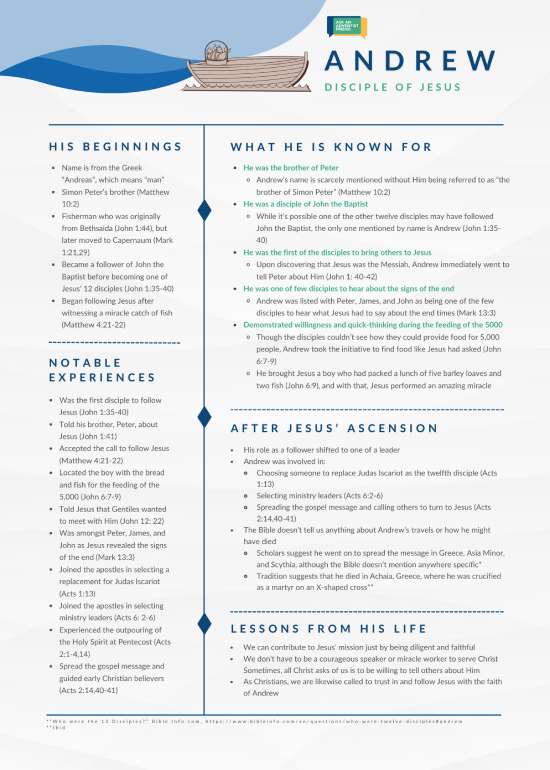
Andrew was Jesus Christ’s first disciple (John 1:37-40) and the first to recognize Him as the Messiah.
With this discovery, Andrew invited his brother, Peter, to come meet Jesus for himself.
Though little is known about Andrew, the details we find in the New Testament show that he played a valuable role in Jesus’ ministry.
Let’s look at some of Andrew’s most memorable moments in Scripture.
We’ll cover:
- Andrew’s beginnings
- What Andrew is known for in the Bible
- Andrew after Jesus’ ascension
- What we can learn from his life
First, some background information…
Andrew’s beginnings
Little is known about the apostle Andrew, since Bible writers didn’t often provide background details about people who weren’t immediately pertinent to the story at hand. But the Bible does give us an overview of who Andrew was and where he came from.
Andrew had a Greek name that comes from the word “Andreas,” which simply means “man.”1
He was the son of a Jewish man named Jonah or John (different versions translate the name differently) and a brother to the well-known disciple Peter (John 1:42; Matthew 10:2).
Like his brother, Peter, and his fellow disciple, Philip, Andrew was originally from Bethsaida in Galilee (John 1:44), though he later moved to Capernaum (Mark 1:21, 29).
Andrew and Peter both worked as fishermen (Mark 1:16), but Andrew was the only one said to have been a follower of John the Baptist (John 1:35-40). And it was the decision to follow John the Baptist that first led Andrew to Christ.
According to the Gospel of John, Andrew heard about Jesus when John the Baptist announced Him as the Lamb of God (John 1:35-40). Immediately, Andrew and another one of John’s disciples followed after Jesus and ended up spending the day with Him (John 1:38-39).
Evidently impressed by his encounter with Jesus, Andrew went to tell Peter he had met the Messiah (John 1:41). He even brought Peter to Jesus.
And this wouldn’t be the last time they saw Jesus.
They would later be called by Him to spend the rest of their lives following Him.
The calling of Andrew

Though Peter and Andrew met Jesus, the official “call” to discipleship was recorded when Jesus found them fishing (Mark 1:16).
The Gospel of Luke tells us that crowds of people had gathered near the Lake of Gennesaret to hear Jesus speak (Luke 5:1). But instead of speaking to them from the land, Jesus decided to speak to them from one of the fishermen’s boats nearby.
He had seen Andrew and Peter’s boat, and they agreed to let Him climb aboard.
From there, Jesus began teaching the crowd (Luke 5:2-3). Afterward, He turned to Peter and told him to release his nets into the water (Luke 5:4).
Peter responded by telling Jesus that they hadn’t been able to catch any fish, even though they’d been fishing all night long (Luke 5:5). And yet he agreed to cast their net one more time (Luke 5:5).
The Bible tells us:
“And when they had done this, they caught a great number of fish, and their net was breaking. So they signaled to their partners in the other boat to come and help them. And they came and filled both the boats, so that they began to sink” (Luke 5:6-7, NKJV).
It was then, in the face of a miracle, that Jesus called Andrew and his brother Peter to become His disciples.
“Then He said to them, ‘Follow Me, and I will make you fishers of men’” (Matthew 4:19, NKJV).
And without any hesitation, Andrew and Peter accepted His offer and decided to follow Jesus (Matthew 4:20).
The story of Andrew’s calling tells us a little bit about the kind of person he was: a faithful, dedicated individual. When convinced of Jesus’ messiahship, he couldn’t help but tell others, and he readily left behind his job, family, and hometown to become a loyal follower of Jesus.
What is Andrew known for in the Bible?
The most well-known detail about Andrew is that he became Jesus’ first disciple.
However, a couple more things set him apart from the other disciples:
- He was a confirmed disciple of John the Baptist (John 1:35-40): While it’s possible that a few more of the 12 disciples also followed John the Baptist, the only one mentioned by name is Andrew.
- He was the first of the disciples to bring others to Jesus (John 1:40-42): Upon discovering that Jesus was the Messiah, Andrew immediately went to tell Peter about Him.
- He may have been one of the few disciples to hear about the signs of the end (Mark 13:3): Though Jesus loved all of His disciples, He became especially close to Peter, James, and John. On this occasion, however, Andrew was included in this “inner circle” of disciples when they asked Jesus about signs of things to come. And so Andrew was listed among them as being one of the few disciples to hear what Jesus had to say about the end times.
- He was the brother of Peter (Matthew 10:2): Aside from James and John, Peter and Andrew were the other set of brothers among the disciples. Between these two, the Bible writers talked a lot more about Peter. In fact, Andrew’s name is scarcely mentioned without him being referred to as “the brother of Simon Peter.”2
But being well-known is not the primary measure for being a good disciple and one we can learn from. Even from the little information Scripture gives us, we can tell that Andrew was a competent disciple who was quick to do the work he was called to do. That simple quality—willingness—is invaluable, especially for a follower of Christ.
We see this willingness demonstrated in how he worked with his fellow disciples and other people he ministered to.
For example, there was one occasion when a group of Greeks came to Philip asking to see Jesus (John 12:20-21).
Philip turned to Andrew with the request, and together they brought the request before Jesus (John 12:22).
(Whenever in doubt about how to respond to a situation, it’s always a good idea to turn to Jesus.)
This situation also demonstrates how willing Andrew was to introduce others to Jesus Christ. He didn’t seem to care that they weren’t Jews, but rather left it up to Jesus to decide how to proceed.
Andrew demonstrated that same willingness and quick thinking when he ministered to the crowds following Jesus.
One time, a group of 5,000 people were following after Jesus, and everyone ran out of food (John 6:2). Testing the disciples, Jesus asked them where they could go to find food for the people (John 6:5-6).
Though the disciples didn’t see how they could provide for 5,000 people, Andrew took the initiative to find food like Jesus had asked (John 6:7-9).
He brought Jesus a boy who had packed a lunch of five barley loaves and two fish (John 6:9).
And while he didn’t understand how that would be enough to feed the crowd, he offered it up to Jesus anyway. He did what he knew to do, given the circumstances.
Though the Bible doesn’t often address Andrew’s role in Jesus’ ministry, the occasions it does mention him point to his continuous dedication to Christ.
What did Andrew do as an apostle, after Jesus’ ascension?

Photo by Hans Reniers on Unsplash
While we know little about Andrew’s specific role when he was a disciple to Jesus, even less is recorded about his life after Jesus’ ascension back to heaven.
Like the rest of the disciples, it’s very likely he took up Jesus’ call to spread the Gospel around the world (Acts 1:6-8).
Some scholars suggest he went on to spread the message in Greece, Asia Minor, and Scythia, although the Bible doesn’t mention any specific locations.3
Tradition also suggests that Andrew died in Achaia, Greece, where he was crucified as a martyr.4 Unofficial records claim that Andrew asked to be crucified on an X-shaped cross out of respect for Jesus’ own crucifixion.5 This idea has become so popular that X-shaped crosses are now referred to as St. Andrew’s crosses.6
However, it’s worth noting that the Bible doesn’t tell us anything about Andrew’s travels or how he might have died.
Instead, the book of Acts tells us how Andrew’s role as a follower had shifted to one of a leader, as all twelve apostles were called to make administrative decisions and teach early Christian believers while Christ was in heaven.
The Bible tells us Andrew was involved in:
- Choosing someone to replace Judas Iscariot as the 12th disciple (Acts 1:13)
- Selecting ministry leaders (Acts 6:2-6)
- Spreading the Gospel message, and calling others to turn to Jesus (Acts 2:14, 40-41)
While these may not be roles or jobs that get much attention, they are similar to the kinds of tasks that are consistently important in ministry today, whether in a small church, large congregation, or discipleship group.
What can we learn from the life of Andrew?
Andrew’s life and ministry teach us that we can contribute to Jesus’ mission just by being diligent and faithful and maintaining a state of readiness and receptiveness to be used by God.
There wasn’t anything remarkable about Andrew from an earthly perspective.
He was a poor fisherman, and unlike his brother Peter, he didn’t end up becoming one of the most well-known apostles.
But Andrew was no doubt an invaluable member of the 12.
It was Andrew who brought Peter to meet Jesus.
It was Andrew who led Gentiles to Jesus when others might have turned them away.
It was Andrew who hadn’t given up on the feeding of the 5,000.
And it was Andrew who first sought after Christ.
He had an incredible faith and was passionate about bringing others to Jesus.
As Christians, we are likewise called to trust in and follow Jesus with the faith of Andrew.
His example also shows us that we don’t have to be courageous speakers or miracle workers to serve Christ. Sometimes, all Christ asks of us is that we be willing to do what needs doing and to always point back to Jesus.
In the end, that’s our goal as Christians—to bring others to Christ like Andrew did.
Want to continue learning about the disciples?
Related Articles





- “What was it Like Being Jesus’ Disciple and Apostle?” General Conference Corporation of Seventh-day Adventists, [↵]
- Matthew 4:18; Matthew 10:2; Mark 1:16; John 1:40. [↵]
- “Who were the 12 Disciples?” BibleInfo.com, [↵]
- Ibid. [↵]
- Ibid. [↵]
- Ibid. [↵]
More Answers
Contáctanos
ContáctanosEnvíanos un mensaje¡Nos encantaría saber de ti! No dudes en hacer una pregunta, solicitar información o hacer una sugerencia.
Contate-Nos
Contate-NosEnvie-nos uma mensagemAdoraríamos ouvir de você! Sinta-se à vontade para fazer uma pergunta, solicitar informações ou oferecer uma sugestão.
Sobre nosotros
Cuando tienes preguntas importantes, quieres respuestas directamente de la fuente. Eso es lo que hemos venido a hacer con AskAnAdventistFriend.com. Este sitio es operado por Adventistas del Séptimo Día dedicados y activos que quieren responder a tus preguntas. La...
Sobre nós
Quando você tem perguntas importantes, você quer respostas diretamente da fonte. É por isso que estamos aqui com AskAnAdventistFriend.com Este site é operado por Adventistas do Sétimo Dia dedicados e engajados que querem responder às suas perguntas A maior parte do...
Maktaba ya Rasilimali
Free Resources to Boost Your Bible StudyLike what you’ve read on our website? You can take the content with you by downloading our FREE Bible study tools below. Each PDF accompanies an article on AskAnAdventistFriend.com, providing you with supplemental content,...
Changia
Tusaidie kuendelea kupata majibu!AskAnAdventistFriend ni mradi unaolenga kuwafikia wengine bila kujipatia faida ambao umejikita katika kujibu maswali yako kuhusu Waadventista wa Sabato, Yesu, Biblia, Pambano Kuu, na mengineyo. Ikiwa ungependa kuchangia kifedha...
Masomo ya Biblia mtandaoni
Chagua Kujifunza Biblia Mtandaoni Want to keep learning? There’s always more to discover within the pages of the Bible. Find out more about Jesus, humanity, the plan of salvation, and how God loves you enough to sacrifice everything, just to give you a chance to...
Tutumie Maombi Yako
Tuma Ombi Lako Tunaweza kukuombea? Maombi yana nguvu. Tunapoomba, tunawasiliana na Mungu, tunasaidiana, tunakaribisha uwepo wa Mungu katika maisha yetu, na tunafungua mioyo yetu kwa uongozi wa Roho Mtakatifu. Biblia inatuambia “Msijisumbue kwa neno lo lote; bali...
Kuhusu Tovuti
Unapokuwa na Maswali Muhimu, Unahitaji Majibu Moja kwa Moja Kutoka Kwenye Chanzo. Hili ndilo tunalofanya katika AskAnAdventistFriend.com. Tovuti hii inaendeshwa na Waadventista wa Sabato waliojitolea na walio tayari kujibu maswali yako. Sehemu kubwa ya maudhui yetu...
Wasiliana Nasi
Wasiliana NasiTutumie UjumbeTungependa kusikia kutoka kwako! Jisikie huru kuuliza swali, kutafuta taarifa, au kutoa pendekezo.

Is Demon Possession Real? Here’s What the Bible Says
Is Demon Possession Real? Here’s What the Bible SaysThe topic of demon possession can be brought to mind from stories, movies, the Bible, or even as a metaphor. And it can include mental images of people behaving in disturbing, erratic, or unnatural ways. Every now...
እንኳን ደህና መጡ ወደ ድህረ ገጻችን
ሰላም እንዴት ነው? ይህ የአማርኛ እትም ነው። እኛ በድህረ ገጻችን ላይ አማርኛ ቋንቋ ለመጠቀም እንፈልጋለን። ይህ ድህረ ገጽ ለመረጃ መስጠትና ለማስተላለፊያ ነው። በአማርኛ እና በእንግሊዝኛ የተጻፉ የጥቅስ አንቀጾችን እንለቀቅበታለን። አማርኛ የኢትዮጵያ አንዱ ከተለመዱ ቋንቋዎች ነው። በአብዛኛው አካባቢ የተናገረ ሲሆን እንዲሁም የመንግስት ቋንቋ ነው። በዚህ ድህረ ገጽ ላይ አማርኛ የተጻፉ ትምህርቶች፣ መመሪያዎችና...

Jesus and the Pharisees and Sadducees (Why They Opposed Jesus)
The Pharisees and Sadducees hated Jesus and wanted Him dead. This page looks at who they were and what motivated them to oppose Jesus.

13 Bible Study Tools to Boost Your Daily Bible Reading
Bible study tools come in all types, including concordances, encyclopedias, downloadables, journaling, atlases, and more. Use these tools to enrich your study for a fuller understanding God’s Word.

A Christian’s Guide to a Joyful Life (Even When It’s Hard)
Joy. It’s something you long for, yet maybe you’re not sure how to truly experience it on a day-to-day basis. Sure, you have moments of joy—but how about the rest of the time?

The Many Names of Jesus in the Bible and What They Mean
The Many Names of Jesus in the Bible and What They MeanThe Bible includes a lot of names for Jesus, and they all reveal different facets of His identity, power, character, and mission. We’ve all had nicknames throughout our lives. They might be shortened versions of...

How Can We Prepare for Sabbath?
How Can We Prepare for Sabbath?Sabbath is a special, consecrated time of rest each week. And to make sure we can fully embrace it, respect it, enjoy it, and “call the Sabbath a delight” (Isaiah 58:13, CSB), it can be helpful to prepare for it ahead of time. These...

What is the Role of Laypeople vs. the Role of Clergy?
The word “laity” comes from the Greek word laikos, which means “of the people.”

Bible Verses For When You’re Discouraged
Life is never easy, but sometimes things become extra difficult, painful, or disheartening.

When Is Jesus Coming Back?
The Bible doesn’t tell us exactly when the Second Coming will occur, but learn about the signs that point to the nearness of the return of Christ.

How Do I Begin Observing the Sabbath?
The Sabbath, which comes on the seventh day of the week, is a special day honoring the fourth commandment and God’s creation.

Understanding The Parable of The Lost Sheep
The parables of Jesus teach object lessons about the kingdom of God. And three parables in particular, the parable of the lost sheep, the parable of the lost coin, and the parable of the prodigal son, specifically teach about God’s unconditional, redemptive love.

All About the Old and New Covenants in the Bible
When God promised a Messiah to Adam and Eve, He established an everlasting covenant that reaches down to us. This includes both the old and new covenants.

Is It Normal For Christians to Experience Doubt?
Yes, it is completely normal for Christians to experience periods of doubt in their spiritual life.

After Jesus’ Ascension: What He Did Throughout the New Testament
After Jesus’ Ascension: His work Throughout the New TestamentWe first get to know Jesus, the Son of God and our Messiah, by reading the Gospel accounts of His earthly ministry. And after He died for our sins and was resurrected, He returned to heaven. This is known as...

How Adventists Developed the Sanctuary Doctrine and What It Means
How Adventists Developed the Sanctuary Doctrine and What It MeansWhen Adventists talk about “sanctuary doctrine,” they’re referring to the concept that the heavenly sanctuary reveals the plan of salvation—both in our personal walk with Jesus and in the work Jesus...

Legalism in the Bible: Definition, Dangers, and Examples
Find out what the Bible says about legalism, why it’s dangerous, and how we can avoid it today.
What Does the Story of the Prodigal Son Really Mean?
The Parable of the Prodigal Son tells the story of a wayward son, a jealous brother, and a father with unconditional love. Let’s see what we can learn from it today.

Who is Mary Magdalene in the Bible
Mary Magdalene was a remarkably dedicated follower and supporter of Jesus Christ during His earthly ministry.
Didn’t find your answer? Ask us!
We understand your concern of having questions but not knowing who to ask—we’ve felt it ourselves. When you’re ready to learn more about Adventists, send us a question! We know a thing or two about Adventists.