
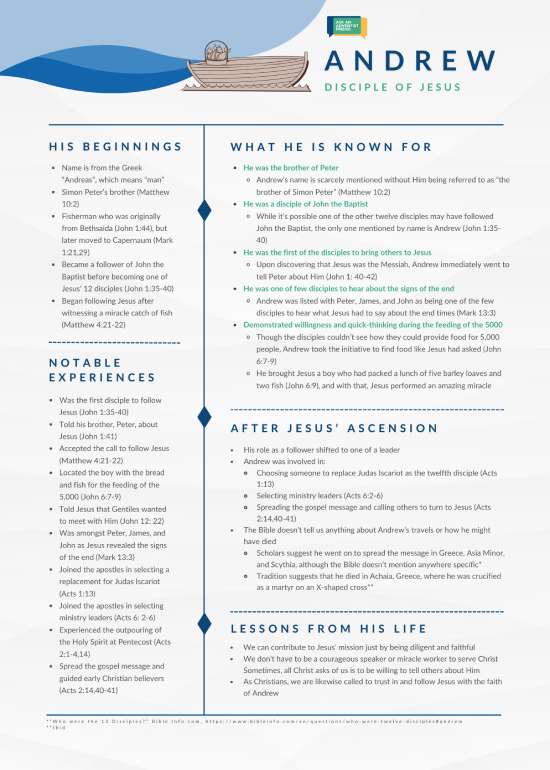
Andrew was Jesus Christ’s first disciple (John 1:37-40) and the first to recognize Him as the Messiah.
With this discovery, Andrew invited his brother, Peter, to come meet Jesus for himself.
Though little is known about Andrew, the details we find in the New Testament show that he played a valuable role in Jesus’ ministry.
Let’s look at some of Andrew’s most memorable moments in Scripture.
We’ll cover:
- Andrew’s beginnings
- What Andrew is known for in the Bible
- Andrew after Jesus’ ascension
- What we can learn from his life
First, some background information…
Andrew’s beginnings
Little is known about the apostle Andrew, since Bible writers didn’t often provide background details about people who weren’t immediately pertinent to the story at hand. But the Bible does give us an overview of who Andrew was and where he came from.
Andrew had a Greek name that comes from the word “Andreas,” which simply means “man.”1
He was the son of a Jewish man named Jonah or John (different versions translate the name differently) and a brother to the well-known disciple Peter (John 1:42; Matthew 10:2).
Like his brother, Peter, and his fellow disciple, Philip, Andrew was originally from Bethsaida in Galilee (John 1:44), though he later moved to Capernaum (Mark 1:21, 29).
Andrew and Peter both worked as fishermen (Mark 1:16), but Andrew was the only one said to have been a follower of John the Baptist (John 1:35-40). And it was the decision to follow John the Baptist that first led Andrew to Christ.
According to the Gospel of John, Andrew heard about Jesus when John the Baptist announced Him as the Lamb of God (John 1:35-40). Immediately, Andrew and another one of John’s disciples followed after Jesus and ended up spending the day with Him (John 1:38-39).
Evidently impressed by his encounter with Jesus, Andrew went to tell Peter he had met the Messiah (John 1:41). He even brought Peter to Jesus.
And this wouldn’t be the last time they saw Jesus.
They would later be called by Him to spend the rest of their lives following Him.
The calling of Andrew

Though Peter and Andrew met Jesus, the official “call” to discipleship was recorded when Jesus found them fishing (Mark 1:16).
The Gospel of Luke tells us that crowds of people had gathered near the Lake of Gennesaret to hear Jesus speak (Luke 5:1). But instead of speaking to them from the land, Jesus decided to speak to them from one of the fishermen’s boats nearby.
He had seen Andrew and Peter’s boat, and they agreed to let Him climb aboard.
From there, Jesus began teaching the crowd (Luke 5:2-3). Afterward, He turned to Peter and told him to release his nets into the water (Luke 5:4).
Peter responded by telling Jesus that they hadn’t been able to catch any fish, even though they’d been fishing all night long (Luke 5:5). And yet he agreed to cast their net one more time (Luke 5:5).
The Bible tells us:
“And when they had done this, they caught a great number of fish, and their net was breaking. So they signaled to their partners in the other boat to come and help them. And they came and filled both the boats, so that they began to sink” (Luke 5:6-7, NKJV).
It was then, in the face of a miracle, that Jesus called Andrew and his brother Peter to become His disciples.
“Then He said to them, ‘Follow Me, and I will make you fishers of men’” (Matthew 4:19, NKJV).
And without any hesitation, Andrew and Peter accepted His offer and decided to follow Jesus (Matthew 4:20).
The story of Andrew’s calling tells us a little bit about the kind of person he was: a faithful, dedicated individual. When convinced of Jesus’ messiahship, he couldn’t help but tell others, and he readily left behind his job, family, and hometown to become a loyal follower of Jesus.
What is Andrew known for in the Bible?
The most well-known detail about Andrew is that he became Jesus’ first disciple.
However, a couple more things set him apart from the other disciples:
- He was a confirmed disciple of John the Baptist (John 1:35-40): While it’s possible that a few more of the 12 disciples also followed John the Baptist, the only one mentioned by name is Andrew.
- He was the first of the disciples to bring others to Jesus (John 1:40-42): Upon discovering that Jesus was the Messiah, Andrew immediately went to tell Peter about Him.
- He may have been one of the few disciples to hear about the signs of the end (Mark 13:3): Though Jesus loved all of His disciples, He became especially close to Peter, James, and John. On this occasion, however, Andrew was included in this “inner circle” of disciples when they asked Jesus about signs of things to come. And so Andrew was listed among them as being one of the few disciples to hear what Jesus had to say about the end times.
- He was the brother of Peter (Matthew 10:2): Aside from James and John, Peter and Andrew were the other set of brothers among the disciples. Between these two, the Bible writers talked a lot more about Peter. In fact, Andrew’s name is scarcely mentioned without him being referred to as “the brother of Simon Peter.”2
But being well-known is not the primary measure for being a good disciple and one we can learn from. Even from the little information Scripture gives us, we can tell that Andrew was a competent disciple who was quick to do the work he was called to do. That simple quality—willingness—is invaluable, especially for a follower of Christ.
We see this willingness demonstrated in how he worked with his fellow disciples and other people he ministered to.
For example, there was one occasion when a group of Greeks came to Philip asking to see Jesus (John 12:20-21).
Philip turned to Andrew with the request, and together they brought the request before Jesus (John 12:22).
(Whenever in doubt about how to respond to a situation, it’s always a good idea to turn to Jesus.)
This situation also demonstrates how willing Andrew was to introduce others to Jesus Christ. He didn’t seem to care that they weren’t Jews, but rather left it up to Jesus to decide how to proceed.
Andrew demonstrated that same willingness and quick thinking when he ministered to the crowds following Jesus.
One time, a group of 5,000 people were following after Jesus, and everyone ran out of food (John 6:2). Testing the disciples, Jesus asked them where they could go to find food for the people (John 6:5-6).
Though the disciples didn’t see how they could provide for 5,000 people, Andrew took the initiative to find food like Jesus had asked (John 6:7-9).
He brought Jesus a boy who had packed a lunch of five barley loaves and two fish (John 6:9).
And while he didn’t understand how that would be enough to feed the crowd, he offered it up to Jesus anyway. He did what he knew to do, given the circumstances.
Though the Bible doesn’t often address Andrew’s role in Jesus’ ministry, the occasions it does mention him point to his continuous dedication to Christ.
What did Andrew do as an apostle, after Jesus’ ascension?

Photo by Hans Reniers on Unsplash
While we know little about Andrew’s specific role when he was a disciple to Jesus, even less is recorded about his life after Jesus’ ascension back to heaven.
Like the rest of the disciples, it’s very likely he took up Jesus’ call to spread the Gospel around the world (Acts 1:6-8).
Some scholars suggest he went on to spread the message in Greece, Asia Minor, and Scythia, although the Bible doesn’t mention any specific locations.3
Tradition also suggests that Andrew died in Achaia, Greece, where he was crucified as a martyr.4 Unofficial records claim that Andrew asked to be crucified on an X-shaped cross out of respect for Jesus’ own crucifixion.5 This idea has become so popular that X-shaped crosses are now referred to as St. Andrew’s crosses.6
However, it’s worth noting that the Bible doesn’t tell us anything about Andrew’s travels or how he might have died.
Instead, the book of Acts tells us how Andrew’s role as a follower had shifted to one of a leader, as all twelve apostles were called to make administrative decisions and teach early Christian believers while Christ was in heaven.
The Bible tells us Andrew was involved in:
- Choosing someone to replace Judas Iscariot as the 12th disciple (Acts 1:13)
- Selecting ministry leaders (Acts 6:2-6)
- Spreading the Gospel message, and calling others to turn to Jesus (Acts 2:14, 40-41)
While these may not be roles or jobs that get much attention, they are similar to the kinds of tasks that are consistently important in ministry today, whether in a small church, large congregation, or discipleship group.
What can we learn from the life of Andrew?
Andrew’s life and ministry teach us that we can contribute to Jesus’ mission just by being diligent and faithful and maintaining a state of readiness and receptiveness to be used by God.
There wasn’t anything remarkable about Andrew from an earthly perspective.
He was a poor fisherman, and unlike his brother Peter, he didn’t end up becoming one of the most well-known apostles.
But Andrew was no doubt an invaluable member of the 12.
It was Andrew who brought Peter to meet Jesus.
It was Andrew who led Gentiles to Jesus when others might have turned them away.
It was Andrew who hadn’t given up on the feeding of the 5,000.
And it was Andrew who first sought after Christ.
He had an incredible faith and was passionate about bringing others to Jesus.
As Christians, we are likewise called to trust in and follow Jesus with the faith of Andrew.
His example also shows us that we don’t have to be courageous speakers or miracle workers to serve Christ. Sometimes, all Christ asks of us is that we be willing to do what needs doing and to always point back to Jesus.
In the end, that’s our goal as Christians—to bring others to Christ like Andrew did.
Want to continue learning about the disciples?
Related Articles





- “What was it Like Being Jesus’ Disciple and Apostle?” General Conference Corporation of Seventh-day Adventists, [↵]
- Matthew 4:18; Matthew 10:2; Mark 1:16; John 1:40. [↵]
- “Who were the 12 Disciples?” BibleInfo.com, [↵]
- Ibid. [↵]
- Ibid. [↵]
- Ibid. [↵]
More Answers

Como os Ensinos de Ellen White Podem Melhorar Sua Saúde
Como os Ensinos de Ellen White Podem Melhorar Sua SaúdeAssistência médica no século XIX era dito deixar "mais doenças do que levava embora" com o uso de sangrias e "remédios" como mercúrio e arsênico.1 À medida que as pessoas questionavam esses métodos, novas...
Cómo las enseñanzas de Elena G. de White pueden mejorar tu salud
La atención médica en el siglo XIX se decía que dejaba “más enfermedades de las que eliminaba” con su uso de sangrías y “medicamentos” como el mercurio y el arsénico.

All About the Gospel of Matthew
The Book of Matthew is one of the four Gospel narratives in the Bible
Descanso e Reconexão: O Que Realmente Significa Guardar o Sábado
A Bíblia nos diz que guardamos o Sábado evitando o trabalho. Deus fez essa lei porque sabia que ela nos fortaleceria e nos traria alegria, além de nos dar tempo para nos reconectar com Ele e recarregar das nossas vidas ocupadas.
Descanso y reconexión: lo que realmente significa guardar el sábado
La Biblia nos dice que guardamos el sábado evitando el trabajo. Dios hizo esta ley porque sabía que nos fortalecería y nos traería alegría, además de darnos tiempo para reconectarnos con Él y recargar energías de nuestras vidas ocupadas.

Todo lo que necesitas saber sobre la Escuela Sabática
La Escuela Sabática es el componente de estudio bíblico del programa de la iglesia en la mayoría de las Iglesias Adventistas del Séptimo Día.

O que os Adventistas do Sétimo Dia acreditam sobre a autoridade da Bíblia?
Saiba como um livro realmente antigo (a Bíblia) é o único fundamento para todas as crenças dos Adventistas do Sétimo Dia.
¿Qué creen los Adventistas sobre la autoridad de la Biblia?
Puede hacerte sentir intimidado o frustrado. Podrías pensar en un líder de iglesia que parecía arruinar toda tu diversión cuando eras niño, o un jefe que supervisa cada uno de tus movimientos en el trabajo…

¿Qué es un médico misionero adventista?
Un médico misionero en la Iglesia Adventista es alguien que cuida de las necesidades médicas de las personas como una forma de mostrar el amor de Jesús. Pueden viajar a otro país, o incluso simplemente servir en su ciudad natal.
Ni nini Mtaalam wa Matibabu wa Kiadventista?
Mmishonari wa matibabu katika Kanisa la Waadventista ni mtu anayejali mahitaji ya matibabu ya watu kama njia ya kuonyesha upendo wa Yesu.
O que é um missionário médico adventista?
Um missionário médico na Igreja Adventista é alguém que cuida das necessidades médicas das pessoas como uma forma de mostrar o amor de Jesus. Eles podem viajar para outro país, ou até mesmo servir em sua cidade natal.

Guía definitiva para el estudio personal de la Biblia
¿Alguna vez has sentido que estudiar la Biblia es un desafío y simplemente no estás seguro de por dónde empezar? ¿O estás buscando ideas nuevas para mejorar tus hábitos actuales de estudio bíblico?
O Guia Definitivo para o Estudo Pessoal da Bíblia
Já sentiu que estudar a Bíblia é desafiador e não tem certeza por onde começar? Ou está procurando ideias novas para melhorar seus hábitos atuais de estudo da Bíblia?
¿Los Adventistas del Séptimo Día observan festividades relacionadas con la Pascua?
La resurrección de Jesús, celebrada en muchas festividades relacionadas con la Pascua, es central para las creencias de la Iglesia Adventista del Séptimo Día.

10 Bible Teachings Adventists Believe About the Devil
10 Bible Teachings Adventists Believe About the DevilSeventh-day Adventists believe the devil (or Lucifer-turned-Satan) is real and active. He is the sole adversary of God and humanity (1 Peter 5:8), making him the opposing force in the cosmic conflict between good...

¿Los Adventistas del Séptimo Día creen que solo ellos irán al cielo?
No, los adventistas definitivamente no creen que son los únicos que irán al cielo. De hecho, no creemos que la admisión al cielo se base en la iglesia o denominación a la que pertenecemos.
Waadventista Wa Sabato Wanaamini Nini Kuhusu Mamlaka ya Biblia?
Jifunze jinsi kitabu kimoja cha zamani sana (Biblia) kilivyo msingi pekee wa imani zote za Waadventista wa Sabato.
Mwongozo Bora Katika Kujifunza Biblia Binafsi
Umewahi kuhisi kwamba kusoma Biblia ni jambo gumu, na hujui uanzie wapi? Au unatafuta mawazo mapya ya kuboresha tabia yako ya usomaji wa Biblia.
Je, Waadventista Wasabato Wanasherehekea Siku Kuu Zinazohusiana na Pasaka?
Kufufuka kwa Yesu, kunakoadhimishwa katika siku kuu nyingi zinazohusiana na Pasaka, ni muhimu katika imani za Kanisa la Waadventista wa Sabato.
Je, Waadventista Wasabato Wanaamini Wao Pekee Ndiyo Watakao Kwenda Mbinguni?
Hapana, Waadventista hakika hawaamini kwamba wao ndio pekee watakao kwenda mbinguni. Kwa kweli, hatuamini kwamba kupokelewa mbinguni kunategemea kanisa au madhehebu tunayohusiana nayo.

Chakula cha Pamoja Katika Kanisa la Kiadventista: Mahali Ambapo Chakula na Urafiki Vinakutana
Mara nyingi, kawaida kwenye ratiba inayotofautiana kutoka mara moja kwa wiki hadi mara moja kwa mwezi hadi mara moja kwa robo, kanisa la Waadventista litakuwa na “karamu za ushirika,” mara nyingi zikiitwa chakula cha mchana cha pamoja.

Je, Waadventista Wa Sabato Wanaamini Nini Kuhusu Uumbaji Katika Biblia?
Waadventista Wa Sabato wanaamini kwamba Mungu ndiye Muumbaji wa ulimwengu. Wanafikia hitimisho hili kutoka kitabu cha kwanza cha Biblia—Mwanzo.

Jinsi Ellen White Alivyochangia Ujumbe wa Afya wa Waadventista
Jinsi Ellen White Alivyochangia Ujumbe wa Afya wa WaadventistaWaadventista wa Sabato wanajulikana kwa kusisitiza maisha yenye afya bora. Na Ellen G. White alikuwa na ushawishi mkubwa katika maendeleo ya kipaumbele hiki na utekelezaji wake miongoni mwa Waadventista....
Os Adventistas do Sétimo Dia observam feriados relacionados à Páscoa?
Os Adventistas do Sétimo Dia observam feriados relacionados à Páscoa?A ressurreição de Jesus, celebrada em muitos feriados relacionados à Páscoa, é central para as crenças da Igreja Adventista do Sétimo Dia. E isso significa que buscamos todas as oportunidades para...
Os Adventistas do Sétimo Dia acreditam que apenas eles irão para o Céu?
Não, os Adventistas definitivamente não acreditam que são os únicos que irão para o céu. Na verdade, não acreditamos que a admissão no céu dependa de qual igreja ou denominação pertencemos.

Ellen White anasema nini kuhusu Maombi?
Je, umewahi kuwa na mzigo ambao ulihitaji kumwambia mtu, lakini uliogopa kuhukumiwa ikiwa ungefanya hivyo?

Nani Aliyebadilisha Sabato kwenda Jumapili?
Nani Aliyebadilisha Sabato kwenda Jumapili?Ikiwa Biblia haijawahi kutaja mabadiliko ya Sabato, kwa nini leo wengi wanaenda kanisani Jumapili? Nani alibadilisha siku hiyo? Lakini hilo sio swali sahihi la kuuliza. Sabato haijabadilika. Kilichobadilika ni uamuzi wa...

Is It Okay to Worship On Sunday Instead of Saturday?
If there’s no wrong time to worship God, why are there different ideas on the day churches meet?

Ellen G. White au Biblia—Kipi ni Muhimu Zaidi kwa Waadventista?
Biblia—bila shaka—ndiyo kitabu muhimu zaidi. Ni kipimo tunachotumia kupima maandishi mengine yote, ikiwa ni pamoja na yale ya Ellen White.
Didn’t find your answer? Ask us!
We understand your concern of having questions but not knowing who to ask—we’ve felt it ourselves. When you’re ready to learn more about Adventists, send us a question! We know a thing or two about Adventists.