
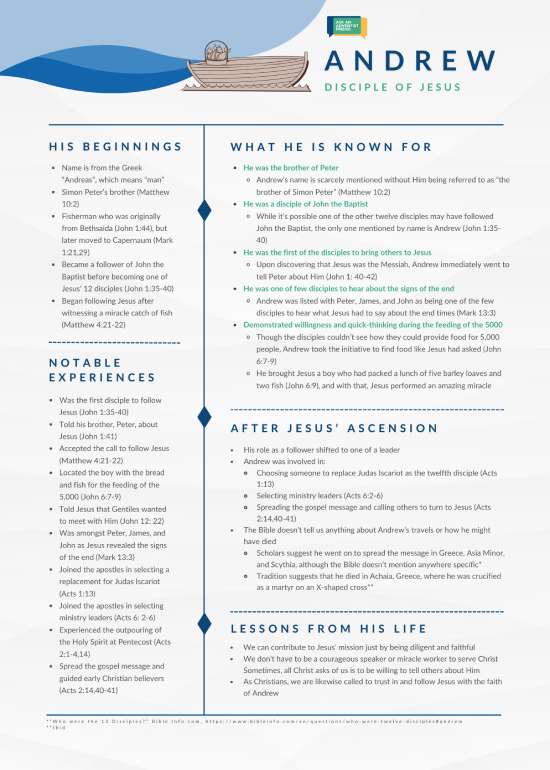
Andrew was Jesus Christ’s first disciple (John 1:37-40) and the first to recognize Him as the Messiah.
With this discovery, Andrew invited his brother, Peter, to come meet Jesus for himself.
Though little is known about Andrew, the details we find in the New Testament show that he played a valuable role in Jesus’ ministry.
Let’s look at some of Andrew’s most memorable moments in Scripture.
We’ll cover:
- Andrew’s beginnings
- What Andrew is known for in the Bible
- Andrew after Jesus’ ascension
- What we can learn from his life
First, some background information…
Andrew’s beginnings
Little is known about the apostle Andrew, since Bible writers didn’t often provide background details about people who weren’t immediately pertinent to the story at hand. But the Bible does give us an overview of who Andrew was and where he came from.
Andrew had a Greek name that comes from the word “Andreas,” which simply means “man.”1
He was the son of a Jewish man named Jonah or John (different versions translate the name differently) and a brother to the well-known disciple Peter (John 1:42; Matthew 10:2).
Like his brother, Peter, and his fellow disciple, Philip, Andrew was originally from Bethsaida in Galilee (John 1:44), though he later moved to Capernaum (Mark 1:21, 29).
Andrew and Peter both worked as fishermen (Mark 1:16), but Andrew was the only one said to have been a follower of John the Baptist (John 1:35-40). And it was the decision to follow John the Baptist that first led Andrew to Christ.
According to the Gospel of John, Andrew heard about Jesus when John the Baptist announced Him as the Lamb of God (John 1:35-40). Immediately, Andrew and another one of John’s disciples followed after Jesus and ended up spending the day with Him (John 1:38-39).
Evidently impressed by his encounter with Jesus, Andrew went to tell Peter he had met the Messiah (John 1:41). He even brought Peter to Jesus.
And this wouldn’t be the last time they saw Jesus.
They would later be called by Him to spend the rest of their lives following Him.
The calling of Andrew

Though Peter and Andrew met Jesus, the official “call” to discipleship was recorded when Jesus found them fishing (Mark 1:16).
The Gospel of Luke tells us that crowds of people had gathered near the Lake of Gennesaret to hear Jesus speak (Luke 5:1). But instead of speaking to them from the land, Jesus decided to speak to them from one of the fishermen’s boats nearby.
He had seen Andrew and Peter’s boat, and they agreed to let Him climb aboard.
From there, Jesus began teaching the crowd (Luke 5:2-3). Afterward, He turned to Peter and told him to release his nets into the water (Luke 5:4).
Peter responded by telling Jesus that they hadn’t been able to catch any fish, even though they’d been fishing all night long (Luke 5:5). And yet he agreed to cast their net one more time (Luke 5:5).
The Bible tells us:
“And when they had done this, they caught a great number of fish, and their net was breaking. So they signaled to their partners in the other boat to come and help them. And they came and filled both the boats, so that they began to sink” (Luke 5:6-7, NKJV).
It was then, in the face of a miracle, that Jesus called Andrew and his brother Peter to become His disciples.
“Then He said to them, ‘Follow Me, and I will make you fishers of men’” (Matthew 4:19, NKJV).
And without any hesitation, Andrew and Peter accepted His offer and decided to follow Jesus (Matthew 4:20).
The story of Andrew’s calling tells us a little bit about the kind of person he was: a faithful, dedicated individual. When convinced of Jesus’ messiahship, he couldn’t help but tell others, and he readily left behind his job, family, and hometown to become a loyal follower of Jesus.
What is Andrew known for in the Bible?
The most well-known detail about Andrew is that he became Jesus’ first disciple.
However, a couple more things set him apart from the other disciples:
- He was a confirmed disciple of John the Baptist (John 1:35-40): While it’s possible that a few more of the 12 disciples also followed John the Baptist, the only one mentioned by name is Andrew.
- He was the first of the disciples to bring others to Jesus (John 1:40-42): Upon discovering that Jesus was the Messiah, Andrew immediately went to tell Peter about Him.
- He may have been one of the few disciples to hear about the signs of the end (Mark 13:3): Though Jesus loved all of His disciples, He became especially close to Peter, James, and John. On this occasion, however, Andrew was included in this “inner circle” of disciples when they asked Jesus about signs of things to come. And so Andrew was listed among them as being one of the few disciples to hear what Jesus had to say about the end times.
- He was the brother of Peter (Matthew 10:2): Aside from James and John, Peter and Andrew were the other set of brothers among the disciples. Between these two, the Bible writers talked a lot more about Peter. In fact, Andrew’s name is scarcely mentioned without him being referred to as “the brother of Simon Peter.”2
But being well-known is not the primary measure for being a good disciple and one we can learn from. Even from the little information Scripture gives us, we can tell that Andrew was a competent disciple who was quick to do the work he was called to do. That simple quality—willingness—is invaluable, especially for a follower of Christ.
We see this willingness demonstrated in how he worked with his fellow disciples and other people he ministered to.
For example, there was one occasion when a group of Greeks came to Philip asking to see Jesus (John 12:20-21).
Philip turned to Andrew with the request, and together they brought the request before Jesus (John 12:22).
(Whenever in doubt about how to respond to a situation, it’s always a good idea to turn to Jesus.)
This situation also demonstrates how willing Andrew was to introduce others to Jesus Christ. He didn’t seem to care that they weren’t Jews, but rather left it up to Jesus to decide how to proceed.
Andrew demonstrated that same willingness and quick thinking when he ministered to the crowds following Jesus.
One time, a group of 5,000 people were following after Jesus, and everyone ran out of food (John 6:2). Testing the disciples, Jesus asked them where they could go to find food for the people (John 6:5-6).
Though the disciples didn’t see how they could provide for 5,000 people, Andrew took the initiative to find food like Jesus had asked (John 6:7-9).
He brought Jesus a boy who had packed a lunch of five barley loaves and two fish (John 6:9).
And while he didn’t understand how that would be enough to feed the crowd, he offered it up to Jesus anyway. He did what he knew to do, given the circumstances.
Though the Bible doesn’t often address Andrew’s role in Jesus’ ministry, the occasions it does mention him point to his continuous dedication to Christ.
What did Andrew do as an apostle, after Jesus’ ascension?

Photo by Hans Reniers on Unsplash
While we know little about Andrew’s specific role when he was a disciple to Jesus, even less is recorded about his life after Jesus’ ascension back to heaven.
Like the rest of the disciples, it’s very likely he took up Jesus’ call to spread the Gospel around the world (Acts 1:6-8).
Some scholars suggest he went on to spread the message in Greece, Asia Minor, and Scythia, although the Bible doesn’t mention any specific locations.3
Tradition also suggests that Andrew died in Achaia, Greece, where he was crucified as a martyr.4 Unofficial records claim that Andrew asked to be crucified on an X-shaped cross out of respect for Jesus’ own crucifixion.5 This idea has become so popular that X-shaped crosses are now referred to as St. Andrew’s crosses.6
However, it’s worth noting that the Bible doesn’t tell us anything about Andrew’s travels or how he might have died.
Instead, the book of Acts tells us how Andrew’s role as a follower had shifted to one of a leader, as all twelve apostles were called to make administrative decisions and teach early Christian believers while Christ was in heaven.
The Bible tells us Andrew was involved in:
- Choosing someone to replace Judas Iscariot as the 12th disciple (Acts 1:13)
- Selecting ministry leaders (Acts 6:2-6)
- Spreading the Gospel message, and calling others to turn to Jesus (Acts 2:14, 40-41)
While these may not be roles or jobs that get much attention, they are similar to the kinds of tasks that are consistently important in ministry today, whether in a small church, large congregation, or discipleship group.
What can we learn from the life of Andrew?
Andrew’s life and ministry teach us that we can contribute to Jesus’ mission just by being diligent and faithful and maintaining a state of readiness and receptiveness to be used by God.
There wasn’t anything remarkable about Andrew from an earthly perspective.
He was a poor fisherman, and unlike his brother Peter, he didn’t end up becoming one of the most well-known apostles.
But Andrew was no doubt an invaluable member of the 12.
It was Andrew who brought Peter to meet Jesus.
It was Andrew who led Gentiles to Jesus when others might have turned them away.
It was Andrew who hadn’t given up on the feeding of the 5,000.
And it was Andrew who first sought after Christ.
He had an incredible faith and was passionate about bringing others to Jesus.
As Christians, we are likewise called to trust in and follow Jesus with the faith of Andrew.
His example also shows us that we don’t have to be courageous speakers or miracle workers to serve Christ. Sometimes, all Christ asks of us is that we be willing to do what needs doing and to always point back to Jesus.
In the end, that’s our goal as Christians—to bring others to Christ like Andrew did.
Want to continue learning about the disciples?
Related Articles





- “What was it Like Being Jesus’ Disciple and Apostle?” General Conference Corporation of Seventh-day Adventists, [↵]
- Matthew 4:18; Matthew 10:2; Mark 1:16; John 1:40. [↵]
- “Who were the 12 Disciples?” BibleInfo.com, [↵]
- Ibid. [↵]
- Ibid. [↵]
- Ibid. [↵]
More Answers

Entendiendo la parábola de la oveja perdida
Los relatos de Jesús enseñan lecciones objetivas sobre el reino de Dios. Y tres parábolas en particular, la parábola de la oveja perdida, la parábola de la moneda perdida y la parábola del hijo pródigo, enseñan específicamente sobre el amor incondicional y redentor de Dios.
¿Cuál es la historia de la Biblia? Una visión general completa
La Biblia es el superventas número uno en el mundo de todos los tiempos. Está traducida a miles de idiomas y es leída por personas de todas las edades y procedencias.
Qual é a História da Bíblia? Uma Visão Geral Completa
Qual é a História da Bíblia? Uma Visão Geral CompletaA Bíblia é o best-seller número um de todos os tempos no mundo.1 Ela é traduzida para milhares de idiomas e lida por pessoas de todas as idades e origens. Sua popularidade é incrível. Mas qual é a história da...
Compreendendo a Parábola da Ovelha Perdida
Compreendendo a Parábola da Ovelha PerdidaAs parábolas de Jesus ensinam lições objetivas sobre o reino de Deus. E três parábolas em particular, a Parábola da Ovelha Perdida, a Parábola da Moeda Perdida e a Parábola do Filho Pródigo, especificamente ensinam sobre o...

¿Cómo ayudó Elena G. de White a fundar la Iglesia Adventista del Séptimo Día?
Elena G. de White, una humilde mujer de Gorham, Maine, fue cofundadora de la Iglesia Adventista del Séptimo Día y una líder clave en ella desde sus inicios.
Kuelewa Mfano wa Kondoo Aliyepotea
Kuelewa Mfano wa Kondoo AliyepoteaMifano ya Yesu inafundisha kwa vielelezo kuhusu ufalme wa Mungu. Na mifano mitatu maalum, Mfano wa Kondoo Aliyepotea, Mfano wa Sarafu Iliyopotea, na Mfano wa Mwana Mpotevu, hususan hufundisha kuhusu upendo wa Mungu usio na masharti...
Como Ellen G. White ajudou a fundar a Igreja Adventista do Sétimo Dia?
Ellen G. White, uma mulher humilde de Gorham, Maine, foi co-fundadora da Igreja Adventista do Sétimo Dia e uma líder chave desde o seu início.

Podemos encontrar Jesus Cristo no Antigo Testamento?
Podemos encontrar Jesus Cristo no Antigo Testamento?Sim, você pode se surpreender ao saber que existem centenas de versículos no Antigo Testamento sobre Jesus. Embora não mencionem Jesus pelo nome, mencionam outros nomes com os quais o associamos, como Messias, Filho...
Je, Tunaweza Kumpata Yesu Kristo Katika Agano la Kale?
Je, Tunaweza Kumpata Yesu Kristo Katika Agano la Kale?Ndio, unaweza kushangaa kujua kwamba kuna mamia ya aya katika Agano la Kale kuhusu Yesu. Ingawa hazimtaji Yesu kwa jina, zinataja majina mengine tunayoyahusisha naye kama Masihi, Mwana wa Mungu, na Mwana wa Adamu....
¿Podemos encontrar a Jesucristo en el Antiguo Testamento?
Sí, podrías sorprenderte al saber que hay cientos de versículos en el Antiguo Testamento sobre Jesús.

El Himnario Adventista del Séptimo Día
El Himnario Adventista del Séptimo Día es un libro de himnos utilizado en todo el mundo por muchas congregaciones Adventistas durante sus servicios de adoración.

¿Qué enseñó Elena G. de White sobre el vegetarianismo?
Una cosa que podrías haber escuchado sobre los Adventistas del Séptimo Día es su énfasis en un estilo de vida vegetariano.
O que Ellen White ensinou sobre o vegetarianismo?
Uma coisa que você pode ter ouvido sobre os Adventistas do Sétimo Dia é o destaque dado a um estilo de vida vegetariano.

Cómo calmar pensamientos ansiosos usando la Biblia
Cómo calmar pensamientos ansiosos usando la BibliaEstabas esperando una llamada telefónica de tu hija hace media hora, y todavía no ha llamado. Tampoco responde a tus llamadas. Sientes cómo late tu corazón mientras tus pensamientos se aceleran: ¿Y si ha tenido un...
Como acalmar pensamentos ansiosos, usando a Bíblia
Você estava esperando uma ligação de sua filha há meia hora, e ela ainda não ligou. Ela também não está atendendo suas chamadas.
Jinsi ya Kutuliza Fikira za Wasiwasi, Kwa Kutumia Biblia
Jinsi ya Kutuliza Fikira za Wasiwasi, Kwa Kutumia BibliaUlikuwa unategemea simu kutoka kwa binti yako nusu saa iliyopita, na bado hajapiga simu. Pia hajibu simu zako. Unahisi moyo wako ukidunda huku mawazo yako yakikimbia: labda amepata ajali ya gari?, Vipi kama kitu...
O Hinário Adventista do Sétimo Dia
O Hinário Adventista do Sétimo Dia é um livro de cânticos usado em todo o mundo por muitas congregações adventistas durante seus cultos de adoração.

Elena de White y el libro El conflicto de los siglos
El Gran Conflicto es uno de los libros más valorados por los Adventistas del Séptimo Día.
Ellen White e o Livro O Grande Conflito
O Grande Conflito é um dos livros mais valorizados por Adventistas do Sétimo Dia, escrito por Ellen G. White.
Ellen White na Kitabu cha Pambano Kuu
Pambano Kuu ni moja ya vitabu vya Ellen G. White vinavyo thaminiwa zaidi na Waadventista wa Sabato.
¿Qué es el Espíritu de Profecía (libros 1-4) de Elena G. de White?
Aplicar a profecia bíblica à história, aos eventos recentes e especialmente ao futuro pode ser uma tarefa assustadora. Até um pouco assustador para alguns.
O que é o Espírito de Profecia (Livros 1-4) de Ellen G. White?
Aplicar a profecia bíblica à história, aos eventos recentes e especialmente ao futuro pode ser uma tarefa assustadora.
Roho ya Unabii Ni nini (Kitabu cha 1-4) na Ellen G. White?
Kutumia unabii wa Biblia katika historia, matukio ya hivi karibuni, na hasa siku za usoni, inaweza kuwa kazi ngumu. Hata linaweza kuwa jambo la kutisha kidogo kwa baadhi.
Kuna Historia Gani Nyuma ya Biblia? Muhtasari Kamili
Kuna Historia Gani Nyuma ya Biblia? Muhtasari KamiliBiblia ni kitabu ambacho kimeuzwa zaidi duniani wakati wote.1 Imetafsiriwa katika maelfu ya lugha, kusomwa na watu wa umri na asili mbalimbali. Ukubwa wake ni wa kipekee. Lakini ni nini historia ya Biblia? Hiyo pia...

Muundo wa Uongozi wa Kanisa la Waadventista wa Sabato.
Kanisa la Waadventista wa Sabato lina mfumo wa uwakilishi unaounganisha makanisa yake zaidi ya 90,000 ulimwenguni na kuwapa washiriki wake nafasi katika kufanya maamuzi.
La estructura de liderazgo de la Iglesia Adventista del Séptimo Día
La Iglesia Adventista del Séptimo Día tiene una forma de estructura representativa que conecta sus más de 90,000 congregaciones en todo el mundo y brinda a sus miembros una parte en la toma de decisiones.
A Estrutura de Liderança da Igreja Adventista do Sétimo Dia
A Igreja Adventista do Sétimo Dia possui uma forma de estrutura representativa que conecta suas mais de 90.000 congregações em todo o mundo e dá aos seus membros uma parte no processo de tomada de decisão.

¿Quién es María Magdalena en la Biblia?
María Magdalena fue una seguidora y partidaria notablemente dedicada de Jesucristo durante su ministerio terrenal.
Quem é Maria Madalena na Bíblia?
Maria Madalena foi uma seguidora e apoiadora dedicada de Jesus Cristo durante o Seu ministério terreno.
Didn’t find your answer? Ask us!
We understand your concern of having questions but not knowing who to ask—we’ve felt it ourselves. When you’re ready to learn more about Adventists, send us a question! We know a thing or two about Adventists.