
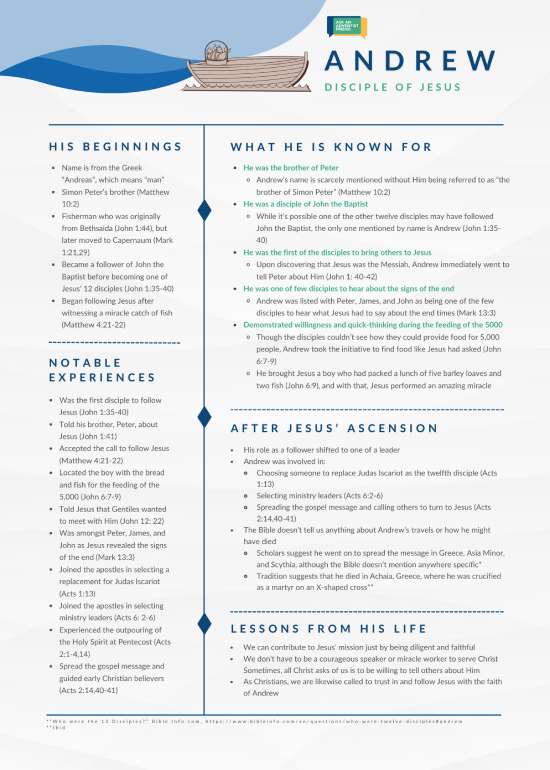
Andrew was Jesus Christ’s first disciple (John 1:37-40) and the first to recognize Him as the Messiah.
With this discovery, Andrew invited his brother, Peter, to come meet Jesus for himself.
Though little is known about Andrew, the details we find in the New Testament show that he played a valuable role in Jesus’ ministry.
Let’s look at some of Andrew’s most memorable moments in Scripture.
We’ll cover:
- Andrew’s beginnings
- What Andrew is known for in the Bible
- Andrew after Jesus’ ascension
- What we can learn from his life
First, some background information…
Andrew’s beginnings
Little is known about the apostle Andrew, since Bible writers didn’t often provide background details about people who weren’t immediately pertinent to the story at hand. But the Bible does give us an overview of who Andrew was and where he came from.
Andrew had a Greek name that comes from the word “Andreas,” which simply means “man.”1
He was the son of a Jewish man named Jonah or John (different versions translate the name differently) and a brother to the well-known disciple Peter (John 1:42; Matthew 10:2).
Like his brother, Peter, and his fellow disciple, Philip, Andrew was originally from Bethsaida in Galilee (John 1:44), though he later moved to Capernaum (Mark 1:21, 29).
Andrew and Peter both worked as fishermen (Mark 1:16), but Andrew was the only one said to have been a follower of John the Baptist (John 1:35-40). And it was the decision to follow John the Baptist that first led Andrew to Christ.
According to the Gospel of John, Andrew heard about Jesus when John the Baptist announced Him as the Lamb of God (John 1:35-40). Immediately, Andrew and another one of John’s disciples followed after Jesus and ended up spending the day with Him (John 1:38-39).
Evidently impressed by his encounter with Jesus, Andrew went to tell Peter he had met the Messiah (John 1:41). He even brought Peter to Jesus.
And this wouldn’t be the last time they saw Jesus.
They would later be called by Him to spend the rest of their lives following Him.
The calling of Andrew

Though Peter and Andrew met Jesus, the official “call” to discipleship was recorded when Jesus found them fishing (Mark 1:16).
The Gospel of Luke tells us that crowds of people had gathered near the Lake of Gennesaret to hear Jesus speak (Luke 5:1). But instead of speaking to them from the land, Jesus decided to speak to them from one of the fishermen’s boats nearby.
He had seen Andrew and Peter’s boat, and they agreed to let Him climb aboard.
From there, Jesus began teaching the crowd (Luke 5:2-3). Afterward, He turned to Peter and told him to release his nets into the water (Luke 5:4).
Peter responded by telling Jesus that they hadn’t been able to catch any fish, even though they’d been fishing all night long (Luke 5:5). And yet he agreed to cast their net one more time (Luke 5:5).
The Bible tells us:
“And when they had done this, they caught a great number of fish, and their net was breaking. So they signaled to their partners in the other boat to come and help them. And they came and filled both the boats, so that they began to sink” (Luke 5:6-7, NKJV).
It was then, in the face of a miracle, that Jesus called Andrew and his brother Peter to become His disciples.
“Then He said to them, ‘Follow Me, and I will make you fishers of men’” (Matthew 4:19, NKJV).
And without any hesitation, Andrew and Peter accepted His offer and decided to follow Jesus (Matthew 4:20).
The story of Andrew’s calling tells us a little bit about the kind of person he was: a faithful, dedicated individual. When convinced of Jesus’ messiahship, he couldn’t help but tell others, and he readily left behind his job, family, and hometown to become a loyal follower of Jesus.
What is Andrew known for in the Bible?
The most well-known detail about Andrew is that he became Jesus’ first disciple.
However, a couple more things set him apart from the other disciples:
- He was a confirmed disciple of John the Baptist (John 1:35-40): While it’s possible that a few more of the 12 disciples also followed John the Baptist, the only one mentioned by name is Andrew.
- He was the first of the disciples to bring others to Jesus (John 1:40-42): Upon discovering that Jesus was the Messiah, Andrew immediately went to tell Peter about Him.
- He may have been one of the few disciples to hear about the signs of the end (Mark 13:3): Though Jesus loved all of His disciples, He became especially close to Peter, James, and John. On this occasion, however, Andrew was included in this “inner circle” of disciples when they asked Jesus about signs of things to come. And so Andrew was listed among them as being one of the few disciples to hear what Jesus had to say about the end times.
- He was the brother of Peter (Matthew 10:2): Aside from James and John, Peter and Andrew were the other set of brothers among the disciples. Between these two, the Bible writers talked a lot more about Peter. In fact, Andrew’s name is scarcely mentioned without him being referred to as “the brother of Simon Peter.”2
But being well-known is not the primary measure for being a good disciple and one we can learn from. Even from the little information Scripture gives us, we can tell that Andrew was a competent disciple who was quick to do the work he was called to do. That simple quality—willingness—is invaluable, especially for a follower of Christ.
We see this willingness demonstrated in how he worked with his fellow disciples and other people he ministered to.
For example, there was one occasion when a group of Greeks came to Philip asking to see Jesus (John 12:20-21).
Philip turned to Andrew with the request, and together they brought the request before Jesus (John 12:22).
(Whenever in doubt about how to respond to a situation, it’s always a good idea to turn to Jesus.)
This situation also demonstrates how willing Andrew was to introduce others to Jesus Christ. He didn’t seem to care that they weren’t Jews, but rather left it up to Jesus to decide how to proceed.
Andrew demonstrated that same willingness and quick thinking when he ministered to the crowds following Jesus.
One time, a group of 5,000 people were following after Jesus, and everyone ran out of food (John 6:2). Testing the disciples, Jesus asked them where they could go to find food for the people (John 6:5-6).
Though the disciples didn’t see how they could provide for 5,000 people, Andrew took the initiative to find food like Jesus had asked (John 6:7-9).
He brought Jesus a boy who had packed a lunch of five barley loaves and two fish (John 6:9).
And while he didn’t understand how that would be enough to feed the crowd, he offered it up to Jesus anyway. He did what he knew to do, given the circumstances.
Though the Bible doesn’t often address Andrew’s role in Jesus’ ministry, the occasions it does mention him point to his continuous dedication to Christ.
What did Andrew do as an apostle, after Jesus’ ascension?

Photo by Hans Reniers on Unsplash
While we know little about Andrew’s specific role when he was a disciple to Jesus, even less is recorded about his life after Jesus’ ascension back to heaven.
Like the rest of the disciples, it’s very likely he took up Jesus’ call to spread the Gospel around the world (Acts 1:6-8).
Some scholars suggest he went on to spread the message in Greece, Asia Minor, and Scythia, although the Bible doesn’t mention any specific locations.3
Tradition also suggests that Andrew died in Achaia, Greece, where he was crucified as a martyr.4 Unofficial records claim that Andrew asked to be crucified on an X-shaped cross out of respect for Jesus’ own crucifixion.5 This idea has become so popular that X-shaped crosses are now referred to as St. Andrew’s crosses.6
However, it’s worth noting that the Bible doesn’t tell us anything about Andrew’s travels or how he might have died.
Instead, the book of Acts tells us how Andrew’s role as a follower had shifted to one of a leader, as all twelve apostles were called to make administrative decisions and teach early Christian believers while Christ was in heaven.
The Bible tells us Andrew was involved in:
- Choosing someone to replace Judas Iscariot as the 12th disciple (Acts 1:13)
- Selecting ministry leaders (Acts 6:2-6)
- Spreading the Gospel message, and calling others to turn to Jesus (Acts 2:14, 40-41)
While these may not be roles or jobs that get much attention, they are similar to the kinds of tasks that are consistently important in ministry today, whether in a small church, large congregation, or discipleship group.
What can we learn from the life of Andrew?
Andrew’s life and ministry teach us that we can contribute to Jesus’ mission just by being diligent and faithful and maintaining a state of readiness and receptiveness to be used by God.
There wasn’t anything remarkable about Andrew from an earthly perspective.
He was a poor fisherman, and unlike his brother Peter, he didn’t end up becoming one of the most well-known apostles.
But Andrew was no doubt an invaluable member of the 12.
It was Andrew who brought Peter to meet Jesus.
It was Andrew who led Gentiles to Jesus when others might have turned them away.
It was Andrew who hadn’t given up on the feeding of the 5,000.
And it was Andrew who first sought after Christ.
He had an incredible faith and was passionate about bringing others to Jesus.
As Christians, we are likewise called to trust in and follow Jesus with the faith of Andrew.
His example also shows us that we don’t have to be courageous speakers or miracle workers to serve Christ. Sometimes, all Christ asks of us is that we be willing to do what needs doing and to always point back to Jesus.
In the end, that’s our goal as Christians—to bring others to Christ like Andrew did.
Want to continue learning about the disciples?
Related Articles





- “What was it Like Being Jesus’ Disciple and Apostle?” General Conference Corporation of Seventh-day Adventists, [↵]
- Matthew 4:18; Matthew 10:2; Mark 1:16; John 1:40. [↵]
- “Who were the 12 Disciples?” BibleInfo.com, [↵]
- Ibid. [↵]
- Ibid. [↵]
- Ibid. [↵]
More Answers

Mariamu Magdalene ni Nani Katika Biblia?
Mariamu Magdalene alikuwa mfuasi na msaidizi wa kipekee wa Yesu Kristo wakati wa huduma yake duniani.

Ninawezaje Kuanza Kutunza Sabato?
Sabato, inayokuja kila siku ya saba ya juma, ni siku maalum inayoheshimu amri ya nne na uumbaji wa Mungu.
Como Começo a Observar o Sábado?
O Sábado, que ocorre no sétimo dia da semana, é um dia especial honrando o quarto mandamento e a criação de Deus.
¿Cómo comienzo a observar el sábado?
El sábado, que es el séptimo día de la semana, es un día especial que honra el cuarto mandamiento y la creación de Dios.

Legalismo na Bíblia: Definição, Perigos e Exemplos
Descubra o que a Bíblia diz sobre o legalismo, por que é perigoso e como podemos evitá-lo hoje.
Legalismo en la Biblia: Definición, Peligros y Ejemplos
Descubra lo que dice la Biblia sobre el legalismo, por qué es peligroso y cómo podemos evitarlo hoy.
Uhalisi wa Kisheria katika Biblia: Maana, Hatari, na Mifano
Gundua kile Biblia inachosema kuhusu uhalisi wa kisheria, kwanini ni hatari na namna tunavyoweza kuepuka leo.
¿Qué significa realmente la historia del Hijo Pródigo?
La parábola del hijo pródigo cuenta la historia de un hijo descarriado, un hermano celoso y un padre con amor incondicional. Veamos qué podemos aprender de esta historia hoy.
Hadithi ya Mwana Mpotevu Kweli Inamaanisha Nini?
Hadithi ya Mwana Mpotevu inaeleza kisa cha mwana aliye mbali na familia, kaka mwenye wivu, na baba mwenye upendo usio na masharti. Tuchunguze tunachoweza kujifunza kutoka kwake leo.
Qual é o Verdadeiro Significado da Parábola do Filho Pródigo?
A Parábola do Filho Pródigo conta a história de um filho rebelde, um irmão ciumento e um pai com amor incondicional. Vamos ver o que podemos aprender com isso hoje.

Narrativas de Cura na Bíblia e o que Elas Significam Para Você
Umewahi kuhisi kana kwamba isingewezekana kwako kuponywa? Kweli, kuna visa vya watu wanaoshinda changamoto zilizoshindikana au kupata uponyaji wa kimiujiza wa afya zao.

Je, Ni Kawaida Wakristo Kuwa na Mashaka?
Ndio, ni kawaida kabisa kwa Wakristo kupitia vipindi vya mashaka katika maisha yao ya kiroho. Kila mtu ameshawahi kuwa na mashaka wakati mmoja au mwingine, hata wachungaji, wanatheolojia, na watu muhimu katika Biblia.

Kila Kitu Kuhusu Agano la Kale na Jipya katika Biblia
Kila Kitu Kuhusu Agano la Kale na Jipya katika Biblia“Agano" ni mada iliyoenea kote katika Biblia. Wakristo mara nyingi hutofautisha agano la kale na jipya wanapoyazungumzia, lakini kwa kweli, Maandiko yanarejelea hatua au kufanywa upya tofauti wa agano moja. Ndiyo...
Tudo sobre as Antigas e Novas Alianças na Bíblia
Quando Deus prometeu um Messias a Adão e Eva, Ele estabeleceu uma aliança eterna que se estende até nós. Isto inclui tanto a antiga como a nova aliança.
Todo sobre el antiguo y el nuevo pacto en la Biblia
Todo sobre el antiguo y el nuevo pacto en la BibliaEl 'pacto' es un tema recurrente a lo largo de la Biblia. Los cristianos suelen hablar del antiguo y del nuevo pacto como entidades separadas, pero en realidad, la Escritura se refiere a diferentes fases o...
É Normal Para Cristãos Experimentarem Dúvida?
Sim, é completamente normal para os cristãos passarem por períodos de dúvida em sua vida espiritual.

Cómo los Adventistas desarrollaron la doctrina del santuario y en qué consiste
Cuando los Adventistas hablan de la “doctrina del santuario”, se refieren al concepto de que el santuario celestial revela el plan de salvación, tanto en nuestro caminar personal con Jesús como en la obra que Él continúa haciendo como nuestro intercesor en el cielo.

Ellen White Alifundisha nini Kuhusu Matumizi ya Vyakula Vinavyotokana na Mimea?
Moja ya mambo ambayo unaweza kuwa umewahi kusikia kuhusu Waadventista wa Sabato ni msisitizo wao kwenye mtindo wa maisha wa kutumia vyakula vinavyotokana na mimea.

Kitabu cha Nyimbo cha Waadventista Wa Sabato
Kitabu cha nyimbo cha Waadventista wa Sabato ni kitabu cha nyimbo kinachotumiwa ulimwenguni kote na makanisa mengi ya Waadventista wakati wa ibada zao.
Como os Adventistas Desenvolveram a Doutrina do Santuário e o Que Ela Significa
Quando os Adventistas falam sobre a “doutrina do santuário”, estão se referindo ao conceito de que o santuário celestial revela o plano de salvação
Namna Waadventista Walivyojifunza Fundisho la Patakatifu na Maana Yake
Wakati Waadventista wanapozungumzia “fundisho la Patakatifu,” wanarejelea dhana kwamba hekalu la mbinguni linafunua mpango wa wokovu
Relatos de sanidad en la Biblia y lo que significan para ti
¿Alguna vez has sentido que la sanidad simplemente no es posible para ti? Claro, hay historias de personas que superan probabilidades insuperables o experimentan restauraciones milagrosas de su salud.
Es normal que los cristianos experimenten dudas
¿Es normal que los cristianos experimenten dudas?Sí, es completamente normal que los cristianos experimenten períodos de duda en su vida espiritual. Todos han dudado en un momento u otro, incluso pastores, teólogos y figuras importantes en la Biblia. No se siente bien...

Lo que el ejemplo de Jesús puede enseñarnos sobre el ayuno y la oración
El ayuno y la oración fueron una gran parte del ministerio de Jesús en la Tierra. Aprendamos cómo el ejemplo de Jesús puede enseñarnos a tener una relación más profunda con Dios.
O Que o Exemplo de Jesus Pode Nos Ensinar Sobre Oração e Jejum
El ayuno y la oración fueron una gran parte del ministerio de Jesús en la Tierra. Aprendamos cómo el ejemplo de Jesús puede enseñarnos a tener una relación más profunda con Dios.
Kile Mfano wa Yesu Kinatufundisha Kuhusu Maombi na Kufunga
Kufunga na kuomba vilikuwa sehemu muhimu ya huduma ya Yesu Duniani. Hebu tujifunze jinsi mfano wa Yesu unavyoweza kutufundisha jinsi ya kuwa na uhusiano wa karibu zaidi na Mungu. Kufunga na kuomba vilichukua sehemu kubwa ya huduma ya Yesu Duniani.

¿Cuándo regresará Jesús?
La Biblia dice que nadie lo sabe, ni siquiera los ángeles (Mateo 24:36). Es por eso que la Biblia nos aconseja no fijar fechas para su regreso. Mientras tanto, somos llamados a estar listos.
Quando Jesus Voltará?
A Bíblia diz que ninguém pode saber, nem mesmo os anjos (Mateus 24:36)! Por isso, a Bíblia nos desencoraja de tentar marcar datas para Sua volta. Enquanto isso, somos encorajados a estar prontos.
Ni Lini Yesu Atarudi Tena?
Biblia inasema kwamba hakuna mtu anayeweza kujua, hata malaika (Mathayo 24:36)! Ndio maana Biblia inatushauri tusijaribu kuweka tarehe ya kurudi kwake. Kwa sasa, tunahimizwa kuwa tayari.
Didn’t find your answer? Ask us!
We understand your concern of having questions but not knowing who to ask—we’ve felt it ourselves. When you’re ready to learn more about Adventists, send us a question! We know a thing or two about Adventists.