
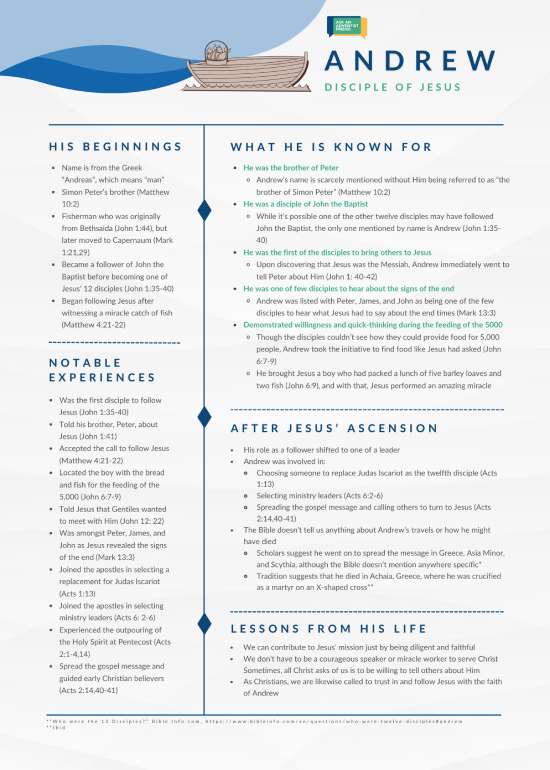
Andrew was Jesus Christ’s first disciple (John 1:37-40) and the first to recognize Him as the Messiah.
With this discovery, Andrew invited his brother, Peter, to come meet Jesus for himself.
Though little is known about Andrew, the details we find in the New Testament show that he played a valuable role in Jesus’ ministry.
Let’s look at some of Andrew’s most memorable moments in Scripture.
We’ll cover:
- Andrew’s beginnings
- What Andrew is known for in the Bible
- Andrew after Jesus’ ascension
- What we can learn from his life
First, some background information…
Andrew’s beginnings
Little is known about the apostle Andrew, since Bible writers didn’t often provide background details about people who weren’t immediately pertinent to the story at hand. But the Bible does give us an overview of who Andrew was and where he came from.
Andrew had a Greek name that comes from the word “Andreas,” which simply means “man.”1
He was the son of a Jewish man named Jonah or John (different versions translate the name differently) and a brother to the well-known disciple Peter (John 1:42; Matthew 10:2).
Like his brother, Peter, and his fellow disciple, Philip, Andrew was originally from Bethsaida in Galilee (John 1:44), though he later moved to Capernaum (Mark 1:21, 29).
Andrew and Peter both worked as fishermen (Mark 1:16), but Andrew was the only one said to have been a follower of John the Baptist (John 1:35-40). And it was the decision to follow John the Baptist that first led Andrew to Christ.
According to the Gospel of John, Andrew heard about Jesus when John the Baptist announced Him as the Lamb of God (John 1:35-40). Immediately, Andrew and another one of John’s disciples followed after Jesus and ended up spending the day with Him (John 1:38-39).
Evidently impressed by his encounter with Jesus, Andrew went to tell Peter he had met the Messiah (John 1:41). He even brought Peter to Jesus.
And this wouldn’t be the last time they saw Jesus.
They would later be called by Him to spend the rest of their lives following Him.
The calling of Andrew

Though Peter and Andrew met Jesus, the official “call” to discipleship was recorded when Jesus found them fishing (Mark 1:16).
The Gospel of Luke tells us that crowds of people had gathered near the Lake of Gennesaret to hear Jesus speak (Luke 5:1). But instead of speaking to them from the land, Jesus decided to speak to them from one of the fishermen’s boats nearby.
He had seen Andrew and Peter’s boat, and they agreed to let Him climb aboard.
From there, Jesus began teaching the crowd (Luke 5:2-3). Afterward, He turned to Peter and told him to release his nets into the water (Luke 5:4).
Peter responded by telling Jesus that they hadn’t been able to catch any fish, even though they’d been fishing all night long (Luke 5:5). And yet he agreed to cast their net one more time (Luke 5:5).
The Bible tells us:
“And when they had done this, they caught a great number of fish, and their net was breaking. So they signaled to their partners in the other boat to come and help them. And they came and filled both the boats, so that they began to sink” (Luke 5:6-7, NKJV).
It was then, in the face of a miracle, that Jesus called Andrew and his brother Peter to become His disciples.
“Then He said to them, ‘Follow Me, and I will make you fishers of men’” (Matthew 4:19, NKJV).
And without any hesitation, Andrew and Peter accepted His offer and decided to follow Jesus (Matthew 4:20).
The story of Andrew’s calling tells us a little bit about the kind of person he was: a faithful, dedicated individual. When convinced of Jesus’ messiahship, he couldn’t help but tell others, and he readily left behind his job, family, and hometown to become a loyal follower of Jesus.
What is Andrew known for in the Bible?
The most well-known detail about Andrew is that he became Jesus’ first disciple.
However, a couple more things set him apart from the other disciples:
- He was a confirmed disciple of John the Baptist (John 1:35-40): While it’s possible that a few more of the 12 disciples also followed John the Baptist, the only one mentioned by name is Andrew.
- He was the first of the disciples to bring others to Jesus (John 1:40-42): Upon discovering that Jesus was the Messiah, Andrew immediately went to tell Peter about Him.
- He may have been one of the few disciples to hear about the signs of the end (Mark 13:3): Though Jesus loved all of His disciples, He became especially close to Peter, James, and John. On this occasion, however, Andrew was included in this “inner circle” of disciples when they asked Jesus about signs of things to come. And so Andrew was listed among them as being one of the few disciples to hear what Jesus had to say about the end times.
- He was the brother of Peter (Matthew 10:2): Aside from James and John, Peter and Andrew were the other set of brothers among the disciples. Between these two, the Bible writers talked a lot more about Peter. In fact, Andrew’s name is scarcely mentioned without him being referred to as “the brother of Simon Peter.”2
But being well-known is not the primary measure for being a good disciple and one we can learn from. Even from the little information Scripture gives us, we can tell that Andrew was a competent disciple who was quick to do the work he was called to do. That simple quality—willingness—is invaluable, especially for a follower of Christ.
We see this willingness demonstrated in how he worked with his fellow disciples and other people he ministered to.
For example, there was one occasion when a group of Greeks came to Philip asking to see Jesus (John 12:20-21).
Philip turned to Andrew with the request, and together they brought the request before Jesus (John 12:22).
(Whenever in doubt about how to respond to a situation, it’s always a good idea to turn to Jesus.)
This situation also demonstrates how willing Andrew was to introduce others to Jesus Christ. He didn’t seem to care that they weren’t Jews, but rather left it up to Jesus to decide how to proceed.
Andrew demonstrated that same willingness and quick thinking when he ministered to the crowds following Jesus.
One time, a group of 5,000 people were following after Jesus, and everyone ran out of food (John 6:2). Testing the disciples, Jesus asked them where they could go to find food for the people (John 6:5-6).
Though the disciples didn’t see how they could provide for 5,000 people, Andrew took the initiative to find food like Jesus had asked (John 6:7-9).
He brought Jesus a boy who had packed a lunch of five barley loaves and two fish (John 6:9).
And while he didn’t understand how that would be enough to feed the crowd, he offered it up to Jesus anyway. He did what he knew to do, given the circumstances.
Though the Bible doesn’t often address Andrew’s role in Jesus’ ministry, the occasions it does mention him point to his continuous dedication to Christ.
What did Andrew do as an apostle, after Jesus’ ascension?

Photo by Hans Reniers on Unsplash
While we know little about Andrew’s specific role when he was a disciple to Jesus, even less is recorded about his life after Jesus’ ascension back to heaven.
Like the rest of the disciples, it’s very likely he took up Jesus’ call to spread the Gospel around the world (Acts 1:6-8).
Some scholars suggest he went on to spread the message in Greece, Asia Minor, and Scythia, although the Bible doesn’t mention any specific locations.3
Tradition also suggests that Andrew died in Achaia, Greece, where he was crucified as a martyr.4 Unofficial records claim that Andrew asked to be crucified on an X-shaped cross out of respect for Jesus’ own crucifixion.5 This idea has become so popular that X-shaped crosses are now referred to as St. Andrew’s crosses.6
However, it’s worth noting that the Bible doesn’t tell us anything about Andrew’s travels or how he might have died.
Instead, the book of Acts tells us how Andrew’s role as a follower had shifted to one of a leader, as all twelve apostles were called to make administrative decisions and teach early Christian believers while Christ was in heaven.
The Bible tells us Andrew was involved in:
- Choosing someone to replace Judas Iscariot as the 12th disciple (Acts 1:13)
- Selecting ministry leaders (Acts 6:2-6)
- Spreading the Gospel message, and calling others to turn to Jesus (Acts 2:14, 40-41)
While these may not be roles or jobs that get much attention, they are similar to the kinds of tasks that are consistently important in ministry today, whether in a small church, large congregation, or discipleship group.
What can we learn from the life of Andrew?
Andrew’s life and ministry teach us that we can contribute to Jesus’ mission just by being diligent and faithful and maintaining a state of readiness and receptiveness to be used by God.
There wasn’t anything remarkable about Andrew from an earthly perspective.
He was a poor fisherman, and unlike his brother Peter, he didn’t end up becoming one of the most well-known apostles.
But Andrew was no doubt an invaluable member of the 12.
It was Andrew who brought Peter to meet Jesus.
It was Andrew who led Gentiles to Jesus when others might have turned them away.
It was Andrew who hadn’t given up on the feeding of the 5,000.
And it was Andrew who first sought after Christ.
He had an incredible faith and was passionate about bringing others to Jesus.
As Christians, we are likewise called to trust in and follow Jesus with the faith of Andrew.
His example also shows us that we don’t have to be courageous speakers or miracle workers to serve Christ. Sometimes, all Christ asks of us is that we be willing to do what needs doing and to always point back to Jesus.
In the end, that’s our goal as Christians—to bring others to Christ like Andrew did.
Want to continue learning about the disciples?
Related Articles





- “What was it Like Being Jesus’ Disciple and Apostle?” General Conference Corporation of Seventh-day Adventists, [↵]
- Matthew 4:18; Matthew 10:2; Mark 1:16; John 1:40. [↵]
- “Who were the 12 Disciples?” BibleInfo.com, [↵]
- Ibid. [↵]
- Ibid. [↵]
- Ibid. [↵]
More Answers

Aya za Biblia Wakati Unapojisikia Kukata Tamaa
Maisha kamwe sio rahisi, lakini mara kwa mara mambo huwa magumu zaidi, yenye maumivu, au yanayo vunja moyo.
Versículos Bíblicos Para Quando Você Estiver Desanimado
A vida nunca é fácil, mas às vezes as coisas se tornam ainda mais difíceis, dolorosas ou desanimadoras.
Versículos bíblicos para cuando te sientes desanimado
La vida no siempre es fácil. A veces las cosas se tornan especialmente complicadas, dolorosas o desalentadoras.

Após a Ascensão de Jesus: O Que Ele Fez ao Longo do Novo Testamento
Primeiro conhecemos Jesus, o Filho de Deus e nosso Messias, lendo os relatos do Evangelho sobre Seu ministério terreno.
Después de la ascensión de Jesús: Lo que hizo a lo largo del Nuevo Testamento
Primero conocemos a Jesús, el Hijo de Dios y nuestro Mesías, al leer los relatos de los Evangelios sobre su ministerio terrenal.
Baada ya Yesu kupaa: Alichofanya katika Agano Jipya
Tunapata kumjua Yesu, Mwana wa Mungu na Masihi wetu, kwanza kwa kusoma habari za Injili kuhusu huduma yake duniani.

Hadithi za Uponyaji Katika Biblia na Maana Yake Kwako
Umewahi kuhisi kana kwamba isingewezekana kwako kuponywa? Kweli, kuna visa vya watu wanaoshinda changamoto zilizoshindikana au kupata uponyaji wa kimiujiza wa afya zao.
Msaada wa Upatikanaji na Maoni
Ikiwa unapata ugumu katika kupata maudhui katika tovuti yetu, unaweza kuomba kuyapata kwa namna mbadala kulingana na uhitaji wako. Ili kuomba taarifa katika muundo mbadala, tafadhali wasiliana nasi. Unaweza kujumuisha pia namna bora zaidi tunayoweza kuitumia...
Ayuda y comentarios sobre accesibilidad
Si encuentra alguna dificultad para acceder al contenido de nuestro sitio web, puede solicitar disponibilidad en un formato alternativo para sus necesidades de accesibilidad. Para solicitar información en un formato alternativo, comuníquese con nosotros. Asegúrese de...
Ajuda e Feedback de Acessibilidade
Se você encontrar alguma dificuldade em acessar o conteúdo em nosso site, pode solicitar que ele seja disponibilizado em um formato alternativo para suas necessidades de acessibilidade. Para solicitar informações em um formato alternativo, entre em contato conosco....
Sera ya Faragha
Sera ya FaraghaFaragha yako ni muhimu sana kwetu. Hivyo, katika sera hii tunaelezea jinsi tunavyokusanya, kutumia, kuwasiliana na kutumia taarifa binafsi: Wakati unapotembelea tovuti ya askanadventistfriend.com, shirika letu litajifunza taarifa fulani kuhusu wewe...
Política de Privacidad
Política de Privacidade
Sua privacidade é muito importante para nós. Assim, nesta política, descrevemos como coletamos, usamos, comunicamos e fazemos uso de informações pessoais: Ao acessar o site askanadventistfriend.com, nossa organização aprenderá certas informações sobre você durante sua...
Descargo de responsabilidad
Ask An Adventist Friend se compromete a mantener este sitio web actualizado y preciso. Si, no obstante, encuentra algo que sea incorrecto o esté desactualizado, le agradeceríamos que nos lo hiciera saber. Por favor, indique dónde en el sitio web leyó la información....
Isenção de responsabilidade
Pergunte a um Amigo Adventista está comprometido em manter este site atualizado e preciso. Se você encontrar algo que esteja incorreto ou desatualizado, agradeceríamos se você pudesse nos informar. Por favor, indique onde no site você leu a informação. Nós iremos...
Ilani ya Uwajibikaji
Ask An Adventist Friend imejitolea kuhakikisha tovuti hii inabaki kuwa ya kisasa na sahihi. Hata hivyo, iwapo utabaini taarifa yoyote isiyo sahihi au iliyopitwa na wakati, tutafurahi ikiwa utatufahamisha. Tafadhali eleza mahali ulipoisoma taarifa hiyo kwenye tovuti....
Merci de vous etre inscrit
You’re In! Welcome to the AskAnAdventistFriend Community!We’re so glad you’ve joined us, and we look forward to growing together in this faith journey! In the next few minutes, keep an eye out for a message from us in your inbox. In it, you’ll be asked to confirm your...
Gracias por Registrarte
¡Bienvenido a la comunidad AskAnAdventistFriend!¡Estamos felices de que te hayas unido a nosotros y esperamos crecer juntos en esta jornada de fe! En los próximos minutos, revisa tu bandeja de entrada, recibirás un mensaje de nosotros. En él, te pediremos que...
Obrigado por se Inscrever
Você agora faz parte! Seja bem-vindo à Comunidade AskAnAdventistFriend!Estamos muito felizes que você se juntou a nós e esperamos crescer juntos nesta jornada de fé! Nos próximos minutos, fique de olho na sua caixa de entrada para receber uma mensagem nossa. Nela,...
Asante Kwa Kujiandikisha
Umejiunga! Karibu kwenye Jamii ya AskAnAdventistFriend!Tuna furaha kubwa kwamba umejiunga nasi, na tunatarajia kukua pamoja nawe katika safari hii ya imani! Katika dakika chache zijazo, angalia ujumbe kutoka kwetu kwenye sanduku lako la barua. Katika ujumbe huo,...
Jiunge na Jamii ya AskAnAdventistFriend
Jiunge na Jamii ya AskAnAdventistFriendIkiwa umefurahia kile ulichoona kwenye tovuti yetu, usikose maudhui maalum ambayo yanapatikana tu kwa watu wanao pokea barua pepe zetu! Utapokea taarifa kuhusu maudhui mapya zaidi, pamoja na motisha, msukumo, na taarifa muhimu...
Estudios Bíblicos en Línea
Elige un estudio bíblico en línea Want to keep learning? There’s always more to discover within the pages of the Bible. Find out more about Jesus, humanity, the plan of salvation, and how God loves you enough to sacrifice everything, just to give you a chance to...
Pide Oración
Envíanos tu pedido de oración ¿Podemos orar por tí? La oración es poderosa. Cuando oramos, nos comunicamos con Dios, nos apoyamos mutuamente, nos sintonizamos con la presencia de Dios en nuestras vidas y abrimos nuestros corazones para ser movidos por el Espíritu...
Estudos Bíblicos Online
Escolha um Estudo Bíblico Online Want to keep learning? There’s always more to discover within the pages of the Bible. Find out more about Jesus, humanity, the plan of salvation, and how God loves you enough to sacrifice everything, just to give you a chance to choose...
Envie-nos seus pedidos de oração
Envie-nos seu pedido de oração Podemos orar por você? A oração é poderosa. Quando oramos, nos comunicamos com Deus, apoiamos uns aos outros, sintonizamos com a presença de Deus em nossas vidas e abrimos nosso coração para sermos movidos pelo Espírito Santo. A Bíblia...
Únete a la Comunidad
Únete a la comunidad de AskAnAdventistFriendSi te gusta lo que has visto en nuestro sitio web hasta ahora, ¡no querrás perderte el contenido exclusivo disponible solo para nuestra comunidad de correo electrónico! Serás notificado sobre contenido nuevo mientras también...
Junte-se à Comunidade
Junte-se à Comunidade AskAnAdventistFriendSe você gostou do que viu em nosso site até agora, não vai querer perder o conteúdo exclusivo disponível apenas para nossa comunidade de e-mail! Você será notificado sobre novos conteúdos, além de receber encorajamento...
Dona
¡Ayúdanos a seguir generando respuestas!AskAnAdventistFriend es un proyecto de divulgación sin fines de lucro que se compromete a responder tus preguntas sobre el Adventismo del Séptimo Día, Jesús, la Biblia, el Conflicto de los Siglos y más. Si deseas apoyar a...
Doe
Ajude-nos a continuar respondendo!AskAnAdventistFriend é um projeto de evangelismo sem fins lucrativos, dedicado a responder às suas perguntas sobre o Adventismo do Sétimo Dia, Jesus, a Bíblia, o Grande Conflito e muito mais. Se você deseja apoiar o...
Didn’t find your answer? Ask us!
We understand your concern of having questions but not knowing who to ask—we’ve felt it ourselves. When you’re ready to learn more about Adventists, send us a question! We know a thing or two about Adventists.