
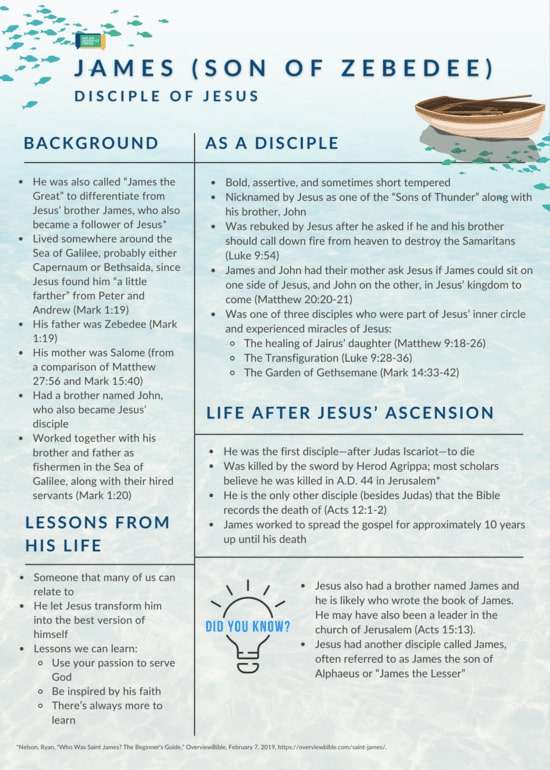
As Jesus Christ ministered on earth, His twelve disciples were some of His closest companions. Three of those 12 were said to be His “inner circle.”
One of them was James, the son of Zebedee. He was the older brother of John, another disciple.
James was a fisherman until he was called to become one of Jesus’ closest disciples. After Jesus’ ascension, he played an important role in the early church before becoming the first apostle to be martyred.
Though you might know this disciple by name, there’s more to his story than you might realize. So let’s look at:
James’ background
There isn’t a large list of confirmed facts about James the son of Zebedee, but we know that he was also called James the Great. (This was likely to differentiate between him and another disciple named James who was called James the Younger).1
James lived somewhere around the Sea of Galilee, probably either Capernaum or Bethsaida, since Jesus found him “a little farther” from Simon Peter and Andrew (Mark 1:19).
He had a brother named John, who also became Jesus’ disciple. The Bible tells us their father was Zebedee (Mark 1:19), and we can infer that their mother was Salome from a comparison of Matthew 27:56 and Mark 15:40.
James, John, and their father all worked together as fishermen on the Sea of Galilee, along with their hired servants (Mark 1:20).
While several Jameses are mentioned in the New Testament, they’re several different people. Jesus had a brother James (how’s that for confusing!), and this brother likely wrote the book of James.2 He may have also been a leader in the church of Jerusalem (Acts 15:13).
Jesus had another disciple called James, often referred to as James the son of Alphaeus or James the Less.
But let’s focus on James the Greater, the brother of John.
His story with Jesus began when Jesus was preaching in Nazareth. Jesus had just called Peter and Andrew to be His disciples. Then, He noticed a few others:
“He saw two other brothers, James the son of Zebedee, and John his brother, in the boat with Zebedee their father, mending their nets. He called them, and immediately they left the boat and their father, and followed Him” (Matthew 4:21-22, NKJV).
Mark’s account adds that they left their father with the hired servants so that their father wouldn’t have to continue the family business alone (Mark 1:20).
The book of Luke tells a slightly different story, indicating that perhaps James and John were not full-time disciples until a little later. Luke 5 says Peter, Andrew, James, and John had partnered in fishing, but had brought back nothing after a whole night. Jesus told them to cast their nets down again (Luke 5:4).
When they did so, they brought back so many fish that the nets were breaking (Luke 5:6)!
Jesus told them,
“‘Do not fear; from now on you will be catching people’” (Luke 5:10, NASB).
Or, as Mark 1:17 puts it,
“Then Jesus said to them, ‘Follow Me, and I will make you become fishers of men’” (NKJV).
On land, the disciples abandoned their fishing nets and followed Jesus.
James as a disciple
Like all of Jesus’ disciples, and like any of us, James had both good qualities and troublesome qualities. But regardless of his qualities, he began a strong and unwavering relationship with his Savior. He was regarded as one of Jesus’ closest disciples, along with John and Peter.
James’ character
The parts of the New Testament that talk about James and his brother John describe them as bold, assertive, and sometimes short-tempered men.
Because of this, Jesus nicknamed the two brothers the “Sons of Thunder,” or “Boanerges” in Aramaic (Mark 3:17).
We can see this trait of James in a story in Luke, when Jesus and His disciples were traveling to Jerusalem. They sent messengers ahead to a Samaritan village, but the Samaritans refused to accept Jesus because He was going to Jerusalem, a Jewish city. The Samaritans and the Jews had long been rivals.
This response riled up James and John. They said to Jesus,
“‘Lord, do You want us to command fire to come down from heaven and consume them, just as Elijah did?’” (Luke 9:54, NKJV)
Their temper had definitely gotten the better of them. Jesus chastised them for thinking this way:
“‘You do not know what manner of spirit you are of. For the Son of Man did not come to destroy men’s lives but to save them’” (Luke 9:55-56, NKJV).
These Samaritans were people Jesus had come to minister to.
Another time, the brothers were so sure of their honorable position that they had their mother ask Jesus if James could sit on one side of Jesus and John on the other in Jesus’ future kingdom (Matthew 20:20-21).
(According to Mark’s account, the brothers do the asking themselves.)
Sitting beside the king was about the next-best thing to being king themselves.
Jesus replied,
“You do not know what you ask. Are you able to drink the cup that I drink, and be baptized with the baptism that I am baptized with?” (Mark 10:38, NKJV)
The brothers foolishly said they could do it, though they had no idea what it actually meant to drink from Jesus’ cup of suffering and death.
Jesus said,
“You will indeed drink My cup, and be baptized with the baptism that I am baptized with; but to sit on My right hand and on My left is not Mine to give, but it is for those for whom it is prepared by My Father” (Matthew 20:23, NKJV).
James and John may have thought this was a wonderful thing. But they would understand the true and full meaning of this when Jesus died and rose again.
But before we get there, let’s look at James’ role among the other disciples.
One of Jesus’ closest companions
Since James was part of Jesus’ “inner circle,” he sometimes got to witness situations that the other disciples didn’t. Here are a few stories to illustrate this.
The healing of Jairus’ daughter

Photo by cottonbro studio
This story is recorded in all the Gospel accounts except for John’s.3 A Jewish ruler named Jairus approached Jesus, begging Him to come heal his dying daughter. Jesus took all His disciples with Him to the man’s home, but only Peter, James, and John were allowed to enter the house with Jesus (Mark 5:37).
By the time Jesus arrived, the girl had died and mourners had arrived, so Jesus had to send all the mourners out. Then, before the eyes of the girl’s parents, He raised her back to life.
So James was privy to the raising of Jairus’ daughter, one of Jesus’ most precious miracles, and saw for himself Jesus’ loving power.
The Transfiguration 4
Jesus took Peter, James, and John atop a mountain, where He became “transfigured”—His face and clothes shone white (Matthew 17:2). Then Elijah and Moses appeared and talked with Jesus.
While Peter attempted to respond to the situation (Matthew 17:4), James and John were notably silent. It is likely that James was in shock, trying to process the appearance of a legendary prophet and patriarch.
And when he heard a voice from heaven, declaring Jesus as the true Son of God, James finally became overwhelmed by this miraculous experience. He fell down and hid his face in fear with the other disciples (Matthew 17:6).
But Jesus reassured him as he experienced these powerful signs (Matthew 17:7).
We can only imagine how this experience must have strengthened James’ faith in Jesus as the Son of God.
The Garden of Gethsemane
James and the other two disciples also accompanied Jesus in the Garden of Gethsemane, the night He was arrested.5 But their response to this privilege was lacking.
Three different times Jesus asked James, John, and Peter to watch and pray while He went on a little farther to pray alone. All the while, Jesus experienced deep spiritual agony in the garden as he prayed about his coming fate on the Cross (Luke 22:44). And three times, Jesus’ closest companions, who were supposed to be His best friends, fell asleep.
Soon after, Judas, another disciple of Jesus, came to betray Him, bringing a group of soldiers to arrest Him.
Though James had an insider’s view of Jesus’s ministry, he still had plenty to learn. It took seeing Jesus crucified to help him understand His true purpose and ministry.
And the few encounters the disciples had with Jesus before He ascended back into heaven solidified Jesus’ true mission in James’ mind, fueling his passion to be a witness for Him.
So let’s look at James’ life after Jesus’ time on earth ended.
James’ life after Jesus’ ascension

Photo by Ricardo Cruz on Unsplash
The only thing the Bible tells us about James’ life after the ascension of Jesus is that he was the first disciple—after Judas Iscariot—to die.
He’s also the only apostle the Bible records the death of. Acts 12:1-2 gives us a brief insight:
“Now about this time Herod the king stretched out his hand to harass some from the church. Then he killed James the brother of John with the sword” (NKJV).
This Herod was King Herod Agrippa, and most scholars believe James was killed in AD 44 in Jerusalem.6 Some Spanish legends suggest his body was brought to Santiago de Compostela, whose basilica became an important Christian landmark in the Middle Ages.7
Christian Church historian Eusebius of Caesarea, living in the third and fourth centuries AD, added this anecdote about James’ death:
“It appears that the guard who brought him [James] into court was so moved when he saw him testify that he confessed that he, too, was a Christian. So they were both taken away together, and on the way he asked James to forgive him. James thought for a moment, then he said ‘I wish you peace,’ and kissed him. So both were beheaded at the same time.”8
There isn’t any validation from Scripture that this actually happened, but we do know James worked to spread the Gospel for approximately 10 years up until his death. Otherwise Herod wouldn’t have targeted him over other important apostles like Peter or John.
A popular legend has it that he worked as an evangelist, spreading the Gospel in Spain before he died.9 But no proof exists for this endeavor except a text written hundreds of years later, the Breviary of the Apostles.10 And it is unlikely that James would have done all this and come back to Jerusalem to be killed in AD 44.
Paul also said in Romans that he wanted to preach “not where Christ was named” (Romans 15:20, NKJV) and speaks of going to Spain in the next few verses (Romans 15:24). If James had already started a church there, Paul likely wouldn’t have said that Christ wasn’t named there.
But while James’ life was short compared to the other apostles, we can still learn a lot from it.
Takeaways from James’ life

Photo by Joshua Earle on Unsplash
James is an apostle many of us can relate to. He could be emotional, hasty, and prideful. But he also let Jesus transform him into the best version of himself.
James served God with his whole heart
James had a lot of zeal and passion—hence the nickname Son of Thunder. In his early days as a disciple, he held a shortsighted view of Jesus’ ministry although he was very committed to Jesus.
Afterward, when he figured out what Jesus’ true purpose was on earth and what He had accomplished in His death, James recommitted himself as an apostle—but this time, spreading the truth of Jesus to all around him.
As followers of Jesus, we can use our love for Him to guide our interactions with others. We can share Jesus with those around us by the way we act, how we treat people, and what we say.
His faith is inspiring
James’ zeal was a little misdirected early on as a disciple. But his heart was in the right place, and when the time came to pick a side, James chose Jesus.
He turned this enthusiasm into a force hard to reckon with, spreading the Gospel to those in Jerusalem and perhaps the surrounding areas. He understood Jesus’ true purpose now, and he had the faith in Him to match it.
He was even willing to risk his life for Jesus. King Herod Agrippa I had his eye on James, and one day he came for him. James’ faith stood strong, even when he was threatened with a sword (Acts 12:2).
And he died for his faith.
This can be an inspiration to us. No matter what happens to us, in the end, it’s our faith that matters most. We know that Jesus will be waiting to welcome us at His return.
There’s always more to learn

Photo by Sincerely Media on Unsplash
Even though he was one of Jesus’ closest apostles, James was far from a perfect or mature man. He thought he was one of the best and deserved a special place next to Jesus. He still had to learn that the best way to serve Jesus was by serving others.
This was the example Jesus set on earth, and James had to make some mistakes before learning this truth.
Since we are human, we will make mistakes in our lives and even in our relationship with Jesus. But we can still learn, and we can still grow, no matter how old we already are. There will always be opportunities to serve others, just as James learned.
James led an exciting life, one that involved fishing and traveling about Judea as Jesus’ disciple. He witnessed things not all the 12 apostles had the privilege to see, and he became a faithful servant of God.
He would become a martyr, as Jesus predicted (Matthew 20:23). While James didn’t know that’s what Jesus meant when He told him, he grew in faith and conviction nonetheless. He didn’t live a long life, but he became an inspiring servant of God. And that’s one of the most important things about his Apostolic legacy.
Curious about the other disciples? Read about them on our main page about the disciples.
Related Articles





- “James,” ATS Bible Dictionary, Bible Hub. [↵]
- “Introduction,” Holy Bible, English Standard Version, Crossway, 2007. [↵]
- Matthew 9:18-26; Mark 5:21-43; Luke 8:40-56. [↵]
- Matthew 17:1-8; Mark 9:2-8; Luke 9:28-36. [↵]
- Matthew 26:37-46; Mark 14:33-42. [↵]
- Nelson. [↵]
- “St.James,” Britannica. [↵]
- Nelson.[↵]
- Ibid. [↵]
- Ibid. [↵]
More Answers

¿Por qué muchos Adventistas del Séptimo Día eligen una dieta vegetariana?
¿Por qué muchos Adventistas del Séptimo Día eligen una dieta vegetariana?Puede que tengas un amigo adventista que sea vegetariano, o tal vez estés asistiendo a una Iglesia Adventista del Séptimo Día por primera vez y notes que en la comida compartida no hay carne....

What is Jesus’ Parable of the Sower About?
The parable of the sower is ultimately about how people responded to Jesus Christ and His message of the kingdom of God—the Gospel.

O que os Adventistas do Sétimo Dia acreditam sobre o Grande Conflito (Bem vs. Mal)?
O “Grande Conflito” é a frase que os Adventistas do Sétimo Dia normalmente usam para descrever o conflito espiritual cósmico entre as forças do bem (Deus) e as forças do mal ou do pecado (Satanás/o diabo).

Was Jesus Ever Hypocritical? Learn What the Bible Says.
Was Jesus Ever Hypocritical? Learn What the Bible SaysMany undesirable traits are associated with hypocrisy. But overall, hypocrites intentionally try to make others believe they uphold or represent a certain belief system, character trait, lifestyle, etc., when in...

Kukatishwa Tamaa Kukuu na Kile Tunachojifunza
Wafuasi wa Miller walitabiri kurudi kwa Kristo Oktoba 22, 1844, lakini Yesu hakuja kamwe. Tukio lingine lilitokea. Gundua kilichotokea kweli na Kukatishwa Tamaa Kukuu kunaweza kutufundisha leo.

When in Doubt: 7 Ways Christians Can Manage Uncertainty
When in Doubt: 7 Ways Christians Can Manage UncertaintyFew things in life are truly certain. And no matter how convinced some people can appear on the surface, no one is immune to doubt. And this isn’t a bad thing. Doubt has a purpose. A role to serve. (Just imagine...
El gran chasco y las lecciones que nos enseña
Los Milleritas predijeron el regreso de Cristo el 22 de octubre de 1844, pero Jesús nunca llegó. Ocurrió otro evento. Descubre lo que realmente sucedió y qué puede enseñarnos hoy El gran chasco.

Is Jesus the Same Being as Michael the Archangel?
Many Christians have wondered at the mysterious identity of Michael the Archangel.
A Grande Desapontamento e Lições que nos Ensina
Os Milleritas previram o retorno de Cristo em 22 de outubro de 1844, mas Jesus nunca chegou. Outro evento ocorreu. Descubra o que realmente aconteceu e o que o Grande Desapontamento pode nos ensinar hoje.
James Springer White, Co-Fundador da Igreja Adventista do Sétimo Dia
James Springer White (1821–1881) foi uma figura chave na Igreja Adventista do Sétimo Dia e marido de Ellen G. White.
James Springer White, cofundador de la Iglesia Adventista del Séptimo Día
James Springer White (1821–1881) fue una figura clave en la Iglesia Adventista del Séptimo Día y el esposo de Elena G. de White.

Kila Kitu Unachohitaji Kujua Kuhusu Chakula cha Siku ya Sabato
Kwa Waadventista Wa Sabato, kushiriki chakula cha Siku ya Sabato pamoja na marafiki na familia ni moja ya sehemu muhimu na ya kumbukumbu ya Sabato.

Nini Maana ya “Mwadventista”?
Waadventista wa Sabato ni dhehebu la Kikristo la Kiprotestanti wanaoshikilia Sabato ya siku ya saba kama ilivyoandikwa katika Biblia.

How to Have a Personal Relationship with Jesus: A 10-Step Guide
How to Have a Personal Relationship with Jesus: A GuideNo matter who you are, you’re surrounded by relationships. Friends, family, colleagues, acquaintances...they all play a part in our lives, for better or worse. So you’re surely aware of a lot of the components...

Biblia Ina Maana Gani Inaposema Yesu ni Mwana wa Mungu?
Biblia inapomwita Yesu Mwana wa Mungu inarejelea uungu wake. Jifunze ni nini kinachofanya hili kuwa muhimu na kinahusianaje na wokovu.

“Go and Sin No More”—What Did Jesus Mean?
These well-known words of Jesus Christ come from two New Testament stories in the book of John—a man healed by the Pool of Bethesda (John 5) and a woman caught in adultery (John 8).

Quais são as Mensagens dos Três Anjos em Apocalipse 14?
As mensagens dos três anjos em Apocalipse 14 advertem o mundo a adorar a Deus, deixar a confusão religiosa e evitar a adoração de tradições humanas em vez dos mandamentos de Deus.

Je! Tunaweza Kuitunza Siku Yoyote ya Wiki Kama Sabato?
Katika sura za kwanza kabisa za Biblia, tunamwona Mungu akianzisha kumbukumbu ya kila wiki na siku ya mapumziko, inayoitwa Sabato (Mwanzo 2:2-3).
¿Cuáles son los mensajes de los tres ángeles en Apocalipsis 14?
Los mensajes de los tres ángeles en Apocalipsis 14 invitan al mundo a adorar a Dios, abandonar la confusión religiosa y evitar la adoración de tradiciones humanas en lugar de los mandamientos de Dios.
Por que muitos Adventistas do Sétimo Dia escolhem uma dieta vegetariana?
Embora nem todo adventista seja vegetariano, muitos evitam completamente o consumo de carne para viver de forma mais saudável, buscando honrar a Deus física, espiritual e mentalmente.

Understanding the Miracles of Jesus Christ
Understanding the Miracles of Jesus ChristWhat do you think of when someone says something is “a miracle”? Maybe you think of an unexpected recovery, surviving a dangerous accident, or getting an answer to a seemingly impossible prayer. Simply put, miracles are...
O que significa “Adventista”?
O que significa "Adventista"?Os Adventistas do Sétimo Dia são uma denominação cristã protestante que observa o sábado bíblico do sétimo dia. A partir dessa crença, eles obtêm a primeira parte de seu nome. Mas e quanto à segunda parte - "Adventista"? “Adventista”...
¿Podemos guardar el sábado bíblico cualquier día de la semana?
En los primeros capítulos de la Biblia, encontramos a Dios estableciendo un memorial semanal y día de reposo, conocido como el sábado (Génesis 2:2-3).
Podemos guardar o Sábado em qualquer dia da semana?
Nos primeiros capítulos da Bíblia, encontramos Deus estabelecendo um memorial semanal e dia de descanso, conhecido como o Sábado (Gênesis 2:2-3).
O que significa a Bíblia quando chama Jesus de Filho de Deus?
Quando a Bíblia chama Jesus de Filho de Deus, está se referindo à Sua divindade. Saiba o que torna isso tão significativo e o que tem a ver com a salvação.
¿Qué creen los Adventistas del Séptimo Día acerca de la Biblia?
La Biblia forma la base de todo lo que los Adventistas del Séptimo Día creen y enseñan.

Legado Duradouro de Ellen G. White
Ellen G. White é um nome bem conhecido entre os Adventistas do Sétimo Dia, mas ela também teve um impacto em muitas outras partes da história, além de ser co-fundadora da Igreja Adventista.

What Does it Mean to Have Faith in Jesus?
What Does it Mean to Have Faith in Jesus?To have faith in Jesus means we place our spiritual hope, trust, belief, and priority in Him as our loving Savior. And that sounds great as an idea. That’s our goal, right? But when we go through difficult times, face...
James Springer White, Mwanzilishi wa Kanisa la Waadventista Wa Sabato
James Springer White (1821–1881) alikuwa mtu muhimu katika Kanisa la Waadventista wa Sabato na mume wa Ellen G. White.
Didn’t find your answer? Ask us!
We understand your concern of having questions but not knowing who to ask—we’ve felt it ourselves. When you’re ready to learn more about Adventists, send us a question! We know a thing or two about Adventists.