
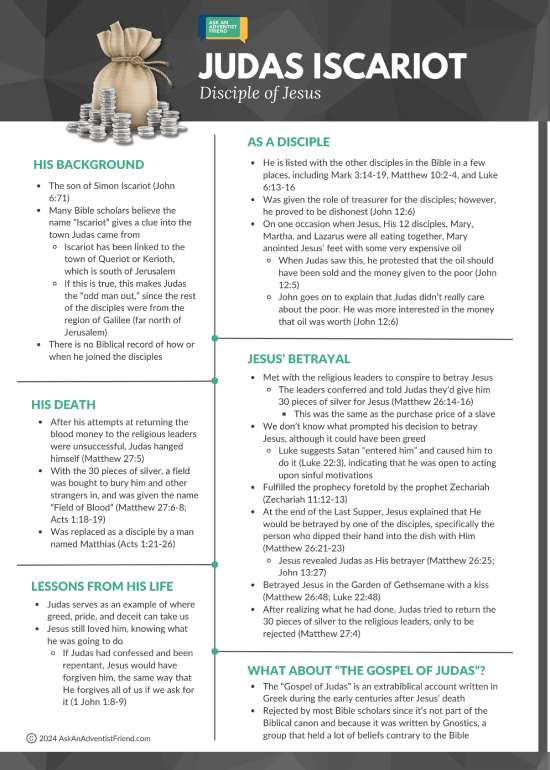
 The name Judas is one that many people throughout history, Christian or not, recognize for his act of betrayal.
He was the disciple who betrayed Jesus Christ to the authorities for 30 pieces of silver—a choice that led to Him being crucified on the Cross.
While we don’t know a lot of personal details about this notorious man, the Bible offers clues into the mind and personality of Judas Iscariot. We’ll see what we can learn about:
- Judas’ background
- Judas as a disciple
- Jesus’ betrayal
- Judas’ death
- What Judas’ life means for us today
Let’s begin with some basics.
Judas’ background
Not much is known about Judas’ background except his name and his father’s name. He was the son of Simon Iscariot (John 6:71).
The name Iscariot may provide us with some clues about Judas.
Scholars most commonly believe that the name comes from Hebrew and means “man of Kerioth.”1 If this is the case, Judas would have come from Kerioth, a town south of Jerusalem in Judah.
And that would have instantly made him the odd one out among the twelve disciples. The others were all from the region of Galilee, far north of Jerusalem. These two regions had different cultures. Judas could easily be viewed as “not one of us” by the other disciples because of this.
According to some scholars, Iscariot may instead be a corrupted form of the Latin word sicarius, which means “murderer” or “assassin.”2
Still other Bible scholars note the similarity of “Iscariot” to the Sicarii, or “dagger-men.” These were a group of nationalist Jews who rebelled against Roman occupation and committed violent acts in the name of the Jewish nation.3 However, this group doesn’t appear to be very active until after Judas died.4
Regardless of what Iscariot tells us, it does do one important thing: differentiate this Judas from other New Testament Judases. There are two others named Judas: Judas the son of James and Judas Barsabbas.
Judas the son of James is none other than the disciple Thaddeus. In biblical times, people often had more than one name (think Simon Peter or Saul and Paul), so this is nothing unusual. Changes in culture, God changing their names, and even different ways of translating passages are reasons many Bible characters went by multiple names.
And Judas Barsabbas was an early church leader and prophet sent to Antioch by the early church (Acts 15:22, 32).
We don’t know much about Judas Iscariot’s background, and we don’t know how he joined the disciples. But we do know some of what happened during his time as a disciple before he betrayed Jesus.
Judas as a disciple
As a disciple, Judas received little attention in the Gospel accounts during Jesus’ ministry—the Bible doesn’t even say how he became a disciple. We can assume he accompanied Jesus and the other disciples as Jesus preached and healed among the Jews. He is listed in a few places with the other disciples, including Mark 3:14-19, Matthew 10:2-4, and Luke 6:13-16.

Photo by Josh Appel on Unsplash
But we do get a revealing glimpse of his character from a few key moments, especially in the Gospel of John.
Judas was given the role of treasurer for the group. But John tells us he wasn’t an honest treasurer:
“[Judas] was a thief, and had the money box; and he used to take what was put in it” (John 12:6, NKJV).
John includes this bit of information just after telling another account about Judas.
Not long before Jesus was betrayed and crucified, Jesus and the disciples visited their friends, Lazarus and Martha, in Bethany. Jesus had raised Lazarus from the dead earlier (John 11:43-44). When they were all eating together, Martha and Lazarus’ sister, Mary, anointed Jesus’ feet with some very expensive oil.
When Judas saw this, he exclaimed,
“‘Why was this fragrant oil not sold for three hundred denarii and given to the poor?’” (John 12:5, NKJV).
John goes on to explain that Judas didn’t really care about the poor. He was more interested in the money that oil was worth:
“He didn’t say this because he cared about the poor but because he was a thief” (John 12:6, CSB).
Right after this scene, the Gospel accounts of John, Matthew, and Mark all jump directly into the chain of events that would make Judas infamous forever.
Jesus’ betrayal
Judas’ betrayal of Jesus begins with Judas approaching the chief priests and scribes—the religious leaders.
What prompts him to do this, we don’t know for sure, but it could have been greed (he was a thief, after all). Luke says that Satan “entered him” and caused him to do it (Luke 22:3), indicating that he was open to acting upon sinful motivations.
Scholars debate over whether he literally became possessed by a demon, or if it was simply a way of saying he chose to follow these corrupt motivations, thus making him a tool of the devil.
It’s also possible that Judas was disappointed that Jesus hadn’t met his expectations of a Messiah. Like the other Jews—and even the other disciples—he had expected Jesus to be a victorious conqueror over the Romans, not a suffering servant like Isaiah 53 depicts.
Regardless, Judas went to the religious leaders and asked,
“‘What are you willing to give me if I betray Him [Jesus] to you?’” (Matthew 26:15, NKJV).
The leaders conferred and told him they’d give him 30 pieces of silver for Jesus (Matthew 26:15). Which, by the way, was the value of a slave.5
Judas was satisfied.
This reflects the prophecy foretold by the prophet Zechariah (Zechariah 11:12-13). There’s more to it, though, so we’ll discuss it in depth in a bit.
Passover came, and Jesus and the disciples ate the Last Supper. Toward the end, Jesus explained that He would be betrayed by one of the disciples (Matthew 26:21).
The disciples were afraid and asked Jesus if they were the ones. Jesus responded that the person who dipped his hand into the dish with Him was the one who would betray Him (Matthew 26:23).
Then Judas said, “‘Rabbi, is it I?’” (Matthew 26:25, NKJV).
Jesus replied, “‘You have said it’” (Matthew 26:25, NKJV).
In John, Jesus gives a piece of dipped bread to Judas, exposing him as His betrayer. We’re told that Satan entered Judas then, and Jesus said, “‘What you do, do quickly’” (John 13:27, NKJV). Judas immediately left the room.
Judas gathered the Jewish authorities and led them to where Jesus and the disciples were, now in the Garden of Gethsemane. Judas had told the authorities he would give the man they wanted a kiss of greeting (Matthew 26:48). So when he approached Jesus, he greeted Him and kissed Him.
Jesus, knowing what Judas was doing, said to him,
“‘Judas, are you betraying the Son of Man with a kiss?’” (Luke 22:48, NKJV).
The authorities seized Jesus and dragged Him away, beginning the events that would lead to the crucifixion.
Jesus’ betrayal at the hands of Judas is a tragedy, and yet, Jesus had to be betrayed both to fulfill prophecy and to save humanity. Unfortunately, Judas chose to be the means by which that would happen.
Let’s move now to what happened to Judas after his infamous act.
Judas’ death

Photo by Tamara Gore on Unsplash
Judas met his own end not long after Jesus died.
The Bible tells us that Judas was filled with remorse for his actions. When Jesus went before Pontius Pilate—the Roman governor—for a trial, Judas returned the 30 pieces of silver to the religious leaders, saying,
“‘I have sinned by betraying innocent blood’” (Matthew 27:4, NKJV).
But the priests didn’t care and wouldn’t take the money back. “‘What is that to us?’” they retorted. “‘You see to it!’” (Matthew 27:4, NKJV).
Ellen White, a founder of the Seventh-day Adventist Church, offered these comments on the scene:
“As the trial drew to a close, Judas could endure the torture of his guilty conscience no longer. Suddenly a hoarse voice rang through the hall, sending a thrill of terror to all hearts: ‘He is innocent; spare Him, O Caiaphas! … Rushing to the throne of judgment, he threw down before the high priest the pieces of silver that had been the price of his Lord’s betrayal. … [Jesus] knew that Judas did not repent; his confession was forced from his guilty soul by an awful sense of condemnation.”6
After this, Judas hung himself:
“Then [Judas] threw down the pieces of silver in the temple and departed, and went and hanged himself” (Matthew 27:5, NKJV).
Matthew goes on to record,
“But the chief priests took the silver pieces and said, ‘It is not lawful to put them into the treasury, because they are the price of blood.’ And they consulted together and bought with them the potter’s field, to bury strangers in. Therefore that field has been called the Field of Blood to this day” (Matthew 27:6-8, NKJV).
The book of Acts records the account in a slightly different way:
“Now this man [Judas] purchased a field with the wages of iniquity [the 30 pieces of silver]; and falling headlong, he burst open in the middle and all his entrails gushed out. And it became known to all those dwelling in Jerusalem; so that field is called in their own language, Akel Dama, that is, Field of Blood” (Acts 1:18-19, NKJV).
Although these two gruesome death accounts seem to contain different details, they are speaking of the same event. The differences between the accounts are rhetorical, meaning the authors used different words to describe the same idea.7 After Judas hung himself, he was buried in the field that had been bought by the 30 pieces of silver.
These events reflect the prophecy in Zechariah:
“Then I said to them, ‘If it is agreeable to you, give me my wages; and if not, refrain.’ So they weighed out for my wages thirty pieces of silver. And the Lord said to me, ‘Throw it to the potter’—that princely price they set on me. So I took the thirty pieces of silver and threw them into the house of the Lord for the potter” (Zechariah 11:12-13, NKJV).
They had been predicted centuries before. Whether or not Judas knew he was fulfilling them, we don’t know.
But after Judas’ death and Jesus’ ascension back to heaven, the disciples appointed someone else to take Judas’ place.
Who replaced Judas as the twelfth disciple?
Judas’ place among the 12 disciples was taken by a man named Matthias, who had followed Jesus from the beginning.
The disciples gathered, and Peter proposed,
“‘Therefore, of these men who have accompanied us all the time that the Lord Jesus went in and out among us, beginning from the baptism of John to that day when He was taken up from us, one of these must become a witness with us of His resurrection’” (Acts 1:21-22, NKJV).
Of these men, two were proposed: Joseph Justus (also called Barsabbas) and Matthias.
They prayed over the decision and cast lots (similar to rolling dice today), and the lot fell to Matthias.
This is the only time Matthias is mentioned in the Bible, but we can assume he worked as fervently as the other disciples did in the first-century Christian church.
What Judas’ life means for us today

Photo by Nils Stahl on Unsplash
Judas may have lived a traitor’s life and not been truly repentant for his sins, but we can still take away a few important lessons from his life.
Judas is an example
Through Judas and his fate, we have a perfect example of where greed, pride, and deceit can lead. John indicates that these qualities were present in Judas from the beginning.
Even so, Judas could’ve allowed Jesus to change his heart under His ministering and teaching.
This happened with other Bible characters. For example, after Jesus was arrested, Peter denied knowing Jesus or having any affiliation with Him. Three times! Yet Peter later repented, and Jesus forgave him. Peter went on to be a pillar in the early Christian church.
This also happened with the thief on the cross. He had rebelled against God’s principles and laws, but as he died on the cross, he realized Jesus was the true Son of God. Then and there, he repented of his disobedient life, and Jesus gave him eternal life.
Judas could have done the same if only he’d been sincerely sorry.
Instead, he gave in to personal selfishness, leading him to betray the Savior of the world and die a horrible death. He is the classic example of what not to do. His is a fate we can avoid if we listen to Jesus.
Jesus still loved him
Even as Jesus allowed Judas to be His disciple throughout His ministry, He knew someday this man would betray Him, condemning Him to a painful, agonizing death. Yet He still loved him, still gave him a chance, still sought to change his heart.
Even when Jesus revealed Judas as the traitor, He spoke with compassion and forgiveness in His voice. He simply told him to do what he was going to do quickly.
And had Judas confessed and been repentant, Jesus would have forgiven him, even as He forgives all of us if we ask for it (1 John 1:8-9).
Interestingly though, some people believe Judas was always in league with Jesus and never betrayed Him because of his own greed and sinfulness. Here’s how.
The Gospel of Judas
The Gospel of Judas is an extrabiblical account written in the early centuries after Jesus’ death. Written in Greek, this text was discovered in Egypt in the 1970s and translated to English in the early 2000s.8
In this account, Judas is portrayed as a very close friend of Jesus. As such, he was the only person who really knew the true mission of Jesus—that He must die on the Cross for all humanity, instead of ascending a throne on earth and defeating the Romans.9
So, unlike the Bible’s account, which paints Judas as a cold-hearted betrayer, The Gospel of Judas describes him as the man Jesus instructed to betray Him in order for God’s plan of salvation to work.10
However, most Bible scholars don’t accept this book as accurate for these reasons:
- It’s not part of the biblical canon. The early church leaders were very careful in selecting what should be included in the New Testament, choosing only what lined up accurately. If a book was left out, it likely had some theological or historical issues with it.11
- It was written by Gnostics. This group in the early centuries after Christ held many beliefs that contradicted the Bible. Thus anything they wrote is subject to question by Christians.12
The Gospel of Judas might make an interesting read, but it’s not a source to trust for insight into the character of Judas Iscariot.
The most infamous disciple
The Bible records many cruel, rebellious people among its stories. Undoubtedly, however, Judas Iscariot ranks among the worst. He was a thief and betrayer, who ultimately sent Jesus to His death.
While he is by no means a man we should emulate, don’t forget that Jesus allowed him to be one of His disciples. He extended a lot of grace to Judas, encouraging him to change with the opportunities He presented. Jesus would have forgiven him, had Judas sincerely asked.
Because that’s who Jesus is—a God of boundaryless, unwavering love.
He doesn’t care what we did in the past or what we’re doing now. He still loves us so much that even if we never loved Him back, He would still have given up His life just for us. He will still forgive us now if we sincerely ask for it.
What else did Jesus teach during His time on earth?
To learn about the other disciples, start with the overview of the Twelve or
Related pages



- Horn, Siegfried, “Iscariot,” Seventh-day Adventist Bible Dictionary, p. 532 [↵]
- “Judas Iscariot,” Britannica, October 17, 2023, [↵]
- “Zealots And Sicarii,” Encyclopedia.com. [↵]
- Ibid. [↵]
- Denova, Rebecca. “Judas Iscariot,” World History Encyclopedia, [↵]
- White, Ellen, Desire of Ages, pp.721-722. [↵]
- Seventh-day Adventist Bible Commentary, Acts 1:17. [↵]
- “Judas Iscariot,” Britannica. [↵]
- Ibid [↵]
- Ibid. [↵]
- “Gospel of Judas’ is heresy and unreliable, Union experts say,” Union University, April 10, 2006, [↵]
- Ibid. [↵]
More Answers

How to Join the Seventh-day Adventist Church
Whether you heard about the Seventh-day Adventist Church through a traveling evangelist, during your online searches, or through a loved one or relative, you might be considering joining yourself.

What Are the Three Angels’ Messages in Revelation 14?
The three angels’ messages in Revelation 14 warn the world to worship God, leave religious confusion, and avoid worship of human traditions instead of God’s commands.

Is the Old Testament Important for Christians Today?
Yes, the Old Testament is important because it kicks off the story that is continued by the New Testament. Without it, we wouldn’t have the vital background to Jesus’ first coming and the other accounts of the New Testament.
![The Early Christian Church [Overview]](https://devsite.askanadventistfriend.com/wp-content/uploads/2023/01/old-temple-400x250.jpg)
The Early Christian Church [Overview]
The Early Christian Church describes the faith community that developed from followers of Jesus after He returned to heaven (Acts 1) in A.D. 31. Their purpose was to be witnesses of the life, death, and resurrection of Jesus and grow their faith community into a worldwide movement.

Individual or Group Bible Study—Which Is Better?
They’re both great, of course! But depending on where you’re at and what your goals are, it’s worth looking into the different benefits of each.

How Do Adventists Do Baby Dedications?
For Christians, dedication ceremonies for babies, also for older children, are an important time for parents and the church. It’s a special part of the worship service when parents present their young children to God and the church family. Both parents, along with the congregation, regard this as a solemn promise to be a Christ-like example to the child.

What You Need to Know About Temptation and How to Resist It
Ever felt like you face the same temptation day after day? The one temptation that always seems to resurface?
It can be frustrating, yes. But be encouraged—being tempted doesn’t mean you have done anything wrong! And even if you give in to temptation, you are never too imperfect to come before God.

All About the 2300-Day Prophecy and the Investigative Judgment
This page will explain what the 2300-day prophecy is about. We’ll especially be looking at what events marked its fulfillment and what it has to do with the Investigative Judgment.

Was Ellen G. White Really a Prophet?
If you look at what Scripture provides as tests for a true prophet, Ellen White meets all the criteria.

Do Adventists Celebrate Communion and Foot Washing?
Like many Christian denominations, Adventists regularly participate in communion, also referred to as the “Lord’s Supper” or the “Last Supper.” They also practice foot washing (John 13:1-20), or the “ordinance of humility,” during the service—which isn’t as common.

Faith and Works—Do Both Matter in the Christian Life?
In so many religions all throughout time, individuals work toward enlightenment, salvation, or the favor of a deity. People are taught subtly—or not so subtly—that if you only do enough good deeds, you’ll be worthy/ascended/redeemed/approved, etc.

What is the Concept of “Present Truth” and Why is it Important?
Present truth is the principle that certain biblical truths are relevant to God’s people at specific times in history. God sends the Holy Spirit to reveal truths that help us better understand how to interpret and apply His Word in a present moment.

What is the Spirit of Prophecy (Books 1–4) by Ellen G. White?
Applying biblical prophecy to history, recent events, and especially the future, can be a daunting task. Even a little scary for some. But even so, we can’t help but want to know more. We want to be prepared—to feel like we know how to weather the storm.

Do Seventh-day Adventists Celebrate Easter
Yes, many Seventh-day Adventists do celebrate Easter.

Ellen G. White’s Counsel on Christian Education
Ellen White, a co-founder of the Seventh-day Adventist Church, saw that the U.S. educational system during her time was lacking. And as part of her life of ministry, she sought out practical ways to be better stewards of our minds, bodies, and the lives we’re given.

What Does Ellen White Say About Prayer?
Have you ever had a burden you just had to tell someone, but you were afraid of being judged if you did? Ellen G. White, an important figure in the Seventh-day Adventist Church and a prolific writer, described prayer as talking to God in a personal way—He’s the friend we can tell everything to.

Were All Ellen White’s Visions About the Future?
While the visions God gave Ellen White were often about the distant future or last-day events, she had many others that addressed different topics. They may not be discussed as much as her visions about the Second Coming or the End Times, but they tackled some timely topics for her day.

What Did Ellen White Say About End-Time Prophecy?
We can read in Scripture about the series of events and signs that lead up to the second coming of Jesus Christ. And it sounds pretty intense, to say the least. The symbolic nature of the language of prophecy also can make things tricky to understand at first.

Does the Adventist Church Have Youth Ministry Programs?
The Seventh-day Adventist Church has been organizing and operating youth ministry programs since 1879.
In our opinion, youth ministry is one of the most important ministries a church can have.

Were All Ellen White’s Books Inspired?
As the most translated female author in the world, Ellen White wrote numerous books, articles, pamphlets, and more. These writings focused on developing Christian character, emphasizing Bible truth, practical tips for living well and staying healthy, and discussing effective methods of delivering the gospel message to the world.

Do Adventists Celebrate Birthdays?
Yes, most Seventh-day Adventists do celebrate birthdays because we see them as excellent reminders of the life God has blessed us with. And we celebrate them the same way everyone else does—with friends, family, presents, and a special meal.

The Ultimate Guide to Personal Bible Study
Ever felt that studying the Bible is challenging, and you’re just not sure where to start? Or looking for fresh ideas to improve your current Bible study habits? We’ve got you covered with simple techniques and plans to improve your Bible study experience.

What Is Salvation, and How Do I Get Saved?
Salvation, or being saved, is what God wants for all of us. And since God created us with free will, this salvation is ultimately our choice. We become “saved” by accepting that Jesus Christ died on the cross, taking the punishment meant for sinners upon Himself.

What Is the 70-Week Prophecy in Daniel 9
Could a prophecy accurately predict an event over 500 years before it was supposed to happen?
The 70-week prophecy of Daniel 9 did, culminating in one of the most important events in earth’s history: Jesus’ sacrifice for us on the cross.

Do Seventh-day Adventists Believe in Hell?
Seventh-day Adventists believe that any human being who accepts God’s free gift of salvation through Jesus will be given eternal life. But what about the eternal fate of those who choose not to accept Jesus?

Sola Scriptura—What It Means and Why It Matters
Sola scriptura is a term that originated during the Protestant Reformation. It represents the way many Christians view the Bible and its authority. While the idea is simple enough, there is so much more to sola scriptura than its basic definition.

What Do Adventists Offer for Young Adults?
In recent years, the age group often classified as “young adults” has been trickier to engage. It’s been a significant concern for Christian churches around the world. Though interestingly enough, similar observations regarding young adults have been coming up in conversations about the economy, the entertainment industry, politics, and more.

King David: How Was He a Man After God’s Own Heart?
War, bloodshed, murder, adultery—all of these crimes overshadowed the life of a biblical Old Testament man named David. Yet he was called a man after God’s own heart, not to mention one of Israel’s greatest heroes and kings.

Do Seventh-day Adventists Believe in the Secret Rapture
The secret rapture belief asserts that the followers of Jesus will be suddenly and stealthily “raptured” from earth and taken to heaven. Then, any people left on earth will face a period of great difficulty—before Christ’s second coming actually happens.
Didn’t find your answer? Ask us!
We understand your concern of having questions but not knowing who to ask—we’ve felt it ourselves. When you’re ready to learn more about Adventists, send us a question! We know a thing or two about Adventists.