
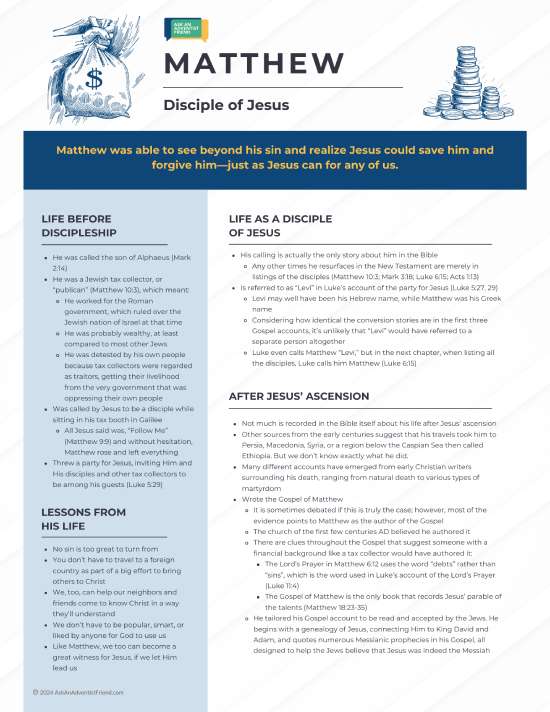
 In the first book of the New Testament, we find the Gospel story from the perspective of Matthew. He was a Jewish tax collector from Capernaum in the first century AD, and he was likely despised by fellow Jews for choosing that profession.
Despite his beginnings, Matthew was willing to be uniquely used by God. To begin with, he was a converted tax collector—that alone was rare. And He served as one of Jesus Christ’ twelve disciples, wrote one of the synoptic Gospel accounts, continued to serve as an apostle after Jesus returned to heaven, and likely died a martyr’s death.
Matthew was able to see beyond his circumstances and realize Jesus could save him and forgive him—just as Jesus can for any of us.
So let’s get into the details of Matthew’s story:
- Life before discipleship
- Life as Jesus’ disciple
- Life after Jesus’ ascension
- Lessons from Matthew’s life
We’ll start by examining what his life was like before he encountered Jesus Christ.
Matthew’s life as a tax collector, before discipleship

Photo by Pixabay
There isn’t a detailed biographical record of what Matthew’s early life was like. And in the book he wrote about the Gospel story, he certainly wasn’t focused on what happened in his own life before meeting Jesus.
But since we know his occupation, that has sparked a lot of interest and speculation in religious media. For example, The Chosen series about all the disciples has taken a few creative liberties with his character.
Here are the specific facts about Matthew we can get straight from the Bible:
- He was also called the son of Alphaeus (Mark 2:14).
- He was also known as Levi (Mark 2:14; Luke 5:27).
- He was a tax collector, or “publican” (Matthew 9:9; 10:3).
Just knowing he was a tax collector, however, provides us with more contextual likelihoods about Matthew:
- He worked for the Roman government, which ruled over the Jewish nation of Israel at that time
- He was probably wealthy, at least compared to most other Jews
- He was more than likely detested by his own people
Here’s why.
The Jews were currently living under the rulership of the Roman Empire, which ruled with a heavy hand over the nations it conquered. One of the “features” of this Roman authority was that Jews had to pay hefty taxes to the Roman government.
But unlike the taxation systems we’re used to today, which are supposed to pay for a country’s infrastructure, government programs, education, etc., Roman taxes benefited none but Rome, making them even more powerful and rich.1 Today we’d call it taxation without representation.
And to make matters worse, the Roman government contracted with locals to do their dirty work of collecting those fees—one of the jobs available for Jews to sign up for.
So when a Jew opted to make a living this way, you can see how that wouldn’t go over well with their fellow Hebrews.
That made tax collectors and taxes the object of bitter loathing for the Jewish nation. They were regarded as traitors, getting their livelihood from the very government that was oppressing their own people.2
Perhaps living with the disdain of their own people made it easier for them to justify the other reason they were despised. They often took advantage of their position and lined their own pockets by collecting more than was necessary, or arbitrarily charging fees for things like crossing a certain bridge or using a busy road.3
And while we don’t have any kind of exact record of how or if Matthew also cheated his fellow Jews like other tax collectors did, there’s a strong likelihood that he would have taken advantage of the people at some point.
Then how did a man in such a despised and dishonest profession become one of Jesus Christ’s closest companions?
Matthew’s calling

The books of Matthew, Mark, and Luke4 document Matthew’s call to discipleship. Like any other day, he was sitting in his tax booth in Galilee. Jesus, who had just drawn the attention of many by healing a paralyzed man, passed by Matthew’s post.
All Jesus said was, “Follow Me” (Matthew 9:9, NKJV).
But those words must have captivated Matthew. This man had chosen him? Matthew could have easily thought, “Why me?” But he didn’t question Jesus’ choice.
Without hesitation, Matthew got up and left everything—the money, the job, the security, the favor of the Romans. He gave it all up to become Jesus’ disciple.
He also threw a party for Jesus, inviting Him, all His disciples, and other tax collectors to be among his guests (Luke 5:29).
And at this party comes another pivotal moment in Matthew’s life.
The Pharisees, in line with their character, complained about Jesus associating with these types of people. They said to Jesus,
“‘Why do You eat and drink with tax collectors and sinners?’” (Luke 5:30, NKJV).
They had identified Matthew as a sinner of sinners. But notice Jesus’ response:
“‘Those who are well have no need of a physician, but those who are sick. I have not come to call the righteous, but sinners, to repentance’” (Luke 5:31-32, NKJV).
Jesus threw the Pharisees’ grumblings right back in their faces. He wanted to be with these sinners, these people who wanted to follow Him. These were the people who could be saved, because they humbled themselves and looked to Jesus for direction.
The fact that Matthew recognized his shortcomings and was willing to move beyond them reveals his strength.
It was the Pharisees who were farthest away from salvation at that point, if they continued to believe they were too good for what Jesus had to say.
Sometimes a redemption story can be the most powerful kind.
Life as Jesus’ disciple
While Matthew was one of Jesus’ disciples and undoubtedly got involved with important tasks during Jesus’ ministry, his calling is actually the only story about him in Scripture. Any other times he resurfaces in the New Testament are merely in listings of the disciples:
- Matthew 10:3
- Mark 3:18
- Luke 6:15
- Acts 1:13
But that doesn’t diminish his importance. As we’ll see in a bit, his talents helped preserve Jesus’ time on earth forever.
If you read the verses before Luke’s account of the party put on by Matthew, you might have noticed something strange: Jesus called a man named Levi, and this Levi hosted the party (Luke 5:27, 29).
Isn’t his name Matthew?
Levi may well have been his Hebrew name, while Matthew was his Greek name. But in any case, one person having multiple names was not uncommon in those days. For example, Peter was also known as Simon, and Bartholomew was also called Nathanael.
And considering how identical the conversion stories are in the first three Gospel accounts, it’s unlikely that “Levi” would have referred to a separate person altogether. Luke even calls Matthew “Levi” (verse 27). But a few verses later, when listing all the disciples, he calls him Matthew (Luke 6:15).
Throughout most of what we can read about Jesus’ earthly ministry, Matthew silently accompanies Jesus and isn’t often mentioned specifically. But that doesn’t mean his role wasn’t important. He was likely a captivated narrator, focusing more on what was happening around him and having little need to mention his own name in his documentation.
Life after Jesus’ ascension
Matthew, now an apostle, continued to work with the other apostles to share Christianity with others after Jesus returned to heaven. But when it comes to this part of his life, not much is recorded in the Bible itself.
Other sources from the early centuries suggest that his travels took him to Persia, Macedonia, Syria, or a region below the Caspian Sea then called Ethiopia.5 We don’t know exactly what he did, but we can assume he worked among the Gentiles as an evangelist, telling them the wonderful news of Jesus.
It’s also not officially known how he died. Many different accounts have emerged from different early Christian writers, ranging from natural death to various types of martyrdom. Foxe’s Book of Martyrs, written in the 1500s by a Protestant historian, offers this fate for Matthew:
“He afterwards traveled to Parthia, where he met his death, being slain with the sword, about the year 60.”60
He would have been an older man by this time. From the abundance of stories about his martyrdom, we can assume that Matthew remained faithful to Jesus up until his last breath.
And not only was Matthew a faithful apostle, carrying on the ministry of Christ, but he also wrote down his account of the Gospel story, bringing believers together for ages to come: the Gospel of Matthew.
Writing the book of Matthew

Photo by Tim Wildsmith on Unsplash
There are some scholars who debate whether the apostle Matthew truly was the author of the Gospel of Matthew, which was believed to be written somewhere in the 50s-60s AD.7 Early church writers like Papias and Eusebius generally ascribed the book to him, but he also seems to share a lot of material from Mark, who was not an eyewitness.8
However, most of the evidence points to Matthew as the author of the Gospel.
First, the church of the first few centuries AD believed he authored it. Though we’ve seen from Matthew’s numerous death accounts that they don’t always get it right, there’s something to be said for so many people of his time believing in his authorship.
Second, the Gospel of Matthew itself presents numerous clues. Compare these portions of the Lord’s prayer from Luke and Matthew:
“And forgive us our sins, for we also forgive everyone who is indebted to us” (Luke 11:4, NKJV).
“And forgive us our debts, as we forgive our debtors” (Matthew 6:12, NKJV).
Matthew heard the words through the lens of his financial background, so that could be why he expressed them this way.
Also, Matthew’s Gospel account is the only one to include Jesus’ parable about the talents (Matthew 18:23-35). A story about money and investment would have special appeal to someone who regularly handled money as a career.
And Matthew tailored his writing to be read and accepted by the Jews. He begins with a genealogy of Jesus, connecting him to King David and Abraham, and quotes numerous Messianic prophecies in his Gospel, all designed to help the Jews believe that Jesus was indeed the Messiah.
Lessons from Matthew’s life
While we don’t have a detailed life sketch of Matthew, there’s still a lot we can learn from His time as an apostle.
A big takeaway from Matthew’s life is that no lifestyle is too hard to change. A tax collector like Matthew was like the scum of the earth in the eyes of his fellow Jews. He probably had many material possessions, but few friends. Perhaps one part of him felt guilty for the life he led, but the other part was too deeply mired in it to stop.
But he gave up all that to become a follower of Jesus, and one of Jesus’ closest companions.
Jesus doesn’t care how badly we’ve messed up. No matter what we’ve done, we’re all equal in His eyes. He loves us, sees our potential, and wants to be our closest friend.
We can also see from Matthew’s story that you don’t have to travel to a foreign country as part of a big effort to bring others to Christ. There’s nothing wrong with that, and Matthew certainly did his share of it. But his telling of the Gospel story was written for his own people. We, too, can help our neighbors and friends come to know Christ in a way they’ll understand.
Matthew, an example for us all
Matthew was an outcast of society. The Jews hated him because he took their money, and he was unforgivable in the Pharisees’ eyes. And for the Romans, he was just a pawn.
Yet Jesus called Matthew. He knew that Matthew’s identity was far more than his life circumstances or what others thought of him.
We don’t have to be popular. We don’t have to be smart. We don’t have to be liked by anyone. But that doesn’t make us unusable to God. Often, the result of God changing our lives for the better can glorify Him even more.
And when we do accept that call, we can allow ourselves to grow and be changed. Matthew’s life was transformed by this event, and he eventually became a powerful witness for Jesus. We too, can become a great witness for Jesus, if we let Him lead us.
Matthew was not the only apostle whose life was changed. Learn about the disciples’ collective experience with Jesus, or
Related pages



- Edersheim, Alfred. Sketches of Jewish social life in the days of Christ, Internet Archive. p.55. [↵]
- Ibid. [↵]
- Ibid. [↵]
- Matthew 9:9, Mark 2:14, Luke 5:27. [↵]
- Foxe, John, Foxe’s Book of Martyrs, Charles Foster Publishing, 1897 [↵]
- Nelson, Ryan, “Who Was Matthew the Apostle? The Beginner’s Guide,” Overview Bible, April 1, 2019. [↵]
- Chilton, Brian, “Who Wrote the Gospel of Matthew?”, CrossExamined.org, June 11, 2017. [↵]
- Ibid. [↵]
More Answers

The Ultimate Guide to Personal Bible Study
Ever felt that studying the Bible is challenging, and you’re just not sure where to start? Or looking for fresh ideas to improve your current Bible study habits? We’ve got you covered with simple techniques and plans to improve your Bible study experience.

What Is Salvation, and How Do I Get Saved?
Salvation, or being saved, is what God wants for all of us. And since God created us with free will, this salvation is ultimately our choice. We become “saved” by accepting that Jesus Christ died on the cross, taking the punishment meant for sinners upon Himself.

What Is the 70-Week Prophecy in Daniel 9
Could a prophecy accurately predict an event over 500 years before it was supposed to happen?
The 70-week prophecy of Daniel 9 did, culminating in one of the most important events in earth’s history: Jesus’ sacrifice for us on the cross.

Do Seventh-day Adventists Believe in Hell?
Seventh-day Adventists believe that any human being who accepts God’s free gift of salvation through Jesus will be given eternal life. But what about the eternal fate of those who choose not to accept Jesus?

Sola Scriptura—What It Means and Why It Matters
Sola scriptura is a term that originated during the Protestant Reformation. It represents the way many Christians view the Bible and its authority. While the idea is simple enough, there is so much more to sola scriptura than its basic definition.

What Do Adventists Offer for Young Adults?
In recent years, the age group often classified as “young adults” has been trickier to engage. It’s been a significant concern for Christian churches around the world. Though interestingly enough, similar observations regarding young adults have been coming up in conversations about the economy, the entertainment industry, politics, and more.

King David: How Was He a Man After God’s Own Heart?
War, bloodshed, murder, adultery—all of these crimes overshadowed the life of a biblical Old Testament man named David. Yet he was called a man after God’s own heart, not to mention one of Israel’s greatest heroes and kings.

Do Seventh-day Adventists Believe in the Secret Rapture
The secret rapture belief asserts that the followers of Jesus will be suddenly and stealthily “raptured” from earth and taken to heaven. Then, any people left on earth will face a period of great difficulty—before Christ’s second coming actually happens.

Do I Need to be an Adventist to be Saved?
The answer to this question is simply, “no.”
When it comes to salvation in Jesus Christ, all that is required of a person is to acknowledge Jesus’ sacrifice for us, believe that He has saved us, and claim the free gift of salvation that is always available to us. Salvation is not based on denomination.

Do You Have to Be Vegetarian to Be Adventist?
Of course not. Membership in the Seventh-day Adventist Church has never included any dietary requirements. However, there might be some reasons people might think that. So many Adventists are vegetarians or even vegan, and a plant-based lifestyle has many health benefits.

What Does the Bible Say About the End Times?
First of all, when we say “end times,” this refers to the period of time that precedes the second coming of Jesus—and the end of this sinful world before it’s recreated into the new earth. And several passages of Scripture provide us with clues and guidelines to help us recognize when these times are near, what kinds of things we can expect, and what it might mean for our daily lives and priorities.

All About Seventh-day Adventist Colporteurs
The Seventh-day Adventist Church uses a variety of methods to spread the hope of the gospel to the world. One of these ways is through colporteuring, also called “canvassing” or “literature evangelism.”

How Ellen White Influenced the Adventist Health Message
Seventh-day Adventists are known for their emphasis on healthy living. And Ellen G. White was a significant influence in the development of this priority and practice among Adventists.

Does Prayer Work? If So, How Are Prayers Answered?
Prayer is how human beings reach out to a higher power. For Christians, it’s how we communicate with God. But does it really work? Is it true that God actually intervenes in situations when we call out to Him for help? And why are some prayers answered immediately, while others seem to go unanswered or not get answered for a long time?

What Did Ellen White Teach About Vegetarianism?
One thing you might have heard about Seventh-day Adventists is their emphasis on a vegetarian lifestyle. If you’re wondering why that is, it goes back to our church’s humble beginnings:
Steps to Christ: A Guide to a Relationship with Jesus
Whether you’re just starting your journey with Jesus Christ, are coming back after some time away, or have had a relationship with Jesus for years, using a book—in addition to the Bible—to guide or supplement that relationship can be helpful, comforting, and joyful.

What Is an Adventist Book Center (ABC)?
When you walk into any one of the many Adventist Book Center (ABC) locations, chances are you’ll be greeted by pleasant gospel music in the background, friendly employees, and row after row of Christian books, movies, Bibles, study guides, kids’ games, and more.

Prayer—How Do I Do It?
Prayer is intentional communication with God. And the way you go about it is much like how you’d communicate with your best friend. You can reach out anytime and anywhere, in the way that’s most natural between the two of you.

15 Examples of Prayer in the Bible
Prayer is the primary way we maintain our relationship with God. It’s our method of communication, and He miraculously hears every word that comes from our hearts.

Do Seventh-day Adventists Celebrate Holidays?
Wondering whether your Adventist classmate or coworker keeps the same holidays you do? Perhaps you want to include them in some festivities, but you also want to respect their beliefs. Thus, you’re unsure of how to navigate the holiday question. Will they accept your invitation to the office Christmas party?

Ellen White and Adventist Healthcare—Ahead of Their Time
Medical care in the mid-1800s was primitive, to say the least. Basic concepts we take for granted—such as proper handwashing or recognizing the dangers of bloodletting—were nonexistent. And doctors often had little more than nine months of training!

How Ellen White’s Teachings Can Improve Your Health
Healthcare in the nineteenth century was said to leave “more disease than it took away” with its use of bloodletting and “medicines” like mercury and arsenic. As people questioned these methods, new approaches popped up. But which ones were reliable?

Do Adventists Worship Ellen White?
Ellen White was a co-founder and leader in the Seventh-day Adventist Church from its beginning. Adventists believe that she had the prophetic gift (Ephesians 4:14; 1 Corinthians 12:28) and passes the biblical tests of a prophet.

Can I Be an Adventist If I Don’t Believe in Ellen White?
Ellen White is an important part of the Seventh-day Adventist Church: she played a significant role in its founding, provided biblical support for several key doctrines, and continues to inspire church members today with her insightful counsel.

The Adventist Haystack (It’s Not What You Think) + 4 Recipes
Haystacks are basically a taco salad—with an Adventist spin on it! Most versions are vegetarian and offer an endless combination of tasty toppings. We eat them often because they’re healthy, scrumptious, and easy to make.

Do Seventh-day Adventists Believe in Medical Care?
The Seventh-day Adventist Church believes in and supports evidence-based medical care. In fact, medicine has played a significant part in our history, and today we run a major health system with hospitals, medical schools, and clinics throughout the world.

Why do Adventists Emphasize Religious Liberty?
Adventists see religious liberty as an essential human right. After all, God endowed humanity with freedom of choice from the very beginning. So we believe it’s best for governments to also support their citizens’ rights to worship based on their convictions.

All about Adventist Elementary Schools
The Seventh-day Adventist Church operates the largest Protestant education system in the world. A big part of this system is our K-8 elementary schools, or primary schools, as they’re known in other parts of the world.

What Are Pathfinder and Adventurer Clubs?
Like the boy or girl scouts, Pathfinders and Adventurers learn about nature and life skills. But what makes these clubs special is their purpose to bring young people closer to Jesus.
Didn’t find your answer? Ask us!
We understand your concern of having questions but not knowing who to ask—we’ve felt it ourselves. When you’re ready to learn more about Adventists, send us a question! We know a thing or two about Adventists.