
Though we know little about him from the Bible or tradition, we do know that he went by a few names, specifically Thaddeus, Lebbaeus, and Judas of James.
As we piece together the small tidbits about Thaddeus, let’s see what these names tell us about him and what we can learn from his life.
We’ll look at:
Thaddeus’s name(s)
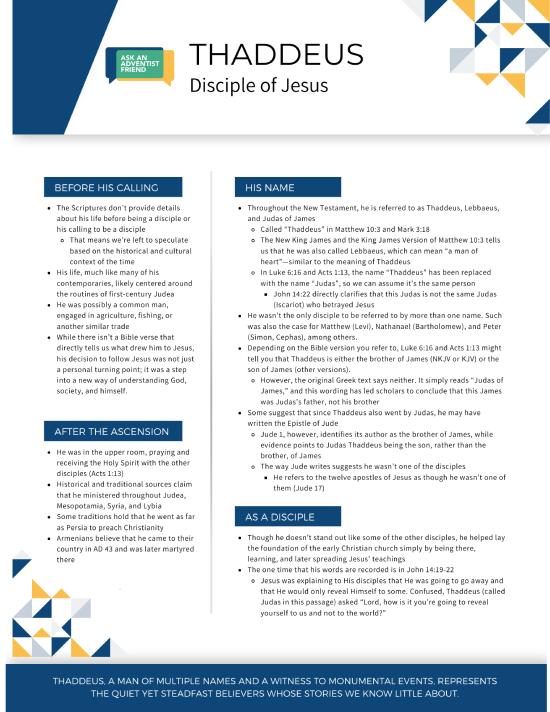 The different Gospel accounts present Thaddeus with different names. In Matthew 10:3 and Mark 3:18, he’s listed as “Thaddeus.” But in Luke 6:16 and Acts 1:13, the name “Thaddeus” is excluded completely, and we find someone named “Judas” instead. For this reason, we can safely assume they’re the same individual.
And John 14:22 directly clarifies that this Judas is not the same Judas (Iscariot) who betrayed Jesus.
But these names aren’t just a case of mistaken identity or a biblical typo. They’re a glimpse into the naming conventions in ancient times.
Some suggest that Judas was his real name. Then, “Thaddeus,” his surname or family name (Matthew 10:3), would have distinguished him from Judas Iscariot, the betrayer of Jesus.
Just as some of us might go by nicknames or middle names in different settings, Thaddeus’s multiple names may have reflected various aspects of his identity or role within the community. According to Thayer’s Greek Lexicon, Thaddeus can mean “large-hearted or courageous.”1 In Bible times, names were often given based on character qualities (Genesis 32:28; Hosea 1:4-11), and this would’ve been no different.
The New King James and the King James Version of Matthew 10:3 tells us that he was also called Lebbaeus. Lebbaeus can mean “a man of heart”—similar to the meaning of Thaddeus.2
And Thaddeus wasn’t the only disciple to be referred to by more than one name. Such was also the case for Matthew (Levi), Nathanael (Bartholomew), and Peter (Simon, Cephas), among others.
But we still have some mysteries to explore—like who was Thaddeus related to according to the Bible? Was he connected to the disciple James, the son of Alphaeus? And did he write the book of Jude?
More on those next.

Son or brother of James? And, which James?
Depending on the Bible version you refer to, Luke 6:16 and Acts 1:13 might tell you that Thaddeus is either the brother of James (NKJV or KJV) or the son of James (other versions).
However, the original Greek text says neither. It simply reads “Judas of James,” and this wording has led scholars to conclude that this James was Judas’s father, not his brother.3
So, is this James the same as any of the other ones listed in the Bible? In Luke 6:15-16, James the son of Alphaeus (aka “James the Less”) is mentioned. Could they be related?
Adventist scholars don’t believe so:
“Almost certainly this James, the father of Thaddaeus or Judas, is not to be identified with any other James of the NT, for the name was very common.”4
(And the name James remains common, even today!)
The Judas who wrote the Epistle of Jude?

Photo by Tim Wildsmith on Unsplash
Jude, the title of an epistle in the New Testament and the name of the author who wrote it, is the same as the name Judas. This has led some to wonder whether the disciple Judas Thaddeus, also known as “Jude the Apostle,” might’ve written the book of Jude.
The Seventh-day Adventist Bible Dictionary offers a different perspective. It suggests that the author of Jude—who may have been the brother of Jesus (Matthew 13:55; Mark 6:3)—and Judas the disciple are two different people.5
Jude 1 identifies its author as the brother of James, while evidence points to Judas Thaddeus being the son, rather than the brother, of James. What’s more, the way Jude writes suggests he wasn’t one of the disciples. He refers to the twelve apostles of Jesus as though he wasn’t one of them (Jude 17).6
So, now that we know a little more about Thaddeus’s name, let’s see what we can learn about him as a person.
Thaddeus before his calling

Photo by Korhan Erdol
The Scriptures don’t provide details about Thaddeus’s life before being a disciple or his calling to be a disciple. That means we’re left to speculate based on the historical and cultural context of the time.
Thaddeus’s life, much like many of his contemporaries, likely centered around the routines of first-century Judea. He was possibly a common man, engaged in agriculture, fishing, or another similar trade.
In those times, the Jewish people were under Roman occupation, which meant dealing with taxes and soldiers while also trying to uphold the rich customs and laws of Judaism. Like the other Jews, Thaddeus would’ve longed for the coming of the Messiah to end the Roman occupation.
So, what might have drawn Thaddeus to Jesus?
While there isn’t a Bible verse that directly tells us, there are many likely possibilities. Perhaps he felt discontent with the status quo and wanted something beyond the stagnant rituals of the Jews. Maybe it was the Roman oppression that made the message of a new kingdom, one based on love and justice, so appealing. Or it could have been the miracles and teachings of Jesus, stories of which were undoubtedly spreading across the regions.
Thaddeus’s decision to follow Jesus was not just a personal turning point; it was a step into a new way of understanding God, society, and himself.
Thaddeus as a disciple
Once Thaddeus decided to follow Jesus, he became a key player in a story that would shape the course of history. Though he doesn’t stand out like Peter or John, he was still part of the core team—those dozen men who were the first to hear Jesus’ teachings and witness His miracles.
Being a disciple wasn’t just about being front and center; it was about being part of the support system, the group that carried the message of Jesus to the masses. Thaddeus helped lay the foundation of the early Christian church simply by being there, learning, and later spreading Jesus’ teachings. He reminds us that sometimes, the most profound impact is made not by words but by presence and perseverance.
The one time that Thaddeus’s words are recorded is in John 14:19-22. Jesus was explaining to His disciples that He was going to go away and that He would only reveal Himself to some. Confused, Thaddeus (called Judas in this passage) asked:
“Lord, how is it you’re going to reveal yourself to us and not to the world?” (John 14:22, CSB)
His question revealed the mindset he shared with all the other Jews: the hope of a Messiah who would reveal Himself to the whole world and conquer the Jews’ enemies. Here’s how some Bible commentators put it:
“Judas doubtless had in mind a visible manifestation of glory such as was expected to attend the advent of the Messiah. It was apparently disappointing to him that the manifestation was to be made to only a few…. In common with his Jewish compatriots he doubtless shared the hope that the Messiah would manifest Himself in judgment over the Gentiles and in the re-establishment of the spiritual theocracy.”7
Like the other disciples, Thaddeus had to slowly unlearn all he’d expected the Messiah to do. Jesus’ ministry was so different from what he’d been waiting for. But over time, he would come to understand and become a strong witness for the Gospel.
Thaddeus after the ascension

Photo by Jeremy Yap on Unsplash
After Jesus’ ascension, Thaddeus was in the upper room, praying and receiving the Holy Spirit with the other disciples (Acts 1:13). From there, we know nothing more about him except what various historical and traditional sources suggest.
Let’s take a look at those.
Oral church tradition claims that he ministered throughout Judea, Mesopotamia, Syria, and Lybia.8
And some traditions hold that he went as far as Persia to preach Christianity.9 This is the tradition mentioned in Foxe’s Book of Martyrs:
“Being sent to Persia, he wrought many miracles and made many converts, which stirring up the resentment of people in power, he was crucified in the year 72 after Christ.”10
On the other hand, Armenians believe that Thaddeus came to their country in AD 43 and was later martyred there.11
But regardless, his presence at Pentecost suggests that he continued the work he started with Jesus. He likely traveled, spreading the teachings of Christ, and played a crucial role in establishing early Christian communities.
Thaddeus—quiet yet steadfast
Thaddeus, a man of multiple names and a witness to monumental events, represents the quiet yet steadfast believers whose stories we know little about.
His journey with Jesus is a reminder that every follower, regardless of their role’s prominence, contributes significantly to the spread of the Gospel message.
Curious about the others who walked with Jesus?
Continue your journey through history and faith by exploring our series on the lives of the disciples.
Related pages



- “Lexicon :: Strong’s G2280 – thaddaios,” Blue Letter Bible. [↵]
- “Lexicon :: Strong’s G3002 – lebbaios” Blue Letter Bible. [↵]
- Seventh-day Adventist Bible Commentary, vol. 5, p. 597. [↵]
- Ibid. [↵]
- Horn, Siegfried, Seventh-day Adventist Bible Dictionary, Revised Edition, p. 630. [↵]
- Ibid. [↵]
- Seventh-day Adventist Bible Commentary, vol. 5, comments on John 14:22. [↵]
- “Jude the Apostle,” New World Encyclopedia. [↵]
- “St. Jude,” Britannica. [↵]
- Foxe, John, Foxe’s Book of Martyrs, p. 34. [↵]
- “Saints Thaddeus and Bartholomew,” The Armenian Prelacy. [↵]
More Answers

The Barren Fig Tree Parable: What It Means to Bear Fruit
Find out what the Parable of the Barren Fig Tree really means.

¿Qué son las reuniones evangelísticas adventistas?
¿Qué son las reuniones evangelísticas adventistas?La Iglesia Adventista del Séptimo Día pone un gran énfasis en compartir el evangelio mediante la evangelización, o compartir el evangelio a través de la predicación, la enseñanza y el testimonio. Una de las formas en...
O que são os Encontros Evangelísticos Adventistas?
O que são os Encontros Evangelísticos Adventistas?A Igreja Adventista do Sétimo Dia dá grande ênfase ao compartilhamento do evangelho por meio da evangelização, ou seja, compartilhar o evangelho através da pregação, ensino e testemunho. Uma das formas de realizarmos...

O Que os Adventistas Acreditam Sobre Fé e Obras?
O Que os Adventistas Acreditam Sobre Fé e Obras?Os adventistas acreditam que somos salvos pela fé, que é a crença e confiança que temos em Jesus Cristo para nos salvar dos nossos pecados. Jesus, então, nos capacita a viver em harmonia com os mandamentos de Deus e a...
¿Qué creen los Adventistas sobre la fe y las obras?
¿Qué creen los Adventistas sobre la fe y las obras?Los adventistas creen que somos salvos por la fe, que es la creencia y confianza que tenemos en Jesucristo para salvarnos de nuestros pecados. Jesús, entonces, nos capacita para vivir en armonía con los mandamientos...

Je, Ninahitaji Kuwa Mwadventista Ili Niokolewe
Je, Ninahitaji Kuwa Mwadventista Ili Niokolewe?Jibu la swali hili ni rahisi, “hapana.” Linapokuja swala la wokovu katika Yesu Kristo, kinachohitajika kwa mtu ni kukiri dhabihu ya Yesu kwa ajili yetu, kuamini kwamba Ametuokoa, na kudai zawadi ya bure ya wokovu ambayo...
¿Necesito ser adventista para ser salvo?
¿Necesito ser adventista para ser salvo?La respuesta a esta pregunta es simplemente, “no.” Cuando se trata de la salvación en Jesucristo, todo lo que se requiere de una persona es reconocer el sacrificio de Jesús por nosotros, creer que Él nos ha salvado y reclamar el...
Preciso ser Adventista para ser salvo?
A resposta para essa pergunta é simplesmente: “não.”

Lo que la Biblia dice sobre la Segunda Venida de Jesucristo
¿Tienes curiosidad sobre lo que la Biblia dice acerca de la Segunda Venida de Jesucristo? Cubriremos los versículos clave y su significado.

¿Quién fue Mateo, el apóstol, en la Biblia?
En el primer libro del Nuevo Testamento, encontramos la historia del Evangelio desde la perspectiva de Mateo.

2 Corinthians: An Overview of Paul’s Most Personal Letter
Discover Paul’s lessons on forgiveness, reconciliation, generosity, and more. It’s all in the book of 2 Corinthians!
Quem Foi Mateus, o Apóstolo, na Bíblia?
Quem Foi Mateus, o Apóstolo, na Bíblia?No primeiro livro do Novo Testamento, encontramos a história do Evangelho sob a perspectiva de Mateus. Ele era um coletor de impostos judeu de Cafarnaum, no primeiro século d.C., e provavelmente era desprezado pelos outros judeus...

The Pharisee and the Tax Collector Parable: Its Meaning Made Simple
The Meaning of the Pharisee and the Tax Collector ParableIn Luke 18:9-14, Jesus told a parable about two men who went to the temple to pray. One was a Pharisee and the other a tax collector. The Pharisee prayed (well, bragged) about his own good works compared to the...
Biblia Inasema Nini Kuhusu Ujio wa Pili wa Yesu Kristo
Unajuliza Biblia inasema nini kuhusu Kurudi kwa Yesu Kristo Mara ya Pili? Tutajadili aya kuu na maana zake.

The Story of the Widow’s Mite—What It Really Means
The Story of the Widow’s Mite—What It Really MeansPeople often assume bigger is better, but the Bible turns this concept on its head with the story of the Widow’s Mite. Of all the donations Jesus sees at the temple, the gift that draws His attention is not the...

Consejo de Elena G. de White sobre la Educación Universitaria
Consejo de Elena G. de White sobre la Educación UniversitariaElena G. de White, una cofundadora importante del Adventismo, es conocida a menudo por su orientación práctica y espiritual para la educación infantil adecuada. Pero también estuvo significativamente...
Mathayo Alikuwa Nani Katika Biblia?
Mathayo Alikuwa Nani Katika Biblia?Katika kitabu cha kwanza cha Agano Jipya, tunapata simulizi la Injili kutoka kwa Mathayo. Alikuwa mtoza ushuru Myahudi kutoka Kapernaumu katika karne ya kwanza MK, na huenda alichukiwa na Wayahudi wenzake kwa kuchagua kazi hiyo....

¿Cuáles son los beneficios de vivir en el campo?
¿Cuáles son los beneficios de vivir en el campo?Visitar el campo puede ofrecer un descanso muy necesario del típico ajetreo y bullicio de la ciudad. Muchos incluso han decidido mudarse a zonas rurales para disfrutar de un ritmo más lento, espacios amplios, aire...
Quais São os Benefícios de Viver no Campo?
Visitar o campo pode oferecer uma pausa muito necessária do típico agito da cidade.

¿Qué significa la parábola de la perla de gran precio?
Esto es lo que Jesús enseñó sobre el reino de los cielos a través de esta breve parábola sobre un comerciante que encuentra una perla invaluable.
O Que Significa a Parábola da Pérola de Grande Valor?
Aqui está o que Jesus ensinou sobre o reino dos céus por meio desta parábola curta sobre um comerciante que encontra uma pérola inestimável.

Por Que Muitos Adventistas Querem Viver no Campo
Por Que Muitos Adventistas Querem Viver no CampoViver em áreas rurais é algo que os adventistas têm valorizado historicamente, embora as necessidades da vida moderna nem sempre tenham tornado isso possível. Convenhamos, as vantagens da vida na cidade são bastante...

Uma Visão Geral de Romanos: Fé, Justiça, Relacionamentos
Uma Visão Geral de Romanos: Fé, Justiça, RelacionamentosO livro de Romanos é uma das 21 epístolas, ou cartas abertas, do Novo Testamento. E embora seja um texto bíblico antigo, ainda tem uma relevância significativa (até surpreendente) para nossas vidas hoje. O...

Jesus é o Mesmo Ser que Miguel, o Arcanjo?
Jesus é o Mesmo Ser que Miguel, o Arcanjo?Muitos cristãos têm se perguntado sobre a misteriosa identidade de Miguel, o Arcanjo. Desde os primórdios do cristianismo, muitos interpretaram Miguel como o Messias identificado com a figura do Anjo do Senhor. O reformador...
Je, Faida za Kuishi Vijijini ni Zipi?
Kutembelea maeneo ya vijijini kunaweza kutoa mapumziko yanayohitajika sana kutoka kwenye pilikapilika za kawaida za mijini.
Je, Mfano wa Lulu ya Thamani Kubwa Unamaanisha Nini?
Hivi ndivyo Yesu alivyofundisha kuhusu ufalme wa mbinguni kupitia mfano huu mfupi wa mfanyabiashara aliyepata lulu ya thamani isiyo na kifani.
Kwa Nini Waadventista Wengi Wanataka Kuishi Vijijini
Kwa Nini Waadventista Wengi Wanataka Kuishi VijijiniKuishi maeneo ya vijijini ni jambo ambalo Waadventista wamekuwa wakilithamini kihistoria, ingawa mahitaji ya maisha ya kisasa hayafanyi iwezekane kila wakati. Tukubali, faida za kuishi mjini zinaonekana wazi: fursa...
Muhtasari wa Kitabu cha Warumi: Imani, Haki, Mahusiano
Hapa kuna muhtasari na historia ya waraka mrefu zaidi wa Paulo.

Sobre o que é a Parábola do Semeador de Jesus?
A parábola do semeador é, em última análise, sobre como as pessoas responderam a Jesus Cristo e Sua mensagem do reino de Deus—o Evangelho.
Didn’t find your answer? Ask us!
We understand your concern of having questions but not knowing who to ask—we’ve felt it ourselves. When you’re ready to learn more about Adventists, send us a question! We know a thing or two about Adventists.