
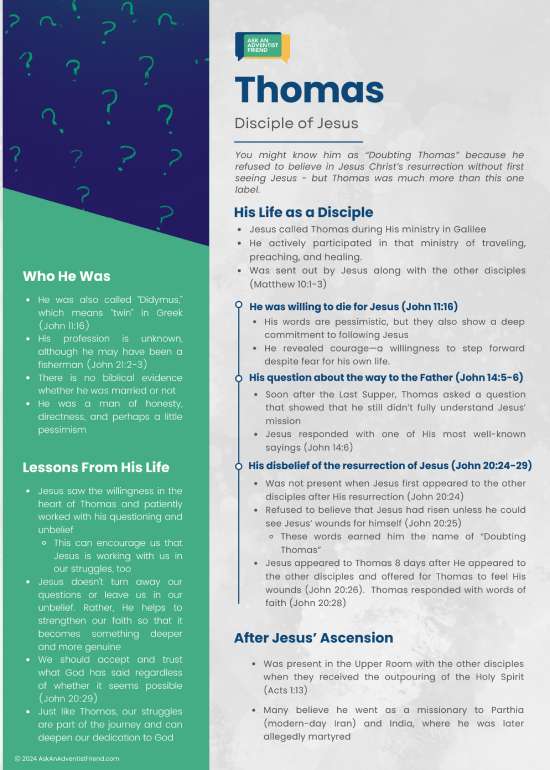
 You might know him as “Doubting Thomas” because he refused to believe in Jesus Christ’s resurrection without first seeing Jesus.
But Thomas was much more than this one label.
As one of the 12 disciples of Jesus, Thomas the Apostle followed Jesus and grew in His work of teaching, preaching, and healing. Despite his struggle with unbelief after Jesus was resurrected—the story that made Thomas famous—he went on to spread the Gospel throughout the known world.
The Bible doesn’t spend a lot of time talking about this unique character, but we’ll look at what it does say and what scholars have concluded from clues in history. You’ll learn:
Who Thomas was

Photo by Kevin Malik
In the New Testament, Thomas shows up in every single list of the 12 disciples (Matthew 10:3; Mark 3:18; Luke 6:15). But we know little else about him except for the accounts of him in the Gospel of John. These snippets of his interactions with Jesus and the other apostles show us a man of honesty, directness, and perhaps a little pessimism.
John 11:16 tells us that he was also called “Didymus,” which means “twin” in Greek (and the Aramaic for Thomas means the same). It’s possible that he had a twin brother, though we don’t know who that was.
Some suggest he was Jesus’ twin, but the Bible doesn’t offer any such evidence.1
And while some movies or TV shows depict him as having a wife or girlfriend, the Scriptures don’t say whether he was married or not.
His profession also is unknown. However, John 21:2-3 mentions that he went fishing with some of the apostles, so it’s possible he was also a fisherman.
Thomas’ life as a disciple
Like the other disciples, Jesus called Thomas during His ministry in Galilee. Thomas actively participated in that ministry of traveling, preaching, and healing.
After Jesus had mentored His disciples for some time, He even sent them out on their own, as Matthew 10:1 tells us:
“When [Jesus] had called His twelve disciples to Him, He gave them power over unclean spirits, to cast them out, and to heal all kinds of sickness and all kinds of disease” (NKJV).
Thomas was among those who were sent out (Matthew 10:3).
Little is said about what happened to Thomas during those mission trips, but the Gospel of John does record three interactions Thomas had with Jesus. More on those next.
His willingness to die for Jesus (John 11:16)
The first recorded interaction happened when Jesus received word of His friend Lazarus’s sickness. Lazarus was a close friend of His, and no doubt, the message from Lazarus’s sisters, Mary and Martha, came with the expectation that Jesus would come and heal him.
But that meant going back to Judea. The disciples protested:
“Rabbi, lately the Jews sought to stone You, and are You going there again?” (John 11:8, NKJV)
Why would Jesus go near Jerusalem, where religious leaders were plotting His death?
Jesus, though, recognized the importance of going to Lazarus (who had since died) and resurrecting him (John 11:14-15). This was part of His mission.
And that’s when Thomas pipes up:
“Let us also go, that we may die with Him” (John 11:16, NKJV).
His words are pessimistic, but they also show a deep commitment to following Jesus. Here’s how Adventist scholars put it:
“Since [Thomas’s] Master was bent on going to Bethany, his loyalty led him to follow, though to him, with his mind full of the darkest apprehension, it appeared that they were walking into the jaws of death.”2
He revealed courage—a willingness to step forward despite fear for his own life.
His question about the way to the Father (John 14:5-6)

Photo by Kaushik Panchal on Unsplash
The second interaction the Bible records happens soon after the Lord’s Supper. Jesus is with His disciples, seeking to comfort them before the crisis of His arrest and crucifixion.
Jesus gives them this beautiful promise:
“Let not your heart be troubled; you believe in God, believe also in Me. In My Father’s house are many mansions; if it were not so, I would have told you. I go to prepare a place for you. And if I go and prepare a place for you, I will come again and receive you to Myself; that where I am, there you may be also. And where I go you know, and the way you know” (John 14:1-4, NKJV).
And yet, Thomas is perplexed and asks:
“Lord, we do not know where You are going, and how can we know the way?” (John 14:5, NKJV)
His question showed that he still didn’t fully understand Jesus’ mission. Like many of the Jews, he incorrectly expected the Messiah to conquer the Romans and set up an earthly kingdom—the apostle Peter, too, had wrestled with this misconception (Matthew 16:22).
The Seventh-day Adventist Bible Commentary points out that the disciples “should have known [the answer to Thomas’s question], for they had been clearly told (see verse 4). It was hard for them to divest themselves of the tempting Jewish concept of the Messianic kingdom.”3
We can be thankful that Thomas asked the question, though.
It prompted one of the most well-known sayings of Jesus:
“Jesus said to him, ‘I am the way, the truth, and the life. No one comes to the Father except through Me’” (John 14:6, NKJV).
Thomas and his fellow apostles took a while to understand what this really meant, and their misconceptions would cause deep disappointment—so much so that Thomas would, in fact, not even believe the resurrection at first.
Let’s see how Jesus responded to him.
His disbelief of the resurrection of Jesus (John 20:24-29)
Photo by Lexi Laginess on Unsplash
The disappointment was over. Jesus had risen and appeared to all the disciples for the first time in the upper room!
All of them except Thomas (John 20:24).
He was not present at the time, whether out of discouragement or fear or some other reason. When he heard from the other disciples that they had seen Jesus, perhaps he felt a little spiteful that he’d been left out. We don’t know for sure.
His response, though, was adamant:
“Unless I see in His hands the print of the nails, and put my finger into the print of the nails, and put my hand into His side, I will not believe” (John 20:25, NKJV).
These strong words have earned him the name “Doubting Thomas,” though perhaps “Unbelieving Thomas” is more accurate. After all the disappointments of the past couple days, his sentiments are relatable. It was probably hard to muster faith in that moment.
It was nothing Jesus had said or done that caused Thomas’ doubt. From everything we know about Thomas, he had trusted in Jesus up until now. But he was still struggling to understand Jesus’ true purpose as the Messiah.
Jesus understood, though. Eight days later, He appeared to the disciples again—this time with Thomas present.
He approached Thomas directly:
“Reach your finger here, and look at My hands; and reach your hand here, and put it into My side. Do not be unbelieving, but believing” (John 20:27, NKJV).
Jesus made it clear that He knew the thoughts this apostle was struggling with, and that was enough for Thomas:
“There is no evidence that Thomas took advantage of the offer. The fact that the Lord read the doubts of his heart so accurately was to him convincing evidence of the resurrection.”4
Thomas’s next words were ones of faith:
“My Lord and my God!” (John 20:28)
In this verse, “my Lord” is a translation of the Hebrew “Yahweh,” which means that Thomas recognized Jesus as the same Jehovah God spoken of in the Old Testament.5
This faith would carry him forward in his mission as an apostle.
Thomas after the ascension
Thomas was present in the upper room when the 12 apostles—including Peter, James, John, Andrew, Judas (Thaddeus), and Philip—and other followers of Jesus prayed together and received the outpouring of the Holy Spirit (Acts 1:13). After that, the biblical account doesn’t say anything more about him. However, many believe he went as a missionary to Parthia (modern-day Iran) and India,6 where he was later martyred.
Christians in the state of Kerala in India believe that Thomas came there and first brought Christianity in AD 52.7
Adventist scholars mention something similar:
“In southern India there is a group of indigenous Christians who have been known for centuries as Thomas Christians. They have in their possession a version of the gospel story said to have been handed down to them by the apostle Thomas. They claim that Thomas suffered martyrdom on an eminence known as St. Thomas’ Mount, near Madras.”8
Church traditions also suggest that, during his later ministry, Thomas wrote books like the Gospel of Thomas and the Infancy Gospel of Thomas, though biblical scholars have many reasons to reject that he was the author.
For example, the Gospel of Thomas, which is supposedly a collection of 114 of Jesus’ sayings, is thought to have been written in the middle of the 2nd century—long after Thomas was alive. It also reflects the thinking of Greek mystics (Gnostics) because it connects salvation to knowing these secret sayings of Jesus.9 It isn’t consistent with the Bible.
As for Thomas’s death, we again don’t know for sure what happened, though it’s likely that he was martyred for his faith, as many of the other apostles were. Foxe’s Book of Martyrs gives this account:
“After converting many to Christ, he aroused the anger of the pagan priests, and was martyred being thrust through with a spear.”10
No longer unbelieving, Thomas chose to give his life completely for his risen Lord.
What Thomas’s life teaches us

Photo by Olivia Snow on Unsplash
Thomas, along with the other disciples, had a challenging call upon his life. To be a disciple of Jesus went against his preconceived ideas about the Messiah and brought him great disappointment. But Jesus saw the willingness in the heart of Thomas and patiently worked with his questioning and unbelief.
It encourages us that Jesus is working with us in our struggles, too.
Though we may struggle to believe or understand all Jesus has in store for us, He doesn’t turn away our questions or leave us in our unbelief. Rather, He helps strengthen our faith so that it becomes something deeper and more genuine.
God often reaches us through personal encounters, just as He did with Thomas after the resurrection. Thomas needed to know at that moment that Jesus knew his thoughts of unbelief, and the experience transformed him.
Though God may not appear to us visibly, this story encourages us to accept and trust what God has said regardless of whether it seems possible. And from the story of Thomas, we find a special blessing for us:
“Jesus said to him, ‘Thomas, because you have seen Me, you have believed. Blessed are those who have not seen and yet have believed’” (John 20:29, NKJV).
Those small seeds of belief will grow in our lives, just as they did in Thomas’s. Though you may feel like you’re struggling, take heart. Those struggles are part of the journey, and they will deepen your dedication to God. Just as they did with Thomas.
Related pages



- Nichols, Francis, ed., The Seventh-day Adventist Bible Commentary, vol. 5, p. 1013. [↵]
- Ibid. [↵]
- Ibid., p. 1035. [↵]
- Ibid., p. 1068. [↵]
- Ibid. [↵]
- Coogan, Michael, The Oxford Companion to the Bible, p. 743. [↵]
- Zacharia, Paul, “The Surprisingly Early History of Christianity in India,” Smithsonian Magazine. [↵]
- The Seventh-day Adventist Bible Commentary, vol. 5, p. 596. [↵]
- Wallace, J. Warner, “Why Shouldn’t We Trust the Non-Canonical Gospels Attributed to Thomas?” Cold-Case Christianity. [↵]
- Foxe, John, Foxe’s Book of Martyrs, p. 34. [↵]
More Answers

What Does the Parable of the 10 Virgins Teach Us?
The story of the 10 virgins found in Matthew 25:1-13 is a well-recognized parable of Jesus, and one with a profoundly important message for all of humanity.

Sabato katika Maisha na Mafundisho ya Ellen White
Sabato katika Maisha na Mafundisho ya Ellen WhiteSabato ni mada muhimu katika Kanisa la Waadventista wa Sabato. Sio jambo la kushangaza, basi, kwamba Ellen G. White, mwanzilishi mwenza wa kanisa, alisoma mafundisho ya Biblia kuhusu Sabato na akaandika kiasi kikubwa...

Una visión general de la educación superior Adventista del Séptimo Día
Una visión general de la educación superior Adventista del Séptimo DíaLa Iglesia Adventista del Séptimo Día tiene alrededor de 118 instituciones de educación superior en todo el mundo.1 Aunque muchas de ellas se encuentran en América del Norte, también encontrarás...
Uma Visão Geral da Educação Superior Adventista do Sétimo Dia
Uma Visão Geral da Educação Superior Adventista do Sétimo DiaA Igreja Adventista do Sétimo Dia tem cerca de 118 escolas terciárias ao redor do mundo.1 Embora muitas delas estejam localizadas na América do Norte, você também encontrará universidades Adventistas em...
Jesús y Juan el Bautista: Su relación y ministerio
Juan el Bautista y Jesús eran primos, amigos y colaboradores cercanos en el ministerio. Aprende la significancia duradera de su relación.

The Parable of the Unforgiving Servant—A Walk-through
Through this somewhat alarming story, Jesus teaches us about forgiveness, mercy, and human nature.

Comprendiendo la vida y el ministerio de Elena G. de White
Comprendiendo la vida y el ministerio de Elena G. de White Ellen Gould White fue una de las cofundadoras de la Iglesia Adventista del Séptimo Día. Y aunque vivió la mayor parte de su vida en el siglo XIX, el impacto de su vida y ministerio continúa hoy. Viviendo su...
Compreendendo a Vida e o Ministério de Ellen G. White
Saiba quem Ellen G. White realmente foi e o papel que desempenhou ao guiar a Igreja Adventista do Sétimo Dia primitiva por meio de seu ministério e escritos inspirados.

Explorando la profecía de las 2300 tardes y mañanas y el juicio investigador
¿De qué se trata la profecía de las 2300 tardes y mañanas? Nos enfocaremos especialmente en qué eventos marcaron su cumplimiento y en qué tiene que ver con el juicio investigador.
Explorando a Profecia dos 2300 Dias e o Juízo Investigativo
Sobre o que se trata a profecia dos 2300 dias? Vamos analisar especialmente quais eventos marcaram o seu cumprimento e qual a sua relação com o Juízo Investigativo.
El sábado en la vida y enseñanzas de Elena de White
El sábado es un tema importante en la Iglesia Adventista del Séptimo Día.
O Sábado na Vida e Ensinos de Ellen White
O Sábado na Vida e Ensinos de Ellen WhiteO sábado é um tópico importante na Igreja Adventista do Sétimo Dia. Não deve surpreender você, então, que Ellen G. White, uma co-fundadora da igreja, tenha estudado os ensinamentos bíblicos sobre o sábado e escrito extensamente...

La armadura de Dios como se describe en Efesios 6
La armadura de Dios como se describe en Efesios 6En Efesios 6, el Apóstol Pablo estaba ayudando a las personas a entender lo que significa defenderse en una guerra espiritual (Efesios 6:10-18). ¿Qué significa eso? Al hacer referencia a la armadura de Dios, Pablo no...

Todo lo que necesitas saber sobre las comidas del Sábado.
Para los Adventistas del Séptimo Día, compartir una comida en sábado con amigos y familiares es una de las partes más especiales y memorables de este día.

What Does the Parable of the Pearl of Great Price Mean?
Here’s what Jesus taught about the kingdom of heaven through this short parable about a merchant who finds a priceless pearl.

¿Qué significa “Adventista”?
¿Qué significa "Adventista"?Los Adventistas del Séptimo Día son una denominación cristiana protestante que sostiene el sábado bíblico que es el séptimo día. De esta creencia, obtienen la primera parte de su nombre. Pero, ¿qué hay de la segunda parte, "Adventista"?...

Ujumbe wa Malaika Watatu Katika Ufunuo 14 Ni Upi?
Ujumbe wa malaika watatu katika Ufunuo 14 unawaonya ulimwengu kuabudu Mungu, kuacha mchafuko wa kidini, na kuepuka ibada za tamaduni za kibinadamu badala ya amri za Mungu.
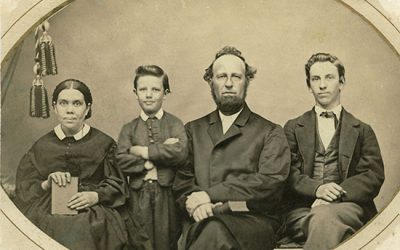
¿Quiénes fueron los hijos de Elena G. de White?
Elena G. de White, probablemente la cofundadora más conocida de la Iglesia Adventista del Séptimo Día, tuvo cuatro hijos con su esposo, James: Henry Nichols, James Edson, William Clarence y John Herbert.

Kwa nini Wadventista wa Sabato Wengi wanachagua Lishe Inayotokana na Mimea?
Ingawa siyo kila Mwadventista anatumia vyakula vya mimea pekee, wengi hujiepusha kabisa na nyama ili kuishi maisha yenye afya katika juhudi za kumheshimu Mungu, kimwili, kiroho, na kiakili.
![Understanding the Book of Mark [An Overview]](https://devsite.askanadventistfriend.com/wp-content/uploads/2026/02/bible-open-to-mark-400x250.jpg)
Understanding the Book of Mark [An Overview]
Understanding the Book of Mark [An Overview]The Book of Mark is one of the four Gospel accounts that begin the New Testament, and its author is widely believed to be John Mark, a relative of Barnabas who worked with both Peter and Paul. It’s the shortest Gospel...

An Overview of Romans: Faith, Righteousness, and Relationships
Here’s a breakdown and background of Paul’s longest epistle.
Tudo o que você precisa saber sobre as refeições do Sábado
Tudo o que você precisa saber sobre as refeições do Sábado.Para os Adventistas do Sétimo Dia, compartilhar uma refeição de sábado com amigos e família é uma das partes mais especiais e memoráveis do sábado. É por isso que queremos compartilhar com você tudo sobre as...
Yesu na Yohana Mbaptisti: Uhusiano Wao na Huduma
Yohana Mbatizaji na Yesu walikuwa ndugu wa damu, marafiki, na wafanyakazi wa karibu katika huduma. Jifunze umuhimu wa kudumu wa uhusiano wao.
Muhtasari wa Elimu ya Juu ya WaAdventista wa Sabato
Muhtasari wa Elimu ya Juu ya WaAdventista wa SabatoKanisa la WaAdventista Wasabato lina takribani shule za sekondari 118 ulimwenguni kote.1 Ingawa nyingi zipo ndani ya Amerika Kaskazini, pia utapata vyuo vikuu vya WaAdventista katika nchi mbalimbali duniani—mahali...
The Book of John: An Overview
Here’s a study companion for the Gospel according to John.

Waadventista wa Sabato Wanaamini Nini Kuhusu Pambano Kuu (Wema na Uovu)?
Pambano Kuu” ni msemo ambao Waadventista wa Sabato kawaida huutumia kuelezea mgogoro wa kiroho wa ulimwengu kati ya nguvu za mema (Mungu) na nguvu za uovu au dhambi (Shetani/iblis).
Silaha Zote za Mungu Kama Ilivyoelezwa Katika Waefeso 6
Katika Waefeso 6, Mtume Paulo alikuwa akisaidia watu kuelewa maana ya kujilinda katika vita vya kiroho (Waefeso 6:10-18).
A Armadura de Deus conforme Descrita em Efésios 6
Em Efésios 6, o Apóstolo Paulo estava ajudando as pessoas a entender o que significa se defender em uma guerra espiritual (Efésios 6:10-18).
¿Qué creen los Adventistas del Séptimo Día sobre el gran conflicto (bien vs. mal)?
El “gran conflicto” es la frase que los Adventistas del Séptimo Día suelen usar para describir el conflicto espiritual cósmico entre las fuerzas del bien (Dios) y las fuerzas del mal o del pecado (Satanás/el diablo).
Didn’t find your answer? Ask us!
We understand your concern of having questions but not knowing who to ask—we’ve felt it ourselves. When you’re ready to learn more about Adventists, send us a question! We know a thing or two about Adventists.