
Ellen White, one of the founders of the Seventh-day Adventist Church, believed that education was not complete unless it was founded upon the principles of the Bible.
It’s crucial for giving students a framework through which to understand every other aspect of life.
But what does the Bible have to do with math or science? Is it important to integrate the Bible with schoolwork?
We’ll answer these questions by looking at:
- Why Ellen White cared about education
- Her insights for a Bible-based education
- Where her counsel about education came from
- How to incorporate the Bible into the classroom
Let’s first get some background to Ellen White’s emphasis on education.
Why Ellen White cared about education
Ellen White focused so much on education because she recognized its ripple effect on every other part of life. As Proverbs 22:6 states, the direction of a person’s life is shaped during the training received in the formative years. An education that leads children to know God is vital because it’ll impact them for the rest of their lives—and possibly for eternity.
Ellen White advocated for whole-person education—what she called true education.
This type of education went beyond the three Rs. She emphasized that it “is the harmonious development of the physical, the mental, and the spiritual powers.”1
It also incorporates service, a core principle of Christianity: “It prepares the student for the joy of service in this world and for the higher joy of wider service in the world to come.”2
Taking it one step further, she wrote that education, in its highest sense, is connected to the work of redemption. Both have their foundation in Jesus Christ.3
And if education is so closely tied together with redemption, it makes sense that the Bible would play an important role in both.
Ellen White’s insights for a Bible-based education

Photo by Gift Habeshaw on Unsplash
Ellen White believed in having the Bible as the foundation for education. She wrote, “The Bible is the great educator; for it is not possible prayerfully to study its sacred pages without having the intellect disciplined, ennobled, purified, and refined.”4
Though the Word of God isn’t a comprehensive textbook on every subject, it provides a worldview that can shape how a student thinks about life.
And how does it do this?
For one, the Bible shows us our origin and our ultimate purpose.
It shows us that God created humans to reflect His image. But to a great extent, we lost the image of God when Adam and Eve chose to disobey Him (Genesis 3). A Bible-based education plays a role in restoring us to reflect the character of God again.5
This restoration ties education to the Great Controversy theme in the Bible.6 The Great Controversy is the unseen battle between good and evil—God and Satan—happening at this very moment. Satan has worked hard to skew our understanding of God and turn Him into something He is not.
Educating children within a biblical framework can help them see God’s true character and the way the love of God can transform their lives.
When it comes to the use of the Bible in the classroom, Ellen White offered balanced guidelines. The Word of God couldn’t just be inserted into the curriculum to “flavor” the other subjects.7
She wrote,
“The Bible should not be brought into our schools to be sandwiched in between infidelity. The Bible must be made the groundwork and subject matter of education.”8
In other words, teachers and students shouldn’t treat the Bible like every other textbook that may or may not contradict Christian teachings. Rather, the Bible is the authority for evaluating every other textbook.
But the Bible can’t be the only textbook, either.9 Not every subject is in the Bible.
What Ellen White advocated for is an education through the lens of a biblical worldview. This means that the subject matter of the classes promotes the values of the Bible and points to Jesus. The students learn to evaluate everything by the principles of the Bible.
But what is the purpose of a biblical framework after the child has finished school?
Proverbs 22:6 tells us,
“Train up a child in the way he should go, and when he is old he will not depart from it.”

Photo by Stormseeker on Unsplash
This is what a biblical education seeks to do—to teach students to use the Bible to think and reason for themselves all throughout life. Ellen White said,
“It is the work of true education to develop this power, to train the youth to be thinkers, and not mere reflectors of other men’s thought.”10
As a result, students will have the skills to discern truth with the help of the Holy Spirit and effectively share that truth with others.
This kind of education prepares us to be good citizens and witnesses for Christ.
Here’s how Ellen White described this philosophy:
“The Holy Scriptures are the perfect standard of truth, and as such should be given the highest place in education. To obtain an education worthy of the name, we must receive a knowledge of God, the Creator, and of Christ, the Redeemer, as they are revealed in the sacred Word.”
Now that we have seen her counsels regarding a Bible-based education, let’s see where these counsels came from.
Where Ellen White’s counsel about education came from
Everything Ellen White taught about education is solidly rooted in the Bible and the truths the Spirit of God impressed upon her.
The context in which she lived also played a role in her desire to improve educational practices. So what did education look like in her day?
Education in Ellen White’s time

Photo by Austrian National Library on Unsplash
In the mid-to-late 1800s, education in industrialized countries was far from what it is today. In the United States, most schools were one-room country schoolhouses where students were taught the “three Rs” of reading, writing, and arithmetic. Though much of the class material was moral and practical, the main learning method was memorization. Students didn’t have to think critically about what they were studying.11
The schoolhouses were dark, and little physical movement was permitted outside of recess. “Fidgeting” called for severe punishment.
As a result, education was one-sided, focusing on developing mental capacities over physical ones.
The few schools of a higher caliber often taught a classical curriculum.12 Students, mostly young men, learned the arts and studied the writings of classic thinkers, such as Cicero, Plato, and Homer. These authors were steeped in Greek and Roman philosophy, which often contradicted biblical principles.
At this time in America, the Transcendentalist period was also in full swing, and its ideas about humanity’s inherent goodness clashed with the Bible’s teaching that man is sinful and needs a Savior.
Education needed help, and Ellen White stepped in to do what she could for the next generation. While she was also interested in what educational reformers were proposing, the Bible was her principal guide.
The Bible and God’s counsel
The Bible shaped every aspect of Ellen White’s educational counsel. She often quoted passages from Scripture and used their principles when outlining teaching methods.
For example, in her book Education, she traces education from the time of Adam and Eve to the Israelites and gleans principles for today.
Just like the Israelites were instructed to educate their children in a true knowledge of God, she encouraged teachers to make the law of God a practical part of daily life:
“These words that I am giving you today are to be in your heart. Repeat them to your children. Talk about them when you sit in your house and when you walk along the road, when you lie down and when you get up” (Deuteronomy 6:6–7, CSB).
As Ellen White wrote these ideas down, God was guiding her. Though she didn’t record a specific vision on the topic, she wrote that “the subject of education has been presented before me in different lines, in varied aspects, by many illustrations, and with direct specification, now upon one point, and again upon another.”13
Let’s look at how we can make her counsel practical.
How to incorporate the Bible into the classroom
As we addressed earlier, students can be taught to evaluate every subject through a biblical worldview. Here are ways to do this:
Use biblical themes for essay topics
When teaching students how to write, teachers can give them essay prompts on themes that encourage them to look for answers in the Bible. Students could also study a Bible character or topic, such as faith or ambition, and write about their findings.
Give reading assignments based on biographies in the Bible
The Bible is a unique collection of narratives that can make for great character studies.
Ellen White pointed out that because God is the ultimate author of the Bible, its biographies don’t have the human bias common in other stories:
“No part of the Bible is of greater value than its biographies. These biographies differ from all others in that they are absolutely true to life. It is impossible for any finite mind to interpret rightly, in all things, the workings of another. None but [God]…[can] delineate character, or give a faithful picture of a human life.”14
Through reading Bible narratives, students will also learn the principle of cause and effect: actions have consequences. Ellen White puts it this way:
“No truth does the Bible more clearly teach than that what we do is the result of what we are. To a great degree the experiences of life are the fruition of our own thoughts and deeds.”15
Teach science from a biblical perspective, using the story of Creation

Teachers can use a creationist curriculum, coupled with a study of the Creation story, to establish students in a biblical perspective of our origins.
Study the methods of government in Bible times
While learning about modern types of government, students can also learn about how governments look at various points in Bible history. For example, the special form of government God designed for the Israelites in contrast to those of other nations mentioned in the Bible, such as the Babylonians, Persians, and Romans.
Include the narratives of the Bible in the study of history
We often think of the Bible as a spiritual book, but it’s also a rich repository of ancient history. In fact, the Institute for Creation Research states,
“The Bible has proven to be more historically and archaeologically accurate than any other ancient book. It has been subjected to the minutest scientific textual analysis possible to humanity and has been proven to be authentic in every way.”
So why not use it as a source in your world history curriculum?
A Bible-based education develops individual thinkers
Ellen White summed up her biblical integration ideas in a single quote:
“In [the Bible’s] pages are found history the most ancient; biography the truest to life; principles of government for the control of the state, for the regulation of the household—principles that human wisdom has never equaled.”16
Even if the students aren’t directly participating in Bible study, their teachers can weave those principles into many aspects of the classroom. The Bible can be the standard for testing all other subject matter and activities.
In this way, children carry a solid foundation into adulthood—the ability to think for themselves and evaluate life by the Bible.
- White, Ellen G., Education, p. 13 [↵]
- Ibid. [↵]
- Ibid., p. 30 [↵]
- White, Ellen, Christian Education (International Tract Society, 1894), p. 103 [↵]
- Douglass, Herbert E., Messenger of the Lord, p. 346 [↵]
- Ibid. [↵]
- bid., p. 347 [↵]
- White, Ellen G., Fundamentals of Christian Education, p. 474 [↵]
- Messenger of the Lord, p. 347 [↵]
- Education, p. 17 [↵]
- Knight, George, “The Transformation of Education” in Land, Gary, The World of Ellen White, pp. 162-163 [↵]
- Ibid. [↵]
- Fundamentals of Christian Education, p. 310 [↵]
- Education, p. 146 [↵]
- Ibid. [↵]
- Ibid., p. 125 [↵]
More Answers

What Day Is the Sabbath, and How Do We Know?
The Sabbath is a declaration of weekly rest by God which we find in the Bible (Genesis 2:2-3). But you may be wondering:

Why Do Some Bibles Have More Books Than Others?
Christians consider the Bible as their sacred writings. But within Christianity, different denominations use Bibles with different numbers of books.

Can We Find Jesus Christ In the Old Testament?
Yes, you might be surprised to know that there are hundreds of verses in the Old Testament about Jesus.

What the Bible Says About Resolving Conflicts
While it’s the main ingredient in a good story, it unfortunately can spoil things in real life. It might start from minor differences of opinion. But unchecked, it can turn into what feels like a full-blown war.

The Benefits of A Seventh-day Adventist Academy
Adventist academies are high schools (grades 9-12) that are owned and operated by the Seventh-day Adventist Church.

Are Seventh-day Adventists Christians?
Yes, the Seventh-day Adventist Church is a Protestant Christian denomination formed in 1863. Just like other Christians, we believe that Jesus Christ is our Savior and seek to follow the principles of the Word of God.


Adventist Movies: Where Faith and Film Meet
The Adventist Church uses film to share our faith and uplift positive values. Learn more about specific Adventist-produced films and where to find them.

Does the Bible Teach Predestination?
your choices, actions, and habits really matter to your eternal destiny? Or is the path you choose in life predetermined, and your life is just following a script that’s been laid out for you?
The Seven Churches of Revelation and What They Mean
The seven churches were churches that received messages from Jesus Christ through the apostle John while he was exiled on the island of Patmos. These letters are in chapters 2 and 3 of Revelation.

Do Adventists Celebrate Christmas?
In general, most Seventh-day Adventists do celebrate Christmas.
Since our denomination doesn’t have specific guidelines about holidays, it’s up to each member to decide whether to celebrate it based on their personal convictions and study of the Bible.

How Can I Know Ellen White’s Messages Were From God?
It’s natural to be a bit skeptical when you hear about someone being “divinely inspired,” or that something is a “message from God,” etc. And we expect nothing different if you’re hearing about Ellen White, an influential co-founder of the Seventh-day Adventist Church, for the first time. After all, the Bible tells us that we’re supposed to test these things!

Ellen G. White’s Time in Australia
Ellen White traveled to Australia in the later part of her life, and she ended up spending nine years there. In that time, she helped the Australian Seventh-day Adventist Church increase in size and strength.

Ellen G. White’s Time in Europe
When the Seventh-day Adventist Church was still young, a council of the church in Europe requested Ellen White, one of Adventism’s key leaders, to come to Europe. Despite the many obstacles, God led her there to help the new churches and members for two years.

Ellen G. White’s Travels and Worldwide Mission
Though Ellen White, a co-founder of the Seventh-day Adventist Church, is best known for her ministry in the United States, she also traveled to twelve other countries in her lifetime—a big accomplishment in the 19th century when travel was strenuous and long.

Ellen G. White’s Counsel on College Education
Ellen G. (Harmon) White, a significant co-founder of Adventism, is often known for her practical and spiritual guidance for proper childhood education. But she was also significantly involved in the development of Seventh-day Adventist higher education.

8 Pieces of Advice from Ellen White’s Counsel for Families
In this article, we’ll look at the insight Ellen White received from God. We’ll cover 8 major themes she highlighted for families.

Was Everything Ellen White Said Divinely Inspired?
The Seventh-day Adventist Church believes that many of Ellen White’s messages were inspired by God. But that doesn’t mean everything she ever said was prophetic, or meant to be taken as direct instruction from God. So let’s break down how to identify the nature of her many written messages and quotes.
Who Were Ellen White’s Children?
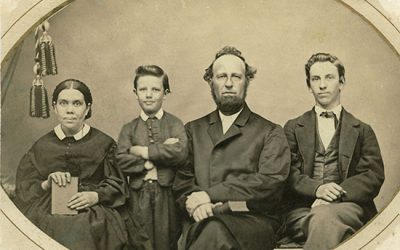
Being the children of a woman with a prophetic calling from God had its blessings and its challenges.
In this overview, we’ll look at the highlights of the lives of Ellen White’s sons during her many years of ministry, as well as the ways each of them decided to serve Jesus Christ:

Ellen White’s Spiritual Counsel on Marriage
As one of the founders of the Seventh-day Adventist Church, Ellen G. White was held in high regard. She was a prolific author and was heavily engaged in the mission of the denomination, prayerfully pursuing the guidance of the Holy Spirit.

Sabbath Keeping: What It Looks Like in the Bible
That Sabbath would not be about a checklist of rules but about a mindset of rest. It’s a day to set aside daily cares and connect with God, our Creator. Out of our love for Him, we take the principles of the Bible and apply them in the way we keep the Sabbath.

Ellen G. White or the Bible—Which is More Important to Adventists?
Ellen G. White or the Bible—Which is More Important to Adventists?The Bible—without a shadow of a doubt—is the most important book. It’s the standard we use to test all other writings, including those of Ellen White. The Seventh-day Adventist Church believes that “the...
Are Any of Ellen G. White’s Prophecies Yet to Come True?
Ellen White, a co-founder of the Seventh-day Adventist Church, demonstrated many times over that she had the spiritual gift of prophecy. Some of her predictions’ timelines have already passed, and those prophecies have been fulfilled. Others have yet to be fulfilled.

What Was Ellen G. White’s Counsel on Music?
Ellen G. White, one of the founders of the Seventh-day Adventist Church, also provided helpful guidance regarding music choices for Christians. She provided sound principles to answer questions the young Adventist Church had.

What Does the Bible Say About Modesty
Seventh-day Adventists and Christians in general try to ensure their outward presentation and lifestyle glorify God. This often involves daily habits like the ways we hold conversations, the ways we dress and accessorize, and the ways we regard other people when we’re out and about.

What Were Ellen White’s Visions About the Adventist Church?
What Were Ellen White’s Visions About the Adventist Church?Led by the Holy Spirit, Ellen G. White was given many messages, counsel, revelations, and visions about the Bible, history, prophecy, and how we can apply biblical principles to our daily lives. She was also a...

Is it necessary to attend church to draw closer to Christ?
What Does the Bible Say About Going to Church?While you certainly don’t have to go to church to develop a relationship with Jesus, the Bible makes it clear that gathering together with other believers can be really beneficial for your spiritual growth. For the early...

How Do I Know God Has Forgiven My Sins?
Knowing you’re forgiven is a big part of finding freedom in Christianity. The Bible tells us that after we’ve prayed for God’s forgiveness, we can believe we’re forgiven and accept His gift of pardon.

How Do Adventists Make Movie and Music Choices?
How do Adventists decide what music to listen to and which movies to watch? Learn how Bible principles can help us make better entertainment choices.
Didn’t find your answer? Ask us!
We understand your concern of having questions but not knowing who to ask—we’ve felt it ourselves. When you’re ready to learn more about Adventists, send us a question! We know a thing or two about Adventists.