
The most accurate Bible possible would be one that’s printed in its original languages—Hebrew and Greek. But since most of us are not Hebrew or Greek scholars, the next best option is an English Bible translation that most closely reflects the original language and intent while also presenting these ideas in a practical and understandable way.
You might feel overwhelmed with all the options out there—about 900 in the English language.1 That’s almost like a GPS giving you hundreds of routes to choose from!
But the process doesn’t have to be difficult. By understanding the three main categories of Bibles, you’ll find a version that suits your needs and helps you come to know Jesus better.
Here, we’ll cover:
- Why are there so many Bible versions?
- What are the different types of Bible translations?
- How to choose the best Bible version for you
Let’s first touch on why we have so many versions in the first place.
Why are there so many Bible versions?

Photo by Tim Wildsmith on Unsplash
The number of different Scripture translations has mushroomed in the past centuries as original manuscripts have been discovered and repeatedly translated.
The Old Testament was written in Hebrew, and the New Testament in Greek and Aramaic. After the first century, these languages became less and less common because Latin was the primary language of the Roman Empire.
And with the spread of Christianity to different countries, the Hebrew and Greek texts soon needed to be translated into those languages as well.
The result was many different manuscripts that have been used in recent centuries for modern translations.
As we’ll see next, those versions are divided into three main categories. The most accurate ones will be those translated from the original Hebrew and Greek manuscripts.
What are the different types of Bible translations?
Bible translations fall into three categories based on how closely they reflect the original wording of Greek and Hebrew manuscripts. They are:
1. Literal translations
2. Dynamic equivalents
3. Paraphrases
Literal translations
Literal, or word-for-word, translations seek to translate each Hebrew and Greek word in as literal a manner as possible. They are also called formal equivalents.
This can result in text that’s a little more clunky or difficult for modern readers to understand.
The reason for this is the differences between the Bible’s original languages and English. Sometimes, Greek and Hebrew words have multiple meanings in English, making it challenging for translators to know which English word to use.
And there are more than just word differences between these languages. There are variations in sentence structure, emphasis, and punctuation, too.
Even so, literal translations are the most accurate Bibles for in-depth study. Having additional resources on hand can also help with understanding what the original Bible writers meant. Try out a Strong’s Exhaustive Concordance of the Bible or Hebrew-English and Greek-English lexicons.
The following are some of the most popular translations in this category.
The King James Version (KJV)

Photo by Humble Lamb on Unsplash
Date translated: 1611
- Translated/produced by: Bible scholars of the Church of England; commissioned by King James
- Pros:
- Poetic writing style
- Traditional Bible for centuries
- Most popular Bible in use today
- Considered the most accurate translation for its time
- Cons:
- An old English version with archaic language. Some words had very different connotations back then.
- Harder to understand
The Revised Standard Version (RSV)
- Date published: 1952
- Translated/produced by: National Council of the Churches of Christ
- Pros:
- First translation to use the Dead Sea Scrolls
- Updated language
- Cons:
- Possible concerns about the theological viewpoints of the translators and bias in the text
- Can be hard to find printed copies
The New American Standard Bible (NASB)
- Date published: 1963
- Translated/produced by: The Lockman Foundation
- Pros:
- Highly accurate
- Contemporary English
- Translation notes with literal meanings of words and other possible translations
- Con:
- More literal wording that may not flow like modern wording
- Read the NASB for free.
The Amplified Bible (AMP)
- Date published: 1965
- Translated/produced by: Zondervan and the Lockman Foundation
- Pros:
- Additional meanings of words and phrases within the text to enhance the understanding
- One of the most easy-to-understand literal translations
- Con:
- The extra phrasing in brackets and parentheses can make the text feel cluttered, especially when reading out loud
The New King James Version (NKJV)
- Date published: 1982
- Translated/produced by: 130 Bible scholars, pastors, and theologians; published by Thomas Nelson
- Pros:
- Updated version of the KJV (updated grammar and wording while retaining the traditional poetic beauty of the KJV)
- Easier read with the older style
- Con:
- Still contains many archaic phrases
The English Standard Version (ESV)
- Date published: 2001
- Translated/produced by: Crossway; over 100 scholars and pastors
- Pros:
- More modern wording
- Keeps some of the most-loved verses close to the KJV translation
- Cons:
- Some hard-to-read sentence structure
- Concerns about possible theological bias (since the RSV was referenced in translations)
Dynamic equivalents
Dynamic equivalents, or thought-for-thought translations, convey the message of the Bible’s text rather than the exact words. Scholars have sought to use cultural, linguistic, and historical background to express in modern language what the original author intended.
While these translations are generally easier to read and understand, they’re not perfect. Every scholar comes to their work with a theological bias, so these translations may potentially express more bias than word-for-word translations.
But this fact doesn’t mean we should avoid dynamic equivalents.
Instead, they can make for enjoyable devotional reading in conjunction with other Bible study tools and more literal translations.
Check out these ones:
The New International Version (NIV)
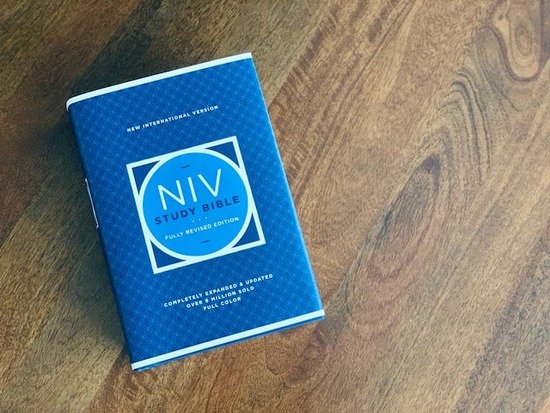
Photo by Tim Wildsmith on Unsplash
Date published: 1978
- Translated/produced by: Biblica (International Bible Society)
- Pros:
- One of the most popular, easy-to-read, modern versions of the Bible
- Uses word-for-word and thought-for-thought translation, striking a balance between
- Cons:
- Wording isn’t always the most poetic
- Translators sometimes added words that weren’t original, making it seem interpreted rather than translated
The New Living Translation (NLT)
- Date published: 1996
- Translated/produced by: Tyndale House Publishers
- Pros:
- A highly accessible version
- Changes traditional metaphors or terms to modern-day equivalents for easier understanding
- Cons:
- The colloquial language can make it seem far away from the original text
- Its use of modern terms and metaphors may change the originally intended meaning
God’s Word Translation (GW)
- Date published: 1995
- Translated/produced by: God’s Word to the Nations Society
- Pros:
- Printed in a single-column format for easy reading.
- Displays the reading in the way the Bible writers would speak if they lived today
- Con:
- Sometimes interprets phrases instead of translating them
- Read the GW translation for free.
The Christian Standard Bible (CSB)
- Date published: 2017
- Translated/produced by: Holman Bible Publishers
- Pros:
- An updated version of the Holman Christian Standard Bible, which is known as an “optimal equivalence” because it contains both word-for-word and thought-for-thought translation throughout
- Uses gender-neutral terms when the original language would also refer to both genders
- Easy-to-read text
- Con:
- Uses some unconventional translating ideas, like translating “beer” for “strong drink”
Paraphrases
Paraphrases are not translations in the strictest sense. Rather, they involve interpretation, rewording, and expanding upon the original text of the Bible to make it more understandable.
Paraphrases tend to have a greater potential for bias, particularly since they’re often the work of one individual rather than a committee of Bible scholars.
For these reasons, they work best when combined with more literal translations. But they can be a great addition to a devotional routine or study.
Here are four common paraphrases:
The Living Bible (TLB)
- Date published: 1971
- Produced by: Kenneth Taylor
- Pro:
- Seeks to communicate the meaning of each passage in as simple a way as possible
- Cons:
- Less poetic
- Potential bias and interpretation that may not be accurate to the originally-intended meaning
Good News Translation (GNT)
- Date published: 1976
- Produced by: Dr. Robert Bratcher together with a committee appointed by the American Bible Society
- Pros:
- Accessible to non-native English speakers
- Easy to read and understand
- Con:
- Potentially strays too far from the original meaning of the text
The Clear Word
- Date published: 1994
- Produced by: Jack J. Blanco
- Pro:
- A devotional paraphrase from an Adventist perspective
- Con:
- Not an actual Bible
- Learn more about the Clear Word.
The Message (MSG)
- Date published: 2002
- Produced by: Eugene H. Peterson
- Pros:
- Easy-to-read, colloquial language
- Can give a different perspective to verses
- Cons:
- A very loose translation of the original with heavy interpretation
- Some of the idioms used are American
How to choose the best Bible version for you

Photo by Kelly Sikkema on Unsplash
As we’ve already mentioned, the best Bible translation will be as close as possible to the originally intended meaning of its authors. Generally, word-for-word translations fit this criterion best.
Your purpose will also affect which one you should choose.
Let’s go through a few different purposes and the Bible versions that might work best for you:
- Bible study. If you are looking to dig deep into the Bible, a word-for-word translation (such as the NASB or the KJV) is ideal since it sticks closest to the original language. Though not always the easiest to read, Bible dictionaries and concordances can help remedy that challenge.
- Devotional reading. When looking for simple encouragement for your day and ways to connect with God, pick a Bible you can easily understand. Depending on what you are most used to hearing, this version could be a word-for-word translation or a dynamic equivalent.
- Memorization. Remember Psalm 23’s classic “thy rod and thy staff they comfort me”? Some versions are written very poetically and are the standard you hear quoted. The King James Version is one of the most famous.
- Reading aloud. Choose a translation that allows the words to easily roll off your tongue and that is easy for listeners to understand. Thought-for-thought translations usually fit this bill because they are written in modern English.
- Secondary Bible. You may already have a favorite Bible but want another for comparison. A good way to balance your selection is to pick the opposite type of Bible from the one you have now. If you use a thought-for-thought version, pick a word-for-word translation and vice versa.
- Children’s Bible. A thought-for-thought version with simpler language may be the best for children who might struggle with more literal wording.
The key is getting to know the ultimate author of the Bible
Due to the challenges of translating from language to language, no Bible translation will ever be able to fully convey the originally intended meaning of all its passages.
After all, Scripture was written by finite humans about an infinite God. So there’s always more to learn.
But the good news is that this fact hasn’t obscured the message in the Word of God. Through the years, God has used His people to preserve this valuable book so that it could continue to be transformative in the lives of many.
So instead of getting hung up on the details, use the principles listed here to pick an accurate and readable Bible.
Then, focus on what’s most important: getting to know the author of the Bible. He has promised to give us the Holy Spirit to guide us to all truth (John 16:13).
- “Number of English Translations of the Bible,” American Bible Society. [↵]
Related Articles



More Answers

Do I Need to be an Adventist to be Saved?
The answer to this question is simply, “no.”
When it comes to salvation in Jesus Christ, all that is required of a person is to acknowledge Jesus’ sacrifice for us, believe that He has saved us, and claim the free gift of salvation that is always available to us. Salvation is not based on denomination.

Do You Have to Be Vegetarian to Be Adventist?
Of course not. Membership in the Seventh-day Adventist Church has never included any dietary requirements. However, there might be some reasons people might think that. So many Adventists are vegetarians or even vegan, and a plant-based lifestyle has many health benefits.

What Does the Bible Say About the End Times?
First of all, when we say “end times,” this refers to the period of time that precedes the second coming of Jesus—and the end of this sinful world before it’s recreated into the new earth. And several passages of Scripture provide us with clues and guidelines to help us recognize when these times are near, what kinds of things we can expect, and what it might mean for our daily lives and priorities.

All About Seventh-day Adventist Colporteurs
The Seventh-day Adventist Church uses a variety of methods to spread the hope of the gospel to the world. One of these ways is through colporteuring, also called “canvassing” or “literature evangelism.”

How Ellen White Influenced the Adventist Health Message
Seventh-day Adventists are known for their emphasis on healthy living. And Ellen G. White was a significant influence in the development of this priority and practice among Adventists.

Does Prayer Work? If So, How Are Prayers Answered?
Prayer is how human beings reach out to a higher power. For Christians, it’s how we communicate with God. But does it really work? Is it true that God actually intervenes in situations when we call out to Him for help? And why are some prayers answered immediately, while others seem to go unanswered or not get answered for a long time?

What Did Ellen White Teach About Vegetarianism?
One thing you might have heard about Seventh-day Adventists is their emphasis on a vegetarian lifestyle. If you’re wondering why that is, it goes back to our church’s humble beginnings:
Steps to Christ: A Guide to a Relationship with Jesus
Whether you’re just starting your journey with Jesus Christ, are coming back after some time away, or have had a relationship with Jesus for years, using a book—in addition to the Bible—to guide or supplement that relationship can be helpful, comforting, and joyful.

What Is an Adventist Book Center (ABC)?
When you walk into any one of the many Adventist Book Center (ABC) locations, chances are you’ll be greeted by pleasant gospel music in the background, friendly employees, and row after row of Christian books, movies, Bibles, study guides, kids’ games, and more.

Prayer—How Do I Do It?
Prayer is intentional communication with God. And the way you go about it is much like how you’d communicate with your best friend. You can reach out anytime and anywhere, in the way that’s most natural between the two of you.

15 Examples of Prayer in the Bible
Prayer is the primary way we maintain our relationship with God. It’s our method of communication, and He miraculously hears every word that comes from our hearts.

Do Seventh-day Adventists Celebrate Holidays?
Wondering whether your Adventist classmate or coworker keeps the same holidays you do? Perhaps you want to include them in some festivities, but you also want to respect their beliefs. Thus, you’re unsure of how to navigate the holiday question. Will they accept your invitation to the office Christmas party?

Ellen White and Adventist Healthcare—Ahead of Their Time
Medical care in the mid-1800s was primitive, to say the least. Basic concepts we take for granted—such as proper handwashing or recognizing the dangers of bloodletting—were nonexistent. And doctors often had little more than nine months of training!

How Ellen White’s Teachings Can Improve Your Health
Healthcare in the nineteenth century was said to leave “more disease than it took away” with its use of bloodletting and “medicines” like mercury and arsenic. As people questioned these methods, new approaches popped up. But which ones were reliable?

Do Adventists Worship Ellen White?
Ellen White was a co-founder and leader in the Seventh-day Adventist Church from its beginning. Adventists believe that she had the prophetic gift (Ephesians 4:14; 1 Corinthians 12:28) and passes the biblical tests of a prophet.

Can I Be an Adventist If I Don’t Believe in Ellen White?
Ellen White is an important part of the Seventh-day Adventist Church: she played a significant role in its founding, provided biblical support for several key doctrines, and continues to inspire church members today with her insightful counsel.

The Adventist Haystack (It’s Not What You Think) + 4 Recipes
Haystacks are basically a taco salad—with an Adventist spin on it! Most versions are vegetarian and offer an endless combination of tasty toppings. We eat them often because they’re healthy, scrumptious, and easy to make.

Do Seventh-day Adventists Believe in Medical Care?
The Seventh-day Adventist Church believes in and supports evidence-based medical care. In fact, medicine has played a significant part in our history, and today we run a major health system with hospitals, medical schools, and clinics throughout the world.

Why do Adventists Emphasize Religious Liberty?
Adventists see religious liberty as an essential human right. After all, God endowed humanity with freedom of choice from the very beginning. So we believe it’s best for governments to also support their citizens’ rights to worship based on their convictions.

All about Adventist Elementary Schools
The Seventh-day Adventist Church operates the largest Protestant education system in the world. A big part of this system is our K-8 elementary schools, or primary schools, as they’re known in other parts of the world.

What Are Pathfinder and Adventurer Clubs?
Like the boy or girl scouts, Pathfinders and Adventurers learn about nature and life skills. But what makes these clubs special is their purpose to bring young people closer to Jesus.

13th Sabbath Offering: What It Is and Why It Matters
While the previous 12 Sabbaths of the quarter feature an established Adventist ministry and its current giving needs, the 13th is a rotating spot reserved for current mission projects.

A Look at Adventist Colleges and Universities
On the outside, Seventh-day Adventist universities may not look much different than other college campuses. But the real differences are beneath the surface.

What Is ASI (Adventist-Laymen’s Services and Industries)?
ASI, which stands for Adventist-laymen’s Services and Industries, is a membership-based organization that provides support for Seventh-day Adventist laypeople (Adventist professionals who aren’t pastors).

What Are Adventist Evangelistic Meetings?
The Seventh-day Adventist Church puts a huge emphasis on sharing the gospel through evangelism, or sharing the gospel through preaching, teaching, and testimony. One of the ways we accomplish this is by organizing public events called evangelistic meetings.

Rest and Reconnection: What It Really Means to Keep the Sabbath
The Bible tells us that we keep the Sabbath by avoiding work. God made this law because he knew it would strengthen us and bring us joy, as well as give us time to reconnect with Him and recharge from our busy lives.


The Parables of Jesus: What They Teach Us About Life
Have you ever been on the verge of sleep in the middle of a long lecture or sermon when suddenly the speaker takes a turn and begins to tell a story?

The Story of Moses in the Bible: What His Life Teaches Us
A baby on death row, an outcast prince, a humble shepherd, and an unlikely deliverer. All these titles describe the individual that led Israel out of slavery in Egypt to the borders of the Promised Land.
Didn’t find your answer? Ask us!
We understand your concern of having questions but not knowing who to ask—we’ve felt it ourselves. When you’re ready to learn more about Adventists, send us a question! We know a thing or two about Adventists.