
The New Testament book of 1 Corinthians is a letter from the Apostle Paul to the first church in Corinth. It offers firm but loving guidance to Christians living in a city famous for moral corruption.
And the heart of the message is to keep the Gospel of Jesus Christ at the center of all things.
But 1 Corinthians wasn’t only for a small group of believers in the early church. Paul’s lessons about church conflict and other tough topics still hit home today.
So let’s break down what this book is all about:
- Background and context
- Why Paul wrote it
- What it’s about
- How it’s relevant today
- Where we go from here
With the basics of the book under our belt, we can see how the principles discussed here are timelessly helpful and based on unconditional love.
To help us grasp the big picture, let’s take a trip back in time (cue Greco-Roman marketplace music).
*Note: All referenced verses are from the book of 1 Corinthians, unless specified otherwise.
1 Corinthians: setting the stage

Photo by Petra Reid
Author: The Apostle Paul, with the help of a secretary/scribe (or “amanuensis”) named Sosthenes (1:1, 16:21).
Audience: To the Corinthian Christians, “The church of God at Corinth” (1:2, CSB). But the word “Christian” wasn’t common yet, so they would’ve called one another “saints” or “brethren” (1:2; 2:1).
This book also mentions a few Christian converts by name. Specifically, Chloe (and her people), Crispus, Gaius, Stephanas, Fortunatus, and Achaicus.1 Most of them weren’t wealthy, powerful, or of noble birth (1:26).
Genre: An epistle (or letter). It’s one of at least 12 more letters attributed to Paul. They include 2 Corinthians, Romans, Galatians, Ephesians, Philippians, Colossians, 1 & 2 Thessalonians. Plus 1 & 2 Timothy, Titus, Philemon (and some say Hebrews).
It’s the first letter the Bible records from Paul to the Corinthians. But as we’ll see later, experts believe he wrote a previous letter, now lost.
Date: In the springtime around AD 55 (16:8).2
Location: Paul sent his letter from Ephesus to Corinth, likely via Timothy (4:17; 16:10).
Corinth was a Greek city destroyed by the Romans in 146 BC and rebuilt as a Roman colony by Julius Caesar in 44 BC.3
And this was no ordinary city.
“In this important harbor city teaming with human traffic and commerce, vice and immorality also abounded.”4 It was so corrupt that people used the phrase “to Corinthianize” to describe promiscuity amid extreme luxury.5
Corinth was the center of Aphrodite worship for the Greek mainland.6 Since she was considered the goddess of love and sexuality, worship practices were known to involve highly permissive sexual behavior that included promiscuity and prostitution.7
But even with all that going on, Paul still saw great potential for drawing people to Christ.
He stayed in Corinth for 18 months and “persuaded both Jews and Greeks” about the Gospel (Acts 18:1-5; 11, NKJV). Despite setbacks and persecution, many Corinthians got baptized (Acts 18:7-8, 12-17).
Paul stayed long enough to establish a growing group of Christians in Corinth. Then he left to share the good news of Jesus in Ephesus (18:18-19).
But it wasn’t long until Paul had reason to reconnect with his Corinthian converts. Let’s talk about why.
Why did Paul write the book of 1 Corinthians?
Towards the end of Paul’s three-year stay in Ephesus, he hears troubling news from a few Christians in Corinth (1:11). We don’t know what they told him, but we know he’s concerned enough to send an urgent letter of advice to the Corinthians. This letter serves three immediate purposes:
1. To address issues like divisions over leaders, immoral behavior, and worship distractions
2. To answer questions on marriage, spiritual gifts, idol-related foods, and Christ’s resurrection
3. To remind them to let Christ shape their identity, behavior, and relationships
Paul knew how fragile the young church in Corinth was. He wrote like a loving father guiding his children. He explains where they’ve gone astray and gives principles for better decision making.
At the same time, he warns them not to put church leaders, like himself, in the place of Jesus. By forming strong Christian self-identities, they can overcome social pressure.8
In Paul’s time, of course, there were no quick weekend trips, video calls, or emails. But he did everything in his power to reach them. He:
- Sent an initial letter with some guidance (5:9)
- Sent the letter we know as 1 Corinthians (1:2)
- Urged Apollos to return to Corinth (16:12; more on this soon)
- Sent Timothy as a trusted spiritual counselor (16:10)
- Promised to visit in person as soon as possible (16:5-7)
Let’s go into more detail about the instructions Paul gave the Corinthians.
Key verses and themes of 1 Corinthians
Paul addresses several complex themes in 1 Corinthians, including:
1. Divisions in the church (1:10-4:21)
2. Incest (5:2)
3. Lawsuits between members (6:1-8)
4. Sexual immorality (6:9-20)
5. Marriage and divorce (Chapter 7)
6. Idolatry (Chapters 8-10)
7. Spiritual gifts (Chapters 11-12, 14)
8. Love (13)
9. Christ’s resurrection (Chapter 15)
Much like texts today, it’s hard to get tone across in a letter. But Paul clarifies his intentions early on:
“I’m not writing this to shame you, but to warn you as my dear children. For you may have countless instructors in Christ, but you don’t have many fathers. For I became your Father in Christ Jesus through the Gospel” (4:14-15, CSB).
Let’s break down the themes by how they’re grouped in the Bible.
Chapters 1-4: Church divisions and wisdom
Paul’s focus in the first few chapters is to warn the people how destructive church divisions can be. He also includes a greeting, discussion on wisdom, and reminder of the Gospel message. But it all supports his arguments against divisions within the church family.
Let’s explore the main themes of 1 Corinthians chapters 1-4 to see how it all connects.
Greeting
Paul opens by reminding his audience that they’re all connected by Christ, and he’s writing as a representative of God (1:1-9).
And he doesn’t waste any words or thoughts. He uses every part of 1 Corinthians to promote spiritual growth and turn people’s minds back to Jesus.
Divisions

Photo by SHVETS production
Paul wasn’t the only Christian evangelist to come through Corinth. Other apostles, like Apollos and Cephas (aka Peter) also taught and baptized Corinthians. All the apostles were on the same team. But the people started picking favorites, which divided them (1:10-13).
The purpose of Christianity is to unite in Christ. So, Paul addresses the dangers of dividing over human leadership:
- By fighting over who they prefer, they’re showing spiritual immaturity (3:1-4)
- By placing confidence in humans, they’re losing hold of Christ (3:21-23)
- Evangelists are simple servants of God (4:1)
- No one should place apostles on a pedestal (4:9-13)
- Only God knows the heart and can judge between teachers (4:3-5)
None of the apostles encouraged this “celebrity” treatment. Paul asks Apollos to return to Corinth, but Apollos decides to wait (1 Corinthians 16:12). This suggests he wants to let things calm down until his presence will cause less division.
Wisdom
Paul supports his teaching against divisions with teachings on wisdom. He says humans can only understand spiritual subjects with the help of the Holy Spirit:
“The natural person does not accept the things of the Spirit of God, for they are folly to him, and he is not able to understand them because they are spiritually discerned” (2:14, ESV).
Because of sin, humans inherited Satan’s self-centered nature. Generosity and humility don’t tend to gain much personal wealth or success. Only when the Holy Spirit transforms us to recognize and understand unconditional love can we embrace a self-sacrificing Savior:
“For the word of the cross is folly to those who are perishing, but to us who are being saved it is the power of God” (1:18, ESV).
“For Jews demand signs and Greeks seek wisdom, but we preach Christ crucified, a stumbling block to Jews and folly to Gentiles, but to those who are called, both Jews and Greeks, Christ the power of God and the wisdom of God” (1:22-24, ESV).
Paul also reminds the Corinthians how they came to accept salvation in the first place. It was through total trust in God—not human reasoning (1:26-30). That’s why they should “boast in the Lord” instead of which apostle to follow (1:31, ESV).
Next, Paul tackles a few other areas where the Corinthians lacked wisdom.
Chapters 5-7: Sexual immorality, marriage, divorce, and lawsuits
Imagine becoming one of the first Christians in a city that encourages immorality. Paul knows the pressures they’re facing and addresses their backsliding head on.
Let’s do a quick breakdown of the major issues.
Sexual immorality (5:1-13; 6:9-20)
First, Paul refers to a letter that warned against sexual immorality (porneia in Greek9):
“I wrote to you in my letter not to associate with sexually immoral people” (5:9, ESV).
Experts believe this refers to a previous letter that isn’t part of 1 Corinthians:
“This letter is now lost, but it seems to have urged a moral discipline on the church which was not well received.”10
It’s obvious they were still struggling with inappropriate behavior. Some were even bragging about it!
Here’s how Paul responds:
“Your boasting is not good. Do you not know that a little leaven leavens the whole lump?” (5:6, ESV).
For context, it only takes 1-2% of the flour’s weight in yeast for bread to rise. Paul’s analogy shows that a few people are corrupting the entire company of Christians. So, he gives this advice:
- Send away a certain man who claims Christianity, yet brags about incest (5:1-2)
- Avoid people who claim Christianity, yet embrace destructive behaviors (5:11)
- Don’t avoid sinners altogether. We’re all sinners. This is about avoiding Christians who claim to follow Jesus yet promote known types of sin (5:10)
While it might feel abrupt or dramatic to send a person away from the community, Paul points out that ignoring a fellow Christian’s ongoing sinful behavior—especially when it’s actively affecting others—isn’t loving at all (5:5; 6:3). He hopes that removing this man from church fellowship will awaken his conscience.11
And he reminds them that baptized Christians unite with Christ and the body of believers:
“Or do you not know that your body is a temple of the Holy Spirit within you, whom you have from God? You are not your own, for you were bought with a price. So glorify God in your body” (6:19-20, ESV; see also 3:16-17).
This unity leads us to Paul’s next point: Legal action between Christians.
Lawsuits among Christians (6:1-11)
Paul tells the Corinthians to keep the secular world out of Christian legal matters. And he doesn’t beat around the bush:
“I say this to your shame! Can it be that there is not one wise person among you who is able to arbitrate between fellow believers?” (6:5, CSB).
This wasn’t a new concept. In the Old Testament, God instructed His people to appoint judges of their own (Deuteronomy 16:18).
But Paul also gives them the big picture. He advises more forgiveness, as God gives them undeserved forgiveness and mercy (6:9-11).
Marriage, divorce, and singleness (1 Corinthians 7)
From this point on in the book, Paul answers questions from the Corinthian church. And someone asks if it is “good” for a man to be celibate (7:1).
Since Corinth was an environment that included moral vice and legal prostitution, it’s no wonder the Corinthians had concerns.
Here are Paul’s points in a nutshell:
Staying single for prioritizing service: It’s easier to serve God with undivided attention (verses 7, 32). Paul also says widows are free to remarry but might prefer staying single (verses 39-40).
Marriage can help guard against sexual immorality: Paul shares in verses 2-5 and 9 how it makes sense that having a spouse and regular sexual intimacy helps avoid the temptation “because sexual immorality is so common” (verse 2, CSB). But he later notes that marriage can also come with distracting challenges (verses 33-34).
So Paul isn’t anti-marriage. But he has a very straightforward style of acknowledging the stress of maintaining marriage in a sinful world (and especially in a place like Corinth). He sees both marriage and singleness as callings from God (verses 17-31).
“Let each one live his life in the situation the Lord assigned when God called him. This is what I command in all the churches” (verse 17, CSB).
Divorce is to be avoided: Paul advises against divorce, even from a non-Christian spouse (verses 10-16).
These days, a few of Paul’s points might raise more questions than answers. But here’s what’s important:
The Corinthians were navigating a complex society. Some likely still followed the Jewish rule that all men must marry.12 And it seems others held the inaccurate belief that any sex, even within marriage, somehow polluted the body and spirit. And so, they felt avoiding marriage and sex was a Christian duty.13
Paul’s words would’ve set them free from basing their decisions on human customs that were likely well-intended, but often placed unnecessary expectations or restrictions on them that were not biblical.
Chapters 8-10: Idol foods and freedom of conscience
Next, Paul answers a question about eating food offered to idols. Some Corinthians were comfortable eating food offered to idols since idols are worthless. But others followed their consciences by not eating idol foods. Paul confronts the real issue here—how to love fellow Christians:14
“Now about food sacrificed to idols: We know that ‘we all have knowledge.’ Knowledge puffs up, but love builds up” (8:1, CSB).
“‘All things are lawful,’ but not all things are helpful. ‘All things are lawful,’ but not all things build up” (10:23, ESV).
Our pride in thinking we know best can overshadow our love and care for others.
Even though Christ gives us freedom of conscience, Paul says to be very careful not to use this to harm someone else’s faith journey. He calls that a “stumbling block” to other Christians (8:9).
Here’s just one possible example, though there could be many types of situations where this principle applies:
Some faith groups might ask visitors to wear head coverings or modest clothing. A visitor from a different Christian faith might not have a spiritual conviction to do this. But as a visitor to a gathering of such a group, they have two choices:
1. Dress how they always dress because it’s not distracting to their own faith walk.
2. Dress as requested out of respect and courtesy.
Paul doesn’t tell the Corinthian Christians to all have the same conscience. Or to go with the crowd. He instructs them to rely on God:
“So, whether you eat or drink, or whatever you do, do all to the glory of God” (10:31, ESV).
“No temptation has overtaken you that is not common to man. God is faithful, and He will not let you be tempted beyond your ability…” (10:13a, ESV).
Chapters 11-12, 14: Church behavior based on love
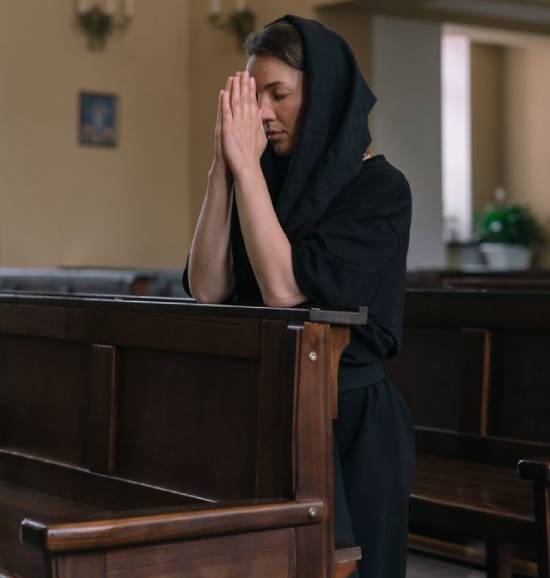
Photo by Mikhail Nilov
Next, Paul teaches Christians how to keep a Christlike atmosphere during worship so everyone can benefit.
Head coverings while prophesying or praying (11:2-16)
This is one of the more difficult passages in 1 Corinthians to interpret. Some scholars disagree about what Paul means by “head,” what kind of covering or hairstyle he has in mind, the cultural significance of covered and uncovered heads, and how his statements about men and women relate to one another. Craig Blomberg, MA, PhD, even considers it the most challenging of any text of similar length in the New Testament.15
Theologian Lucy Peppiatt, PhD, summarizes four different ways that Corinthians scholars interpret this passage:16
- Theory 1 (Subordination): Paul showed a pattern of teaching an order of male authority and required women to cover their heads when praying or prophesying
- Theory 2 (Subordination yet with equality): Paul affirmed some form of male headship in 1 Corinthians 11:2-10 while balancing it with the mutual dependence and inherent equality of men and women in verses 11-16
- Theory 3 (Paul correcting the Corinthians): Some of the ideas in this passage reflect the Corinthians’ own views about women and head coverings, which Paul quoted or responded to rather than endorsed
- Theory 4 (Cultural honor and shame): Paul was concerned with head coverings or hair styles because of what they communicated about honor, sexual propriety, gender, or religious identity within the culture at the time
The last theory focuses on proper manners according to the customs of the time, and is closer to Blomberg’s position. He puts forth that the common practices carried cultural messages regarding sexual and religious faithfulness—and that the underlying principle is not necessarily the head covering itself, but avoiding appearances that could communicate the wrong thing within a person’s culture.17
Following this set of ideas, the principle remains relevant even when the specific customs aren’t.
So whatever Paul’s purpose was with 1 Corinthians 11:2-16, he wasn’t making a blanket statement that men are more valuable to God than women. Or that men have more access to, or a closer connection with God, than women. Because in the same passage, Paul also explicitly says:
- Women pray and prophesy (11:5)
- “In the Lord, woman is not independent of man, nor is man independent of woman” (11:11)
- Woman came from man, but man is born of woman (11:12)
- Ultimately “everything comes from God” (11:12)
We can also consider Paul’s perspective on male and female believers in general:
“There is no Jew or Greek, slave or free, male and female; since you are all one in Christ Jesus” (Galatians 3:28, CSB).
Corrupting the Lord’s Supper (11:17-34)
The Corinthians were treating the Lord’s Supper like an excuse to overeat and get drunk. And on top of that, the wealthy were acting greedy while the poor among them went hungry (17-23).
Paul tells them to examine their motives and the effects of their behavior (27-33).
And he reemphasizes the purpose of the Lord’s Supper: It’s to keep Jesus’ sacrifice fresh in the mind until His Second Coming (23-26).
Spiritual gifts (12:1-31)
Paul’s main point is that different Christians have different spiritual gifts. And when used as God intends, they all work together to build up the church and its members:
“To each is given the manifestation of the Spirit for the common good” (12:7, ESV).
“For just as the body is one and has many parts, and all the parts of that body, though many, are one body—so also is Christ” (12:12, CSB).
Paul wants the Corinthians to know that they each have equally important roles to play in the church.
Prophesying, worship, and avoiding distractions (14:1-39)
Paul discussed how to create a more Christlike atmosphere in church, because “God is not a God of confusion but of peace” (14:33, ESV).
The gift of speaking in tongues is something much debated. But many believe that tongues are actually foreign languages. Ángel Manuel Rodríguez, ThD, of the Biblical Research Institute says:
“The biblical support for the interpretation of the gift of tongues as languages is very strong. In fact, the Greek word glossa, when used to designate a gift, does not mean ‘tongue’ but ‘language.’”18
Based on Paul’s comments, it was a spiritual gift that required discretion. The correct use of tongues added clarity for other language speakers. But the incorrect use caused distraction and confusion. Pagan worship often involved incoherent sounds and words. Paul wanted to distinguish the gift of tongues from these misleading practices.19
Paul recommends the following reforms:
- Not to speak in tongues when there’s no one to interpret the language (verses 6-19)
- Only to use tongues when it’s appropriate (verses 21-25)
- To take turns talking, especially when prophesying (verse 31)
- For women not to ask their husbands questions during worship (verses 34-35)
The last point tends to ruffle feathers. But cultural context can help add clarity:
“Both Greek and Jewish custom dictated that women should be kept in the background in public affairs. Violation of this custom would be looked upon as disgraceful and would bring reproach upon the church.”20
Despite these customs, the early church was still ahead of its time.
We’ve already read that Paul considered it normal for women to pray and prophesy in public worship (11:15, 13). So, he wasn’t telling women never to speak in church. And it may tie in with earlier verses about not talking over each other while using spiritual gifts.
In general, it reminds us all to avoid anything that could be disruptive during worship. And it reminds us that the goals of spiritual gifts are to uplift God, build up others, and reduce confusion. Paul’s points in this chapter encourage us to maintain reverence in the sanctuary.
The love chapter (13:1-13)

Photo by K Adams on Unsplash
While discussing spiritual gifts, Paul gives his famous talk on love and its basis for Christian behavior and motivation. This chapter teaches that our spiritual abilities don’t matter if they don’t stem out of love. And it’s actually a prose poem that can make it easier for us to remember.
Here’s a popular passage many of us might have heard at weddings:
“Love is patient, love is kind.
Love does not envy, is not boastful, is not arrogant, is not rude, is not self-seeking, is not irritable, and does not keep a record of wrongs.
Love finds no joy in unrighteousness but rejoices in the truth.
It bears all things, believes all things, hopes all things, endures all things” (13:4-7, CSB).
Aphrodite worship influenced Corinthian culture. She was the goddess of love—but she didn’t represent biblical love. According to Greek mythology, infidelity was part of her nature.21 And in general, the Greeks assigned selfish behavior to their gods.22 A huge contrast to selfless, Christlike love. That’s why clarifying biblical love would have been crucial for the Corinthian church.
Paul emphasized that serving God without love causes more harm than good (13:2-3). Love must be the basis for all actions:
“Now these three remain: faith, hope, and love—but the greatest of these is love” (13:13, CSB).
And this chapter isn’t talking only about romantic love. The type of love Paul expounds upon is agape. This is love in its truest form. It’s the same caring, compassionate, self-sacrificing love Jesus Christ demonstrated.
This may help us understand why the KJV uses the word “charity” instead of “love.” To love like Christ means showing love without expecting anything in return.
By reminding Christians to love like Christ loves, Paul makes it central to all his guidance in this book. Love is the very essence of God’s identity (1 John 4:7-13). And becoming a Christian means demonstrating that love to others everywhere.
Chapter 15: The resurrection and the letter’s closing
Throughout 1 Corinthians, Paul sprinkles in reminders to focus on Christ. But now he responds to doubts in the church about Christ’s resurrection. It can feel like a sudden change in topic, but scholars think Paul saw this misunderstanding as the root of other problems in the church.23
Resurrection is at the very foundation of Christianity. So, Paul really wants to make sure they “get it.”
But where did this disbelief in Christ’s resurrection come from?
Scholarly opinions differ. One theory is that a certain Greek philosophy influenced them. It was one that denied the possibility of physical resurrection.24 And it’s a realistic theory, given the other cultural influences Paul addressed.
To correct this influence, here’s what Paul does:
- Gives a Gospel overview (verses 3-4)
- Reminds them of all the witnesses who saw Jesus alive after the resurrection (verses 5-9)
- Explains that because Jesus lives, He can fulfill His promise to resurrect His people (verses 12-23)
- Describes what it’ll be like when Jesus resurrects believers at the Second Coming (verses 24-28, 50-58)
- Reminds them not to rely on human wisdom or philosophy to understand the resurrection (verses 35-49)
Paul closes 1 Corinthians with a few final instructions and his plans to visit. He encourages them to stay strong in their faith. And he also sends greetings from other churches, showing them they’re not alone in their struggles.
R. E. Richards of the Text & Canon Institute explains:
“Paul was one of the great letter writers of his age … Paul saw his letters as part of his mission. Today, looking back, we can be glad he did.”25
Why 1 Corinthians matters today

Photo by Malachi Cowie
Times change, culture changes, norms change, etc. But people—because of our shared fallen nature—don’t change much. So we can see how many of Paul’s lessons in 1 Corinthians apply today.
The Corinthians lived near influences that conflicted with their Christian values and beliefs. And it’s the same for many of us today. Church division, sexual temptations, and court cases are still problems today. And we wrestle with how to prepare for Christ’s return, how to use spiritual gifts, and how to effectively lead public worship.
Paul’s message to the Corinthians lives on in God’s word. And it contains powerful principles for our own lives. Let’s look at a few examples:
- God is a merciful teacher who doesn’t give up on us when we make mistakes
- Our choices should always reflect love for God and for others. It matters in everything from handling church frustrations to figuring out legal matters. And it’s a great reason to earmark 1 Corinthians 13
- When we allow Christ’s selfless love to flow through us, we’ll live and worship in a way that serves those around us
- We should treat evangelists like simple servants pointing us to Christ, not celebrities
- Our surroundings and culture can have a significant impact on our faith. It doesn’t mean we have to uproot and move away. But it’s a reminder to keep biblical principles and Christ’s example as our foundation
- Though spiritual gifts can feel like a mystery, they’re part of our calling as Christians. We can accept the challenge of asking God to help us uncover our spiritual gifts
- God gives different gifts to different people. If we embrace what God’s given us, no matter how big or small, we can work together as a church to reach people for Christ
Paul proves in his letter that when problems arise in a church, it doesn’t mean we should abandon our fellowship. We can ask for guidance, unite in Christ, and come out stronger than ever.
Where do we go from here?
First Corinthians is a timeless and powerful letter. It instructs Christians how to live out the Gospel in the real world while facing real problems. And it zeroes in on tough topics while keeping love, faith, and hope in Christ at its core.
But we’ve only scratched the surface!
While reading through and studying this book more thoroughly, remember that using study tools like Bible commentaries and historical references can add rich depth and help us understand context.
But the most important thing to accompany Bible study is prayer for the Holy Spirit’s guidance. Then we can be sure to get the most out of a power-packed book like 1 Corinthians.
Want to know more about the heart behind this book? Get to know its author!
Related Articles



- 1 Corinthians 1:11, 14; 16:15, 17 [↵]
- Andrews Study Bible, NKJV, (Berrien Springs, MI: Andrews University Press, 2010), p. 1490.[↵]
- Ibid. [↵]
- Ibid. [↵]
- “Corinthianize,” Collins English Dictionary; Study Bible (KJV), Pacific Rim Press: Loma Linda, CA (1997), p. 295. [↵]
- “Aphrodite,” Britannica (2025). [↵]
- Study Bible (KJV), p. 295; Matthijs den Dulk, “Licentious Corinthians,” in Ethnic Stereotypes and the Letters of Paul (Cambridge University Press, 2026), pp. 108–136. [↵]
- McVay, John, “1 Corinthians: The Gospel on the Street,” Adult Sabbath School Bible Study Guide, 1st Quarter, 1998. Silver Spring, MD. [↵]
- Strong’s #G4202. [↵]
- Barton, John, and John Muddiman, The Oxford Bible Commentary (Oxford University Press, 2001), p. 1109. [↵]
- Andrews Study Bible, NKJV. p. 1498, study note on 1 Corinthians 5:5. [↵]
- Nichol, Francis D., Seventh-day Adventist Bible Commentary, vol. 6. Washington, D.C.: Review and Herald Publishing Association (1957), pp. 705-706. [↵]
- Barton, John, and John Muddiman. The Oxford Bible Commentary. Oxford University Press (2001), p. 1118. [↵]
- Andrews Study Bible, NKJV, p. 1502, study note on 1 Corinthians 8:1–11:1. [↵]
- Blomberg, Craig L., 1 Corinthians, The NIV Application Commentary (Grand Rapids, MI: Zondervan, 1994), p. 214. [↵]
- Peppiatt, Lucy, Women and Worship at Corinth: Paul’s Rhetorical Arguments in 1 Corinthians (Cascade Books, 2015). [↵]
- Blomberg, Craig L., “2 Thessalonians and 1 Corinthians,” lesson 9 in Understanding the New Testament, BiblicalTraining.org. [↵]
- Rodríguez, Ángel M., “The Gift of Tongues in 1 Corinthians 14,” Biblical Research Institute. [↵]
- Seventh-day Adventist Bible Commentary, vol. 6, p. 796. [↵]
- Ibid., p. 793. [↵]
- “Aphrodite,” Britannica. [↵]
- Garland, Robert, The Greek World: A Study of History and Culture, p. 86. [↵]
- Oxford Bible Commentary, p. 1130. [↵]
- Szymik, Stefan H. “The Corinthian Opponents of the Resurrection in 1 Cor 15:12. The Epicurean Hypothesis Reconsidered.” The Biblical Annals, vol. 10, no. 3 (2020), pp. 437–456. [↵]
- Richards, E. Randolph, “Paul and First-Century Letter Writing,” Text & Canon Institute. [↵]
More Answers

2 Corinthians: An Overview of Paul’s Most Personal Letter
Discover Paul’s lessons on forgiveness, reconciliation, generosity, and more. It’s all in the book of 2 Corinthians!

Every Bible Verse About Hell in the Bible
Find out where and how often the Bible talks about hell.

Bible Verses That Mention “Heaven” (and How to Tell What They Mean)
Here’s every occurrence of the word “heaven” in the Bible, as well as the root words and original definitions.

A Guide to the Book of Galatians
A walkthrough and breakdown of Paul’s letter to the Galatian churches.

Understanding the Book of Mark (An Overview)
A walkthrough of the Gospel according to Mark, including background information and references.

An Overview of Romans: Faith, Righteousness, and Relationships
Here’s a breakdown and background of Paul’s longest epistle.

The Book of John: An Overview
Here’s a study companion for the Gospel according to John.

What Are the Synoptic Gospels? What About John?
What Are the Synoptic Gospels? What About John?The term “Synoptic Gospels” refers to the accounts of the Gospel story—the story of Jesus Christ’s earthly ministry and how it paved the way for salvation—written by Matthew, Mark, and Luke in the New Testament. The word...

The Book of Luke’s Message: Jesus’ Love for All
Learn all about the book of Luke—context, themes, differences, and takeaways.

The Book of Acts: A Simple Guide
The book of Acts is the fifth book in the New Testament. It’s a continuation of one of the Gospel accounts and an intimate look into the eventful early history of the Christian church.

All About the Gospel of Matthew
The Book of Matthew is one of the four Gospel narratives in the Bible

13 Bible Study Tools to Boost Your Daily Bible Reading
Bible study tools come in all types, including concordances, encyclopedias, downloadables, journaling, atlases, and more. Use these tools to enrich your study for a fuller understanding God’s Word.

What Does God Look Like According to the Bible?
What Does God Look Like According to the Bible?As human beings, it’s natural for us to wonder about God’s appearance. But the Bible says very little about it. It’s not hard to understand why, though. As the Creator of the entire universe, His existence transcends our...

How to Really Read and Understand the Bible
If you’re new to the Bible or haven’t picked it up in a while, how do you start? Find out 6 basic steps to read the Bible, plus some helpful reading plans to try.

Why Do Some Bibles Have More Books Than Others?
Christians consider the Bible as their sacred writings. But within Christianity, different denominations use Bibles with different numbers of books.

Bible Translations
Bible Translations—Which Version is “Best”?The most accurate Bible possible would be one that’s printed in its original languages—Hebrew and Greek. But since most of us are not Hebrew or Greek scholars, the next best option is an English Bible translation that most...

Is the Old Testament Important for Christians Today?
Yes, the Old Testament is important because it kicks off the story that is continued by the New Testament. Without it, we wouldn’t have the vital background to Jesus’ first coming and the other accounts of the New Testament.

Individual or Group Bible Study—Which Is Better?
They’re both great, of course! But depending on where you’re at and what your goals are, it’s worth looking into the different benefits of each.

The Ultimate Guide to Personal Bible Study
Ever felt that studying the Bible is challenging, and you’re just not sure where to start? Or looking for fresh ideas to improve your current Bible study habits? We’ve got you covered with simple techniques and plans to improve your Bible study experience.

What’s the History of the Bible?
The Bible is the number one bestseller in the world of all time.1 It’s translated into thousands of languages, read by people of all ages and backgrounds.
![What is the New Testament? [About Each Book and Key Lessons]](https://devsite.askanadventistfriend.com/wp-content/uploads/2022/02/new-testament-400x250.jpg)
What is the New Testament? [About Each Book and Key Lessons]
The New Testament is the second section of the Bible, describing Jesus and how He came to this world to reveal the love of God. It tells about His ministry, His death and resurrection, and the church that resulted.

All about the prophets in the Bible
Prophets were individuals in the Bible who received messages from God and communicated those messages to the recipients—whether through speaking or writing. Their writings, known as prophetic books, comprise a huge part of the Bible.

Understanding Prophecy in the Bible
Seventh-day Adventists have emphasized Bible prophecy from the beginning. We have our roots in the study of God’s Word, especially the prophecies that have to do with the future.

All About the Old Testament
The Old Testament is the first section of the Bible and makes up about three-quarters of its material. It lays out the story of Creation, humanity’s fall into sin, and God’s promise to rescue us from sin.
Didn’t find your answer? Ask us!
We understand your concern of having questions but not knowing who to ask—we’ve felt it ourselves. When you’re ready to learn more about Adventists, send us a question! We know a thing or two about Adventists.