
 Two of Jesus Christ’s 12 disciples were named James. While more is known about James the son of Zebedee and brother of John, let’s see what there is to know about the other James, known as James the son of Alphaeus—also sometimes referred to as “James the Lesser.”
Strictly looking at Scripture, this James is only mentioned a handful of times.
So we’ll go through these mentions in the Bible and also take a look at other historical accounts to see what we can find out about this son of Alphaeus. We’ll also determine which details are true and which are likely based on speculation.
We’ll cover:
- Biblical facts about James, the son of Alphaeus
- Theories about James, the son of Alphaeus
- The significance of James as a disciple and apostle
Let’s start by examining what the Bible does tell us about this man; then we’ll look at what else we can determine through additional sources.
Biblical facts about James, the son of Alphaeus

Photo by Priscilla Du Preez 🇨🇦 on Unsplash
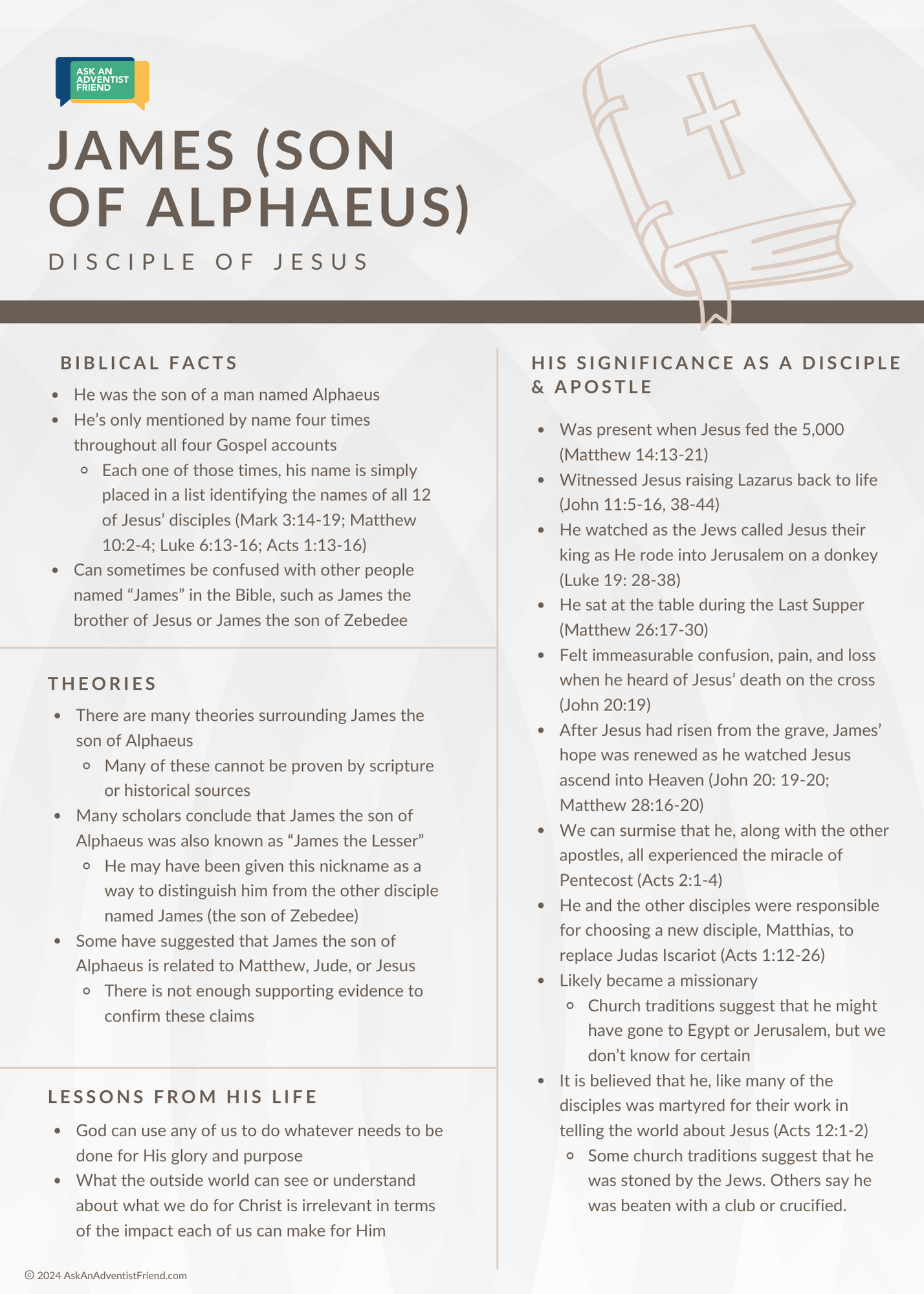
Well, based on New Testament mentions, the only things we know for sure about this specific James is that he was indeed one of Jesus’ disciples, and he was the son of a man named Alphaeus.
He’s only mentioned by the name four times throughout the New Testament.
And each one of those times, his name is simply placed in a list identifying the names of all 12 of Jesus’ disciples (Mark 3:14-19; Matthew 10:2-4; Luke 6:13-16; Acts 1:13-16).
Even so, Christian scholars have done their best to fill in the gaps and have provided a few theories on who James was.
Theories about James, the son of Alphaeus
Some of these theories are based on connections scholars believe they’ve found between other significant people of the time who may have interacted with James and the other disciples.
Others come from extrabiblical sources that have to do with history, pop culture, and art.
Like references from the TV show, The Chosen, for example.
This series portrays James, son of Alphaeus as a man with a disability. While this certainly is possible, neither Scripture nor other historical sources provide any details that would confirm or deny this.
And this turns out to be the case for many of the theories surrounding James, son of Alphaeus, even from some of the more scholarly sources.
But some of the details in these theories can be muddied by the fact that there are a lot of Jameses in the Bible. For one, there’s James, the brother of Jesus. There’s also James, son of Zebedee, who was another disciple alongside James, son of Alphaeus. So at times, it can be tricky to distinguish who’s who.
However, most mentions of the name “James” in the Gospel accounts are referring to either the brother of Jesus or the son of Zebedee. You can usually tell which one by looking at the setting in which one of these Jameses is mentioned.
Most of the time, when Jesus is talking with His disciples, it’s James the son of Zebedee who gets more of the spotlight, especially because he is often mentioned alongside his brother John, a very well-known member of the 12 disciples.
James the brother of Jesus is usually mentioned in a listing of Jesus’ family members, or is identified specifically as Jesus’ brother or Mary’s son (Matthew 13:55-56; 27:56).
And in addition to the issue of multiple Jameses, it was common in those times for people to go by multiple names. Take Simon, for instance, who also goes by Peter (though not to be confused with another disciple, Simon the Zealot).
This situation with naming has also led many scholars to consider that James, the son of Alphaeus might have gone by other names too, or had certain identifiers included with his name, such as James the Lesser, or James the Younger.1
James the Lesser

Photo by Kelly Sikkema on Unsplash
Many scholars conclude that James, the son of Alphaeus is the same as “James the Less” or “James the Lesser.”2
This makes sense, considering that James, the son of Zebedee, was known as James the Elder or James the Greater.
The disciples might have given the two Jameses these nicknames as a way to distinguish them from each other.
Though there are other possible reasons James, the son of Alphaeus could have been called James the Lesser. Maybe he was shorter, younger, or more soft-spoken than the bold son of Zebedee who, along with his brother, had earned the nickname, “son of thunder” (Mark 3:17).3
And some theorize that James, the son of Alphaeus is called James the Lesser because he might have been related to other notable figures in Scripture.4
James’ connection to others in the Bible

Photo by Ioann-Mark Kuznietsov on Unsplash
Though we don’t have a lot of information on James’ life and ministry as a disciple, there are multiple theories about James’ connection to the other people mentioned in the Bible.
Was James related to Jesus?
If we assume James, the son of Alphaeus to be the one referred to as James the Younger, that would mean he is the son of a woman named Mary, who was the wife of “Clopas” which might have been another name for Alphaeus (Matthew 27:55-56; Mark 15:40; John 19:25).5
Many take John 19:25 to mean that Mary of Clopas was the sister of Mary, the mother of Jesus. This has led some to believe that James and Jesus were cousins.6
Others still associate James, the son of Alphaeus with James, the half-brother of Christ, whom Paul speaks about in Galatians 1:19.7
But the doubts of these theories outweigh their support, especially that James, the son of Alphaeus could be Jesus’ brother.
Was James related to Matthew?
There are some who have also attempted to connect James, the son of Alphaeus with the disciple Matthew.8
Scripture says that Matthew, known in some accounts as Levi, was the son of a man named Alphaeus (Mark 2:14).
Because James and Matthew had a father with the same name, some Bible scholars believe that James was Matthew’s brother.9
But a lot of scholars deny this theory because many people could have been named Alphaeus (just like many people were named James).10 There’s also the fact that the Bible has a convention of mentioning brothers in pairs, but Matthew and James are never mentioned together.11
Was James related to Jude?
Most scholars believe James was related to Jude, otherwise known as Judas the Zealot (not Judas Iscariot).
However, there is some confusion as to how they were related.
When James and Jude are listed among the disciples, Jude is sometimes referred to as “the son of James,” although other translations like the King James Version, refer to Jude as James’ brother.12
“And when it was day, he called unto him his disciples: and of them he chose twelve, whom also he named apostles; Simon, (whom he also named Peter,) and Andrew his brother, James and John, Philip and Bartholomew, Matthew and Thomas, James the son of Alphaeus, and Simon called Zelotes, and Judas the brother of James, and Judas Iscariot, which also was the traitor.” (Luke 6:13-16, KJV).
Some of this confusion might come back to the fact that the original Greek suggests he is Jude of James, which could suggest either relation.13
However, the book of Jude reasserts that James was Jude’s brother.
“Jude, a bondservant of Jesus Christ, and brother of James…” (Jude 1:1, NKJV).
James’ significance as a disciple of Jesus

Photo by Corinna Widmer
While we don’t know any significant specifics about James’ relationship with Christ or the other disciples, we do know that James wasn’t as prominent as the other 12.
But even though we don’t hear much about who James was or what he did, that doesn’t mean he didn’t do amazing things for Christ. After all, each disciple was chosen specifically by Jesus. James, the son of Alphaeus was selected by the Son of God to learn from Him, minister with Him, and represent Him to the world.
James remained by Jesus’ side throughout His earthly ministry and experienced a lot of the same events the other disciples did.
He witnessed Jesus perform countless miracles. He was there when Jesus fed the 5,000 (Matthew 14:13-21). He was there when Jesus raised Lazarus back to life (John 11:5-16, 38-44).
He and the rest of the 12 had a unique opportunity to walk alongside Christ. They traveled together, ate together, served together.
That means James got to experience some of the most pivotal events in Jesus’ ministry.
He watched as the Jews called Jesus their king as He rode into Jerusalem on a donkey (Luke 19:28-38).
He sat at the table during the Last Supper (Matthew 26:17-30).
And he, along with the other disciples, felt immeasurable confusion, pain, and loss when he heard of Jesus’ death on the Cross (John 20:19).
And after Jesus had risen from the grave, James’ hope was renewed as he watched Him ascend into heaven (John 20:19-20; Matthew 28:16-20).
Though James didn’t have a starring role in any of these events, he witnessed them all the same. And in witnessing the life and character of Christ, he was opened up to an entirely new way of thinking and living.
His time with Jesus likely challenged his cultural worldview. There might have been times when he, like the other disciples, wondered why Jesus did things the way He did.
He may have wondered why Jesus would show kindness to Romans, the Jews’ enemy (Luke 7:1-10). He might have wondered why Jesus reached out to outcasts when no one else would (Matthew 15:21-28; Luke 14:12-14). Or why Jesus would take on a tax collector as His disciple (Mark 2:13-17).
Slowly but surely, James’ experiences with Jesus shaped him into the apostle he was meant to be—one who would go on to share the gospel with others until his passing.
James as an apostle

Photo by Hector John Periquin on Unsplash
Similar to James, son of Alphaeus’ discipleship, what we know about his life after Christ’s death and resurrection comes from what we know about the apostles as a group.
For one, we can surmise that he, along with the other apostles, all experienced the miracle of Pentecost (Acts 2:1-4).
We also know that he and the others were responsible for choosing a new disciple, Matthias, to replace Judas Iscariot (Acts 1:12-26).
James’ role in these pivotal events demonstrates his significance as a church leader. He might not have been as well-known as Peter or John, but the early Christian church would still regard him as one they could turn to for guidance.
It’s also likely that James was a missionary.
We can assume that he, like many of the disciples, traveled to far-away lands to share the gospel.
Church traditions suggest that he might have gone to Egypt or Jerusalem.14 But we don’t know for certain where he might have gone.
But no matter where he went, we can safely assume that James was driven by the Great Commission Jesus had given all of the disciples. He wanted to tell the world about his Savior and friend.
Sadly, it is believed that he, like many of the disciples, was martyred for his work in telling the world about Jesus (Acts 12:1-2).
Some church traditions suggest that he was stoned by the Jews.15 Others say he was beaten with a club or crucified.16
While we can’t say for certain exactly what his life and death entailed, we can say that it matters to be a disciple of Christ.
The measure of discipleship is not by how many people know your name, or how often you’re mentioned throughout the history books.
God chose each of His disciples intentionally. So just because the deeds of James, son of Alphaeus didn’t end up getting recorded doesn’t mean he was any less useful or valuable. He may have touched the lives of many people in subtle yet significant ways. Or he may have exalted Jesus and supported the other disciples in ways that were meaningful, but not obvious or describable to observers.
After all, John plainly stated that the works of Jesus while He was on earth were too numerous to write them all down (John 21:25). That could include several more stories that involved His disciples as well.
Today, we can consider James, the son of Alphaeus as a behind-the-scenes disciple who had a role to play that was God-ordained, even if we don’t know exactly what it was.
And that can help us remember that God can use any of us to do whatever needs to be done for His glory and purpose. What the outside world can see or understand about what we do for Christ is irrelevant in terms of the impact each of us can make for Him.
Want to learn about another little-known disciple?
Find out more about the other disciple named Judas.
Related pages



- Nelson, Ryan, “Who Was James Son of Alphaeus? The Beginner’s Guide,” Overview Bible. [↵]
- Ibid. [↵]
- Ibid.[ ↵]
- Ibid. [↵]
- Rodríguez, Ángel Manuel, “Were the brothers of Jesus mentioned in the Bible sons of Joseph and Mary?” General Conference of Seventh-day Adventist Church. [↵]
- Ibid. [↵]
- Nelson, Overviewbible.com [↵]
- Ibid. [↵]
- Ibid. [↵]
- Ibid. [↵]
- Ibid. [↵]
- Regan, David,“‘Brother of’ or ‘Son of’ James,” Learn the Bible. [↵]
- Ibid. [↵]
- Nelson. [↵]
- James,” Bible Gateway. [↵]
- Nelson. [↵]
More Answers

Why Do Some Bibles Have More Books Than Others?
Christians consider the Bible as their sacred writings. But within Christianity, different denominations use Bibles with different numbers of books.

Can We Find Jesus Christ In the Old Testament?
Yes, you might be surprised to know that there are hundreds of verses in the Old Testament about Jesus.

What the Bible Says About Resolving Conflicts
While it’s the main ingredient in a good story, it unfortunately can spoil things in real life. It might start from minor differences of opinion. But unchecked, it can turn into what feels like a full-blown war.

The Benefits of A Seventh-day Adventist Academy
Adventist academies are high schools (grades 9-12) that are owned and operated by the Seventh-day Adventist Church.

Are Seventh-day Adventists Christians?
Yes, the Seventh-day Adventist Church is a Protestant Christian denomination formed in 1863. Just like other Christians, we believe that Jesus Christ is our Savior and seek to follow the principles of the Word of God.


Adventist Movies: Where Faith and Film Meet
The Adventist Church uses film to share our faith and uplift positive values. Learn more about specific Adventist-produced films and where to find them.

Does the Bible Teach Predestination?
your choices, actions, and habits really matter to your eternal destiny? Or is the path you choose in life predetermined, and your life is just following a script that’s been laid out for you?

The Seven Churches of Revelation and What They Mean
The seven churches were churches that received messages from Jesus Christ through the apostle John while he was exiled on the island of Patmos. These letters are in chapters 2 and 3 of Revelation.

Do Adventists Celebrate Christmas?
In general, most Seventh-day Adventists do celebrate Christmas.
Since our denomination doesn’t have specific guidelines about holidays, it’s up to each member to decide whether to celebrate it based on their personal convictions and study of the Bible.

How Can I Know Ellen White’s Messages Were From God?
It’s natural to be a bit skeptical when you hear about someone being “divinely inspired,” or that something is a “message from God,” etc. And we expect nothing different if you’re hearing about Ellen White, an influential co-founder of the Seventh-day Adventist Church, for the first time. After all, the Bible tells us that we’re supposed to test these things!

Ellen G. White’s Time in Australia
Ellen White traveled to Australia in the later part of her life, and she ended up spending nine years there. In that time, she helped the Australian Seventh-day Adventist Church increase in size and strength.

Ellen G. White’s Time in Europe
When the Seventh-day Adventist Church was still young, a council of the church in Europe requested Ellen White, one of Adventism’s key leaders, to come to Europe. Despite the many obstacles, God led her there to help the new churches and members for two years.

Ellen G. White’s Travels and Worldwide Mission
Though Ellen White, a co-founder of the Seventh-day Adventist Church, is best known for her ministry in the United States, she also traveled to twelve other countries in her lifetime—a big accomplishment in the 19th century when travel was strenuous and long.

Ellen G. White’s Counsel on College Education
Ellen G. (Harmon) White, a significant co-founder of Adventism, is often known for her practical and spiritual guidance for proper childhood education. But she was also significantly involved in the development of Seventh-day Adventist higher education.

8 Pieces of Advice from Ellen White’s Counsel for Families
In this article, we’ll look at the insight Ellen White received from God. We’ll cover 8 major themes she highlighted for families.

Was Everything Ellen White Said Divinely Inspired?
The Seventh-day Adventist Church believes that many of Ellen White’s messages were inspired by God. But that doesn’t mean everything she ever said was prophetic, or meant to be taken as direct instruction from God. So let’s break down how to identify the nature of her many written messages and quotes.

Who Were Ellen White’s Children?
Being the children of a woman with a prophetic calling from God had its blessings and its challenges.
In this overview, we’ll look at the highlights of the lives of Ellen White’s sons during her many years of ministry, as well as the ways each of them decided to serve Jesus Christ:

Ellen White’s Spiritual Counsel on Marriage
As one of the founders of the Seventh-day Adventist Church, Ellen G. White was held in high regard. She was a prolific author and was heavily engaged in the mission of the denomination, prayerfully pursuing the guidance of the Holy Spirit.

Sabbath Keeping: What It Looks Like in the Bible
That Sabbath would not be about a checklist of rules but about a mindset of rest. It’s a day to set aside daily cares and connect with God, our Creator. Out of our love for Him, we take the principles of the Bible and apply them in the way we keep the Sabbath.

Ellen G. White or the Bible—Which is More Important to Adventists?
Ellen G. White or the Bible—Which is More Important to Adventists?The Bible—without a shadow of a doubt—is the most important book. It’s the standard we use to test all other writings, including those of Ellen White. The Seventh-day Adventist Church believes that “the...
Are Any of Ellen G. White’s Prophecies Yet to Come True?
Ellen White, a co-founder of the Seventh-day Adventist Church, demonstrated many times over that she had the spiritual gift of prophecy. Some of her predictions’ timelines have already passed, and those prophecies have been fulfilled. Others have yet to be fulfilled.

What Was Ellen G. White’s Counsel on Music?
Ellen G. White, one of the founders of the Seventh-day Adventist Church, also provided helpful guidance regarding music choices for Christians. She provided sound principles to answer questions the young Adventist Church had.

What Does the Bible Say About Modesty
Seventh-day Adventists and Christians in general try to ensure their outward presentation and lifestyle glorify God. This often involves daily habits like the ways we hold conversations, the ways we dress and accessorize, and the ways we regard other people when we’re out and about.

What Ellen White Said About Using the Bible in Education
Ellen White, one of the founders of the Seventh-day Adventist Church, believed that education was not complete unless it was founded upon the principles of the Bible.
But what does the Bible have to do with math or science? Is it important to integrate the Bible with schoolwork?

What Were Ellen White’s Visions About the Adventist Church?
What Were Ellen White’s Visions About the Adventist Church?Led by the Holy Spirit, Ellen G. White was given many messages, counsel, revelations, and visions about the Bible, history, prophecy, and how we can apply biblical principles to our daily lives. She was also a...

Is it necessary to attend church to draw closer to Christ?
What Does the Bible Say About Going to Church?While you certainly don’t have to go to church to develop a relationship with Jesus, the Bible makes it clear that gathering together with other believers can be really beneficial for your spiritual growth. For the early...

How Do I Know God Has Forgiven My Sins?
Knowing you’re forgiven is a big part of finding freedom in Christianity. The Bible tells us that after we’ve prayed for God’s forgiveness, we can believe we’re forgiven and accept His gift of pardon.

How Do Adventists Make Movie and Music Choices?
How do Adventists decide what music to listen to and which movies to watch? Learn how Bible principles can help us make better entertainment choices.
Didn’t find your answer? Ask us!
We understand your concern of having questions but not knowing who to ask—we’ve felt it ourselves. When you’re ready to learn more about Adventists, send us a question! We know a thing or two about Adventists.