
As Jesus Christ ministered on earth, His twelve disciples were some of His closest companions. Three of those 12 were said to be His “inner circle.”
One of them was James, the son of Zebedee. He was the older brother of John, another disciple.
James was a fisherman until he was called to become one of Jesus’ closest disciples. After Jesus’ ascension, he played an important role in the early church before becoming the first apostle to be martyred.
Though you might know this disciple by name, there’s more to his story than you might realize. So let’s look at:
James’ background
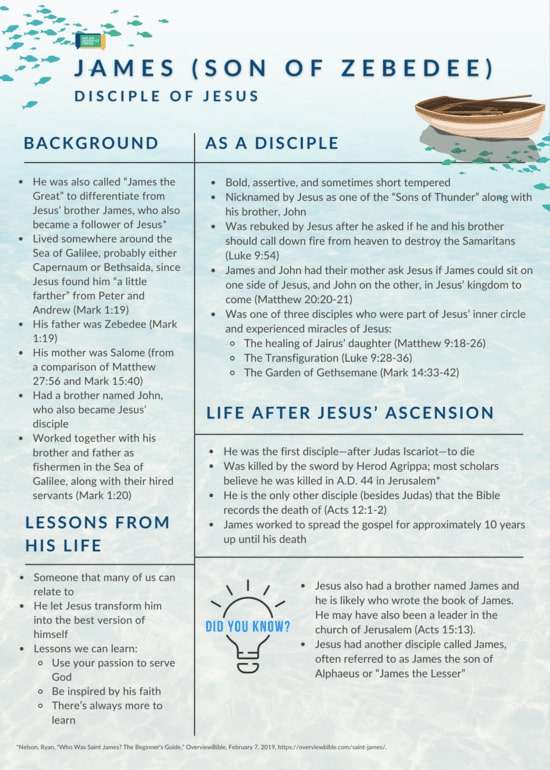
There isn’t a large list of confirmed facts about James the son of Zebedee, but we know that he was also called James the Great. (This was likely to differentiate between him and another disciple named James who was called James the Younger).1
James lived somewhere around the Sea of Galilee, probably either Capernaum or Bethsaida, since Jesus found him “a little farther” from Simon Peter and Andrew (Mark 1:19).
He had a brother named John, who also became Jesus’ disciple. The Bible tells us their father was Zebedee (Mark 1:19), and we can infer that their mother was Salome from a comparison of Matthew 27:56 and Mark 15:40.
James, John, and their father all worked together as fishermen on the Sea of Galilee, along with their hired servants (Mark 1:20).
While several Jameses are mentioned in the New Testament, they’re several different people. Jesus had a brother James (how’s that for confusing!), and this brother likely wrote the book of James.2 He may have also been a leader in the church of Jerusalem (Acts 15:13).
Jesus had another disciple called James, often referred to as James the son of Alphaeus or James the Less.
But let’s focus on James the Greater, the brother of John.
His story with Jesus began when Jesus was preaching in Nazareth. Jesus had just called Peter and Andrew to be His disciples. Then, He noticed a few others:
“He saw two other brothers, James the son of Zebedee, and John his brother, in the boat with Zebedee their father, mending their nets. He called them, and immediately they left the boat and their father, and followed Him” (Matthew 4:21-22, NKJV).
Mark’s account adds that they left their father with the hired servants so that their father wouldn’t have to continue the family business alone (Mark 1:20).
The book of Luke tells a slightly different story, indicating that perhaps James and John were not full-time disciples until a little later. Luke 5 says Peter, Andrew, James, and John had partnered in fishing, but had brought back nothing after a whole night. Jesus told them to cast their nets down again (Luke 5:4).
When they did so, they brought back so many fish that the nets were breaking (Luke 5:6)!
Jesus told them,
“‘Do not fear; from now on you will be catching people’” (Luke 5:10, NASB).
Or, as Mark 1:17 puts it,
“Then Jesus said to them, ‘Follow Me, and I will make you become fishers of men’” (NKJV).
On land, the disciples abandoned their fishing nets and followed Jesus.
James as a disciple
Like all of Jesus’ disciples, and like any of us, James had both good qualities and troublesome qualities. But regardless of his qualities, he began a strong and unwavering relationship with his Savior. He was regarded as one of Jesus’ closest disciples, along with John and Peter.
James’ character
The parts of the New Testament that talk about James and his brother John describe them as bold, assertive, and sometimes short-tempered men.
Because of this, Jesus nicknamed the two brothers the “Sons of Thunder,” or “Boanerges” in Aramaic (Mark 3:17).
We can see this trait of James in a story in Luke, when Jesus and His disciples were traveling to Jerusalem. They sent messengers ahead to a Samaritan village, but the Samaritans refused to accept Jesus because He was going to Jerusalem, a Jewish city. The Samaritans and the Jews had long been rivals.
This response riled up James and John. They said to Jesus,
“‘Lord, do You want us to command fire to come down from heaven and consume them, just as Elijah did?’” (Luke 9:54, NKJV)
Their temper had definitely gotten the better of them. Jesus chastised them for thinking this way:
“‘You do not know what manner of spirit you are of. For the Son of Man did not come to destroy men’s lives but to save them’” (Luke 9:55-56, NKJV).
These Samaritans were people Jesus had come to minister to.
Another time, the brothers were so sure of their honorable position that they had their mother ask Jesus if James could sit on one side of Jesus and John on the other in Jesus’ future kingdom (Matthew 20:20-21).
(According to Mark’s account, the brothers do the asking themselves.)
Sitting beside the king was about the next-best thing to being king themselves.
Jesus replied,
“You do not know what you ask. Are you able to drink the cup that I drink, and be baptized with the baptism that I am baptized with?” (Mark 10:38, NKJV)
The brothers foolishly said they could do it, though they had no idea what it actually meant to drink from Jesus’ cup of suffering and death.
Jesus said,
“You will indeed drink My cup, and be baptized with the baptism that I am baptized with; but to sit on My right hand and on My left is not Mine to give, but it is for those for whom it is prepared by My Father” (Matthew 20:23, NKJV).
James and John may have thought this was a wonderful thing. But they would understand the true and full meaning of this when Jesus died and rose again.
But before we get there, let’s look at James’ role among the other disciples.
One of Jesus’ closest companions
Since James was part of Jesus’ “inner circle,” he sometimes got to witness situations that the other disciples didn’t. Here are a few stories to illustrate this.
The healing of Jairus’ daughter

Photo by cottonbro studio
This story is recorded in all the Gospel accounts except for John’s.3 A Jewish ruler named Jairus approached Jesus, begging Him to come heal his dying daughter. Jesus took all His disciples with Him to the man’s home, but only Peter, James, and John were allowed to enter the house with Jesus (Mark 5:37).
By the time Jesus arrived, the girl had died and mourners had arrived, so Jesus had to send all the mourners out. Then, before the eyes of the girl’s parents, He raised her back to life.
So James was privy to the raising of Jairus’ daughter, one of Jesus’ most precious miracles, and saw for himself Jesus’ loving power.
The Transfiguration 4
Jesus took Peter, James, and John atop a mountain, where He became “transfigured”—His face and clothes shone white (Matthew 17:2). Then Elijah and Moses appeared and talked with Jesus.
While Peter attempted to respond to the situation (Matthew 17:4), James and John were notably silent. It is likely that James was in shock, trying to process the appearance of a legendary prophet and patriarch.
And when he heard a voice from heaven, declaring Jesus as the true Son of God, James finally became overwhelmed by this miraculous experience. He fell down and hid his face in fear with the other disciples (Matthew 17:6).
But Jesus reassured him as he experienced these powerful signs (Matthew 17:7).
We can only imagine how this experience must have strengthened James’ faith in Jesus as the Son of God.
The Garden of Gethsemane
James and the other two disciples also accompanied Jesus in the Garden of Gethsemane, the night He was arrested.5 But their response to this privilege was lacking.
Three different times Jesus asked James, John, and Peter to watch and pray while He went on a little farther to pray alone. All the while, Jesus experienced deep spiritual agony in the garden as he prayed about his coming fate on the Cross (Luke 22:44). And three times, Jesus’ closest companions, who were supposed to be His best friends, fell asleep.
Soon after, Judas, another disciple of Jesus, came to betray Him, bringing a group of soldiers to arrest Him.
Though James had an insider’s view of Jesus’s ministry, he still had plenty to learn. It took seeing Jesus crucified to help him understand His true purpose and ministry.
And the few encounters the disciples had with Jesus before He ascended back into heaven solidified Jesus’ true mission in James’ mind, fueling his passion to be a witness for Him.
So let’s look at James’ life after Jesus’ time on earth ended.
James’ life after Jesus’ ascension

Photo by Ricardo Cruz on Unsplash
The only thing the Bible tells us about James’ life after the ascension of Jesus is that he was the first disciple—after Judas Iscariot—to die.
He’s also the only apostle the Bible records the death of. Acts 12:1-2 gives us a brief insight:
“Now about this time Herod the king stretched out his hand to harass some from the church. Then he killed James the brother of John with the sword” (NKJV).
This Herod was King Herod Agrippa, and most scholars believe James was killed in AD 44 in Jerusalem.6 Some Spanish legends suggest his body was brought to Santiago de Compostela, whose basilica became an important Christian landmark in the Middle Ages.7
Christian Church historian Eusebius of Caesarea, living in the third and fourth centuries AD, added this anecdote about James’ death:
“It appears that the guard who brought him [James] into court was so moved when he saw him testify that he confessed that he, too, was a Christian. So they were both taken away together, and on the way he asked James to forgive him. James thought for a moment, then he said ‘I wish you peace,’ and kissed him. So both were beheaded at the same time.”8
There isn’t any validation from Scripture that this actually happened, but we do know James worked to spread the Gospel for approximately 10 years up until his death. Otherwise Herod wouldn’t have targeted him over other important apostles like Peter or John.
A popular legend has it that he worked as an evangelist, spreading the Gospel in Spain before he died.9 But no proof exists for this endeavor except a text written hundreds of years later, the Breviary of the Apostles.10 And it is unlikely that James would have done all this and come back to Jerusalem to be killed in AD 44.
Paul also said in Romans that he wanted to preach “not where Christ was named” (Romans 15:20, NKJV) and speaks of going to Spain in the next few verses (Romans 15:24). If James had already started a church there, Paul likely wouldn’t have said that Christ wasn’t named there.
But while James’ life was short compared to the other apostles, we can still learn a lot from it.
Takeaways from James’ life

Photo by Joshua Earle on Unsplash
James is an apostle many of us can relate to. He could be emotional, hasty, and prideful. But he also let Jesus transform him into the best version of himself.
James served God with his whole heart
James had a lot of zeal and passion—hence the nickname Son of Thunder. In his early days as a disciple, he held a shortsighted view of Jesus’ ministry although he was very committed to Jesus.
Afterward, when he figured out what Jesus’ true purpose was on earth and what He had accomplished in His death, James recommitted himself as an apostle—but this time, spreading the truth of Jesus to all around him.
As followers of Jesus, we can use our love for Him to guide our interactions with others. We can share Jesus with those around us by the way we act, how we treat people, and what we say.
His faith is inspiring
James’ zeal was a little misdirected early on as a disciple. But his heart was in the right place, and when the time came to pick a side, James chose Jesus.
He turned this enthusiasm into a force hard to reckon with, spreading the Gospel to those in Jerusalem and perhaps the surrounding areas. He understood Jesus’ true purpose now, and he had the faith in Him to match it.
He was even willing to risk his life for Jesus. King Herod Agrippa I had his eye on James, and one day he came for him. James’ faith stood strong, even when he was threatened with a sword (Acts 12:2).
And he died for his faith.
This can be an inspiration to us. No matter what happens to us, in the end, it’s our faith that matters most. We know that Jesus will be waiting to welcome us at His return.
There’s always more to learn

Photo by Sincerely Media on Unsplash
Even though he was one of Jesus’ closest apostles, James was far from a perfect or mature man. He thought he was one of the best and deserved a special place next to Jesus. He still had to learn that the best way to serve Jesus was by serving others.
This was the example Jesus set on earth, and James had to make some mistakes before learning this truth.
Since we are human, we will make mistakes in our lives and even in our relationship with Jesus. But we can still learn, and we can still grow, no matter how old we already are. There will always be opportunities to serve others, just as James learned.
James led an exciting life, one that involved fishing and traveling about Judea as Jesus’ disciple. He witnessed things not all the 12 apostles had the privilege to see, and he became a faithful servant of God.
He would become a martyr, as Jesus predicted (Matthew 20:23). While James didn’t know that’s what Jesus meant when He told him, he grew in faith and conviction nonetheless. He didn’t live a long life, but he became an inspiring servant of God. And that’s one of the most important things about his Apostolic legacy.
Curious about the other disciples? Read about them on our main page about the disciples.
Related Articles





- “James,” ATS Bible Dictionary, Bible Hub. [↵]
- “Introduction,” Holy Bible, English Standard Version, Crossway, 2007. [↵]
- Matthew 9:18-26; Mark 5:21-43; Luke 8:40-56. [↵]
- Matthew 17:1-8; Mark 9:2-8; Luke 9:28-36. [↵]
- Matthew 26:37-46; Mark 14:33-42. [↵]
- Nelson. [↵]
- “St.James,” Britannica. [↵]
- Nelson.[↵]
- Ibid. [↵]
- Ibid. [↵]
More Answers

Why Do Some Bibles Have More Books Than Others?
Christians consider the Bible as their sacred writings. But within Christianity, different denominations use Bibles with different numbers of books.

Can We Find Jesus Christ In the Old Testament?
Yes, you might be surprised to know that there are hundreds of verses in the Old Testament about Jesus.

What the Bible Says About Resolving Conflicts
While it’s the main ingredient in a good story, it unfortunately can spoil things in real life. It might start from minor differences of opinion. But unchecked, it can turn into what feels like a full-blown war.

The Benefits of A Seventh-day Adventist Academy
Adventist academies are high schools (grades 9-12) that are owned and operated by the Seventh-day Adventist Church.

Are Seventh-day Adventists Christians?
Yes, the Seventh-day Adventist Church is a Protestant Christian denomination formed in 1863. Just like other Christians, we believe that Jesus Christ is our Savior and seek to follow the principles of the Word of God.


Adventist Movies: Where Faith and Film Meet
The Adventist Church uses film to share our faith and uplift positive values. Learn more about specific Adventist-produced films and where to find them.

Does the Bible Teach Predestination?
your choices, actions, and habits really matter to your eternal destiny? Or is the path you choose in life predetermined, and your life is just following a script that’s been laid out for you?

The Seven Churches of Revelation and What They Mean
The seven churches were churches that received messages from Jesus Christ through the apostle John while he was exiled on the island of Patmos. These letters are in chapters 2 and 3 of Revelation.

Do Adventists Celebrate Christmas?
In general, most Seventh-day Adventists do celebrate Christmas.
Since our denomination doesn’t have specific guidelines about holidays, it’s up to each member to decide whether to celebrate it based on their personal convictions and study of the Bible.

How Can I Know Ellen White’s Messages Were From God?
It’s natural to be a bit skeptical when you hear about someone being “divinely inspired,” or that something is a “message from God,” etc. And we expect nothing different if you’re hearing about Ellen White, an influential co-founder of the Seventh-day Adventist Church, for the first time. After all, the Bible tells us that we’re supposed to test these things!

Ellen G. White’s Time in Australia
Ellen White traveled to Australia in the later part of her life, and she ended up spending nine years there. In that time, she helped the Australian Seventh-day Adventist Church increase in size and strength.

Ellen G. White’s Time in Europe
When the Seventh-day Adventist Church was still young, a council of the church in Europe requested Ellen White, one of Adventism’s key leaders, to come to Europe. Despite the many obstacles, God led her there to help the new churches and members for two years.

Ellen G. White’s Travels and Worldwide Mission
Though Ellen White, a co-founder of the Seventh-day Adventist Church, is best known for her ministry in the United States, she also traveled to twelve other countries in her lifetime—a big accomplishment in the 19th century when travel was strenuous and long.

Ellen G. White’s Counsel on College Education
Ellen G. (Harmon) White, a significant co-founder of Adventism, is often known for her practical and spiritual guidance for proper childhood education. But she was also significantly involved in the development of Seventh-day Adventist higher education.

8 Pieces of Advice from Ellen White’s Counsel for Families
In this article, we’ll look at the insight Ellen White received from God. We’ll cover 8 major themes she highlighted for families.

Was Everything Ellen White Said Divinely Inspired?
The Seventh-day Adventist Church believes that many of Ellen White’s messages were inspired by God. But that doesn’t mean everything she ever said was prophetic, or meant to be taken as direct instruction from God. So let’s break down how to identify the nature of her many written messages and quotes.

Who Were Ellen White’s Children?
Being the children of a woman with a prophetic calling from God had its blessings and its challenges.
In this overview, we’ll look at the highlights of the lives of Ellen White’s sons during her many years of ministry, as well as the ways each of them decided to serve Jesus Christ:

Ellen White’s Spiritual Counsel on Marriage
As one of the founders of the Seventh-day Adventist Church, Ellen G. White was held in high regard. She was a prolific author and was heavily engaged in the mission of the denomination, prayerfully pursuing the guidance of the Holy Spirit.

Sabbath Keeping: What It Looks Like in the Bible
That Sabbath would not be about a checklist of rules but about a mindset of rest. It’s a day to set aside daily cares and connect with God, our Creator. Out of our love for Him, we take the principles of the Bible and apply them in the way we keep the Sabbath.

Ellen G. White or the Bible—Which is More Important to Adventists?
Ellen G. White or the Bible—Which is More Important to Adventists?The Bible—without a shadow of a doubt—is the most important book. It’s the standard we use to test all other writings, including those of Ellen White. The Seventh-day Adventist Church believes that “the...
Are Any of Ellen G. White’s Prophecies Yet to Come True?
Ellen White, a co-founder of the Seventh-day Adventist Church, demonstrated many times over that she had the spiritual gift of prophecy. Some of her predictions’ timelines have already passed, and those prophecies have been fulfilled. Others have yet to be fulfilled.

What Was Ellen G. White’s Counsel on Music?
Ellen G. White, one of the founders of the Seventh-day Adventist Church, also provided helpful guidance regarding music choices for Christians. She provided sound principles to answer questions the young Adventist Church had.

What Does the Bible Say About Modesty
Seventh-day Adventists and Christians in general try to ensure their outward presentation and lifestyle glorify God. This often involves daily habits like the ways we hold conversations, the ways we dress and accessorize, and the ways we regard other people when we’re out and about.

What Ellen White Said About Using the Bible in Education
Ellen White, one of the founders of the Seventh-day Adventist Church, believed that education was not complete unless it was founded upon the principles of the Bible.
But what does the Bible have to do with math or science? Is it important to integrate the Bible with schoolwork?

What Were Ellen White’s Visions About the Adventist Church?
What Were Ellen White’s Visions About the Adventist Church?Led by the Holy Spirit, Ellen G. White was given many messages, counsel, revelations, and visions about the Bible, history, prophecy, and how we can apply biblical principles to our daily lives. She was also a...

Is it necessary to attend church to draw closer to Christ?
What Does the Bible Say About Going to Church?While you certainly don’t have to go to church to develop a relationship with Jesus, the Bible makes it clear that gathering together with other believers can be really beneficial for your spiritual growth. For the early...

How Do I Know God Has Forgiven My Sins?
Knowing you’re forgiven is a big part of finding freedom in Christianity. The Bible tells us that after we’ve prayed for God’s forgiveness, we can believe we’re forgiven and accept His gift of pardon.

How Do Adventists Make Movie and Music Choices?
How do Adventists decide what music to listen to and which movies to watch? Learn how Bible principles can help us make better entertainment choices.
Didn’t find your answer? Ask us!
We understand your concern of having questions but not knowing who to ask—we’ve felt it ourselves. When you’re ready to learn more about Adventists, send us a question! We know a thing or two about Adventists.