
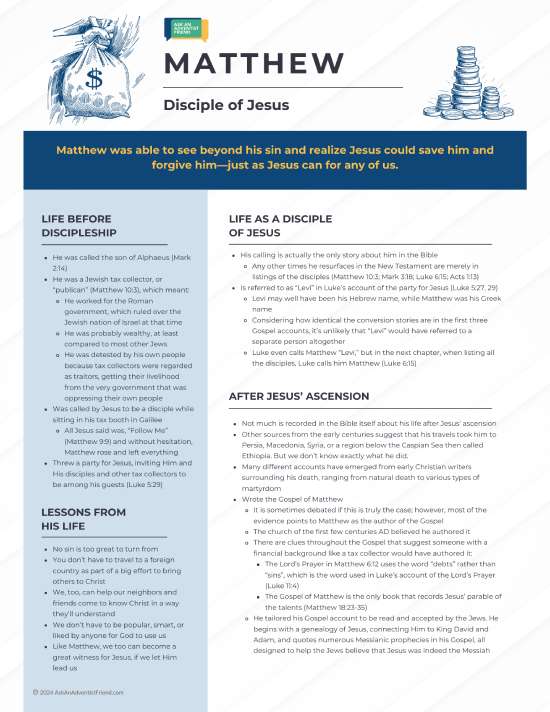
 In the first book of the New Testament, we find the Gospel story from the perspective of Matthew. He was a Jewish tax collector from Capernaum in the first century AD, and he was likely despised by fellow Jews for choosing that profession.
Despite his beginnings, Matthew was willing to be uniquely used by God. To begin with, he was a converted tax collector—that alone was rare. And He served as one of Jesus Christ’ twelve disciples, wrote one of the synoptic Gospel accounts, continued to serve as an apostle after Jesus returned to heaven, and likely died a martyr’s death.
Matthew was able to see beyond his circumstances and realize Jesus could save him and forgive him—just as Jesus can for any of us.
So let’s get into the details of Matthew’s story:
- Life before discipleship
- Life as Jesus’ disciple
- Life after Jesus’ ascension
- Lessons from Matthew’s life
We’ll start by examining what his life was like before he encountered Jesus Christ.
Matthew’s life as a tax collector, before discipleship

Photo by Pixabay
There isn’t a detailed biographical record of what Matthew’s early life was like. And in the book he wrote about the Gospel story, he certainly wasn’t focused on what happened in his own life before meeting Jesus.
But since we know his occupation, that has sparked a lot of interest and speculation in religious media. For example, The Chosen series about all the disciples has taken a few creative liberties with his character.
Here are the specific facts about Matthew we can get straight from the Bible:
- He was also called the son of Alphaeus (Mark 2:14).
- He was also known as Levi (Mark 2:14; Luke 5:27).
- He was a tax collector, or “publican” (Matthew 9:9; 10:3).
Just knowing he was a tax collector, however, provides us with more contextual likelihoods about Matthew:
- He worked for the Roman government, which ruled over the Jewish nation of Israel at that time
- He was probably wealthy, at least compared to most other Jews
- He was more than likely detested by his own people
Here’s why.
The Jews were currently living under the rulership of the Roman Empire, which ruled with a heavy hand over the nations it conquered. One of the “features” of this Roman authority was that Jews had to pay hefty taxes to the Roman government.
But unlike the taxation systems we’re used to today, which are supposed to pay for a country’s infrastructure, government programs, education, etc., Roman taxes benefited none but Rome, making them even more powerful and rich.1 Today we’d call it taxation without representation.
And to make matters worse, the Roman government contracted with locals to do their dirty work of collecting those fees—one of the jobs available for Jews to sign up for.
So when a Jew opted to make a living this way, you can see how that wouldn’t go over well with their fellow Hebrews.
That made tax collectors and taxes the object of bitter loathing for the Jewish nation. They were regarded as traitors, getting their livelihood from the very government that was oppressing their own people.2
Perhaps living with the disdain of their own people made it easier for them to justify the other reason they were despised. They often took advantage of their position and lined their own pockets by collecting more than was necessary, or arbitrarily charging fees for things like crossing a certain bridge or using a busy road.3
And while we don’t have any kind of exact record of how or if Matthew also cheated his fellow Jews like other tax collectors did, there’s a strong likelihood that he would have taken advantage of the people at some point.
Then how did a man in such a despised and dishonest profession become one of Jesus Christ’s closest companions?
Matthew’s calling

The books of Matthew, Mark, and Luke4 document Matthew’s call to discipleship. Like any other day, he was sitting in his tax booth in Galilee. Jesus, who had just drawn the attention of many by healing a paralyzed man, passed by Matthew’s post.
All Jesus said was, “Follow Me” (Matthew 9:9, NKJV).
But those words must have captivated Matthew. This man had chosen him? Matthew could have easily thought, “Why me?” But he didn’t question Jesus’ choice.
Without hesitation, Matthew got up and left everything—the money, the job, the security, the favor of the Romans. He gave it all up to become Jesus’ disciple.
He also threw a party for Jesus, inviting Him, all His disciples, and other tax collectors to be among his guests (Luke 5:29).
And at this party comes another pivotal moment in Matthew’s life.
The Pharisees, in line with their character, complained about Jesus associating with these types of people. They said to Jesus,
“‘Why do You eat and drink with tax collectors and sinners?’” (Luke 5:30, NKJV).
They had identified Matthew as a sinner of sinners. But notice Jesus’ response:
“‘Those who are well have no need of a physician, but those who are sick. I have not come to call the righteous, but sinners, to repentance’” (Luke 5:31-32, NKJV).
Jesus threw the Pharisees’ grumblings right back in their faces. He wanted to be with these sinners, these people who wanted to follow Him. These were the people who could be saved, because they humbled themselves and looked to Jesus for direction.
The fact that Matthew recognized his shortcomings and was willing to move beyond them reveals his strength.
It was the Pharisees who were farthest away from salvation at that point, if they continued to believe they were too good for what Jesus had to say.
Sometimes a redemption story can be the most powerful kind.
Life as Jesus’ disciple
While Matthew was one of Jesus’ disciples and undoubtedly got involved with important tasks during Jesus’ ministry, his calling is actually the only story about him in Scripture. Any other times he resurfaces in the New Testament are merely in listings of the disciples:
- Matthew 10:3
- Mark 3:18
- Luke 6:15
- Acts 1:13
But that doesn’t diminish his importance. As we’ll see in a bit, his talents helped preserve Jesus’ time on earth forever.
If you read the verses before Luke’s account of the party put on by Matthew, you might have noticed something strange: Jesus called a man named Levi, and this Levi hosted the party (Luke 5:27, 29).
Isn’t his name Matthew?
Levi may well have been his Hebrew name, while Matthew was his Greek name. But in any case, one person having multiple names was not uncommon in those days. For example, Peter was also known as Simon, and Bartholomew was also called Nathanael.
And considering how identical the conversion stories are in the first three Gospel accounts, it’s unlikely that “Levi” would have referred to a separate person altogether. Luke even calls Matthew “Levi” (verse 27). But a few verses later, when listing all the disciples, he calls him Matthew (Luke 6:15).
Throughout most of what we can read about Jesus’ earthly ministry, Matthew silently accompanies Jesus and isn’t often mentioned specifically. But that doesn’t mean his role wasn’t important. He was likely a captivated narrator, focusing more on what was happening around him and having little need to mention his own name in his documentation.
Life after Jesus’ ascension
Matthew, now an apostle, continued to work with the other apostles to share Christianity with others after Jesus returned to heaven. But when it comes to this part of his life, not much is recorded in the Bible itself.
Other sources from the early centuries suggest that his travels took him to Persia, Macedonia, Syria, or a region below the Caspian Sea then called Ethiopia.5 We don’t know exactly what he did, but we can assume he worked among the Gentiles as an evangelist, telling them the wonderful news of Jesus.
It’s also not officially known how he died. Many different accounts have emerged from different early Christian writers, ranging from natural death to various types of martyrdom. Foxe’s Book of Martyrs, written in the 1500s by a Protestant historian, offers this fate for Matthew:
“He afterwards traveled to Parthia, where he met his death, being slain with the sword, about the year 60.”60
He would have been an older man by this time. From the abundance of stories about his martyrdom, we can assume that Matthew remained faithful to Jesus up until his last breath.
And not only was Matthew a faithful apostle, carrying on the ministry of Christ, but he also wrote down his account of the Gospel story, bringing believers together for ages to come: the Gospel of Matthew.
Writing the book of Matthew

Photo by Tim Wildsmith on Unsplash
There are some scholars who debate whether the apostle Matthew truly was the author of the Gospel of Matthew, which was believed to be written somewhere in the 50s-60s AD.7 Early church writers like Papias and Eusebius generally ascribed the book to him, but he also seems to share a lot of material from Mark, who was not an eyewitness.8
However, most of the evidence points to Matthew as the author of the Gospel.
First, the church of the first few centuries AD believed he authored it. Though we’ve seen from Matthew’s numerous death accounts that they don’t always get it right, there’s something to be said for so many people of his time believing in his authorship.
Second, the Gospel of Matthew itself presents numerous clues. Compare these portions of the Lord’s prayer from Luke and Matthew:
“And forgive us our sins, for we also forgive everyone who is indebted to us” (Luke 11:4, NKJV).
“And forgive us our debts, as we forgive our debtors” (Matthew 6:12, NKJV).
Matthew heard the words through the lens of his financial background, so that could be why he expressed them this way.
Also, Matthew’s Gospel account is the only one to include Jesus’ parable about the talents (Matthew 18:23-35). A story about money and investment would have special appeal to someone who regularly handled money as a career.
And Matthew tailored his writing to be read and accepted by the Jews. He begins with a genealogy of Jesus, connecting him to King David and Abraham, and quotes numerous Messianic prophecies in his Gospel, all designed to help the Jews believe that Jesus was indeed the Messiah.
Lessons from Matthew’s life
While we don’t have a detailed life sketch of Matthew, there’s still a lot we can learn from His time as an apostle.
A big takeaway from Matthew’s life is that no lifestyle is too hard to change. A tax collector like Matthew was like the scum of the earth in the eyes of his fellow Jews. He probably had many material possessions, but few friends. Perhaps one part of him felt guilty for the life he led, but the other part was too deeply mired in it to stop.
But he gave up all that to become a follower of Jesus, and one of Jesus’ closest companions.
Jesus doesn’t care how badly we’ve messed up. No matter what we’ve done, we’re all equal in His eyes. He loves us, sees our potential, and wants to be our closest friend.
We can also see from Matthew’s story that you don’t have to travel to a foreign country as part of a big effort to bring others to Christ. There’s nothing wrong with that, and Matthew certainly did his share of it. But his telling of the Gospel story was written for his own people. We, too, can help our neighbors and friends come to know Christ in a way they’ll understand.
Matthew, an example for us all
Matthew was an outcast of society. The Jews hated him because he took their money, and he was unforgivable in the Pharisees’ eyes. And for the Romans, he was just a pawn.
Yet Jesus called Matthew. He knew that Matthew’s identity was far more than his life circumstances or what others thought of him.
We don’t have to be popular. We don’t have to be smart. We don’t have to be liked by anyone. But that doesn’t make us unusable to God. Often, the result of God changing our lives for the better can glorify Him even more.
And when we do accept that call, we can allow ourselves to grow and be changed. Matthew’s life was transformed by this event, and he eventually became a powerful witness for Jesus. We too, can become a great witness for Jesus, if we let Him lead us.
Matthew was not the only apostle whose life was changed. Learn about the disciples’ collective experience with Jesus, or
Related pages



- Edersheim, Alfred. Sketches of Jewish social life in the days of Christ, Internet Archive. p.55. [↵]
- Ibid. [↵]
- Ibid. [↵]
- Matthew 9:9, Mark 2:14, Luke 5:27. [↵]
- Foxe, John, Foxe’s Book of Martyrs, Charles Foster Publishing, 1897 [↵]
- Nelson, Ryan, “Who Was Matthew the Apostle? The Beginner’s Guide,” Overview Bible, April 1, 2019. [↵]
- Chilton, Brian, “Who Wrote the Gospel of Matthew?”, CrossExamined.org, June 11, 2017. [↵]
- Ibid. [↵]
More Answers

Why Do Some Bibles Have More Books Than Others?
Christians consider the Bible as their sacred writings. But within Christianity, different denominations use Bibles with different numbers of books.

Can We Find Jesus Christ In the Old Testament?
Yes, you might be surprised to know that there are hundreds of verses in the Old Testament about Jesus.

What the Bible Says About Resolving Conflicts
While it’s the main ingredient in a good story, it unfortunately can spoil things in real life. It might start from minor differences of opinion. But unchecked, it can turn into what feels like a full-blown war.

The Benefits of A Seventh-day Adventist Academy
Adventist academies are high schools (grades 9-12) that are owned and operated by the Seventh-day Adventist Church.

Are Seventh-day Adventists Christians?
Yes, the Seventh-day Adventist Church is a Protestant Christian denomination formed in 1863. Just like other Christians, we believe that Jesus Christ is our Savior and seek to follow the principles of the Word of God.


Adventist Movies: Where Faith and Film Meet
The Adventist Church uses film to share our faith and uplift positive values. Learn more about specific Adventist-produced films and where to find them.

Does the Bible Teach Predestination?
your choices, actions, and habits really matter to your eternal destiny? Or is the path you choose in life predetermined, and your life is just following a script that’s been laid out for you?
The Seven Churches of Revelation and What They Mean
The seven churches were churches that received messages from Jesus Christ through the apostle John while he was exiled on the island of Patmos. These letters are in chapters 2 and 3 of Revelation.

Do Adventists Celebrate Christmas?
In general, most Seventh-day Adventists do celebrate Christmas.
Since our denomination doesn’t have specific guidelines about holidays, it’s up to each member to decide whether to celebrate it based on their personal convictions and study of the Bible.

How Can I Know Ellen White’s Messages Were From God?
It’s natural to be a bit skeptical when you hear about someone being “divinely inspired,” or that something is a “message from God,” etc. And we expect nothing different if you’re hearing about Ellen White, an influential co-founder of the Seventh-day Adventist Church, for the first time. After all, the Bible tells us that we’re supposed to test these things!

Ellen G. White’s Time in Australia
Ellen White traveled to Australia in the later part of her life, and she ended up spending nine years there. In that time, she helped the Australian Seventh-day Adventist Church increase in size and strength.

Ellen G. White’s Time in Europe
When the Seventh-day Adventist Church was still young, a council of the church in Europe requested Ellen White, one of Adventism’s key leaders, to come to Europe. Despite the many obstacles, God led her there to help the new churches and members for two years.

Ellen G. White’s Travels and Worldwide Mission
Though Ellen White, a co-founder of the Seventh-day Adventist Church, is best known for her ministry in the United States, she also traveled to twelve other countries in her lifetime—a big accomplishment in the 19th century when travel was strenuous and long.

Ellen G. White’s Counsel on College Education
Ellen G. (Harmon) White, a significant co-founder of Adventism, is often known for her practical and spiritual guidance for proper childhood education. But she was also significantly involved in the development of Seventh-day Adventist higher education.

8 Pieces of Advice from Ellen White’s Counsel for Families
In this article, we’ll look at the insight Ellen White received from God. We’ll cover 8 major themes she highlighted for families.

Was Everything Ellen White Said Divinely Inspired?
The Seventh-day Adventist Church believes that many of Ellen White’s messages were inspired by God. But that doesn’t mean everything she ever said was prophetic, or meant to be taken as direct instruction from God. So let’s break down how to identify the nature of her many written messages and quotes.

Who Were Ellen White’s Children?
Being the children of a woman with a prophetic calling from God had its blessings and its challenges.
In this overview, we’ll look at the highlights of the lives of Ellen White’s sons during her many years of ministry, as well as the ways each of them decided to serve Jesus Christ:

Ellen White’s Spiritual Counsel on Marriage
As one of the founders of the Seventh-day Adventist Church, Ellen G. White was held in high regard. She was a prolific author and was heavily engaged in the mission of the denomination, prayerfully pursuing the guidance of the Holy Spirit.

Sabbath Keeping: What It Looks Like in the Bible
That Sabbath would not be about a checklist of rules but about a mindset of rest. It’s a day to set aside daily cares and connect with God, our Creator. Out of our love for Him, we take the principles of the Bible and apply them in the way we keep the Sabbath.

Ellen G. White or the Bible—Which is More Important to Adventists?
Ellen G. White or the Bible—Which is More Important to Adventists?The Bible—without a shadow of a doubt—is the most important book. It’s the standard we use to test all other writings, including those of Ellen White. The Seventh-day Adventist Church believes that “the...
Are Any of Ellen G. White’s Prophecies Yet to Come True?
Ellen White, a co-founder of the Seventh-day Adventist Church, demonstrated many times over that she had the spiritual gift of prophecy. Some of her predictions’ timelines have already passed, and those prophecies have been fulfilled. Others have yet to be fulfilled.

What Was Ellen G. White’s Counsel on Music?
Ellen G. White, one of the founders of the Seventh-day Adventist Church, also provided helpful guidance regarding music choices for Christians. She provided sound principles to answer questions the young Adventist Church had.

What Does the Bible Say About Modesty
Seventh-day Adventists and Christians in general try to ensure their outward presentation and lifestyle glorify God. This often involves daily habits like the ways we hold conversations, the ways we dress and accessorize, and the ways we regard other people when we’re out and about.

What Ellen White Said About Using the Bible in Education
Ellen White, one of the founders of the Seventh-day Adventist Church, believed that education was not complete unless it was founded upon the principles of the Bible.
But what does the Bible have to do with math or science? Is it important to integrate the Bible with schoolwork?

What Were Ellen White’s Visions About the Adventist Church?
What Were Ellen White’s Visions About the Adventist Church?Led by the Holy Spirit, Ellen G. White was given many messages, counsel, revelations, and visions about the Bible, history, prophecy, and how we can apply biblical principles to our daily lives. She was also a...

Is it necessary to attend church to draw closer to Christ?
What Does the Bible Say About Going to Church?While you certainly don’t have to go to church to develop a relationship with Jesus, the Bible makes it clear that gathering together with other believers can be really beneficial for your spiritual growth. For the early...

How Do I Know God Has Forgiven My Sins?
Knowing you’re forgiven is a big part of finding freedom in Christianity. The Bible tells us that after we’ve prayed for God’s forgiveness, we can believe we’re forgiven and accept His gift of pardon.

How Do Adventists Make Movie and Music Choices?
How do Adventists decide what music to listen to and which movies to watch? Learn how Bible principles can help us make better entertainment choices.
Didn’t find your answer? Ask us!
We understand your concern of having questions but not knowing who to ask—we’ve felt it ourselves. When you’re ready to learn more about Adventists, send us a question! We know a thing or two about Adventists.