
Even in day-to-day life, we can see glimpses of grace and mercy—like when someone offers an angry, impatient person their spot in a line or when a parent hugs their child after a heated argument.
But even though these are things we could see on any given day, they are typically contrary to our human nature. Instead, they reflect something deeper. Something that comes from God Himself.
In this way, these instances, just like the stories we see in the Bible, give us a glimpse of God’s unfailing graciousness and never-ending mercy.
But what does the Bible mean when it talks about mercy and grace?
We tend to think of them as different terms for forgiveness, and sometimes we might use them interchangeably. But each of their definitions goes deeper.
While mercy and grace are very similar, there are subtle differences between them, with both of them having a unique part in bringing us closer to God.
Let’s break down the nuance of these concepts:
- What is grace?
- What is mercy?
- What is the relationship between grace and mercy?
- What are some stories of grace and mercy in the Bible?
- What do grace and mercy mean for us today?
Let’s start with definitions.
What is grace?

Photo by mister088
Simply put, grace is undeserved kindness.
If we look at the original Hebrew and Greek words the Bible uses for “grace,” we can get an even richer understanding of this concept.
In the Hebrew-Aramaic language, “grace” is represented as ḥēn. It means, “favor…‘to find grace in someone’s eyes’ means to be in a state of favor.”1
In Greek, the word is charis, means “ the state of kindness and favor towards someone…liberality.”2
These definitions explain that grace begins with the relationship, and because of that relationship, kindness is shown.
Have you ever wondered why you give your pets head scratches even after they tear up your shoes? Or why you kiss your child’s head goodnight even after they screamed that they hated you for not letting them have an entire carton of ice cream for dessert?
Are their cute faces and puppy-dog eyes to blame? Possibly, but those traits can only go so far. Ultimately, it’s because you love them—totally, selflessly, unconditionally.
This love is not something they earned by doing something special. It’s because of your relationship. It’s because you’ve chosen to find delight and favor in them. And it’s a love that keeps on loving, regardless of circumstances—even when they hurt, upset, or disobey you.
This is one way of understanding God’s grace, the original blueprint to any demonstrations of grace we see in life.
God’s grace can’t be earned. There’s nothing we can do to make ourselves deserve this gift—it is unmerited favor (Ephesians 2:8-9). It’s something God extends to us simply because of His love for us.
The words of Joseph Caryl, a Puritan pastor, explain it this way:
“Grace is God’s active presence in our lives, which is not dependent on human actions or human response. It is a gift—a gift that is always available, but that can be refused. … God takes the initiative in relating to humanity. We do not have to beg and plead for God’s love and grace. God actively seeks us!”3
God is gracious toward us despite all the times we’ve sinned, hurt Him, and rejected His love.4
The favor of God is so great that He still answers our prayers and surprises us with blessings in times of need.5 This is the immediate grace we experience during our lives on earth. And as if that isn’t generous enough, He also offers us ultimate grace—the gift of eternal life (Titus 3:7).
Even though humanity chose the way of sin, causing each of us to be born into that corrupted nature and to often succumb to it (Genesis 3:6-7), that doesn’t keep God from loving us or wanting to save us. Far from it. He loves us so much that He sent His only son, Jesus Christ, to die on the Cross, taking upon Himself the consequences of sin so we might have the gift of salvation (John 3:16; 1 Peter 2:24).
How could God give up so much for us? Well, when God looks at us, He sees the people He created with His own hands. He sees His creation and His children.6 Just as loving parents will do anything to help their children, and are eager to give them good things, so is God with us.
In fact, the Bible tells us:
“Or what man is there among you who, if his son asks for bread, will give him a stone? Or if he asks for a fish, will he give him a serpent? If you then, being evil, know how to give good gifts to your children, how much more will your Father who is in heaven give good things to those who ask Him!” (Matthew 7:9-11, NKJV).
Like children, we are weak and helpless. We struggle with pride, envy, greed, broken relationships, illnesses—we can’t even begin to deal with sin on our own (Romans 7:15-25).
But we don’t have to be afraid. Though we are weak to sin, we know we can overcome anything when we depend on God and come before His throne of grace (James 4:6; Hebrews 4:15-16).
In this way, truly accepting this grace requires humility (James 4:6). Pride can make it hard to understand how valuable God’s grace really is. It can cause us to push away God’s attempts to help us—both in the immediate blessings He offers us and the ultimate blessing of eternal life (not to mention God’s attempts to transform our characters).
But when we come before God, acknowledging our own weakness and shortcomings, we’re able to surrender control and profess our desire to depend on Him.
This process allows God to take over and change our lives—and characters—for the better. It can also help us find comfort in the fact that, while we can’t depend on ourselves for salvation, peace, or security, we can depend on the loving grace of God.
We can also depend on God for His great mercy.
What is mercy?

Photo by Pavel Danilyuk
Mercy is when warranted consequences are withheld.
In other words, it’s choosing to pardon a person instead of punishing them, even though they’ve hurt or wronged us.
The Hebrew-Aramaic word for mercy is ḥesed, meaning “unfailing love, loyal love, devotion, kindness, often based on a prior relationship, especially a covenant relationship.”7
Meanwhile, the Greek word for “mercy” is eleos, meaning “ pity; the moral quality of feeling compassion and especially of showing kindness toward someone in need.”8
These definitions tell us that mercy, like grace, cannot be earned through good works (Titus 3:5). Instead, it comes from love—namely, the compassion and pity of the wronged for the offending party.
When our kids tearfully confess to breaking a window by accident, do we start berating them and demand that they pay for it? Or do we wipe their tears and tell them we’ll take care of it?
When someone is rude to us at the grocery store, do we retaliate? Or do we hold back and wonder if they might’ve had a bad day to make them act that way?
In the same way, God looks at us through the lens of love and feels mercy and compassion for us.9 Instead of focusing on our failures or shortcomings, God sees our pain. He responds to our weakness with compassion, not condemnation.
The Bible describes God’s mercy in this way:
“He does not deal with us according to our sins,
nor repay us according to our iniquities.
For as high as the heavens are above the earth,
so great is His steadfast love toward those who fear Him;
as far as the east is from the west,
so far does He remove our transgressions from us.
As a father shows compassion to his children,
so the Lord shows compassion to those who fear Him.
For He knows our frame;
He remembers that we are dust” (Psalm 103:10-14, ESV).
Of course, God doesn’t owe us anything.
We’re all sinful (Romans 3:23). And because death is the ultimate consequence of sin, we all deserve death (Romans 6:23).
But God, in His mercy, frees us from the grasp of sin, thus, freeing us from its destruction (John 3:16; 2 Peter 3:9). This mercy applies to the immediate and ultimate consequences of sin.
There are times when He gives us immediate mercy—or mercy here and now, while we live in this world—by protecting us from being overtaken by the devil’s deceptions and corruption.
He also offers the ultimate mercy, allowing every sinner the opportunity to claim Jesus’ sacrifice as payment for their sins so they don’t have to experience eternal death (Romans 5:6-11).
It’s because of this that God is said to be “gracious and full of compassion, slow to anger and great in mercy. The Lord is good to all, and His tender mercies are over all His works” (Psalm 145:8-9, NKJV).
But the Bible also tells us that God upholds justice (Exodus 34:6-7; Isaiah 61:8). So how can He be so merciful and still be just?
He isn’t one or the other—He is both (Isaiah 30:18; Ephesians 2:4). And the truth is, God’s wrath and God’s mercy are both motivated by His love for us.
He shows us mercy because He wants to offer us a second chance—He doesn’t want our sins to seal our fate.
At the same time, He upholds justice because He doesn’t want to see us hurt—He wants to protect us and keep us from harm.
Because He loves us, He wants to save us from a reign of injustice.10 And this is what He will ultimately do for us when He destroys sin for good. But right now, in order to let humankind exert their God-given free will, He leans in favor of mercy so as many people as possible will have the chance to accept His salvation (Ezekiel 33:11).
In this way, we see that a world without the opportunity for mercy would be just as cruel as a world without justice.
Think of the old adage (and Bible verse), “an eye for an eye—a tooth for a tooth” (Deuteronomy 19:21). What would happen if people never showed mercy and were always looking for the payback they deserved (Proverbs 24:29; Proverbs 15:1)? Many have said the whole world would be blind and toothless.
This may be why James 2:13 says:
“…Mercy triumphs over judgment” (NKJV).
It’s not because justice doesn’t matter. It’s because God knows mercy can do something that goes beyond simply upholding justice. Though justice is deserved, mercy is extended instead to bring healing and reconciliation (Colossians 1:19-20; Psalm 103:3-4; Romans 5:10-11). Which encourages growth.
After all, it’s when mercy stands in the place of justice that demonstrates to your child that you care more about the relationship than a broken window.
We can also think about it like this. Say a young boy really wants to watch a certain scary movie, but is told not to—specifically because his parents know he would be very disturbed by the content. But he watches it anyway at a friend’s house. That night, he wakes up from a nightmare, terrified, shaking, and sobbing. When he calls for Mom or Dad, do you think they simply say, “Well, that’s what you get for disobeying. Good luck trying to get back to sleep.”
That would be the just thing to do. To let the consequences play out. After all, the child was warned.
But the whole point of the rule about not watching the movie was to protect him from being disturbed and scared! Justice alone did nothing to fix that.
That’s why it’s more likely that, as loving parents, they respond to their son’s frantic call with compassion. While they certainly might mention that this is why they asked him not to watch the movie, they do so while also comforting him. Any extra punishment wouldn’t help further the cause for the original rule, and their merciful actions will do much more to restore their son’s composure while also reinforcing that Mom and Dad really do care about him.
In this way, both mercy and grace, in relation to justice, work to free us from sin and bring us back to God.
What is the relationship between grace and mercy?
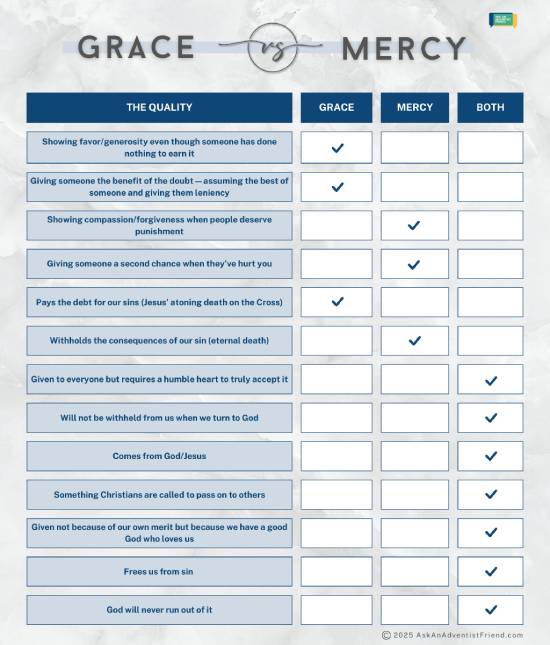
Grace and mercy are two halves of the same coin, each representing different ways God lovingly responds to us despite our shortcomings, poor decisions, and mistakes.
Grace is when God gives us what we don’t deserve, while mercy is when God withholds what we do deserve.11
Both grace and mercy are given out of love. Mercy is given in response to a specific sinful action—or a whole lifetime full of them. Meanwhile, grace can be extended at any time,12 like when God responds with gentleness and understanding in the face of our failures to keep His commands or to measure up to His loving standards.
We can see this relationship in human constructs as well. We can look at the way judges sometimes respond to certain cases, like when a person needs more than only justice if they are to grow beyond this situation. So on top of dismissing or reducing someone’s sentence (an example of mercy), the judge might offer some kind of assistance or rehab to help a guilty person repair their life and find healing, or extend a deadline for them to repay a debt or finish a prescribed program (examples of grace).
Now let’s look in the Bible for examples of the mercy and grace of God.
Grace and mercy in the Bible
God’s character reflects His love for humankind (1 John 4:8). This is evident in the ways He bestows grace and mercy throughout Scripture.
Adam and Eve (Genesis 3)
Adam and Eve sinned by eating fruit from the one tree God warned them not to eat. This act of distrust and disobedience drove them from the Garden of Eden and their Creator, the source of eternal life.
Because of this, they began to age toward death. But God wouldn’t leave them to this eternal fate. He didn’t give up on humanity.
Even after their undeniable disobedience, God taught them a deeper lesson about what love is—showing them mercy by sparing their lives, and showing grace by promising them a future Savior, giving them a chance at undeserved redemption.
Nineveh and Jonah (The Book of Jonah)

Photo by Brett Jordan
The Old Testament tells us that Nineveh was a wicked city in ancient times. They were so immersed in sin that God took special notice of their situation, telling Jonah to warn the Ninevites that continuing this way would lead to their destruction.
Though it definitely took some convincing, Jonah did eventually go to Nineveh to warn them of the consequences coming their way.
Fortunately, Jonah’s warning led the Ninevites to repent, and God, in His mercy, withheld destruction from them.
But, instead of rejoicing about the deliverance of Nineveh, Jonah was angry. He was concerned that people wouldn’t understand his prophecy of destruction was conditional—that whether it would come to pass depended on Nineveh’s response to the warning. He feared that people would see this as an unfulfilled prophecy and accuse him of being a false prophet.13
But, in spite of Jonah’s bitterness and concern for his reputation, God was patient and gracious towards His prophet. And even though it’s not recorded whether Jonah ultimately took it to heart or not, we see God working to help him sympathize with the Ninevites and see them as fellow children of God.
The Prodigal Son (Luke 15:11-24)
The Parable of the Prodigal Son was a fictional story Jesus told to illustrate the mercy and grace God extends to humankind.
In the story, the prodigal son demanded his inheritance from his father and left to squander the money through reckless living. When his irresponsibility eventually led him into poverty and suffering, he realized how much better his life was when he was with his father.
He decided to return to his father to beg for a position as a servant, since he didn’t feel worthy to be treated as his father’s son anymore.
But to his surprise, the father didn’t scold him for what he’d done. In his mercy, he pardoned him.
And it’s this mercy that repaired their relationship.
If the father had turned the son away, the son might never have come back. But because of the father’s mercy, the son was able to find reconciliation, which is what actually gave him a “repentant heart,” or the desire to change. In the father’s graciousness, he even threw a feast and gave him a robe of honor, celebrating that a son he thought he’d lost had returned.
The Thief on the Cross (Luke 23:39-43)
The New Testament tells us that Jesus was crucified alongside two other men, both of whom were thieves.
Though they deserved to be punished for their crimes, unlike the innocent Jesus, one of the thieves called out to Jesus, admitting to his wrongs and asking Jesus to remember Him.
Jesus replied that the thief would be saved, showing how Jesus extended mercy (removing the ultimate consequence of sin) and grace (the gift of eternal life) even while He was suffering on the Cross.
This reminds us that it’s never too late to receive His grace.
The woman caught in adultery (John 8:1-11)
The Pharisees were constantly working to trick Jesus, and this occasion was no different.
They brought a woman to Him whom they had caught in adultery and asked Jesus if they should stone her as the law of Moses commanded.
But Jesus replied by telling them that if any of them were without sin, to go ahead and throw the first stone. Realizing that none of them were without sin, they walked away, one by one.
Jesus extended His mercy to the woman, telling her to go free. At the same time, He also encouraged her to “go and sin no more.”
Though the woman’s story could have ended with this encounter, Jesus’ mercy gave her the chance to turn her life around. In the same way, Jesus’ mercy makes it so our fates aren’t sealed by one specific action or event. He offers us forgiveness again and again, and with it, the chance to start over with a clean slate.
What does mercy and grace mean for us?
Not only does mercy and grace pardon and redeem us, but they also help us draw closer to God.14
The more we experience God’s mercy and grace, the greater picture we get of His selflessness and love.
Because He is more concerned with our well-being and our relationship with Him than with tallying our mistakes, we see how He genuinely cares about us. And His willingness to forgive and care for us despite the ways we hurt Him changes something in our hearts (2 Corinthians 9:8).
The grace and mercy of God moves us, breaking down our desire for sin,15 leading us to repentance, and replacing our desire for sin with a growing desire to honor the God who has done so much for us.16
The more we recognize our need for God’s mercy and grace, the more eager He is to bestow it (2 Chronicles 30:9).
But what about those who take advantage of God’s grace and mercy and use it as an excuse to continue in sin? Does this in any way cheapen God’s generosity?
Grace and mercy aren’t (and can’t be) cheap

Photo by RDNE Stock project
Even in our human relationships, the natural response to recognized mercy and grace is usually gratitude.
Imagine a student who, after being caught cheating, is surprised with a second chance by their professor. If they truly understood the grace being offered to them through this second chance, wouldn’t they be more likely to try their best this time around?
But what would we say about someone who continued to cheat despite being given a second chance?
We might say they did not accept or understand the grace or mercy they were shown. They hardened their hearts and ignored their teacher’s kindness (Matthew 13:15) or failed to acknowledge just how much they needed their mercy.17 They might tell themself that “Cheating isn’t a big deal anyway,” using their second chance as a license to cheat again.
This illustrates the fear some people have—that God’s grace and mercy just offer sinners a free pass on sinning.
But here’s the thing—the Bible tells us that those who hold onto sinful mindsets and deliberately persist in sinful actions have not truly accepted Christ’s grace and mercy—either because they refuse to recognize the love of God, or fail to recognize their own need for a Savior (Romans 2:4; Revelation 3:17).
And if that’s the case, well…that’s not really our business. It’s between them and God. He shows mercy and grace to all, and also gives everyone a choice if they will accept it or not. But just because we find it upsetting that some choose to reject it doesn’t mean that God shouldn’t keep expressing His unconditional love in this way.
Even though God has offered His grace and mercy to everyone, eternal life will only be accepted by those who acknowledge the cost of these priceless gifts. Those who don’t, and persist in sin, reject God’s pardon and salvation, choosing for themselves a path of self-destruction (Isaiah 1:28). And that certainly doesn’t sound like a “free pass.”
In other words, just because it looks like someone is getting away with perpetuating a sin-infected lifestyle doesn’t mean they are. If they reject God’s mercy and grace, they won’t be able to avoid the ultimate consequences of that choice.
At the same time, while some people might seem like they’re deliberately continuing to sin, they might actually be struggling to resist it and eventually come back to God. Just like the prodigal son.
We can’t see the full picture, so we can’t judge God’s reasons for showing someone grace or mercy.
The true value of God’s grace and mercy has nothing to do with how they are received.
God’s grace never was and never will be cheap (1 Peter 1:18-19).
It came at a steep cost to pay for an expensive remedy to a deadly infection—the death of Jesus Christ, bearing all our sin, in our place, even though there was no sin in Him. Jesus suffered this painful, shameful death so we won’t have to (Isaiah 53:5).
Those who realize the profound value of what Jesus has done for us will be overcome with joy and relief and long to dedicate themselves to Him (Romans 6:13-14; 1 Corinthians 6:20).
Though this will mean acknowledging our weakness and tendency toward sin, we won’t be discouraged (Romans 12:3), because even as we struggle against sin, we’ll be empowered by God’s strength, mercy, and grace, which is sufficient for us (2 Corinthians 12:9).
Instead of relying on ourselves and failing, grace and mercy teach us to rely on God to transform our hearts, keep us from sin, and bring us closer to God.
The transformation mercy and grace bring
Accepting God’s grace and mercy doesn’t mean we won’t mess up or fall into sin again. It just means our hearts are in a process of change. We’ve instead placed ourselves on a path that aims away from the sinful nature we were born with, and toward the new life the Holy Spirit gives us (Romans 6:4; 8:1-17).
Like the woman caught in adultery, God will always encourage us to turn away from the habits, thoughts, or actions that used to take hold of us and drag us down (Romans 6:1-4). This process, often called sanctification, is all about our characters becoming more and more like Jesus’ character, step by step.
And as we become more like Jesus, we’ll be inspired to extend grace and mercy toward others, just as He did for us (Matthew 9:13)
Want to learn more about how God’s unconditional love works?
Bible verses about grace and mercy:
- Grace and mercy come from Jesus: 2 Corinthians 12:9; Hebrews 4:16; Romans 3:24; John 3:16-17; Romans 9:15-16.
- Grace and mercy are gifts that cannot be earned: Ephesians 2:8-9; Romans 11:6; Romans 3:23-24; 2 Timothy 1:9; Ephesians 4:7; Galatians 2:19-21; Galatians 5:4; Romans 9:15-16.
- Grace is the gift of salvation: Ephesians 2:8-9; Titus 2:11; Acts 15:11; Titus 3:7.
- Grace frees us from sin and helps us become a new person in Christ: Romans 6:14; 1 Corinthians 15:10; Titus 2:11-14; 2 Corinthians 9:8; Romans 6:1-4.
- Humility is needed to accept grace: James 4:6.
- God gives us grace and mercy because of His loving character: John 1:16; Romans 5:8; Ephesians 2:4-5; Numbers 6:25; Isaiah 30:18; Psalm 103:8; Psalm 25:6-7; Psalm 51:1; Exodus 34:6-7; Jonah 4:2; Malachi 3:17.
- Christians are called to pass along God’s grace and mercy: 2 Corinthians 8:7; 1 Peter 4:10; Acts 20:24; Luke 6:36; Matthew 18:21-22.
- God showed us mercy so we can move on from what holds us back and receive a new, better life: 1 Peter 1:3; Psalm 103:3-4.
- Jesus will not keep mercy from anyone who turns to Him: 1 John 1:9; Proverbs 28:13; 2 Chronicles 30:9; Psalm 40:11-12; Jeremiah 3:12; Isaiah 55:7.
- God abounds in mercy: Lamentations 3:22-23; Psalm 103:8-12; Micah 7:18; Psalm 145:9.
- God gives us mercy when we don’t deserve it: Titus 3:5; Ephesians 2:4-5; Psalm 51:1-2; Jonah 4:2; Nehemiah 9:16-18.
- Strong, James LL.D, S.T.D., The Strongest Strong’s Exhaustive Concordance of the Bible, Zondervan (2001), p. 1501. [↵]
- Ibid, p. 1653. [↵]
- As quoted in: “The Grace of God,” Adventist Stewardship, (Feb. 2022). [↵]
- Genesis 6:5-6; Ezekiel 6:9; Psalm 78:40; Romans 5:8; 1 John 4:10. [↵]
- Hebrews 4:16; James 1:5; John 1:16; 2 Corinthians 9:8-10. [↵]
- Isaiah 64:8; Matthew 23:37; Ephesians 1:4-6. [↵]
- Strong, p.1501. [↵]
- Ibid, p.1607. [↵]
- Isaiah 63:9; James 5:11; Psalm 103:13. [↵]
- Luke 18:7-8; Psalm 34:17; 1 Thessalonians 4:6; Proverbs 11:21. [↵]
- Chacón, Emmer, PhD, “Justice and Mercy: God’s Forgiveness of David,” Ministry Magazine (June 2019). [↵]
- “The Grace of God.” [↵]
- Nichol, F.D. Seventh-day Adventist Bible Commentary, Vol. 4 (1955 ed.), p. 1006. [↵]
- Ibid. [↵]
- Romans 6:14; Romans 8:12-13; 1 Peter 1:14. [↵]
- 1 John 5:3; Romans 1:5; John 14:15. [↵]
- Romans 8:5-8; Proverbs 28:11-14; Isaiah 26:10. [↵]
More Answers

“Go and Sin No More”—What Did Jesus Mean?
These well-known words of Jesus Christ come from two New Testament stories in the book of John—a man healed by the Pool of Bethesda (John 5) and a woman caught in adultery (John 8).

Can God Forgive Me?
In one way or another, every single one of us has made a sizeable mistake that we’re ashamed of.

All About the Old and New Covenants in the Bible
When God promised a Messiah to Adam and Eve, He established an everlasting covenant that reaches down to us. This includes both the old and new covenants.

Legalism in the Bible: Definition, Dangers, and Examples
Find out what the Bible says about legalism, why it’s dangerous, and how we can avoid it today.

Sin
While this might seem like a complicated question, there’s a simple way to look at it. Sin is a failure to love God and love others. It is the opposite of love.

How Does Forgiveness Really Work? What Does the Bible Say?
Forgiveness—a familiar word but often-misunderstood concept. Learn how the Bible defines it, how it’s supposed to work, and what it shows us about God.

The New Covenant—What It Is and What It Means for Us Today
The Bible talks about the covenant, or promise, God made to save us from sin. Learn more about the old and new covenants and why they matter to us.

Why Does God Allow Suffering?
Poverty, genocide, a school shooting. A tsunami or earthquake that wipes out thousands of lives and leaves behind mourning family members.

Does the Bible Teach Predestination?
your choices, actions, and habits really matter to your eternal destiny? Or is the path you choose in life predetermined, and your life is just following a script that’s been laid out for you?

How Do I Know God Has Forgiven My Sins?
Knowing you’re forgiven is a big part of finding freedom in Christianity. The Bible tells us that after we’ve prayed for God’s forgiveness, we can believe we’re forgiven and accept His gift of pardon.

How Does Jesus Christ Help Us Overcome Sin?
You might have heard the phrase somewhere about “gaining victory over sin” through “the power of Jesus Christ” or “through the blood of Jesus,” etc. But what does that mean exactly, and how does it all work…especially if we’re still having to live out our lives in a world that’s still full of sin?

What You Need to Know About Temptation and How to Resist It
Ever felt like you face the same temptation day after day? The one temptation that always seems to resurface?
It can be frustrating, yes. But be encouraged—being tempted doesn’t mean you have done anything wrong! And even if you give in to temptation, you are never too imperfect to come before God.

Faith and Works—Do Both Matter in the Christian Life?
In so many religions all throughout time, individuals work toward enlightenment, salvation, or the favor of a deity. People are taught subtly—or not so subtly—that if you only do enough good deeds, you’ll be worthy/ascended/redeemed/approved, etc.

What Is Salvation, and How Do I Get Saved?
Salvation, or being saved, is what God wants for all of us. And since God created us with free will, this salvation is ultimately our choice. We become “saved” by accepting that Jesus Christ died on the cross, taking the punishment meant for sinners upon Himself.

What the Bible Says About Tattoos (Are They a Sin?)
Only one Bible verse speaks directly to permanent, symbolic markings on the skin. It’s Leviticus 19:28, and it’s one item in a list of ways God told Israel to distance themselves from the pagan practices of the people they lived among.

Why is There Good and Evil in the World?
Human nature is capable of the most self-sacrificing and heroic acts—a soldier risking his life for his country, a mother protecting her children from harm, a man jumping into a swirling current to save someone who is drowning.

What is the Great Controversy?
The Great Controversy is a battle between good and evil that began when a beautiful angel rebelled in heaven. It’s the cause of the evil and suffering in our world today.