
The most accurate Bible possible would be one that’s printed in its original languages—Hebrew and Greek. But since most of us are not Hebrew or Greek scholars, the next best option is an English Bible translation that most closely reflects the original language and intent while also presenting these ideas in a practical and understandable way.
You might feel overwhelmed with all the options out there—about 900 in the English language.1 That’s almost like a GPS giving you hundreds of routes to choose from!
But the process doesn’t have to be difficult. By understanding the three main categories of Bibles, you’ll find a version that suits your needs and helps you come to know Jesus better.
Here, we’ll cover:
- Why are there so many Bible versions?
- What are the different types of Bible translations?
- How to choose the best Bible version for you
Let’s first touch on why we have so many versions in the first place.
Why are there so many Bible versions?

Photo by Tim Wildsmith on Unsplash
The number of different Scripture translations has mushroomed in the past centuries as original manuscripts have been discovered and repeatedly translated.
The Old Testament was written in Hebrew, and the New Testament in Greek and Aramaic. After the first century, these languages became less and less common because Latin was the primary language of the Roman Empire.
And with the spread of Christianity to different countries, the Hebrew and Greek texts soon needed to be translated into those languages as well.
The result was many different manuscripts that have been used in recent centuries for modern translations.
As we’ll see next, those versions are divided into three main categories. The most accurate ones will be those translated from the original Hebrew and Greek manuscripts.
What are the different types of Bible translations?
Bible translations fall into three categories based on how closely they reflect the original wording of Greek and Hebrew manuscripts. They are:
1. Literal translations
2. Dynamic equivalents
3. Paraphrases
Literal translations
Literal, or word-for-word, translations seek to translate each Hebrew and Greek word in as literal a manner as possible. They are also called formal equivalents.
This can result in text that’s a little more clunky or difficult for modern readers to understand.
The reason for this is the differences between the Bible’s original languages and English. Sometimes, Greek and Hebrew words have multiple meanings in English, making it challenging for translators to know which English word to use.
And there are more than just word differences between these languages. There are variations in sentence structure, emphasis, and punctuation, too.
Even so, literal translations are the most accurate Bibles for in-depth study. Having additional resources on hand can also help with understanding what the original Bible writers meant. Try out a Strong’s Exhaustive Concordance of the Bible or Hebrew-English and Greek-English lexicons.
The following are some of the most popular translations in this category.
The King James Version (KJV)

Photo by Humble Lamb on Unsplash
Date translated: 1611
- Translated/produced by: Bible scholars of the Church of England; commissioned by King James
- Pros:
- Poetic writing style
- Traditional Bible for centuries
- Most popular Bible in use today
- Considered the most accurate translation for its time
- Cons:
- An old English version with archaic language. Some words had very different connotations back then.
- Harder to understand
The Revised Standard Version (RSV)
- Date published: 1952
- Translated/produced by: National Council of the Churches of Christ
- Pros:
- First translation to use the Dead Sea Scrolls
- Updated language
- Cons:
- Possible concerns about the theological viewpoints of the translators and bias in the text
- Can be hard to find printed copies
The New American Standard Bible (NASB)
- Date published: 1963
- Translated/produced by: The Lockman Foundation
- Pros:
- Highly accurate
- Contemporary English
- Translation notes with literal meanings of words and other possible translations
- Con:
- More literal wording that may not flow like modern wording
- Read the NASB for free.
The Amplified Bible (AMP)
- Date published: 1965
- Translated/produced by: Zondervan and the Lockman Foundation
- Pros:
- Additional meanings of words and phrases within the text to enhance the understanding
- One of the most easy-to-understand literal translations
- Con:
- The extra phrasing in brackets and parentheses can make the text feel cluttered, especially when reading out loud
The New King James Version (NKJV)
- Date published: 1982
- Translated/produced by: 130 Bible scholars, pastors, and theologians; published by Thomas Nelson
- Pros:
- Updated version of the KJV (updated grammar and wording while retaining the traditional poetic beauty of the KJV)
- Easier read with the older style
- Con:
- Still contains many archaic phrases
The English Standard Version (ESV)
- Date published: 2001
- Translated/produced by: Crossway; over 100 scholars and pastors
- Pros:
- More modern wording
- Keeps some of the most-loved verses close to the KJV translation
- Cons:
- Some hard-to-read sentence structure
- Concerns about possible theological bias (since the RSV was referenced in translations)
Dynamic equivalents
Dynamic equivalents, or thought-for-thought translations, convey the message of the Bible’s text rather than the exact words. Scholars have sought to use cultural, linguistic, and historical background to express in modern language what the original author intended.
While these translations are generally easier to read and understand, they’re not perfect. Every scholar comes to their work with a theological bias, so these translations may potentially express more bias than word-for-word translations.
But this fact doesn’t mean we should avoid dynamic equivalents.
Instead, they can make for enjoyable devotional reading in conjunction with other Bible study tools and more literal translations.
Check out these ones:
The New International Version (NIV)
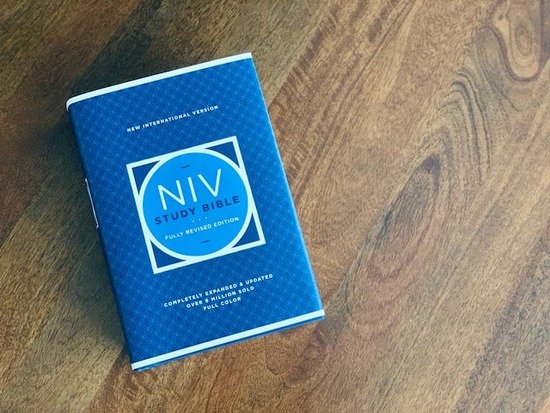
Photo by Tim Wildsmith on Unsplash
Date published: 1978
- Translated/produced by: Biblica (International Bible Society)
- Pros:
- One of the most popular, easy-to-read, modern versions of the Bible
- Uses word-for-word and thought-for-thought translation, striking a balance between
- Cons:
- Wording isn’t always the most poetic
- Translators sometimes added words that weren’t original, making it seem interpreted rather than translated
The New Living Translation (NLT)
- Date published: 1996
- Translated/produced by: Tyndale House Publishers
- Pros:
- A highly accessible version
- Changes traditional metaphors or terms to modern-day equivalents for easier understanding
- Cons:
- The colloquial language can make it seem far away from the original text
- Its use of modern terms and metaphors may change the originally intended meaning
God’s Word Translation (GW)
- Date published: 1995
- Translated/produced by: God’s Word to the Nations Society
- Pros:
- Printed in a single-column format for easy reading.
- Displays the reading in the way the Bible writers would speak if they lived today
- Con:
- Sometimes interprets phrases instead of translating them
- Read the GW translation for free.
The Christian Standard Bible (CSB)
- Date published: 2017
- Translated/produced by: Holman Bible Publishers
- Pros:
- An updated version of the Holman Christian Standard Bible, which is known as an “optimal equivalence” because it contains both word-for-word and thought-for-thought translation throughout
- Uses gender-neutral terms when the original language would also refer to both genders
- Easy-to-read text
- Con:
- Uses some unconventional translating ideas, like translating “beer” for “strong drink”
Paraphrases
Paraphrases are not translations in the strictest sense. Rather, they involve interpretation, rewording, and expanding upon the original text of the Bible to make it more understandable.
Paraphrases tend to have a greater potential for bias, particularly since they’re often the work of one individual rather than a committee of Bible scholars.
For these reasons, they work best when combined with more literal translations. But they can be a great addition to a devotional routine or study.
Here are four common paraphrases:
The Living Bible (TLB)
- Date published: 1971
- Produced by: Kenneth Taylor
- Pro:
- Seeks to communicate the meaning of each passage in as simple a way as possible
- Cons:
- Less poetic
- Potential bias and interpretation that may not be accurate to the originally-intended meaning
Good News Translation (GNT)
- Date published: 1976
- Produced by: Dr. Robert Bratcher together with a committee appointed by the American Bible Society
- Pros:
- Accessible to non-native English speakers
- Easy to read and understand
- Con:
- Potentially strays too far from the original meaning of the text
The Clear Word
- Date published: 1994
- Produced by: Jack J. Blanco
- Pro:
- A devotional paraphrase from an Adventist perspective
- Con:
- Not an actual Bible
- Learn more about the Clear Word.
The Message (MSG)
- Date published: 2002
- Produced by: Eugene H. Peterson
- Pros:
- Easy-to-read, colloquial language
- Can give a different perspective to verses
- Cons:
- A very loose translation of the original with heavy interpretation
- Some of the idioms used are American
How to choose the best Bible version for you

Photo by Kelly Sikkema on Unsplash
As we’ve already mentioned, the best Bible translation will be as close as possible to the originally intended meaning of its authors. Generally, word-for-word translations fit this criterion best.
Your purpose will also affect which one you should choose.
Let’s go through a few different purposes and the Bible versions that might work best for you:
- Bible study. If you are looking to dig deep into the Bible, a word-for-word translation (such as the NASB or the KJV) is ideal since it sticks closest to the original language. Though not always the easiest to read, Bible dictionaries and concordances can help remedy that challenge.
- Devotional reading. When looking for simple encouragement for your day and ways to connect with God, pick a Bible you can easily understand. Depending on what you are most used to hearing, this version could be a word-for-word translation or a dynamic equivalent.
- Memorization. Remember Psalm 23’s classic “thy rod and thy staff they comfort me”? Some versions are written very poetically and are the standard you hear quoted. The King James Version is one of the most famous.
- Reading aloud. Choose a translation that allows the words to easily roll off your tongue and that is easy for listeners to understand. Thought-for-thought translations usually fit this bill because they are written in modern English.
- Secondary Bible. You may already have a favorite Bible but want another for comparison. A good way to balance your selection is to pick the opposite type of Bible from the one you have now. If you use a thought-for-thought version, pick a word-for-word translation and vice versa.
- Children’s Bible. A thought-for-thought version with simpler language may be the best for children who might struggle with more literal wording.
The key is getting to know the ultimate author of the Bible
Due to the challenges of translating from language to language, no Bible translation will ever be able to fully convey the originally intended meaning of all its passages.
After all, Scripture was written by finite humans about an infinite God. So there’s always more to learn.
But the good news is that this fact hasn’t obscured the message in the Word of God. Through the years, God has used His people to preserve this valuable book so that it could continue to be transformative in the lives of many.
So instead of getting hung up on the details, use the principles listed here to pick an accurate and readable Bible.
Then, focus on what’s most important: getting to know the author of the Bible. He has promised to give us the Holy Spirit to guide us to all truth (John 16:13).
- “Number of English Translations of the Bible,” American Bible Society. [↵]
Related Articles


More Answers

History of the Adventist Church
After Jesus didn’t return in 1844 as many Millerites had expected, a small group rediscovered Bible truths that led them to start the Seventh-day Adventist Church in 1863. Here’s their story.

What Does God Look Like According to the Bible?
What Does God Look Like According to the Bible?As human beings, it’s natural for us to wonder about God’s appearance. But the Bible says very little about it. It’s not hard to understand why, though. As the Creator of the entire universe, His existence transcends our...

The Parables of Jesus
Have you ever been on the verge of sleep in the middle of a long lecture or sermon when suddenly the speaker takes a turn and begins to tell a story?

Jesus and John the Baptist: Their Relationship and Ministry
John the Baptist and Jesus were cousins, friends, and close coworkers in ministry. Learn the lasting significance of their relationship.

Sin
While this might seem like a complicated question, there’s a simple way to look at it. Sin is a failure to love God and love others. It is the opposite of love.

Why Did Jesus Have Disciples and Who Were They?
During Jesus’ ministry on earth, He selected certain individuals to help with and continue His work. They would be referred to during that time as His “disciples.”

How to Really Read and Understand the Bible
If you’re new to the Bible or haven’t picked it up in a while, how do you start? Find out 6 basic steps to read the Bible, plus some helpful reading plans to try.



Does Jesus Appear in the Old Testament?
Before His incarnation, Jesus also played an active role in the redemption and salvation of humanity. Discover the different ways He appeared in Old Testament stories.

How Does Forgiveness Really Work? What Does the Bible Say?
Forgiveness—a familiar word but often-misunderstood concept. Learn how the Bible defines it, how it’s supposed to work, and what it shows us about God.

Jesus’ Baptism: What It Means and Why It Matters
Jesus’s baptism marked the beginning of His earthly ministry. It was God’s big reveal regarding who Jesus is.

11 Reasons People Become Seventh-day Adventists
Curious why many people become Adventists? Here are elements of Adventist beliefs, values, and mission often reflected in people’s decisions to join.

Why Is the Genealogy of Jesus Christ So Important?
Have you ever traced your genealogy back several generations? Did you ever try to find out if your ancestors did anything famous (or infamous)?

Jesus and the Woman at the Well: Breaking Down Barriers
Jesus’ meeting with the woman at the well reveals His heart for hurting people and His desire to break down prejudice. This page looks at how Jesus reached out to her.

The New Covenant—What It Is and What It Means for Us Today
The Bible talks about the covenant, or promise, God made to save us from sin. Learn more about the old and new covenants and why they matter to us.

Who is The Son of Man in the Bible?
In calling Himself the Son of Man, Jesus confirmed His role as humanity’s savior. Learn what else this title tells us about Jesus.

What’s the Seventh-day Adventist General Conference Session?
At the General Conference Session, Adventist delegates from around the world gather to assess the state of the organization, pray, and discuss current issues. Here’s how it works.

Who Was Mary, the Mother of Jesus Christ?
Mary, Jesus’ mother, was a humble woman, deeply committed to following God’s will for her life. Learn what the Bible says about Mary and what we can learn from her.

What Does the Bible Mean When It Calls Jesus the Son of God?
When the Bible calls Jesus the Son of God it’s referring to His divinity. Learn what makes this so significant and what it has to do with salvation.

How Adventists View the End of the World
The end of the world is no fun to think about. But here’s how we can actually find hope and comfort in what’s to come.

What Is an Adventist Medical Missionary?
A medical missionary in the Adventist Church is someone who cares for the medical needs of people as a way of showing the love of Jesus. They may travel to another country, or even just serve in their hometown.

Is the Seventh-day Adventist Church Protestant?
With so many Christian denominations, it can be hard to keep track of which ones share which beliefs. Let’s look at the core Protestant beliefs of Adventism.

The True Events Surrounding the Birth of Jesus
Jesus’ birth involved many strange events: a pregnant virgin, a stable birth, angels appearing to shepherds, and wealthy visitors. These help us understand His supernatural yet incredibly humble life.

Are Seventh-day Adventists Evangelicals?
According to its origins and definition, evangelicalism is about following Jesus and the Bible and sharing the Gospel through the way we live our lives. Adventists wholeheartedly harmonize with these principles.

Could Anything Keep Me from Becoming an Adventist?
We are each saved through Christ. But when it comes to church membership, are there certain beliefs or expectations to become an Adventist?

Do Seventh-day Adventists Have “Rules”?
We uphold principles we believe will help us maintain a closer relationship with Jesus and His Word. Learn how these principles guide Adventist lifestyles.

Your Comprehensive List of Ellen G. White’s Visions
Ellen White—an author, health-reform advocate, Bible scholar, and one of the most influential founding figures of the Seventh-day Adventist Church—was blessed by the Holy Spirit with the spiritual gift of prophecy (1 Corinthians 14; Romans 12:6-8). During her lifetime, she received direct guidance and inspiration from God in several different ways.

Do Seventh-day Adventists Have “Rules” For Marriage?
Around the world, many cultures and religions have various marriage traditions, expectations, or even rules when it comes to choosing a partner, planning the wedding, extended family logistics, or a number of other things.
Didn’t find your answer? Ask us!
We understand your concern of having questions but not knowing who to ask—we’ve felt it ourselves. When you’re ready to learn more about Adventists, send us a question! We know a thing or two about Adventists.