
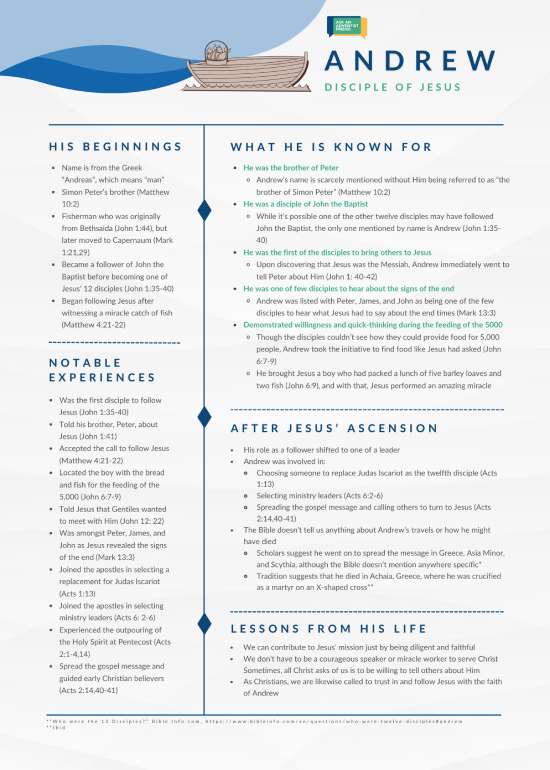
Andrew was Jesus Christ’s first disciple (John 1:37-40) and the first to recognize Him as the Messiah.
With this discovery, Andrew invited his brother, Peter, to come meet Jesus for himself.
Though little is known about Andrew, the details we find in the New Testament show that he played a valuable role in Jesus’ ministry.
Let’s look at some of Andrew’s most memorable moments in Scripture.
We’ll cover:
- Andrew’s beginnings
- What Andrew is known for in the Bible
- Andrew after Jesus’ ascension
- What we can learn from his life
First, some background information…
Andrew’s beginnings
Little is known about the apostle Andrew, since Bible writers didn’t often provide background details about people who weren’t immediately pertinent to the story at hand. But the Bible does give us an overview of who Andrew was and where he came from.
Andrew had a Greek name that comes from the word “Andreas,” which simply means “man.”1
He was the son of a Jewish man named Jonah or John (different versions translate the name differently) and a brother to the well-known disciple Peter (John 1:42; Matthew 10:2).
Like his brother, Peter, and his fellow disciple, Philip, Andrew was originally from Bethsaida in Galilee (John 1:44), though he later moved to Capernaum (Mark 1:21, 29).
Andrew and Peter both worked as fishermen (Mark 1:16), but Andrew was the only one said to have been a follower of John the Baptist (John 1:35-40). And it was the decision to follow John the Baptist that first led Andrew to Christ.
According to the Gospel of John, Andrew heard about Jesus when John the Baptist announced Him as the Lamb of God (John 1:35-40). Immediately, Andrew and another one of John’s disciples followed after Jesus and ended up spending the day with Him (John 1:38-39).
Evidently impressed by his encounter with Jesus, Andrew went to tell Peter he had met the Messiah (John 1:41). He even brought Peter to Jesus.
And this wouldn’t be the last time they saw Jesus.
They would later be called by Him to spend the rest of their lives following Him.
The calling of Andrew

Though Peter and Andrew met Jesus, the official “call” to discipleship was recorded when Jesus found them fishing (Mark 1:16).
The Gospel of Luke tells us that crowds of people had gathered near the Lake of Gennesaret to hear Jesus speak (Luke 5:1). But instead of speaking to them from the land, Jesus decided to speak to them from one of the fishermen’s boats nearby.
He had seen Andrew and Peter’s boat, and they agreed to let Him climb aboard.
From there, Jesus began teaching the crowd (Luke 5:2-3). Afterward, He turned to Peter and told him to release his nets into the water (Luke 5:4).
Peter responded by telling Jesus that they hadn’t been able to catch any fish, even though they’d been fishing all night long (Luke 5:5). And yet he agreed to cast their net one more time (Luke 5:5).
The Bible tells us:
“And when they had done this, they caught a great number of fish, and their net was breaking. So they signaled to their partners in the other boat to come and help them. And they came and filled both the boats, so that they began to sink” (Luke 5:6-7, NKJV).
It was then, in the face of a miracle, that Jesus called Andrew and his brother Peter to become His disciples.
“Then He said to them, ‘Follow Me, and I will make you fishers of men’” (Matthew 4:19, NKJV).
And without any hesitation, Andrew and Peter accepted His offer and decided to follow Jesus (Matthew 4:20).
The story of Andrew’s calling tells us a little bit about the kind of person he was: a faithful, dedicated individual. When convinced of Jesus’ messiahship, he couldn’t help but tell others, and he readily left behind his job, family, and hometown to become a loyal follower of Jesus.
What is Andrew known for in the Bible?
The most well-known detail about Andrew is that he became Jesus’ first disciple.
However, a couple more things set him apart from the other disciples:
- He was a confirmed disciple of John the Baptist (John 1:35-40): While it’s possible that a few more of the 12 disciples also followed John the Baptist, the only one mentioned by name is Andrew.
- He was the first of the disciples to bring others to Jesus (John 1:40-42): Upon discovering that Jesus was the Messiah, Andrew immediately went to tell Peter about Him.
- He may have been one of the few disciples to hear about the signs of the end (Mark 13:3): Though Jesus loved all of His disciples, He became especially close to Peter, James, and John. On this occasion, however, Andrew was included in this “inner circle” of disciples when they asked Jesus about signs of things to come. And so Andrew was listed among them as being one of the few disciples to hear what Jesus had to say about the end times.
- He was the brother of Peter (Matthew 10:2): Aside from James and John, Peter and Andrew were the other set of brothers among the disciples. Between these two, the Bible writers talked a lot more about Peter. In fact, Andrew’s name is scarcely mentioned without him being referred to as “the brother of Simon Peter.”2
But being well-known is not the primary measure for being a good disciple and one we can learn from. Even from the little information Scripture gives us, we can tell that Andrew was a competent disciple who was quick to do the work he was called to do. That simple quality—willingness—is invaluable, especially for a follower of Christ.
We see this willingness demonstrated in how he worked with his fellow disciples and other people he ministered to.
For example, there was one occasion when a group of Greeks came to Philip asking to see Jesus (John 12:20-21).
Philip turned to Andrew with the request, and together they brought the request before Jesus (John 12:22).
(Whenever in doubt about how to respond to a situation, it’s always a good idea to turn to Jesus.)
This situation also demonstrates how willing Andrew was to introduce others to Jesus Christ. He didn’t seem to care that they weren’t Jews, but rather left it up to Jesus to decide how to proceed.
Andrew demonstrated that same willingness and quick thinking when he ministered to the crowds following Jesus.
One time, a group of 5,000 people were following after Jesus, and everyone ran out of food (John 6:2). Testing the disciples, Jesus asked them where they could go to find food for the people (John 6:5-6).
Though the disciples didn’t see how they could provide for 5,000 people, Andrew took the initiative to find food like Jesus had asked (John 6:7-9).
He brought Jesus a boy who had packed a lunch of five barley loaves and two fish (John 6:9).
And while he didn’t understand how that would be enough to feed the crowd, he offered it up to Jesus anyway. He did what he knew to do, given the circumstances.
Though the Bible doesn’t often address Andrew’s role in Jesus’ ministry, the occasions it does mention him point to his continuous dedication to Christ.
What did Andrew do as an apostle, after Jesus’ ascension?

Photo by Hans Reniers on Unsplash
While we know little about Andrew’s specific role when he was a disciple to Jesus, even less is recorded about his life after Jesus’ ascension back to heaven.
Like the rest of the disciples, it’s very likely he took up Jesus’ call to spread the Gospel around the world (Acts 1:6-8).
Some scholars suggest he went on to spread the message in Greece, Asia Minor, and Scythia, although the Bible doesn’t mention any specific locations.3
Tradition also suggests that Andrew died in Achaia, Greece, where he was crucified as a martyr.4 Unofficial records claim that Andrew asked to be crucified on an X-shaped cross out of respect for Jesus’ own crucifixion.5 This idea has become so popular that X-shaped crosses are now referred to as St. Andrew’s crosses.6
However, it’s worth noting that the Bible doesn’t tell us anything about Andrew’s travels or how he might have died.
Instead, the book of Acts tells us how Andrew’s role as a follower had shifted to one of a leader, as all twelve apostles were called to make administrative decisions and teach early Christian believers while Christ was in heaven.
The Bible tells us Andrew was involved in:
- Choosing someone to replace Judas Iscariot as the 12th disciple (Acts 1:13)
- Selecting ministry leaders (Acts 6:2-6)
- Spreading the Gospel message, and calling others to turn to Jesus (Acts 2:14, 40-41)
While these may not be roles or jobs that get much attention, they are similar to the kinds of tasks that are consistently important in ministry today, whether in a small church, large congregation, or discipleship group.
What can we learn from the life of Andrew?
Andrew’s life and ministry teach us that we can contribute to Jesus’ mission just by being diligent and faithful and maintaining a state of readiness and receptiveness to be used by God.
There wasn’t anything remarkable about Andrew from an earthly perspective.
He was a poor fisherman, and unlike his brother Peter, he didn’t end up becoming one of the most well-known apostles.
But Andrew was no doubt an invaluable member of the 12.
It was Andrew who brought Peter to meet Jesus.
It was Andrew who led Gentiles to Jesus when others might have turned them away.
It was Andrew who hadn’t given up on the feeding of the 5,000.
And it was Andrew who first sought after Christ.
He had an incredible faith and was passionate about bringing others to Jesus.
As Christians, we are likewise called to trust in and follow Jesus with the faith of Andrew.
His example also shows us that we don’t have to be courageous speakers or miracle workers to serve Christ. Sometimes, all Christ asks of us is that we be willing to do what needs doing and to always point back to Jesus.
In the end, that’s our goal as Christians—to bring others to Christ like Andrew did.
Want to continue learning about the disciples?
Related Articles





- “What was it Like Being Jesus’ Disciple and Apostle?” General Conference Corporation of Seventh-day Adventists, [↵]
- Matthew 4:18; Matthew 10:2; Mark 1:16; John 1:40. [↵]
- “Who were the 12 Disciples?” BibleInfo.com, [↵]
- Ibid. [↵]
- Ibid. [↵]
- Ibid. [↵]
More Answers

What is the Ellen G. White Estate?
What is the Ellen G. White Estate?Ellen G. White’s contributions to the formation and growth of the Seventh-day Adventist Church are an integral part of its history. As a significant co-founder of the denomination, her writings provided millions of people with...

Getting to Know Mark—Gospel Writer and Follower of Jesus
Mark (whose full name was John Mark) had a lot of roles in the New Testament: he was an early follower of Jesus Christ, he traveled the Mediterranean as a Christian missionary, and he wrote a book of the Bible.

Understanding Luke: The Beloved Physician, Historian, and Evangelist
Who was Luke in the Bible? What was he known for and what contributions did he make for the early church? Find out here.

Exploring the Life of the Apostle Paul
The apostle Paul went from Pharisee to Christian after a miraculous encounter with Jesus. He spent the rest of his life spreading the Gospel and writing words we still read today.

All About the Disciple, Simon the Zealot
“Simon the Zealot” was one of the 12 disciples chosen by Jesus Christ. But despite this important role, the New Testament doesn’t provide specific details about his life, family, job, etc.

Judas Iscariot, the Most Infamous Disciple of Jesus
Judas Iscariot is best known for betraying Jesus with 30 pieces of silver. This page looks more closely at who he was and what led him to do so.

Who Is Thaddeus, the Disciple?
Thaddeus (or Thaddaeus) is one of the more unique and obscure figures among Jesus Christ’s disciples in the New Testament. Though we know little about him from the Bible or tradition, we do know that he went by a few names, specifically Thaddeus, Lebbaeus, and Judas of James.

Matthew—From Tax Collector to Jesus’ Disciple
In the first book of the New Testament, we find the Gospel story from the perspective of Matthew. He was a Jewish tax collector from Capernaum in the first century AD, and he was likely despised by fellow Jews for choosing that profession.

Who Was Jesus’ Disciple Named James, Son of Alphaeus?
Two of Jesus’ 12 disciples were named James. While more is known about James the son of Zebedee and brother of John, let’s see what there is to know about the other James, known as James the son of Alphaeus—also sometimes referred to as “James the Lesser.”

What the Bible Tells Us About Thomas the Apostle of Jesus
You might know him as “Doubting Thomas” because he refused to believe in Jesus Christ’s resurrection without first seeing Jesus.

All About the Disciple James, Son of Zebedee
James the son of Zebedee was a fisherman who became Jesus’ disciple. Discover how his decision to follow Jesus shaped his life and the beginnings of the early Church.

Who was the Apostle John?
What does the Bible say about the apostle John? What is he known for today? Learn more about John’s life, ministry, and legacy here.

All About Bartholomew, a Disciple of Jesus
Bartholomew is a lesser-known character in the New Testament who is mentioned in each of the lists of the twelve disciples of Jesus Christ (Matthew 10:2-4; Mark 3:14-19; Luke 6:13-16). He is most likely the same individual as Nathanael (see John 1), someone who was sincerely studying the Scriptures and waiting for the Messiah to come.

Simon Peter: Fisherman to Disciple to Apostle
Simon Peter was a simple fisherman who became one of the most well-known disciples of Jesus Christ. He is perhaps best known for being part of Jesus’ inner circle of three disciples, walking on water, and proclaiming Jesus as the Son of God.

Who Was Philip the Disciple In the Bible?
Philip was one of the 12 disciples called by Jesus Christ during His earthly ministry. He was originally from the city of Bethsaida and to this day is often known as the “practical disciple.”

How Are Seventh-day Adventists Different from Other Protestants?
As a Protestant Christian denomination, the Seventh-day Adventist Church regards the Bible as the ultimate guide and looks to Jesus Christ as the only way to salvation. We do have some differences of belief or interpretation when it comes to topics like Bible prophecy, end-time events, the Sabbath, and a person’s state after death.

What Do Adventists Believe About the Atonement?
If you’ve spent much time in the Bible books of Leviticus or Numbers, you might’ve noticed the word atonement.

Who Changed the Sabbath to Sunday?
If the Bible never mentions the change of the Sabbath, why do so many today attend church on Sunday?

How Adventists Handle Death and Funerals
Most Seventh-day Adventist funeral services are similar to those of other Protestant denominations, such as Methodists, Baptists, or Presbyterians, but you might find a few differences or unique nuances.

Adventist Culture
Many Seventh-day Adventists adhere to specific lifestyle principles that can make them stand out from those in other Christian denominations. Whether it’s going to church services on Saturday or eating the popular Adventist entrée of “haystacks.”

Do Seventh-day Adventists Believe Only They Will Go to Heaven?
No, Adventists definitely don’t believe they’re the only ones that will go to heaven. As a matter of fact, we don’t believe admittance into heaven is ever based on which church or denomination we belong to. People all over the world from different Christian denominations, religions, and walks of life will be welcomed by Jesus.

What Is Children’s Sabbath School in the Adventist Church?
Children’s Sabbath School is a Bible program offered every Sabbath at Adventist churches for children from birth to age 18. These classes give children the chance to learn Bible stories, make new friends, and participate in fun activities.

How Adventists Developed the Sanctuary Doctrine and What It Means
The sanctuary was a building at the center of ancient Israelite society that gives us a small picture of the original sanctuary, God’s throne room in heaven (Hebrews 8:1-2).

What Do Adventists Believe About Faith and Works?
Adventists believe we are saved by faith, which is the belief and trust we have in Jesus to save us from our sins. Jesus, then, enables us to live in harmony with God’s commandments and serve others with love—sometimes referred to as “works.”

Do Adventists Observe Easter-Related Holidays?
Jesus Christ’s resurrection, celebrated on many Easter-related holidays, is central to the beliefs of the Seventh-day Adventist Church. And that means we seek every opportunity to remember it.

An Overview of Seventh-day Adventist Higher Education
The Seventh-day Adventist Church has about 118 tertiary schools around the world. Though many of them are within North America, you’ll also find Adventist universities in countries across the world—places like Croatia, Austria, Brazil, Madagascar, and the Philippines.
The Ten Commandments from a Seventh-day Adventist Perspective
Ever eaten a salad and gotten a big piece of green stuck in your teeth? And you didn’t realize it was there until you looked in the mirror? (Because no one ever told you!)

Major Fulfilled Bible Prophecies You Should Know About
Prophets seem like something from novels or movies. The predictions they make couldn’t actually happen, could they? After all, nobody can tell the future!

What Day Is the Sabbath, and How Do We Know?
The Sabbath is a declaration of weekly rest by God which we find in the Bible (Genesis 2:2-3). But you may be wondering:
Didn’t find your answer? Ask us!
We understand your concern of having questions but not knowing who to ask—we’ve felt it ourselves. When you’re ready to learn more about Adventists, send us a question! We know a thing or two about Adventists.