
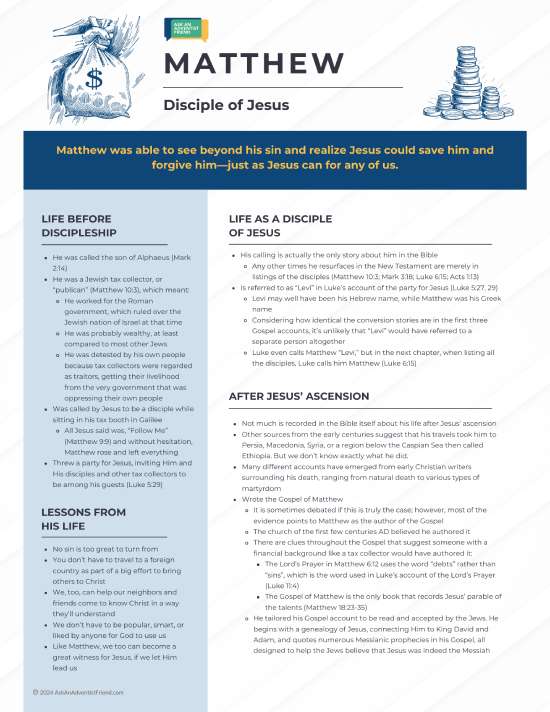
 In the first book of the New Testament, we find the Gospel story from the perspective of Matthew. He was a Jewish tax collector from Capernaum in the first century AD, and he was likely despised by fellow Jews for choosing that profession.
Despite his beginnings, Matthew was willing to be uniquely used by God. To begin with, he was a converted tax collector—that alone was rare. And He served as one of Jesus Christ’ twelve disciples, wrote one of the synoptic Gospel accounts, continued to serve as an apostle after Jesus returned to heaven, and likely died a martyr’s death.
Matthew was able to see beyond his circumstances and realize Jesus could save him and forgive him—just as Jesus can for any of us.
So let’s get into the details of Matthew’s story:
- Life before discipleship
- Life as Jesus’ disciple
- Life after Jesus’ ascension
- Lessons from Matthew’s life
We’ll start by examining what his life was like before he encountered Jesus Christ.
Matthew’s life as a tax collector, before discipleship

Photo by Pixabay
There isn’t a detailed biographical record of what Matthew’s early life was like. And in the book he wrote about the Gospel story, he certainly wasn’t focused on what happened in his own life before meeting Jesus.
But since we know his occupation, that has sparked a lot of interest and speculation in religious media. For example, The Chosen series about all the disciples has taken a few creative liberties with his character.
Here are the specific facts about Matthew we can get straight from the Bible:
- He was also called the son of Alphaeus (Mark 2:14).
- He was also known as Levi (Mark 2:14; Luke 5:27).
- He was a tax collector, or “publican” (Matthew 9:9; 10:3).
Just knowing he was a tax collector, however, provides us with more contextual likelihoods about Matthew:
- He worked for the Roman government, which ruled over the Jewish nation of Israel at that time
- He was probably wealthy, at least compared to most other Jews
- He was more than likely detested by his own people
Here’s why.
The Jews were currently living under the rulership of the Roman Empire, which ruled with a heavy hand over the nations it conquered. One of the “features” of this Roman authority was that Jews had to pay hefty taxes to the Roman government.
But unlike the taxation systems we’re used to today, which are supposed to pay for a country’s infrastructure, government programs, education, etc., Roman taxes benefited none but Rome, making them even more powerful and rich.1 Today we’d call it taxation without representation.
And to make matters worse, the Roman government contracted with locals to do their dirty work of collecting those fees—one of the jobs available for Jews to sign up for.
So when a Jew opted to make a living this way, you can see how that wouldn’t go over well with their fellow Hebrews.
That made tax collectors and taxes the object of bitter loathing for the Jewish nation. They were regarded as traitors, getting their livelihood from the very government that was oppressing their own people.2
Perhaps living with the disdain of their own people made it easier for them to justify the other reason they were despised. They often took advantage of their position and lined their own pockets by collecting more than was necessary, or arbitrarily charging fees for things like crossing a certain bridge or using a busy road.3
And while we don’t have any kind of exact record of how or if Matthew also cheated his fellow Jews like other tax collectors did, there’s a strong likelihood that he would have taken advantage of the people at some point.
Then how did a man in such a despised and dishonest profession become one of Jesus Christ’s closest companions?
Matthew’s calling

The books of Matthew, Mark, and Luke4 document Matthew’s call to discipleship. Like any other day, he was sitting in his tax booth in Galilee. Jesus, who had just drawn the attention of many by healing a paralyzed man, passed by Matthew’s post.
All Jesus said was, “Follow Me” (Matthew 9:9, NKJV).
But those words must have captivated Matthew. This man had chosen him? Matthew could have easily thought, “Why me?” But he didn’t question Jesus’ choice.
Without hesitation, Matthew got up and left everything—the money, the job, the security, the favor of the Romans. He gave it all up to become Jesus’ disciple.
He also threw a party for Jesus, inviting Him, all His disciples, and other tax collectors to be among his guests (Luke 5:29).
And at this party comes another pivotal moment in Matthew’s life.
The Pharisees, in line with their character, complained about Jesus associating with these types of people. They said to Jesus,
“‘Why do You eat and drink with tax collectors and sinners?’” (Luke 5:30, NKJV).
They had identified Matthew as a sinner of sinners. But notice Jesus’ response:
“‘Those who are well have no need of a physician, but those who are sick. I have not come to call the righteous, but sinners, to repentance’” (Luke 5:31-32, NKJV).
Jesus threw the Pharisees’ grumblings right back in their faces. He wanted to be with these sinners, these people who wanted to follow Him. These were the people who could be saved, because they humbled themselves and looked to Jesus for direction.
The fact that Matthew recognized his shortcomings and was willing to move beyond them reveals his strength.
It was the Pharisees who were farthest away from salvation at that point, if they continued to believe they were too good for what Jesus had to say.
Sometimes a redemption story can be the most powerful kind.
Life as Jesus’ disciple
While Matthew was one of Jesus’ disciples and undoubtedly got involved with important tasks during Jesus’ ministry, his calling is actually the only story about him in Scripture. Any other times he resurfaces in the New Testament are merely in listings of the disciples:
- Matthew 10:3
- Mark 3:18
- Luke 6:15
- Acts 1:13
But that doesn’t diminish his importance. As we’ll see in a bit, his talents helped preserve Jesus’ time on earth forever.
If you read the verses before Luke’s account of the party put on by Matthew, you might have noticed something strange: Jesus called a man named Levi, and this Levi hosted the party (Luke 5:27, 29).
Isn’t his name Matthew?
Levi may well have been his Hebrew name, while Matthew was his Greek name. But in any case, one person having multiple names was not uncommon in those days. For example, Peter was also known as Simon, and Bartholomew was also called Nathanael.
And considering how identical the conversion stories are in the first three Gospel accounts, it’s unlikely that “Levi” would have referred to a separate person altogether. Luke even calls Matthew “Levi” (verse 27). But a few verses later, when listing all the disciples, he calls him Matthew (Luke 6:15).
Throughout most of what we can read about Jesus’ earthly ministry, Matthew silently accompanies Jesus and isn’t often mentioned specifically. But that doesn’t mean his role wasn’t important. He was likely a captivated narrator, focusing more on what was happening around him and having little need to mention his own name in his documentation.
Life after Jesus’ ascension
Matthew, now an apostle, continued to work with the other apostles to share Christianity with others after Jesus returned to heaven. But when it comes to this part of his life, not much is recorded in the Bible itself.
Other sources from the early centuries suggest that his travels took him to Persia, Macedonia, Syria, or a region below the Caspian Sea then called Ethiopia.5 We don’t know exactly what he did, but we can assume he worked among the Gentiles as an evangelist, telling them the wonderful news of Jesus.
It’s also not officially known how he died. Many different accounts have emerged from different early Christian writers, ranging from natural death to various types of martyrdom. Foxe’s Book of Martyrs, written in the 1500s by a Protestant historian, offers this fate for Matthew:
“He afterwards traveled to Parthia, where he met his death, being slain with the sword, about the year 60.”60
He would have been an older man by this time. From the abundance of stories about his martyrdom, we can assume that Matthew remained faithful to Jesus up until his last breath.
And not only was Matthew a faithful apostle, carrying on the ministry of Christ, but he also wrote down his account of the Gospel story, bringing believers together for ages to come: the Gospel of Matthew.
Writing the book of Matthew
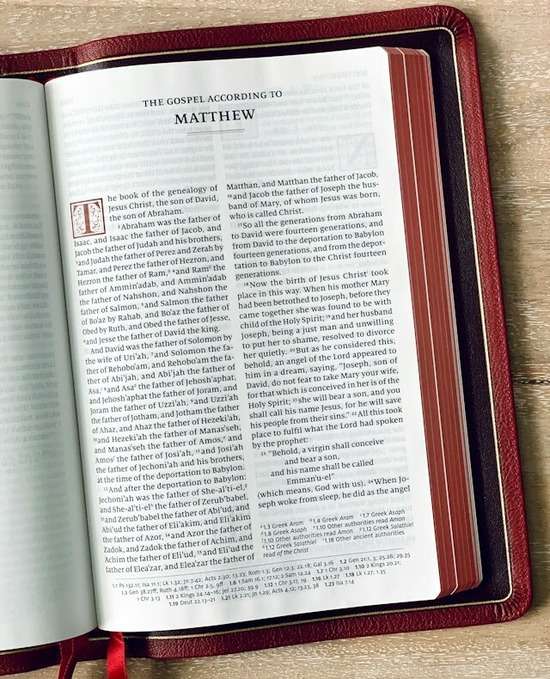
Photo by Tim Wildsmith on Unsplash
There are some scholars who debate whether the apostle Matthew truly was the author of the Gospel of Matthew, which was believed to be written somewhere in the 50s-60s AD.7 Early church writers like Papias and Eusebius generally ascribed the book to him, but he also seems to share a lot of material from Mark, who was not an eyewitness.8
However, most of the evidence points to Matthew as the author of the Gospel.
First, the church of the first few centuries AD believed he authored it. Though we’ve seen from Matthew’s numerous death accounts that they don’t always get it right, there’s something to be said for so many people of his time believing in his authorship.
Second, the Gospel of Matthew itself presents numerous clues. Compare these portions of the Lord’s prayer from Luke and Matthew:
“And forgive us our sins, for we also forgive everyone who is indebted to us” (Luke 11:4, NKJV).
“And forgive us our debts, as we forgive our debtors” (Matthew 6:12, NKJV).
Matthew heard the words through the lens of his financial background, so that could be why he expressed them this way.
Also, Matthew’s Gospel account is the only one to include Jesus’ parable about the talents (Matthew 18:23-35). A story about money and investment would have special appeal to someone who regularly handled money as a career.
And Matthew tailored his writing to be read and accepted by the Jews. He begins with a genealogy of Jesus, connecting him to King David and Abraham, and quotes numerous Messianic prophecies in his Gospel, all designed to help the Jews believe that Jesus was indeed the Messiah.
Lessons from Matthew’s life
While we don’t have a detailed life sketch of Matthew, there’s still a lot we can learn from His time as an apostle.
A big takeaway from Matthew’s life is that no lifestyle is too hard to change. A tax collector like Matthew was like the scum of the earth in the eyes of his fellow Jews. He probably had many material possessions, but few friends. Perhaps one part of him felt guilty for the life he led, but the other part was too deeply mired in it to stop.
But he gave up all that to become a follower of Jesus, and one of Jesus’ closest companions.
Jesus doesn’t care how badly we’ve messed up. No matter what we’ve done, we’re all equal in His eyes. He loves us, sees our potential, and wants to be our closest friend.
We can also see from Matthew’s story that you don’t have to travel to a foreign country as part of a big effort to bring others to Christ. There’s nothing wrong with that, and Matthew certainly did his share of it. But his telling of the Gospel story was written for his own people. We, too, can help our neighbors and friends come to know Christ in a way they’ll understand.
Matthew, an example for us all
Matthew was an outcast of society. The Jews hated him because he took their money, and he was unforgivable in the Pharisees’ eyes. And for the Romans, he was just a pawn.
Yet Jesus called Matthew. He knew that Matthew’s identity was far more than his life circumstances or what others thought of him.
We don’t have to be popular. We don’t have to be smart. We don’t have to be liked by anyone. But that doesn’t make us unusable to God. Often, the result of God changing our lives for the better can glorify Him even more.
And when we do accept that call, we can allow ourselves to grow and be changed. Matthew’s life was transformed by this event, and he eventually became a powerful witness for Jesus. We too, can become a great witness for Jesus, if we let Him lead us.
Matthew was not the only apostle whose life was changed. Learn about the disciples’ collective experience with Jesus, or
Related pages



- Edersheim, Alfred. Sketches of Jewish social life in the days of Christ, Internet Archive. p.55. [↵]
- Ibid. [↵]
- Ibid. [↵]
- Matthew 9:9, Mark 2:14, Luke 5:27. [↵]
- Foxe, John, Foxe’s Book of Martyrs, Charles Foster Publishing, 1897 [↵]
- Nelson, Ryan, “Who Was Matthew the Apostle? The Beginner’s Guide,” Overview Bible, April 1, 2019. [↵]
- Chilton, Brian, “Who Wrote the Gospel of Matthew?”, CrossExamined.org, June 11, 2017. [↵]
- Ibid. [↵]
More Answers

Quem Foram os Juízes de Israel no Antigo Testamento?
Quem Foram os Juízes de Israel no Antigo Testamento?Tempos de crise exigem homens e mulheres de ação. Os israelitas, recém-estabelecidos na Terra Prometida, encontraram-se nesses tempos. À medida que nações inimigas atacavam e oprimiam as tribos, eles clamavam a Deus...

¿En qué se diferencian los Adventistas del Séptimo Día de otros protestantes?
¿En qué se diferencian los Adventistas del Séptimo Día de otros protestantes?Como denominación cristiana protestante, la Iglesia Adventista del Séptimo Día considera la Biblia como la regla suprema de fe y a Jesucristo como el único camino a la salvación. Tenemos...
Como os Adventistas do Sétimo Dia São Diferentes de Outros Protestantes?
Como os Adventistas do Sétimo Dia São Diferentes de Outros Protestantes?Como uma denominação cristã protestante, a Igreja Adventista do Sétimo Dia considera a Bíblia como o guia supremo e vê Jesus Cristo como o único caminho para a salvação. Temos algumas diferenças...

O que é ASI (Associação de Empresários e Profissionais Adventistas)?
O que é ASI (Associação de Empresários e Profissionais Adventistas)?ASI, que significa Associação de Empresários e Profissionais Adventistas (tradução adaptada), é uma organização baseada em associação que oferece apoio aos membros adventistas (profissionais...

Jesús y la Mujer en el Pozo: Derribando Barreras
El encuentro de Jesús con la mujer en el pozo revela su sentir por las personas heridas y su deseo de derribar prejuicios. Esta página analiza cómo Jesús se acercó a ella.

Revealing The True Meaning of The Parable of The Rich Man & Lazarus
Learn the real point behind one of Jesus’ most vivid parables.
O que são as Bem-Aventuranças (E o que significam)?
O que são as Bem-Aventuranças (E o que significam)?As Bem-Aventuranças, encontradas no início do Sermão da Montanha de Jesus no Evangelho de Mateus, são o manifesto do reino de Jesus. Elas descrevem a maneira como Seu reino funciona e o que significa ser um de Seus...

Líderes de la iglesia: ¿Cuál es el rol de un pastor Adventista?
Líderes de la iglesia: ¿Cuál es el rol de un pastor Adventista?¿Cuál es el rol de un pastor en la iglesia Adventista? La posición en sí misma, al menos en lo que respecta a una congregación local, no es muy diferente de la de los pastores en otras denominaciones...
ASI ni Nini (Huduma na Viwanda vya Waadventista vya Kibinafsi)?
ASI ni Nini (Huduma na Viwanda vya Waadventista vya Kibinafsi)?ASI, ambayo inayofupisha maneno (Huduma na Viwanda vya Waadventista vya Kibinafsi), ni shirika la uanachama linalotoa msaada kwa wainjilisti wa Kiadventista (wataalamu wa Kanisa la Waadventista wa Sabato...

Ellen White Alisema Nini Kuhusu Unabii wa Nyakati za Mwisho?
Tunaweza kusoma katika Maandiko kuhusu mfululizo wa matukio na dalili zinazoongoza hadi Ujio wa Pili wa Yesu Kristo.

Safari na Utume wa Ellen G. White Ulimwenguni
Safari na Utume wa Ellen G. White UlimwenguniIngawa Ellen White, mwanzilishi mwenza wa Kanisa la Waadventista wa Sabato, anajulikana zaidi kwa huduma yake nchini Marekani, pia alisafiri kwenda nchi nyingine kumi na mbili katika maisha yake—hili lilikuwa jambo kubwa...

Yote Kuhusu Wainjilisti wa Vitabu wa Kiadventista
Kanisa la Waadventista wa Sabato hutumia mbinu mbalimbali kusambaza tumaini la injili duniani.
¿Qué es ASI (Servicios e Industrias de Laicos Adventistas)?
¿Qué es ASI (Servicios e Industrias de Laicos Adventistas)?ASI, que significa Servicios e Industrias de Laicos Adventistas, es una organización basada en membresía que brinda apoyo a los laicos adventistas (profesionales Adventistas del Séptimo Día que no son...
¿Qué dijo Elena G. de White sobre la profecía de los últimos tiempos?
¿Qué dijo Elena G. de White sobre la profecía de los últimos tiempos?Podemos leer en las Escrituras acerca de la serie de eventos y señales que conducen a la segunda venida de Jesucristo. Y suena bastante intenso, por decir lo menos. La naturaleza simbólica del...
O que Ellen White disse sobre a profecia dos tempos finais?
O que Ellen White disse sobre a profecia dos tempos finais?Podemos ler nas Escrituras sobre a série de eventos e sinais que antecedem a segunda vinda de Jesus Cristo. E, para dizer o mínimo, isso soa bastante intenso. A natureza simbólica da linguagem da profecia...

Meaning of the Parable of the Two Sons in Matthew 21
Meaning of the Parable of the Two Sons in Matthew 21The parable of the two sons in Matthew 21:28-32 is about a father who instructs his sons to work in the family vineyard. The first son refuses to work but later has a change of heart and obeys. The second son says...
Viagens e Missão Mundial de Ellen G. White
Viagens e Missão Mundial de Ellen G. WhiteEmbora Ellen White, cofundadora da Igreja Adventista do Sétimo Dia, seja mais conhecida por seu ministério nos Estados Unidos, ela também viajou para outros doze países durante sua vida — uma grande conquista no século XIX,...
Joseph Bates na Nafasi Yake katika Kanisa la Waadventista
Joseph Bates na Nafasi Yake katika Kanisa la WaadventistaJoseph Bates alikuwa baharia aliyegeuka kuwa mhubiri ambaye alijiunga na Harakati ya Miller na kusubiri Ujio wa Pili wa Yesu kutokea mwaka 1844. Licha ya kukatishwa tamaa wakati hili halikutokea, Bates...

Je, Wasabato Husherehekea Sikukuu?
Je, Wasabato Husherehekea Sikukuu?Je unajiuliza ikiwa mwanafunzi mwenzako au mfanyakazi mwenzako Mwadventista husherehekea sikukuu kama wewe? Labda ungependa kumshirikisha kwenye sherehe fulani, lakini pia unataka kuheshimu imani yake. Kwa hiyo, huna uhakika wa jinsi...

O Que a Bíblia Diz Sobre a Segunda Vinda de Jesus Cristo
Curioso para saber o que a Bíblia diz sobre a Segunda Vinda de Jesus Cristo? Vamos abordar os versículos-chave e o que eles significam.

Waadventista Wanaamini Nini Kuhusu Imani na Matendo?
Waadventista Wanaamini Nini Kuhusu Imani na Matendo?Waadventista wanaamini tunaokolewa kwa imani, ambayo ni imani na tumaini tulilonalo kwa Yesu Kristo kutuokoa kutoka dhambini. Yesu, basi, anatupa uwezo wa kuishi kwa utii wa amri za Mungu na kuwahudumia wengine kwa...
Todo sobre los colportores Adventistas del Séptimo Día
Todo sobre los colportores Adventistas del Séptimo DíaLa Iglesia Adventista del Séptimo Día utiliza una variedad de métodos para difundir la esperanza del evangelio al mundo. Una de estas formas es a través del colportaje, también llamado “venta puerta a puerta” o...
Tudo Sobre Colportores Adventistas do Sétimo Dia
A Igreja Adventista do Sétimo Dia usa uma variedade de métodos para espalhar a esperança do evangelho ao mundo.
Los viajes y la misión mundial de Elena G. de White
Los viajes y la misión mundial de Elena G. de WhiteAunque Elena G. de White, cofundadora de la Iglesia Adventista del Séptimo Día, es más conocida por su ministerio en los Estados Unidos, también viajó a otros doce países durante su vida, un gran logro en el siglo XIX...

Mikutano ya Injili ya Waadventista ni Nini?
Kanisa la Waadventista wa Sabato linaweka mkazo mkubwa katika kushiriki injili kupitia uinjilisti, yaani kushiriki injili kupitia mahubiri, mafundisho, na ushuhuda.
Joseph Bates y su papel en la Iglesia Adventista del Séptimo Día
Joseph Bates y su papel en la Iglesia Adventista del Séptimo DíaJoseph Bates fue un marinero que se convirtió en predicador, se unió al Movimiento Millerita y esperó que ocurriera la Segunda Venida de Jesús en 1844. A pesar de sentirse decepcionado cuando esto no...
Joseph Bates e Seu Papel na Igreja Adventista do Sétimo Dia
Joseph Bates foi um marinheiro que se tornou pregador, juntou-se ao Movimento Millerita e esperou pela Segunda Vinda de Jesus em 1844.
¿Los Adventistas del Séptimo Día celebran las fiestas?
¿Los Adventistas del Séptimo Día celebran las fiestas?¿Te preguntas si tu compañero de clase o de trabajo adventista celebra las mismas fiestas que tú? Tal vez quieres incluirlo en algunas festividades, pero también deseas respetar sus creencias. Entonces, no estás...
Os Adventistas do Sétimo Dia Celebram Feriados?
Está se perguntando se seu colega de classe ou de trabalho adventista celebra os mesmos feriados que você?
Didn’t find your answer? Ask us!
We understand your concern of having questions but not knowing who to ask—we’ve felt it ourselves. When you’re ready to learn more about Adventists, send us a question! We know a thing or two about Adventists.