
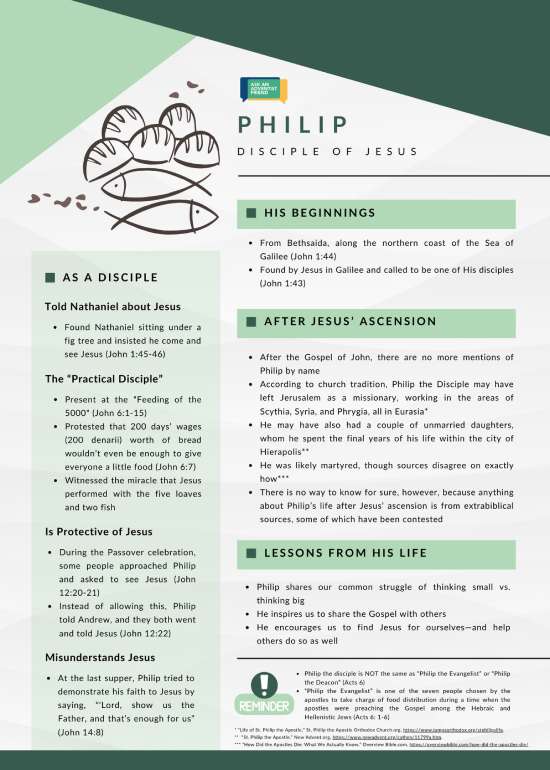
 Philip was one of the 12 disciples called by Jesus Christ during His earthly ministry. He was originally from the city of Bethsaida and to this day is often known as the “practical disciple.”
He was also instrumental in the call of Nathanael, another one of Jesus’ disciples.
Most of what we know about Philip comes from the book of John. And while he may not be as well known as some of the others, there’s still a lot we can learn from his time following Jesus.
We’ll cover:
We’ll start with Philip’s life before he was called to be a disciple of Jesus.
Philip’s beginnings
Piecing together the details we can find in the New Testament, we know he lived in the village of Bethsaida (John 1:44), which sprawled out along the northern coast of the Sea of Galilee.1
Given that Bethsaida was also the hometown of two more of Jesus’ disciples (Peter and Andrew), it’s possible Philip knew them.
But it was in Galilee that Jesus found Philip and called him to become a disciple.
“The following day Jesus wanted to go to Galilee, and He found Philip and said to him, ‘Follow Me’” (John 1:43, NKJV).
And it isn’t long after accepting this call that we hear about his first significant act as a follower of Jesus.
Philip as a disciple
The synoptic Gospels—Matthew, Mark, and Luke2—only mention Philip within a list along with the other disciples of Jesus.
But the Gospel of John provides a few stories that feature Philip as a main character.
Telling another about Jesus
The first story involving Philip happens right after Jesus calls him to be a disciple, in John 1:45-51.
Philip found Nathanael (also called Bartholomew), who was sitting under a fig tree, and told him,
“‘We have found Him of whom Moses in the law, and also the prophets, wrote—Jesus of Nazareth, the son of Joseph’” (John 1:45, NKJV).
At first, Nathanael was a little skeptical. He countered,
“‘Can anything good come out of Nazareth?’” (John 1:46, NKJV).
But Philip was insistent. “‘Come and see’” (John 1:46, NKJV).
Nathanael came and saw, and discovered Jesus had already seen him and knew about him. Then Nathanael believed and also became a disciple.
So Philip wasted no time in telling others about Jesus and ended up adding to His group of disciples.
The “practical disciple”

Photo by Piotr Arnoldes
The next time Philip is featured in John’s narrative is in John 6:1-15. This passage is often recognized as the “feeding of the five thousand.”
But before that, the disciples were faced with thousands of hungry people and no food. All these people had been following Jesus, listening to Him speak and watching everything He did.
Jesus already knew the miracle He would perform, but He tested Philip by asking him where they would buy enough bread for everyone.
Philip had quickly done the math, and protested,
“‘Two hundred denarii worth of bread is not sufficient for them, that every one of them may have a little’” (John 6:7, NKJV).
To put this in perspective, a denarius was one day’s wages at that time (Matthew 20:2). So you can imagine how pragmatic Philip’s eyes must have widened at the thought of so much money. Where would they get it all?
Then Andrew came along with the boy who was willing to share five barley loaves and two fish, which Jesus used to perform the miracle.
Philip had not taken miraculous intervention into account when he tried to tally up how much food they would need and how much it would cost. His faith was still young, but he was privileged to get to grow his faith in the presence of Jesus and all the amazing things He did while He walked the earth.
Philip is protective of Jesus
After Jesus and His disciples had come into Jerusalem to celebrate Passover, we find Philip mentioned specifically in John 12:20-36.
Some people approached Philip, asking to see Jesus. Philip told Andrew instead, and the both of them went and told Jesus.
Jesus spoke to them about His approaching death on behalf of the whole world and these visitors aren’t mentioned again.
Why did these people come to Philip first, before Jesus? We don’t know for sure, but some scholars theorize that since Philip was not a full-blooded Jew and had a Greek name, perhaps he seemed more approachable.3
But looking at Philip’s response (and there’s no record that he ever went back to those Greeks to give them an answer), it’s possible he was acting as a bodyguard for Jesus.
See, Jesus had just raised Lazarus from the dead, which didn’t sit well with the Jewish leaders. They were so upset at this display of a miracle that they essentially put out a warrant for His arrest (John 11:47-57).
Undoubtedly, Jesus was aware of this, and so His disciples may have intercepted everyone wishing to see Him in order to filter out anyone looking to report Him.4
Whatever the case, Jesus answered Philip and Andrew by saying that His time had come. He would be glorified by the Father, and then He would be put to death. His earthly ministry was nearing its end. And then, the good news of His sacrificial death and His resurrection would reach even more people than if He prolonged His time walking among us as a human.
Philip misunderstands Jesus (“Show us the Father”)

Image by Gini George from Pixabay
The last story John tells about Philip is found in John 14:5-14.
Jesus and the disciples had finished the “Last Supper” in John 13. Judas Iscariot has just been revealed as the traitor, and he’s hastily departed. The disciples are asking Jesus questions, and Thomas asks how they can know where He’s going and how they can know the way.
Jesus replies,
“‘I am the way, the truth, and the life. No one comes to the Father except through Me. If you had known Me, you would have known My Father also; and from now on you know Him and have seen Him’” (John 14:6-7, NKJV).
Then Philip pipes up, in an attempt to demonstrate his faith.
“‘Lord, show us the Father, and that’s enough for us’” (John 14:8, CSB).
But he had missed the whole point of what Jesus was saying. Jesus was the Father, because God, Jesus, and the Holy Spirit are three beings in one.
Jesus reminds Philip to refocus:
“‘Have I been among you all this time and you do not know me, Philip? The one who has seen me has seen the Father. …’” (John 14:9, CSB).
He continues for several more verses, describing the attributes of Jesus and God the Father.
Like the other disciples, Philip had seen Jesus’ miracles and heard His preaching, but he was still figuring out just who Jesus was. He would have a sobering reminder in just a few hours.
Jesus would be captured by the authorities. And all the disciples, including Philip, would flee in terror. Then Jesus would be crucified the next day.
But though Jesus would be killed for all the sins of humanity, He would rise from the grave and eventually ascend into heaven, leaving His disciples to carry out His work on earth.
So what did Philip do with this incredible experience he had with Jesus? How did he spend the rest of his life?
Philip after Jesus’ ascension

Photo by Fr. Daniel Ciucci on Unsplash
Not much is known about Philip after Jesus returned to heaven and the disciples (now “apostles”) set out on their own paths of ministry. After the Gospel of John, there aren’t any more mentions of him by name.
But extrabiblical sources do provide us with some ideas about Philip’s later life:
- According to church tradition, Philip the Disciple may have left Jerusalem as a missionary, working in the areas of Scythia, Syria, and Phrygia, all in Eurasia.5
- He may have also had a couple of unmarried daughters, whom he spent the final years of his life with in the city of Hierapolis.6
- He was likely martyred, though sources disagree on exactly how.7
But we can’t know for sure because some of these stories come from contested extrabiblical accounts, like The Acts of Philip, compiled in the fourth century by an unknown person.8 And some early Christian writers got the Apostle Philip mixed up with another New Testament Philip.9
“Philip the Evangelist” is a different person than “Philip the Disciple”
This other New Testament Philip is referred to as “Philip the Evangelist” or sometimes “Philip the Deacon.” In Acts 6, Philip the Evangelist is listed as one of the seven people chosen by the apostles to take charge of food distribution, during a time when the apostles were preaching the Gospel among the Hebraic and Hellenistic Jews (verses 1-6).
Later, Paul and Luke stayed at Philip the Evangelist’s home in Caesarea (Acts 21:8). He had four daughters who were filled with the Holy Spirit and “prophesied” (Acts 21:9, CSB).
You can see how it could be easy to mix the two up, especially in a time before last names were consistently included in records.
Philip the Evangelist preached in Samaria (Acts 8:5) and was the one who was led by the Holy Spirit to approach the Ethiopian eunuch’s carriage and explain Isaiah to him (Acts 8:26-40).
But as for Philip the Disciple, while we don’t have definitive records of his accomplishments after Jesus ascended, it’s likely that he acted in the name of Jesus and benefited the early church.
What we can learn from Philip’s life

Photo by Hannah Busing on Unsplash
Even with only a few stories to draw from, we can still learn valuable lessons from the life of Philip the Disciple.
- He shares our common struggle of thinking small vs. thinking big
Philip was a practical man. He didn’t always think outside the box when it came to how Jesus would respond to various situations. But that also means he’s a lot like many of us. We can relate to his perspective and his thought processes.
And, even with his pragmatic ways, he always chose to trust Jesus. Even when it didn’t always make sense to him.
Similarly, we may not understand all of Scripture, and we may not understand why certain things are happening in our lives. But we can always trust that Jesus has our best interests at heart, and He promised that the Holy Spirit will guide us.
- He inspires us to share the gospel with others
Philip teaches us not to hesitate to tell others about Jesus.
One of the first things Philip did as Jesus’ newest disciple was to excitedly tell his friend Nathanael—that they’d found the one who was prophesied about in Scripture. And now they could find out what He’s like from experience.
Today, the good news of the gospel hasn’t changed. It’s Christ’s free gift of salvation for all who believe and follow, and we want others to meet Jesus and experience this joy and peace as well.
- He encourages us to find Jesus for ourselves—and help others do so as well
When Philip told Nathanael about Jesus, he didn’t preach a sermon at him. He simply came to him and said, “We’ve found Him!”
And Nathanael’s response may not have been what Philip expected.
“Can anything good come out of Nazareth?” (John 1:46, CSB).
But even with that, Philip didn’t start reciting proof-texts or start an impromptu Bible study to show Nathanael why he shouldn’t be hesitant. He didn’t present any type of spoken argument. He simply challenged him to find out for himself.
“‘…Come and see,’ Philip answered” (John 1:46, CSB).
There are times to tell people what we know, and there are times when the best course of action is to encourage others to see for themselves. The Holy Spirit can work through us either way.
Sometimes we don’t have all the answers to everyone’s questions or hesitations when it comes to their personal faith journey. And we don’t have to act like we do. But with Philip the Apostle as an example, we can always nudge others in the right direction and trust that God will be working on their hearts.
One of the biggest blessings of studying Jesus’ 12 disciples is that we get a small glimpse of what any one of us might have been like in those remarkable situations with the Son of God. All 12 had different personality quirks and tendencies that made their way into recorded history.
With Philip, the pragmatists among us can relate to the way he often responded to things.
And we can take courage in the fact that with each surprise or correction from Jesus, the results for Philip were always an increase of faith and a growth in perspective. Reading his story, as short as it may be, we can see a piece of ourselves in him as we learn more about just how amazing our Savior Jesus Christ truly is.
On that note, want to get to know even more about Jesus? Learn about His identity in the Godhead, as well as His ministry on earth.
Related pages



- “Bethsaida,” Bible Places [↵]
- Matthew 10:3, Mark 3:18, Luke 6:14. [↵]
- McArthur, John. Twelve Ordinary Men, p. 119 [↵]
- “John 12:21,” Bible Ref.com [↵]
- “Life of St. Philip the Apostle,” St. Philip the Apostle Orthodox Church.org [↵]
- “St. Philip the Apostle,” New Advent.org [↵]
- “How Did the Apostles Die: What We Actually Know,” Overview Bible.com [↵]
- “The Acts of Philip,” University of Groningen [↵]
- “St. Philip the Apostle,” New Advent.org [↵]
More Answers

Quem Foram os Juízes de Israel no Antigo Testamento?
Quem Foram os Juízes de Israel no Antigo Testamento?Tempos de crise exigem homens e mulheres de ação. Os israelitas, recém-estabelecidos na Terra Prometida, encontraram-se nesses tempos. À medida que nações inimigas atacavam e oprimiam as tribos, eles clamavam a Deus...

¿En qué se diferencian los Adventistas del Séptimo Día de otros protestantes?
¿En qué se diferencian los Adventistas del Séptimo Día de otros protestantes?Como denominación cristiana protestante, la Iglesia Adventista del Séptimo Día considera la Biblia como la regla suprema de fe y a Jesucristo como el único camino a la salvación. Tenemos...
Como os Adventistas do Sétimo Dia São Diferentes de Outros Protestantes?
Como os Adventistas do Sétimo Dia São Diferentes de Outros Protestantes?Como uma denominação cristã protestante, a Igreja Adventista do Sétimo Dia considera a Bíblia como o guia supremo e vê Jesus Cristo como o único caminho para a salvação. Temos algumas diferenças...

O que é ASI (Associação de Empresários e Profissionais Adventistas)?
O que é ASI (Associação de Empresários e Profissionais Adventistas)?ASI, que significa Associação de Empresários e Profissionais Adventistas (tradução adaptada), é uma organização baseada em associação que oferece apoio aos membros adventistas (profissionais...
Jesús y la Mujer en el Pozo: Derribando Barreras
El encuentro de Jesús con la mujer en el pozo revela su sentir por las personas heridas y su deseo de derribar prejuicios. Esta página analiza cómo Jesús se acercó a ella.

Revealing The True Meaning of The Parable of The Rich Man & Lazarus
Learn the real point behind one of Jesus’ most vivid parables.
O que são as Bem-Aventuranças (E o que significam)?
O que são as Bem-Aventuranças (E o que significam)?As Bem-Aventuranças, encontradas no início do Sermão da Montanha de Jesus no Evangelho de Mateus, são o manifesto do reino de Jesus. Elas descrevem a maneira como Seu reino funciona e o que significa ser um de Seus...

Líderes de la iglesia: ¿Cuál es el rol de un pastor Adventista?
Líderes de la iglesia: ¿Cuál es el rol de un pastor Adventista?¿Cuál es el rol de un pastor en la iglesia Adventista? La posición en sí misma, al menos en lo que respecta a una congregación local, no es muy diferente de la de los pastores en otras denominaciones...
ASI ni Nini (Huduma na Viwanda vya Waadventista vya Kibinafsi)?
ASI ni Nini (Huduma na Viwanda vya Waadventista vya Kibinafsi)?ASI, ambayo inayofupisha maneno (Huduma na Viwanda vya Waadventista vya Kibinafsi), ni shirika la uanachama linalotoa msaada kwa wainjilisti wa Kiadventista (wataalamu wa Kanisa la Waadventista wa Sabato...

Ellen White Alisema Nini Kuhusu Unabii wa Nyakati za Mwisho?
Tunaweza kusoma katika Maandiko kuhusu mfululizo wa matukio na dalili zinazoongoza hadi Ujio wa Pili wa Yesu Kristo.

Safari na Utume wa Ellen G. White Ulimwenguni
Safari na Utume wa Ellen G. White UlimwenguniIngawa Ellen White, mwanzilishi mwenza wa Kanisa la Waadventista wa Sabato, anajulikana zaidi kwa huduma yake nchini Marekani, pia alisafiri kwenda nchi nyingine kumi na mbili katika maisha yake—hili lilikuwa jambo kubwa...

Yote Kuhusu Wainjilisti wa Vitabu wa Kiadventista
Kanisa la Waadventista wa Sabato hutumia mbinu mbalimbali kusambaza tumaini la injili duniani.
¿Qué es ASI (Servicios e Industrias de Laicos Adventistas)?
¿Qué es ASI (Servicios e Industrias de Laicos Adventistas)?ASI, que significa Servicios e Industrias de Laicos Adventistas, es una organización basada en membresía que brinda apoyo a los laicos adventistas (profesionales Adventistas del Séptimo Día que no son...
¿Qué dijo Elena G. de White sobre la profecía de los últimos tiempos?
¿Qué dijo Elena G. de White sobre la profecía de los últimos tiempos?Podemos leer en las Escrituras acerca de la serie de eventos y señales que conducen a la segunda venida de Jesucristo. Y suena bastante intenso, por decir lo menos. La naturaleza simbólica del...
O que Ellen White disse sobre a profecia dos tempos finais?
O que Ellen White disse sobre a profecia dos tempos finais?Podemos ler nas Escrituras sobre a série de eventos e sinais que antecedem a segunda vinda de Jesus Cristo. E, para dizer o mínimo, isso soa bastante intenso. A natureza simbólica da linguagem da profecia...

Meaning of the Parable of the Two Sons in Matthew 21
Meaning of the Parable of the Two Sons in Matthew 21The parable of the two sons in Matthew 21:28-32 is about a father who instructs his sons to work in the family vineyard. The first son refuses to work but later has a change of heart and obeys. The second son says...
Viagens e Missão Mundial de Ellen G. White
Viagens e Missão Mundial de Ellen G. WhiteEmbora Ellen White, cofundadora da Igreja Adventista do Sétimo Dia, seja mais conhecida por seu ministério nos Estados Unidos, ela também viajou para outros doze países durante sua vida — uma grande conquista no século XIX,...
Joseph Bates na Nafasi Yake katika Kanisa la Waadventista
Joseph Bates na Nafasi Yake katika Kanisa la WaadventistaJoseph Bates alikuwa baharia aliyegeuka kuwa mhubiri ambaye alijiunga na Harakati ya Miller na kusubiri Ujio wa Pili wa Yesu kutokea mwaka 1844. Licha ya kukatishwa tamaa wakati hili halikutokea, Bates...

Je, Wasabato Husherehekea Sikukuu?
Je, Wasabato Husherehekea Sikukuu?Je unajiuliza ikiwa mwanafunzi mwenzako au mfanyakazi mwenzako Mwadventista husherehekea sikukuu kama wewe? Labda ungependa kumshirikisha kwenye sherehe fulani, lakini pia unataka kuheshimu imani yake. Kwa hiyo, huna uhakika wa jinsi...

O Que a Bíblia Diz Sobre a Segunda Vinda de Jesus Cristo
Curioso para saber o que a Bíblia diz sobre a Segunda Vinda de Jesus Cristo? Vamos abordar os versículos-chave e o que eles significam.

Waadventista Wanaamini Nini Kuhusu Imani na Matendo?
Waadventista Wanaamini Nini Kuhusu Imani na Matendo?Waadventista wanaamini tunaokolewa kwa imani, ambayo ni imani na tumaini tulilonalo kwa Yesu Kristo kutuokoa kutoka dhambini. Yesu, basi, anatupa uwezo wa kuishi kwa utii wa amri za Mungu na kuwahudumia wengine kwa...
Todo sobre los colportores Adventistas del Séptimo Día
Todo sobre los colportores Adventistas del Séptimo DíaLa Iglesia Adventista del Séptimo Día utiliza una variedad de métodos para difundir la esperanza del evangelio al mundo. Una de estas formas es a través del colportaje, también llamado “venta puerta a puerta” o...
Tudo Sobre Colportores Adventistas do Sétimo Dia
A Igreja Adventista do Sétimo Dia usa uma variedade de métodos para espalhar a esperança do evangelho ao mundo.
Los viajes y la misión mundial de Elena G. de White
Los viajes y la misión mundial de Elena G. de WhiteAunque Elena G. de White, cofundadora de la Iglesia Adventista del Séptimo Día, es más conocida por su ministerio en los Estados Unidos, también viajó a otros doce países durante su vida, un gran logro en el siglo XIX...

Mikutano ya Injili ya Waadventista ni Nini?
Kanisa la Waadventista wa Sabato linaweka mkazo mkubwa katika kushiriki injili kupitia uinjilisti, yaani kushiriki injili kupitia mahubiri, mafundisho, na ushuhuda.
Joseph Bates y su papel en la Iglesia Adventista del Séptimo Día
Joseph Bates y su papel en la Iglesia Adventista del Séptimo DíaJoseph Bates fue un marinero que se convirtió en predicador, se unió al Movimiento Millerita y esperó que ocurriera la Segunda Venida de Jesús en 1844. A pesar de sentirse decepcionado cuando esto no...
Joseph Bates e Seu Papel na Igreja Adventista do Sétimo Dia
Joseph Bates foi um marinheiro que se tornou pregador, juntou-se ao Movimento Millerita e esperou pela Segunda Vinda de Jesus em 1844.
¿Los Adventistas del Séptimo Día celebran las fiestas?
¿Los Adventistas del Séptimo Día celebran las fiestas?¿Te preguntas si tu compañero de clase o de trabajo adventista celebra las mismas fiestas que tú? Tal vez quieres incluirlo en algunas festividades, pero también deseas respetar sus creencias. Entonces, no estás...
Os Adventistas do Sétimo Dia Celebram Feriados?
Está se perguntando se seu colega de classe ou de trabalho adventista celebra os mesmos feriados que você?
Didn’t find your answer? Ask us!
We understand your concern of having questions but not knowing who to ask—we’ve felt it ourselves. When you’re ready to learn more about Adventists, send us a question! We know a thing or two about Adventists.