
When the Seventh-day Adventist Church was still young, a council of the church in Europe requested Ellen White, one of Adventism’s key leaders, to come to Europe. Despite the many obstacles, God led her there to help the new churches and members for two years.
Here’s an overview of her journey and all the ways God used her to spread the gospel there.
We’re going to cover:
Let’s first take a look at the timing of her trip.
When Ellen White traveled to Europe

Photo by Katherine McCormack on Unsplash
Ellen White journeyed to Europe in August of 1885 and remained there until 1887.
This was a time when airplanes were yet future. Ships were the only way to cross the sea, while on land, trains and horse-drawn carriages were typical transportation.
No air conditioning existed for the hot summer days, either, so traveling could be rather uncomfortable.
The Adventist Church at this time was just a few decades old, Following the Millerite Movement in the 1840s, those of the Advent Movement began meeting and studying together, but they didn’t organize into a church until 1863. And in Europe, the movement was even newer and it needed support.
On July 6, 1885, Ellen White began her trip across the United States from her home in St. Helena, California. On the way, she stopped in Kansas City, Missouri, Battle Creek, Michigan, and some other places, arriving in Boston in time for her August 7 embarkation on the ship S.S. Cephalonia.
She traveled with her son, William C. White, his wife Mary Kelsey White, and their three-year-old daughter Ella, as well as some other assistants and close church members.
It took 11 days to cross the Atlantic, and the trip was pleasant. Ellen White and her companions arrived in Liverpool, England, on August 18.
She stayed in Europe for two years. She returned to America by way of England again, departing from Liverpool on August 3, 1887, on the ship City of Rome.
This time she traveled with a smaller group: her daughter-in-law Mary and granddaughters Ella and Mabel. They arrived in New York on August 11.
Why Ellen White went to Europe
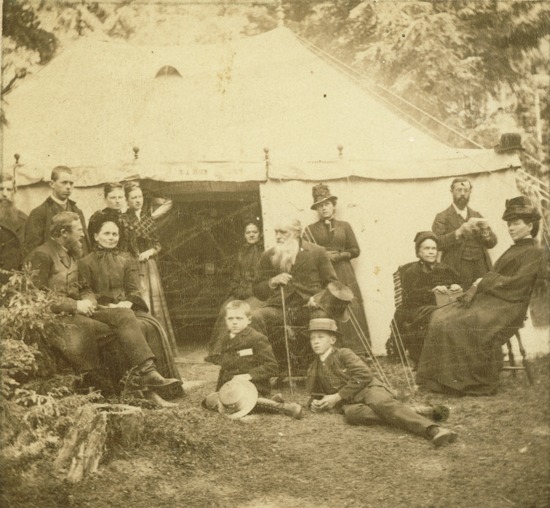
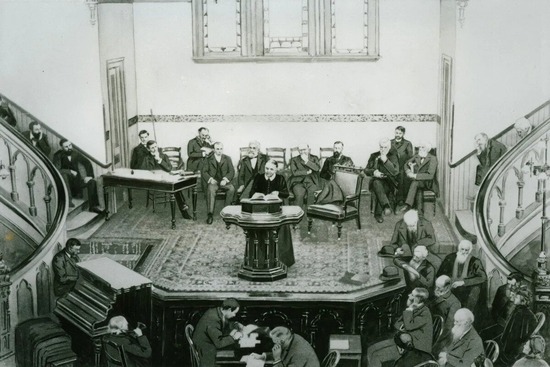
“Ellen White in Norway with a group of Adventist believers”
Ellen White’s goal in traveling to Europe was to assist in the newly started work of the Adventist Church there. She went to encourage and strengthen the small congregations scattered across the Old World.
The request for her to come arrived after the Second European Council of Seventh-day Adventist Missions in 1884. The council members wanted her to visit the European mission. She also felt she could help Europe more in person because her writings hadn’t been translated into all the European languages.1
Before Ellen White was asked to visit Europe, another Adventist, J. N. Andrews, had been a key figure in the European mission. He was the first Adventist missionary to go to the continent and was deeply involved in the writing and editing of Adventist publications. Sadly, though, he had died in 1883.
The European council members also wanted Ellen White’s son, W. C. White, to help oversee some building projects—in addition to assisting his mother.
Despite all these reasons to go, Ellen White took eight months to decide to make the trip. It wasn’t that she didn’t want to see the Adventists in Europe; she deeply wanted to help where she could to share the gospel of Jesus’ second coming.
But she just realized the enormity of such a trip.
She was an older woman—nearly 60 years old—and was worn down from the ceaseless round of meetings, speaking, and travel. Her husband, James White, had died recently, and she was alone. In the Review and Herald, she wrote,
“To travel across the continent to leave from Boston for Europe in the heat of summer and in my condition of health, seemed almost presumptuous. … I had suffered great mental weariness and physical debility…. My courage was gone, and I longed for human help, one who had a firm hold from above, and whose faith would stimulate mine.”2
After many months of debating and worrying, her son William visited her and became that human help. He reminded her of past times when she had been worried and Jesus had helped her. She wrote,
“The love and blessing of God filled my heart, and from that hour I began to gather strength and courage.”3
And she embarked on a new adventure.
What Ellen White did in Europe
From the time she arrived in England to the time she left two years later, Ellen White devoted her attention to the churches and the people. She spoke at countless churches and halls and held numerous tent meetings, which were popular in the day. In between her speaking engagements, she helped start organizations and spent time writing and publishing her books.
She traveled to:
- England
- Switzerland
- Germany
- France
- Italy
- Sweden
- Norway
- Denmark
Many were excited to see and hear her speak in person.
The largest European crowd she addressed was in a military gymnasium in Norway. Sixteen hundred people packed in to hear her talk.4
Working with specific congregations
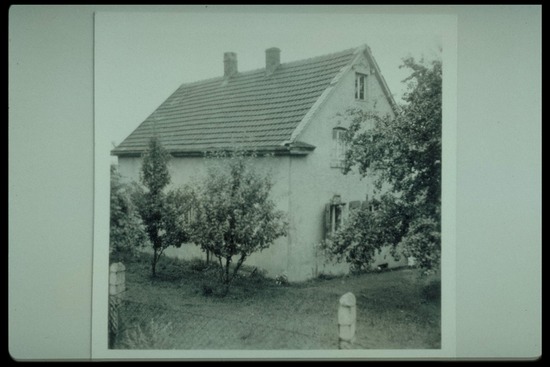
“Adventist church in Vohwinkel, Germany”
Aside from speaking, Ellen White was involved in various church activities and in counseling congregations.
While in Tramelan, Switzerland, on Christmas Day in 1886, she performed the dedication ceremony for the first Seventh-day Adventist church building in Europe.5
On another occasion, she conducted Bible study classes in Basel, Switzerland, for the young people working in the Adventist publishing house there.6 She wrote to her son Edson about the progress of the classes:
“Our meetings are doing good. I wish there could be something of this kind every morning in the Review and Herald office.”7
As Ellen White spent time with various congregations, she also found ways to counsel them in their specific needs.
Church members in Christiana (now Oslo), Norway, were treating the Sabbath in a lax way by sending their children to school on that day and justifying it as acceptable because it was “doing good.” Ellen White counseled them:
“[Your] duty is plain, to obey God’s requirements at whatever cost.”8
Even though attending school on Saturday was a cultural norm, she encouraged them to place God’s principles first.
Another problem the members had was harshly criticizing each other for minor things.9
Ellen White realized that such nit-picking ignored the big picture, just as it did in the time of the Pharisees in the Bible:
“There is a conscientiousness that will carry everything to extremes, and make Christian duties as burdensome as the Jews made the observance of the Sabbath.”10
She began solving the problems by gathering all the members of the church after services one day and praying over them.
She also helped with challenges at a church in Vohwinkel, Germany. There also, unkind criticism had crept in and split the church.
While there, Ellen White had a dream about a group that obviously referred to the church in Vohwinkel. They were all involved in an unhappy and unpeaceful meeting when a stranger with a hidden face addressed their animosity and criticism. When he finished speaking, a light suddenly illuminated the man’s face:
“They [the church members] said one to another: ‘It is Jesus; it is Jesus!’ and then such confessions of sins as were made and confessions to one another. There was weeping, for the hearts seemed to be broken, and then there was rejoicing and the room was filled with the mellow light of heaven.”11
With this in mind, Ellen White went to the Vohwinkel Church that Sabbath. After services, she suggested the members have a social gathering. Everyone was surprised but attended, resulting in a successful time. Later, she gave appeals for peace and unity, all of which helped the members see the dangerous direction they were heading in.
Helping individuals
Ellen White did much to assist the fledgling congregations, but that didn’t sap her time or energy for individual people. One such person was young Edith Andrews, a niece of the Adventist missionary J. N. Andrews.
This girl was dying of tuberculosis, and in her last few months, Ellen White talked and studied Scripture with her. Edith was a friendly girl and a natural leader among the other young people, but she hadn’t always set the best example.12 Ellen White encouraged her to repent and accept Jesus.
Shortly before she died, Edith took the advice to heart. Ellen White later wrote:
“We have evidence that Edith’s life is not what it might have been, but her last days were days of penitence, repentance, and confession.”13
In the midst of all Ellen White’s busyness, one person was just as important to her as a whole congregation.
Starting camp meetings
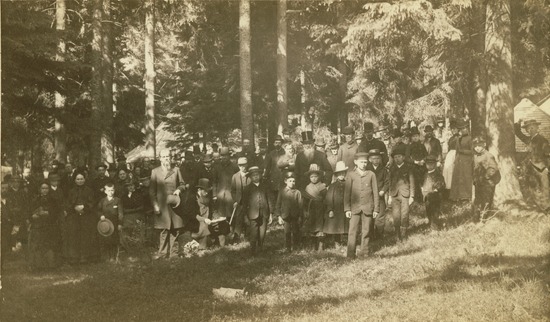
“Adventist camp meeting in Norway, 1887”
Camp meetings—large meetings held in tents with singing and preaching—were in vogue in North American Adventist circles, but not yet in Europe due to the smaller Adventist population there. But through Ellen White’s efforts, the Adventist number grew large enough to support a camp meeting.
The first European camp meeting was held in Moss, Norway, in June of 1887.14 Ellen White was invited to speak at this significant event, and she did.
Writing and publishing
Besides all the preaching, teaching, and visiting Ellen White did over her two-year stay, she also spent a considerable amount of time writing and publishing. Her European headquarters was in Basel, a city in northwestern Switzerland. She would return there in between tours and when winter snow prevented her from traveling.
During this downtime, she wrote for The Review and Herald and compiled copy for her books.
She spent the first winter arranging and editing sermons and travel notes about Europe for a book called Historical Sketches of SDA Foreign Missions.15
The next winter, she took on the formidable task of revisiting and expanding the Spirit of Prophecy book The Great Controversy.16
Readers had been thrilled by the first version in 1884, which was an enlarged version of the original story in Spiritual Gifts. With her trip to Europe, Ellen White realized she needed to enlarge The Great Controversy and gear it toward an audience both inside and outside Adventism.
In Europe, she had the opportunity of visiting the site of the Reformation, including the Swiss cities Basel and Zurich and parts of Germany—all places she’d written about. Her son Willie wrote in a letter,
“During [Ellen White’s] two years residence in Basel, she visited many places where events of special importance occurred in the Reformation days. This refreshed her memory as to what she had been shown [in vision] and this led to important enlargement in those portions of the book dealing with the Reformation days.”17
She was also able to access the extensive library of J. N. Andrews, who had been an earnest scholar in the Adventist Church.
Touring and experiencing different cultures
Yes, Ellen White had gone to Europe to work, but not every moment was spent doing so. During her stay, she found time to take excursions for rest and relaxation.
For example, when she visited France in 1886, she stopped in Paris, where she toured the stock exchange, Versailles, and the tomb of Napoleon.18
The Adventists in Scandinavia also gave her opportunities to experience different cultures. On one visit, Ellen White sampled Swedish culture at breakfast. She described it this way:
“There was a round table with a cloth upon it and a flower pot in the center, and bread, a quarter of uncut cheese, hot milk, and fried cakes, which constituted our breakfast…. We were invited to come to the table, all standing. A blessing was asked and then we stood around the table, took something in our hands, and walked about, talking and eating.”19
She had experienced her first smorgasbord.
Besides seeing these unique examples of culture, Ellen White went on walks and picnics in the countryside of the places she stayed, especially around Basel.
Ellen White’s European legacy

Photo by Joanna Kosinska on Unsplash
Ellen White’s European tour brought lasting encouragement and support to the Adventists there.
At a time before television, radio, and cell phones, seeing leaders in person was an inspiring thing for a group. It was no different for the Adventist Church.
L. H. Christian, president of the European Adventist Division in the 1920s, wrote about Ellen White’s influence years after she visited:
“The advent movement in Europe would never have been the same if it had not been for her visit…. [W]hen now and then in later years a few disloyal ones ridiculed and belittled the gift of prophecy and the servant of God, our people said: ‘We know better. We heard her speak. We have seen her humble, godly, inspiring life. We have her books, and they agree with the Bible and deepen our love for Jesus.’”20
The words of the Europeans sum up Ellen White’s legacy. Not only did she encourage and support individual congregations with her counsel but she also helped many more learn about the truth of the Bible through her evangelism efforts.
Traveling in Europe also helped her realize the need for translating her books into other languages so the Adventist message could reach non-English speakers. She worked with the publishing houses in Switzerland and England to achieve those goals.
In addition, Ellen White used her European experience to enrich her book The Great Controversy.
She had seen places and people in her visions, but sometimes she hadn’t known where or who they were or when they took place. Being in Europe expanded her understanding.
Being outside North America for the first time, Ellen White learned a lot too. She saw firsthand how different the thinking and culture was in the European countries, but she also realized, under all the exterior differences, how similar everyone really is—whether they’re in Michigan or Italy. It paved the way for her ministry in other countries, such as Australia.
Ellen White had set out to spread the gospel of Christ in Europe. Through her encouragement and support, the European churches today can reach even more people with that same message.
Read more about her visit to Europe in the book Ellen G. White in Europe 1885-1887 by D. A. Delafield.
Also get a peek into The Great Controversy, the significant book Ellen White revised in Europe.
Related Articles

- “Establishing the British Mission of the Seventh-day Adventist Church 1863-1887: Chapter 8,” British Conference Union of Seventh-day Adventists, Adventisthistory.org.uk [↵]
- White, Ellen G, The Review and Herald, September 15, 1885 [↵]
- Ibid. [↵]
- Delafield, D. A., Ellen White in Europe, (Review and Herald Publishing Association, 1975), p. 122 [↵]
- Ibid., p. 247 [↵]
- Ibid., p. 212 [↵]
- White, Ellen G, Letter 105, 1886 [↵]
- Delafield, p. 121 [↵]
- Ibid., p. 119 [↵]
- Ibid., p. 120 [↵]
- Ibid., p. 278 [↵]
- Ibid., p. 88 [↵]
- White, Ellen G, Manuscript 30, 1885 [↵]
- Delafield, p. 300 [↵]
- Ibid., p. 256 [↵]
- Ibid. [↵]
- White, Arthur L., The Ellen G. White Writings, p. 127 [↵]
- Ibid., pp. 229–230 [↵]
- White, Ellen G, Manuscript 26, 1885 [↵]
- Delafield, p. 318 [↵]
More Answers

The Barren Fig Tree Parable: What It Means to Bear Fruit
Find out what the Parable of the Barren Fig Tree really means.

¿Qué son las reuniones evangelísticas adventistas?
¿Qué son las reuniones evangelísticas adventistas?La Iglesia Adventista del Séptimo Día pone un gran énfasis en compartir el evangelio mediante la evangelización, o compartir el evangelio a través de la predicación, la enseñanza y el testimonio. Una de las formas en...
O que são os Encontros Evangelísticos Adventistas?
O que são os Encontros Evangelísticos Adventistas?A Igreja Adventista do Sétimo Dia dá grande ênfase ao compartilhamento do evangelho por meio da evangelização, ou seja, compartilhar o evangelho através da pregação, ensino e testemunho. Uma das formas de realizarmos...

O Que os Adventistas Acreditam Sobre Fé e Obras?
O Que os Adventistas Acreditam Sobre Fé e Obras?Os adventistas acreditam que somos salvos pela fé, que é a crença e confiança que temos em Jesus Cristo para nos salvar dos nossos pecados. Jesus, então, nos capacita a viver em harmonia com os mandamentos de Deus e a...
¿Qué creen los Adventistas sobre la fe y las obras?
¿Qué creen los Adventistas sobre la fe y las obras?Los adventistas creen que somos salvos por la fe, que es la creencia y confianza que tenemos en Jesucristo para salvarnos de nuestros pecados. Jesús, entonces, nos capacita para vivir en armonía con los mandamientos...
Je, Ninahitaji Kuwa Mwadventista Ili Niokolewe
Je, Ninahitaji Kuwa Mwadventista Ili Niokolewe?Jibu la swali hili ni rahisi, “hapana.” Linapokuja swala la wokovu katika Yesu Kristo, kinachohitajika kwa mtu ni kukiri dhabihu ya Yesu kwa ajili yetu, kuamini kwamba Ametuokoa, na kudai zawadi ya bure ya wokovu ambayo...
¿Necesito ser adventista para ser salvo?
¿Necesito ser adventista para ser salvo?La respuesta a esta pregunta es simplemente, “no.” Cuando se trata de la salvación en Jesucristo, todo lo que se requiere de una persona es reconocer el sacrificio de Jesús por nosotros, creer que Él nos ha salvado y reclamar el...
Preciso ser Adventista para ser salvo?
A resposta para essa pergunta é simplesmente: “não.”

Lo que la Biblia dice sobre la Segunda Venida de Jesucristo
¿Tienes curiosidad sobre lo que la Biblia dice acerca de la Segunda Venida de Jesucristo? Cubriremos los versículos clave y su significado.

¿Quién fue Mateo, el apóstol, en la Biblia?
En el primer libro del Nuevo Testamento, encontramos la historia del Evangelio desde la perspectiva de Mateo.

2 Corinthians: An Overview of Paul’s Most Personal Letter
Discover Paul’s lessons on forgiveness, reconciliation, generosity, and more. It’s all in the book of 2 Corinthians!
Quem Foi Mateus, o Apóstolo, na Bíblia?
Quem Foi Mateus, o Apóstolo, na Bíblia?No primeiro livro do Novo Testamento, encontramos a história do Evangelho sob a perspectiva de Mateus. Ele era um coletor de impostos judeu de Cafarnaum, no primeiro século d.C., e provavelmente era desprezado pelos outros judeus...
The Pharisee and the Tax Collector Parable: Its Meaning Made Simple
The Meaning of the Pharisee and the Tax Collector ParableIn Luke 18:9-14, Jesus told a parable about two men who went to the temple to pray. One was a Pharisee and the other a tax collector. The Pharisee prayed (well, bragged) about his own good works compared to the...
Biblia Inasema Nini Kuhusu Ujio wa Pili wa Yesu Kristo
Unajuliza Biblia inasema nini kuhusu Kurudi kwa Yesu Kristo Mara ya Pili? Tutajadili aya kuu na maana zake.

The Story of the Widow’s Mite—What It Really Means
The Story of the Widow’s Mite—What It Really MeansPeople often assume bigger is better, but the Bible turns this concept on its head with the story of the Widow’s Mite. Of all the donations Jesus sees at the temple, the gift that draws His attention is not the...

Consejo de Elena G. de White sobre la Educación Universitaria
Consejo de Elena G. de White sobre la Educación UniversitariaElena G. de White, una cofundadora importante del Adventismo, es conocida a menudo por su orientación práctica y espiritual para la educación infantil adecuada. Pero también estuvo significativamente...
Mathayo Alikuwa Nani Katika Biblia?
Mathayo Alikuwa Nani Katika Biblia?Katika kitabu cha kwanza cha Agano Jipya, tunapata simulizi la Injili kutoka kwa Mathayo. Alikuwa mtoza ushuru Myahudi kutoka Kapernaumu katika karne ya kwanza MK, na huenda alichukiwa na Wayahudi wenzake kwa kuchagua kazi hiyo....

¿Cuáles son los beneficios de vivir en el campo?
¿Cuáles son los beneficios de vivir en el campo?Visitar el campo puede ofrecer un descanso muy necesario del típico ajetreo y bullicio de la ciudad. Muchos incluso han decidido mudarse a zonas rurales para disfrutar de un ritmo más lento, espacios amplios, aire...
Quais São os Benefícios de Viver no Campo?
Visitar o campo pode oferecer uma pausa muito necessária do típico agito da cidade.

¿Qué significa la parábola de la perla de gran precio?
Esto es lo que Jesús enseñó sobre el reino de los cielos a través de esta breve parábola sobre un comerciante que encuentra una perla invaluable.
O Que Significa a Parábola da Pérola de Grande Valor?
Aqui está o que Jesus ensinou sobre o reino dos céus por meio desta parábola curta sobre um comerciante que encontra uma pérola inestimável.
Por Que Muitos Adventistas Querem Viver no Campo
Por Que Muitos Adventistas Querem Viver no CampoViver em áreas rurais é algo que os adventistas têm valorizado historicamente, embora as necessidades da vida moderna nem sempre tenham tornado isso possível. Convenhamos, as vantagens da vida na cidade são bastante...

Uma Visão Geral de Romanos: Fé, Justiça, Relacionamentos
Uma Visão Geral de Romanos: Fé, Justiça, RelacionamentosO livro de Romanos é uma das 21 epístolas, ou cartas abertas, do Novo Testamento. E embora seja um texto bíblico antigo, ainda tem uma relevância significativa (até surpreendente) para nossas vidas hoje. O...

Jesus é o Mesmo Ser que Miguel, o Arcanjo?
Jesus é o Mesmo Ser que Miguel, o Arcanjo?Muitos cristãos têm se perguntado sobre a misteriosa identidade de Miguel, o Arcanjo. Desde os primórdios do cristianismo, muitos interpretaram Miguel como o Messias identificado com a figura do Anjo do Senhor. O reformador...
Je, Faida za Kuishi Vijijini ni Zipi?
Kutembelea maeneo ya vijijini kunaweza kutoa mapumziko yanayohitajika sana kutoka kwenye pilikapilika za kawaida za mijini.
Je, Mfano wa Lulu ya Thamani Kubwa Unamaanisha Nini?
Hivi ndivyo Yesu alivyofundisha kuhusu ufalme wa mbinguni kupitia mfano huu mfupi wa mfanyabiashara aliyepata lulu ya thamani isiyo na kifani.
Kwa Nini Waadventista Wengi Wanataka Kuishi Vijijini
Kwa Nini Waadventista Wengi Wanataka Kuishi VijijiniKuishi maeneo ya vijijini ni jambo ambalo Waadventista wamekuwa wakilithamini kihistoria, ingawa mahitaji ya maisha ya kisasa hayafanyi iwezekane kila wakati. Tukubali, faida za kuishi mjini zinaonekana wazi: fursa...
Muhtasari wa Kitabu cha Warumi: Imani, Haki, Mahusiano
Hapa kuna muhtasari na historia ya waraka mrefu zaidi wa Paulo.

Sobre o que é a Parábola do Semeador de Jesus?
A parábola do semeador é, em última análise, sobre como as pessoas responderam a Jesus Cristo e Sua mensagem do reino de Deus—o Evangelho.
Didn’t find your answer? Ask us!
We understand your concern of having questions but not knowing who to ask—we’ve felt it ourselves. When you’re ready to learn more about Adventists, send us a question! We know a thing or two about Adventists.