
Who Was Luke the Evangelist in the Bible?
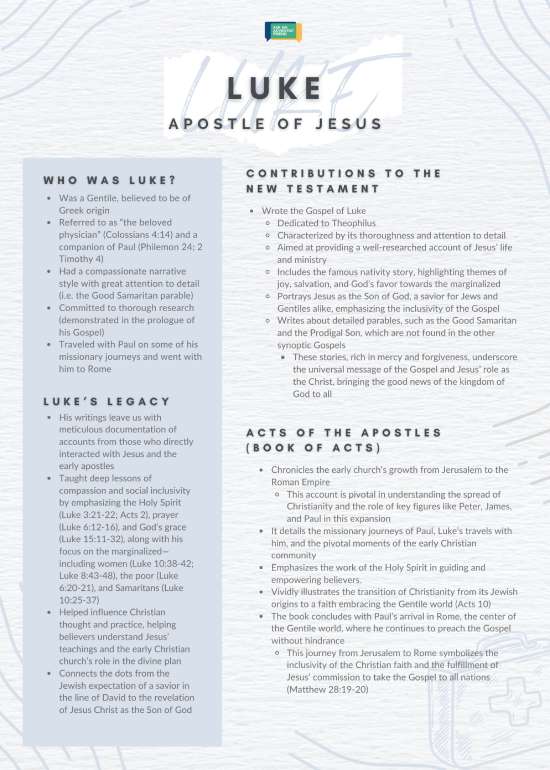 We might be familiar with the New Testament’s third Gospel account, known as “the Gospel of Luke” or the “Gospel According to Luke.” But how much do we understand about the man who wrote it?
Today, Luke is recognized as a physician, evangelist, author, and missionary. He wasn’t a part of the 12 disciples, but he demonstrated his interest in following Jesus Christ and sharing the Gospel through his connection with the apostle Paul and his authorship of two books of the Bible.
So let’s take a closer look through the known details about:
Let’s start by finding out where he came from.
Luke’s background
There is some mystery surrounding Luke’s early life.
Some believe he may have been a Hellenistic Jew, or a Jew who lives among Greek culture, speaks the language, and may adopt various parts of Greek life.1 But most believe he was born Greek.2 This is suggested by Scripture in several areas:
- The apostle Paul refers to Luke alongside a group of Gentiles (Colossians 4:10-14).
- Luke speaks about the Jew’s language as if it is not his own (Acts 1:19).
- Luke’s writings reveal a high level of skill in the Greek language as if it was his first language.
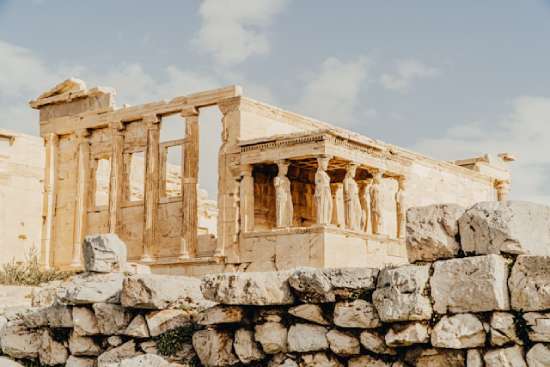
Photo by Dawid Tkocz on Unsplash
If Luke was indeed Greek, he would be the only Gentile, or non-Jew, to write a book of the Bible.3
One thing that is clear from biblical information is that Luke was a doctor. Paul referred to Luke as, “the beloved physician” (Colossians 4:14). And we can also see indications of Luke’s profession in his writings.
The Greek translation of Luke’s Gospel account provides proper medical terminology for ailments like dropsy and inflammation.4 The book of Acts also uses proper terminology for fever and dysentery, among other things.5
His writings also provide a high level of detail, with the style and precision of someone with a formal education (Luke 1:1-4).
And in addition to his professional and educational qualities, Luke served God as an evangelist and missionary.6 He made it a priority in his life to tell the world about Jesus Christ, the Son of God (Luke 2).
What was Luke’s relationship with Jesus?
It is typically believed that Luke did not know Jesus personally, but more likely heard about Him through others who followed Him.
This seems likely, since the Bible doesn’t provide any mention of Luke and Jesus meeting.
Luke even opens his Gospel account by explaining that it is based on the firsthand accounts of others (Luke 1:2). This suggests that all Luke wrote about in the book of Luke wasn’t experienced by him but by the people he interviewed.
And for an author as detailed as Luke was, surely he would have included any firsthand interactions he had with the man his whole book was about.
In fact, there’s only one instance in his writings where he seemed to be recording a firsthand account. And it isn’t in his Gospel account, but in Acts when he talked about his ministry work alongside Paul (Acts 28:16; Acts 16:10-17).
What was Luke’s relationship with other followers of Christ?
We find in Philemon 1:24 that Luke worked alongside Paul and other Christians, including Mark, who wrote another account of the Gospel story.
The Bible doesn’t specify whether Luke ever met the 12 disciples. But, given that he often traveled with Paul (who met some of the disciples), and that his writings include some of the disciples’ personal experiences, it’s likely that Luke spoke to at least a few of them at some point.
Paul, however, is the person the biblical evidence suggests he was closest to. Paul referred to him among those he called co-workers or fellow workers (Colossians 4:10-14), and in later chapters of Acts, when talking about Paul’s ministry, Luke frequently uses “we” as though he was serving closely alongside Paul and those with him.7
Luke went on many missionary journeys with Paul, also facing dangerous situations like potential imprisonment, a harsh storm, and a shipwreck. But he stayed by Paul’s side to spread the Gospel in Troas, Macedonia, Jerusalem, and Rome (Acts 27:1-44).8
He even stayed by Paul when others left, when he was again imprisoned. In what’s believed to be one of Paul’s final letters,9 he made note of Luke’s loyalty, saying:
“Make every effort to come to me soon, because Demas has deserted me, since he loved this present world, and has gone to Thessalonica. Crescens has gone to Galatia, Titus to Dalmatia. Only Luke is with me…” (2 Timothy 4:9-11, CSB, emphasis added).
It’s not hard to deduce Luke’s dedication as a missionary. No wonder he was called the “beloved” physician by Paul. He must have been a significant resource help to Paul and those he traveled with.
Luke’s writings
As for Luke’s authorship of both his Gospel account and the Acts of the Apostles (more commonly known as the Book of Acts), this information isn’t stated directly in Scripture. But these books are generally attributed to him together because:
- There is little if any question that Luke the Evangelist wrote the book of Luke. Even the earliest manuscripts of Luke’s Gospel account do include “according to Luke” in the title.10 And the dedication of both the Gospel of Luke and Acts to Theophilus frames them as a two-volume work.
- In the first chapter of Acts, the author references his “first narrative” about “all that Jesus began to do and teach until the day He was taken up…” (Acts 1:1-2, CSB). That is a summation of the Gospel story.
- The author of Acts talks about going with Paul on his missionary journeys, and Paul confirms Luke as one who served by his side (Colossians 4:14; 2 Timothy 4:11). Historians and early church leaders also describe Luke as a co-worker in ministry with Paul.11
- Many Bible writers don’t use proper medical terminology because they weren’t educated to be doctors. Luke, however, was. It makes sense that he’d be responsible for writing two books that contained proper medical language.12
With these things in mind, let’s go over the noteworthy elements of Luke’s account of the Gospel story.
The Gospel According to Luke

Photo by Tim Wildsmith on Unsplash
After Matthew and Mark’s Gospel accounts, Luke’s telling of Jesus’ life and ministry is the final synoptic Gospel, or one that is expressed as a historical summarization.
Luke began by addressing a man named Theophilus. And since Luke addressed Theophilus as “most excellent,” a common phrase of respect, some believe this could mean Luke was writing this for a high-ranking official.13
And considering the style and depth of Luke’s writing, it seems he wrote with people like Theophilus in mind, to help them better understand and accept the Gospel.
Others believe Theophilus might have been the one who sponsored the creation of Luke’s books so he and other Gentile readers could learn more about Jesus.14
The fact that Luke was writing for a Gentile audience is further supported by how he focused more on Jesus’ ministry to Gentiles than any other Gospel account.15 Additionally, Luke “translates Aramaic terms with Greek words and explains Jewish customs and geography to make his Gospel more intelligible to his original Greek readership.”16
In addition to offering more understanding to Gentile readers, Luke provided more context and depth by mentioning stories and parables that aren’t found in other accounts of the Gospel.
Some of these include the parables of The Good Samaritan, The Prodigal Son, and The Rich Man and Lazarus.17
The parable of the Good Samaritan tells the story of a Jewish man who was helped by a kind and generous Samaritan (Luke 10:25-37). The Jewish man was robbed and beaten on the roadside. Different people, including a priest and a Levite, saw him lying injured on the ground but didn’t stop to help him. But then a Samaritan, whose people were at bitter odds with Jews, did stop to help. Jesus used this parable to illustrate how the kingdom of God wasn’t limited to the Jews, but to everyone who does His will through loving their neighbor.
The parable of the prodigal son tells the story of how a son foolishly wasted his inheritance only to come back to his father, humbled and begging for a job (Luke 15:11-32). But instead of being angry or rejecting his son, the father welcomes him with open arms. This story illustrates how God will gladly forgive us when we come back to Him.
Finally, the parable of the rich man and Lazarus tells the story of a rich man who withheld any charity to a poor beggar named Lazarus (Luke 16:19-31) after their deaths. Lazarus was brought to “Abraham’s Bosom,” a fictional place to represent a good afterlife. And the rich man was brought to Hades, representing a punitive afterlife. Though the story wasn’t meant to accurately portray what happens after people die, the story is used to convey the idea that the kind of character people nurture in their earthly lives will also affect their eternal circumstances. In other words, people will be held accountable for failing to show compassion and mercy to one another as Jesus did, which also shows a lack of acceptance of Jesus as the Savior and Son of God.
All in all, these parables help convey God’s great love for us and the love we’re called to have for others, no matter who they are.
Luke also focused on the humanity of Jesus Christ, giving readers a more complete picture of the nativity scene by mentioning surrounding events like the angel Gabriel’s appearance to Mary (Luke 1:26-38), Mary’s visit to her cousin, Elizabeth (Luke 1:39-45), and the birth of John the Baptist (Luke 1:57-66).
Luke also emphasized Jesus’ role as the prophesied Son of Man from the Old Testament by showing how he overcame human struggles and lived a sinless life.18
The Acts of the Apostles

Photo by Kyle Glenn on Unsplash
The Book of Acts explains how the early church of Christianity embraced the mission to spread the Gospel across the globe.
Like Luke’s Gospel account, Acts is also dedicated to Theophilus (Acts 1:1) and is written with a similar style and wording. These two books together, according to the Seventh-day Adventist Bible Commentary, could be appropriately titled, “The Origin and Development of Christianity.”19
His accounts are also supported by archeological evidence.20 He used names, terminology, and descriptions that match the information found on monumental inscriptions.21
So how was Luke able to gather so much information for his books?
Likely due to his highly educated background, Luke must have made the most of his missionary journeys and recorded important details, consulted eyewitnesses, and conducted additional research.22 And some parts of his writings included his own observations.
He witnessed Paul cast out demons and raise someone back to life (Acts 16:16-18; Acts 20:7-12).
He witnessed the power of the Holy Spirit at work at Pentecost, reminding us of how far the Holy Spirit has brought the Christian Church since then (Acts 2:1-4).
Luke got to witness the early church grow from a small group of Jewish followers to a movement that spread across the Mediterranean.
Key themes in Luke’s writings
Now that we’ve talked about Luke’s role in writing Luke and Acts, let’s look into the themes and lessons these books give us.
These include
- Compassion to all:
- Luke focuses on the stories of outcasts more than any other Gospel account. He wrote of widows and the poor, and he made sure to mention women as well, which was not the norm of the time.23 But he humanized these people, showing that they need a Savior in the same way as everyone else. He also wrote about showing kindness and forgiveness to criminals.24
- Salvation for all:
- Luke also focused on the theme of salvation for all people—particularly the Gentiles. This was groundbreaking for the time as the Jews had been thought of as God’s chosen people for so long. The Jews believed the Messiah would come to save Israel and Judea. They never imagined He had come to save the Gentiles, too.
- And yet, Luke recounts occasions where the Lord Jesus responds to the needs of Gentiles, even those who were considered enemies of the Jews—like Samaritans or people from the Roman empire.25 They professed their faith in Him and He helped them. The disciples continued this work in Acts when they sought to bring the good news of Christ to all parts of the world. We see this in the example of Paul’s missionary travels to far-off lands and how Peter became convicted to reach Gentiles like Cornelius (Acts 10:1-36).
- The outpouring of the Holy Spirit:
- One other central theme of Luke’s writings is the Holy Spirit. Luke’s writings introduce how the Holy Spirit was given to the apostles on the day of Pentecost (Acts 2:1-4). But Luke didn’t stop there. He continued to chronicle how the Holy Spirit guided the early Christian Church through visions, miracles, and other spiritual gifts.26
- The fact that the Holy Spirit didn’t just operate through Jewish men revealed that the Spirit does not discriminate by gender or ethnicity. Instead, it was given to anyone who was willing to accept it (Acts 21:9; Acts 10:44-48).
As a doctor, Luke may have felt a special inclination to alleviate the suffering of others by showing them care and compassion. It makes sense that he would be interested in helping those in need.
These themes also support how Luke was interested in ministering to Gentiles as well as Jews. This would make sense with him being a Gentile himself. This makes Luke stand out among early church leaders who were more focused on ministering to Jews, or to others within their own circle, rather than prioritizing Gentiles or social outcasts like the poor, diseased, or widowed.
But Luke encouraged the early Christians to break these barriers, sharing Jesus with anyone who would listen.
And that’s how Luke lived out the rest of his life.
The death and legacy of Luke the Evangelist
The Bible doesn’t tell us how Luke died.
The last thing the Bible mentions about his life is that he traveled with Paul on his missionary journey to Rome (2 Timothy 4:11).27
Some suggest he was killed for his faith by being nailed to a living olive tree in Greece.28 Others believe he died in Bithynia.29
While we can’t know for sure how Luke died, it’s safe to assume that he lived out the rest of his life teaching others about Jesus.
And the words of his books continue to inspire us today.
He gave us one of the most thorough stories on the life of Jesus, all the way to the beginnings of the early Christian Church. He introduced us to important figures in early Christianity like Paul and showed us how the Holy Spirit guided Jesus’ followers.
The helpful information he provided and his unique perspective on the ministry of Christ strengthens our understanding of early church history while emphasizing that the good news of Jesus Christ is for everyone—including Gentiles:
“Then He said to them, “Thus it is written, and thus it was necessary for the Christ to suffer and to rise from the dead the third day, and that repentance and remission of sins should be preached in His name to all nations, beginning at Jerusalem.” (Luke 24:46-47, NKJV, emphasis added).
Luke might have faced the same exclusion that other Gentiles dealt with. But he didn’t let that stop him from being willing to serve God. And he used his unique position to give other Gentiles hope that they could follow Jesus, too.
Interested to learn about other writers of the Gospel story? Read about Matthew, Mark, or John.
Tracing Luke’s Missionary Journey
- Left Troas with Paul (Acts 16:11).
- Traveled with Paul to Phillipi (Acts 16:12).
- Witnessed the conversion of Lydia (Acts 16:13-15).
- Watched Paul cast a demon out of a girl (Acts 16:16-18).
- Stayed in Philippi; inferred from the resumption of “we” sections when Paul returns to Philippi (Acts 20:5-6).
- Watched Paul bring a man back to life (Acts 20:7-12).
- Met the disciples in Tyre (Acts 21: 3-4).
- Met Philip the evangelist and his daughters (Acts 21:8-9).
- Watched a prophet named Agabus warn Paul (Acts 21:10-11).
- Pleaded with Paul not to go to Jerusalem (Acts 21:12).
- Joined him on his journey to Jerusalem (Acts 21:17).
- Survived a shipwreck and landed on Malta (Acts 27:1-44; Acts 28:1).
- Witnessed Paul miraculously heal from a snake bite (Acts 28:3-6).
- Watched Paul heal the people of Malta (Acts 28:7-10).
- Accompanied Paul to Rome and stayed with him there (Acts 28:14-16).
- Supported Paul during his imprisonment (2 Timothy 4:11).
Related Articles.



- The Remnant Study Bible, Remnant Publications, 2009. pp. 1205. [↵]
- Ibid. [↵]
- Ellis, Earle E., “Saint Luke,” Britannica, August 5, 2024. [↵]
- Hubbard, Reuben A., “Medical Terminology in Luke,” May 1977, Ministry Magazine. [↵]
- Ibid. [↵]
- Philemon 1:24; 2 Timothy 4:11; Acts 28:16; Acts 16:10-17; Acts 20:6; Acts 27:1. [↵]
- Ellis [↵]
- Acts 27:1-44; Philemon 1:24; 2 Timothy 4:11; Acts 28:16; Acts 16:10-17; Acts 20:6; Acts 27:1. [↵]
- Ibid. [↵]
- Nichol, Francis D. Seventh-day Adventist Bible Commentary And Bible Students’ Source Book, Vol. 5 , 1978, p. 663. [↵]
- Ibid. [↵]
- Hubbard. [↵]
- “Who is Theophilus in the Bible books of Luke and Acts?” Bible Info; “The Gospel According to Luke.” Britannica. [↵]
- Remnant Study Bible, p. 1205. [↵]
- Seventh-day Adventist Bible Commentary, Vol. 5 . p. 665. [↵]
- Remnant Study Bible, p. 1205. [↵]
- Luke 10:25-37; Luke 15:11-32; Luke 16:19-31. [↵]
- Remnant Study Bible, p. 1206. [↵]
- Seventh-day Adventist Bible Commentary, Vol. 5, p. 665. [↵]
- Remnant Study Bible, p. 1288. [↵]
- Edwards, James R., “Archaeology Gives New Reality to Paul’s Ephesus Riot,” Biblical Archaeology Society, 2016. [↵]
- Ibid. [↵]
- Luke 16:19-31; Luke 1:39-56; Luke 18:1-8. [↵]
- Luke 23:39-43. [↵]
- Luke 7:2-3, 9-10; Luke 17:11-19. [↵]
- Acts 2:4; Acts 3:6-8; Acts 4:30-31; Acts 10:9-23. [↵]
- “Saint Luke,” [↵]
- Seventh-day Adventist Bible Commentary, Vol. 5, p. 663. [↵]
- “Saint Luke,” [↵]
More Answers

The Barren Fig Tree Parable: What It Means to Bear Fruit
Find out what the Parable of the Barren Fig Tree really means.

¿Qué son las reuniones evangelísticas adventistas?
¿Qué son las reuniones evangelísticas adventistas?La Iglesia Adventista del Séptimo Día pone un gran énfasis en compartir el evangelio mediante la evangelización, o compartir el evangelio a través de la predicación, la enseñanza y el testimonio. Una de las formas en...
O que são os Encontros Evangelísticos Adventistas?
O que são os Encontros Evangelísticos Adventistas?A Igreja Adventista do Sétimo Dia dá grande ênfase ao compartilhamento do evangelho por meio da evangelização, ou seja, compartilhar o evangelho através da pregação, ensino e testemunho. Uma das formas de realizarmos...

O Que os Adventistas Acreditam Sobre Fé e Obras?
O Que os Adventistas Acreditam Sobre Fé e Obras?Os adventistas acreditam que somos salvos pela fé, que é a crença e confiança que temos em Jesus Cristo para nos salvar dos nossos pecados. Jesus, então, nos capacita a viver em harmonia com os mandamentos de Deus e a...
¿Qué creen los Adventistas sobre la fe y las obras?
¿Qué creen los Adventistas sobre la fe y las obras?Los adventistas creen que somos salvos por la fe, que es la creencia y confianza que tenemos en Jesucristo para salvarnos de nuestros pecados. Jesús, entonces, nos capacita para vivir en armonía con los mandamientos...

Je, Ninahitaji Kuwa Mwadventista Ili Niokolewe
Je, Ninahitaji Kuwa Mwadventista Ili Niokolewe?Jibu la swali hili ni rahisi, “hapana.” Linapokuja swala la wokovu katika Yesu Kristo, kinachohitajika kwa mtu ni kukiri dhabihu ya Yesu kwa ajili yetu, kuamini kwamba Ametuokoa, na kudai zawadi ya bure ya wokovu ambayo...
¿Necesito ser adventista para ser salvo?
¿Necesito ser adventista para ser salvo?La respuesta a esta pregunta es simplemente, “no.” Cuando se trata de la salvación en Jesucristo, todo lo que se requiere de una persona es reconocer el sacrificio de Jesús por nosotros, creer que Él nos ha salvado y reclamar el...
Preciso ser Adventista para ser salvo?
A resposta para essa pergunta é simplesmente: “não.”

Lo que la Biblia dice sobre la Segunda Venida de Jesucristo
¿Tienes curiosidad sobre lo que la Biblia dice acerca de la Segunda Venida de Jesucristo? Cubriremos los versículos clave y su significado.

¿Quién fue Mateo, el apóstol, en la Biblia?
En el primer libro del Nuevo Testamento, encontramos la historia del Evangelio desde la perspectiva de Mateo.

2 Corinthians: An Overview of Paul’s Most Personal Letter
Discover Paul’s lessons on forgiveness, reconciliation, generosity, and more. It’s all in the book of 2 Corinthians!
Quem Foi Mateus, o Apóstolo, na Bíblia?
Quem Foi Mateus, o Apóstolo, na Bíblia?No primeiro livro do Novo Testamento, encontramos a história do Evangelho sob a perspectiva de Mateus. Ele era um coletor de impostos judeu de Cafarnaum, no primeiro século d.C., e provavelmente era desprezado pelos outros judeus...

The Pharisee and the Tax Collector Parable: Its Meaning Made Simple
The Meaning of the Pharisee and the Tax Collector ParableIn Luke 18:9-14, Jesus told a parable about two men who went to the temple to pray. One was a Pharisee and the other a tax collector. The Pharisee prayed (well, bragged) about his own good works compared to the...
Biblia Inasema Nini Kuhusu Ujio wa Pili wa Yesu Kristo
Unajuliza Biblia inasema nini kuhusu Kurudi kwa Yesu Kristo Mara ya Pili? Tutajadili aya kuu na maana zake.

The Story of the Widow’s Mite—What It Really Means
The Story of the Widow’s Mite—What It Really MeansPeople often assume bigger is better, but the Bible turns this concept on its head with the story of the Widow’s Mite. Of all the donations Jesus sees at the temple, the gift that draws His attention is not the...

Consejo de Elena G. de White sobre la Educación Universitaria
Consejo de Elena G. de White sobre la Educación UniversitariaElena G. de White, una cofundadora importante del Adventismo, es conocida a menudo por su orientación práctica y espiritual para la educación infantil adecuada. Pero también estuvo significativamente...
Mathayo Alikuwa Nani Katika Biblia?
Mathayo Alikuwa Nani Katika Biblia?Katika kitabu cha kwanza cha Agano Jipya, tunapata simulizi la Injili kutoka kwa Mathayo. Alikuwa mtoza ushuru Myahudi kutoka Kapernaumu katika karne ya kwanza MK, na huenda alichukiwa na Wayahudi wenzake kwa kuchagua kazi hiyo....

¿Cuáles son los beneficios de vivir en el campo?
¿Cuáles son los beneficios de vivir en el campo?Visitar el campo puede ofrecer un descanso muy necesario del típico ajetreo y bullicio de la ciudad. Muchos incluso han decidido mudarse a zonas rurales para disfrutar de un ritmo más lento, espacios amplios, aire...
Quais São os Benefícios de Viver no Campo?
Visitar o campo pode oferecer uma pausa muito necessária do típico agito da cidade.

¿Qué significa la parábola de la perla de gran precio?
Esto es lo que Jesús enseñó sobre el reino de los cielos a través de esta breve parábola sobre un comerciante que encuentra una perla invaluable.
O Que Significa a Parábola da Pérola de Grande Valor?
Aqui está o que Jesus ensinou sobre o reino dos céus por meio desta parábola curta sobre um comerciante que encontra uma pérola inestimável.

Por Que Muitos Adventistas Querem Viver no Campo
Por Que Muitos Adventistas Querem Viver no CampoViver em áreas rurais é algo que os adventistas têm valorizado historicamente, embora as necessidades da vida moderna nem sempre tenham tornado isso possível. Convenhamos, as vantagens da vida na cidade são bastante...

Uma Visão Geral de Romanos: Fé, Justiça, Relacionamentos
Uma Visão Geral de Romanos: Fé, Justiça, RelacionamentosO livro de Romanos é uma das 21 epístolas, ou cartas abertas, do Novo Testamento. E embora seja um texto bíblico antigo, ainda tem uma relevância significativa (até surpreendente) para nossas vidas hoje. O...

Jesus é o Mesmo Ser que Miguel, o Arcanjo?
Jesus é o Mesmo Ser que Miguel, o Arcanjo?Muitos cristãos têm se perguntado sobre a misteriosa identidade de Miguel, o Arcanjo. Desde os primórdios do cristianismo, muitos interpretaram Miguel como o Messias identificado com a figura do Anjo do Senhor. O reformador...
Je, Faida za Kuishi Vijijini ni Zipi?
Kutembelea maeneo ya vijijini kunaweza kutoa mapumziko yanayohitajika sana kutoka kwenye pilikapilika za kawaida za mijini.
Je, Mfano wa Lulu ya Thamani Kubwa Unamaanisha Nini?
Hivi ndivyo Yesu alivyofundisha kuhusu ufalme wa mbinguni kupitia mfano huu mfupi wa mfanyabiashara aliyepata lulu ya thamani isiyo na kifani.
Kwa Nini Waadventista Wengi Wanataka Kuishi Vijijini
Kwa Nini Waadventista Wengi Wanataka Kuishi VijijiniKuishi maeneo ya vijijini ni jambo ambalo Waadventista wamekuwa wakilithamini kihistoria, ingawa mahitaji ya maisha ya kisasa hayafanyi iwezekane kila wakati. Tukubali, faida za kuishi mjini zinaonekana wazi: fursa...
Muhtasari wa Kitabu cha Warumi: Imani, Haki, Mahusiano
Hapa kuna muhtasari na historia ya waraka mrefu zaidi wa Paulo.

Sobre o que é a Parábola do Semeador de Jesus?
A parábola do semeador é, em última análise, sobre como as pessoas responderam a Jesus Cristo e Sua mensagem do reino de Deus—o Evangelho.
Didn’t find your answer? Ask us!
We understand your concern of having questions but not knowing who to ask—we’ve felt it ourselves. When you’re ready to learn more about Adventists, send us a question! We know a thing or two about Adventists.