
Oats, avocados, lentils, tofu—probably not what you first think of in a standard American diet. But if you show up at the home of an Adventist, chances are you may be served one of these staples.
Out of a desire to care for the bodies God gave us, many Adventists eat a diet rich in fruit, vegetables, grains, legumes, and nuts. Some of us are vegetarian, others may be vegan, and others may follow a whole-food, plant-based diet.
And the benefits are huge! A typical Adventist diet is one of the reasons Loma Linda, California—an area with about 9,000 Adventists—is one of the world’s “blue zones,” a region where “people reach age 100 at 10 times greater rates than the rest of the United States.”
You might be wondering why we eat this way and what makes our diet so healthful. And do Adventists have to eat this way?
Here’s everything you need to know about the Adventist diet:
What is the Adventist diet?

Photo by Zlatko Đurić on Unsplash
The Adventist diet is a plant-heavy diet. Some Adventists are vegetarian, eating only small amounts of dairy products and eggs. About 8% eat no animal products whatsoever. Those who do eat meat—about half—stick to biblical principles for meat consumption (Leviticus 11), excluding pork and shellfish.
In addition, Adventists emphasize whole foods and try to avoid highly processed food and sweets. We also abstain from alcohol and tobacco.
When it comes to beverages, we generally opt for water, herbal teas, and natural fruit and vegetable juices rather than sugary drinks or addictive caffeinated beverages.
These decisions stem from the Adventist health message, which includes nutrition as one of its eight health principles.
Where does the Adventist diet come from?
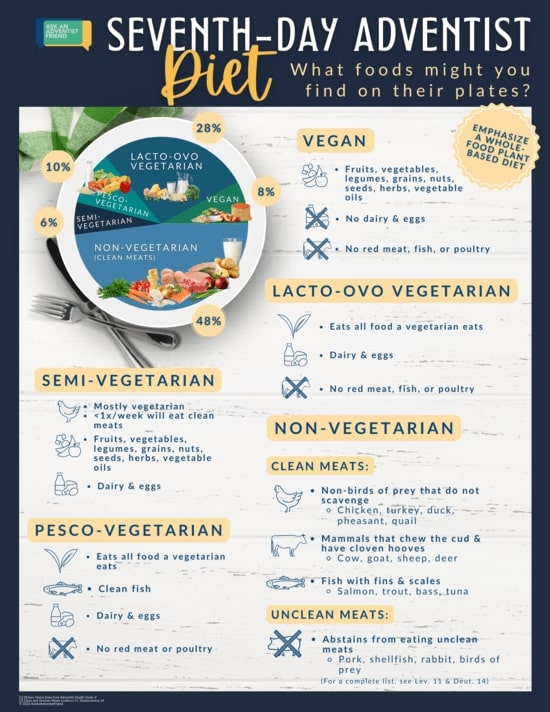
The Adventist diet is the product of our belief that our bodies belong to God and we should honor Him in the way we care for them (1 Corinthians 6:19–20). Eating healthfully is one way we do that. In our food choices, we follow some basic dietary principles from the Bible. We also refer to the writings of Ellen White, a key leader in the Seventh-day Adventist Church, who wrote a lot about how to practically apply these practical principles.
We don’t, however, see a healthy diet as a means of salvation. Rather, it is an outflow of our relationship with God.
It allows us to live our best and healthiest lives so that we can serve Him more effectively. And it helps us create a culture of whole health where physical, mental, and spiritual needs matter.
This means that the Church doesn’t prescribe a specific diet plan for its members. Instead, applying the principles is a personal choice that we make based on conscience and circumstance.
Let’s look at these health principles in more detail.
Biblical principles that promote a healthy diet
When God first created humans, He gave them a diet of fruit, grains, and seeds (Genesis 1:29). Later, He provided them with vegetables from the ground (Genesis 3:18).
But when a worldwide flood wiped out the earth’s vegetation, God permitted Noah and his family to eat meat (Genesis 9:3–4).
Leviticus 11 and Deuteronomy 14 outline more specifics about what kind of meat God advised humans to eat. He divided animals into categories of clean and unclean.
Clean meat comes from…
- Grazing animals that have a split hoof and chew the cud (beef, lamb, venison)
- Fish with scales
- Certain birds (chicken, turkey, etc.)
Scavenger-type animals are the ones considered not clean. These would be animals that eat dead animals or waste (such as pigs or birds of prey) or animals that clean the bottom of the ocean (such as shellfish).
Though Adventists don’t follow the Old Testament ceremonial laws, we see the principle of clean and unclean animals as a health matter rather than a ritual. And it existed even before God gave it to the Israelites. It’s the reason why, many hundreds of years before, God told Noah to bring seven pairs of every clean animal and only two of each unclean animal into the ark (Genesis 7:1–3, 8–9).
He knew that unclean animals aren’t ideal for human health. If you’ve spent any time around pigs, you’ll know the truth of this. They aren’t the cleanest of animals—and they’ll eat anything!
Not surprisingly, researchers found bacteria that cause food poisoning in 90% of pork samples. They’ve also discovered tapeworms that can lead to neurological infections.1
God’s not about making arbitrary rules. He gave the dietary guidelines to protect us and help us have the best health possible.
Ellen White’s counsel
In the mid-1800s as the Adventist Church was growing, Ellen White—one of its leaders—was led by the Holy Spirit to write about healthy living. She discussed the impact of physical health on spiritual health and why it’s important to care for the whole person.
Her recommendations were far ahead of their time when most people didn’t know that eating fried pork and doughnuts would affect their health.2
Here are some nutrition snippets from her books:

Photo by Alexandra Andersson on Unsplash
Plant-based diet: “Grains, fruits, nuts, and vegetables constitute the diet chosen for us by our Creator. These foods, prepared in as simple and natural a manner as possible, are the most healthful and nourishing.”3
Temperance: “True temperance teaches us to dispense entirely with everything hurtful, and to use judiciously that which is healthful.”4
Pork: “God never designed the swine to be eaten under any circumstances.” God actually made swine to be “useful.”… “In a fruitful country, where there was much to decay upon the ground, which would poison the atmosphere, herds of swine were permitted to run free, and devoured the decaying substances, which was a means of preserving health.”5
Sickness in animals used for meat: “There are but a few animals that are free from disease.”6
Moderation in eating sugary foods: “Far too much sugar is ordinarily used in food…. The free use of milk and sugar taken together should be avoided.”7
Avoidance of stimulating (caffeinated) beverages: “Tea and coffee are stimulating. Their effects are similar to those of tobacco; but they affect in a less degree…. Why they suffer when they discontinue the use of these stimulants, is because they have been breaking down nature in her work of preserving the entire system in harmony and in health. They will be troubled with dizziness, headache, numbness, nervousness, and irritability.”8
What are the benefits of the Adventist diet?
Modern science has helped validate the Bible’s and Ellen White’s counsel on diet. It has shown how the Adventist diet:
- Increases lifespan
- Decreases the risk of chronic disease
- Helps with weight loss
- Improves the mind’s ability to function
Longevity

Photo by Gustavo Fring
Adventists have a life expectancy up to ten years longer than the average population. Their diet may be the reason, according to Dan Buettner, who labeled the Adventist hub of Loma Linda as one of the five longevity hotspots in the world.
Indeed, Adventist men who ate a vegetarian diet lived an average of 9.5 years longer than the general Californian population. And Adventist women, 6.1 years longer.
Less chronic disease
Our diet helps prevent chronic conditions, such as cancer, cardiovascular disease, obesity, type 2 diabetes, and high blood pressure.
The Adventist Health Study, conducted by researchers from Loma Linda University, is an ongoing study that has looked at lifestyle and health patterns in over 96,000 Adventists in North America. It revealed that:
- Adventists have less of certain cancers (such as colon cancer) than the general population. Vegetarians had an even lower risk than non-vegetarians.
- A vegan diet led to lower cholesterol levels, blood pressure, and incidence of diabetes.
- Adventists that ate nuts more than five times per week lowered their risk of coronary heart disease and heart attacks.
A healthy weight
The Adventist Health Study also showed connections between diet and weight. It found that vegan Adventists are about 30 pounds lighter than non-vegetarians of similar height.
Eating like an Adventist can help you achieve a healthy weight too, even without restricting portions or calories.9
A sharper mind
Whole plant foods are one of the keys to a sharper mind. More and more research is showing that eating this way can decrease the risk of cognitive decline.10
The Brain Health Guide was developed by experts at the Centre for Aging and Brain Health Innovation to outline what diet helps “prevent cognitive decline in adults over 50.”
Their discovery?
A varied, plant-centered diet that included leafy greens, berries, nuts, legumes, and some fish, but minimal amounts of animal protein—not much different from how Adventists eat!
How can you eat like an Adventist?
You don’t have to be an Adventist to eat like one! And it doesn’t have to be hard—simply start by focusing your diet around plants and whole foods.
Pick a couple of these ideas to try:
- Look at the list of common foods that Adventists eat and see what you can incorporate into your diet. Maybe add some steamed broccoli to a meal. Or replace beef with beans in a taco.
- Decide to leave out all animal products for one meal a day.
- Choose one new plant-based recipe to try each week.
- Fill half your plate with fresh fruits and vegetables, one quarter with a protein source (plant-based if you choose), and one quarter with whole grains. Keep oil, fat, and sugar to a minimum.
A balanced vegetarian diet is adequate for meeting all nutrition requirements—protein, omega-3 fatty acids, zinc, iron, calcium, etc. But people who leave out all animal products need to make sure they’re getting enough vitamin D and B-12. Consult with your doctor or a registered dietitian.
Check out these resources to learn more about the Adventist diet and try it out for yourself:
- Lifestyle Matters
- Vibrant Life
- Pivio—The Complete Health Improvement Project
- CREATION Life
- Life and Health Network

Photo by Tristan Le
It’s more than just a diet. It’s about whole health.
A plant centered diet is an important factor in the physical, mental, and spiritual health of Adventists.
But following dietary guidelines doesn’t earn our salvation or make us more “holy” or “good” than any other human being. It only enhances the life that God wants for us (John 10:10; 3 John 2) promoting wellness.
We also recognize that diet is a personal choice and a matter of conscience. All of us must decide what is best for our well-being and our situation
- M. Greger, “Yersinia in Pork,” NutritionFacts.org, Nov 28, 2012 (volume 11); “Pork Tapeworms on the Brain,” NutritionFacts.org, Sept 4, 2011 (volume 5).[↵]
- Robinson, Doris, The Story of Our Health Message (Southern Publishing Association, Nashville, TN, 1965), p. 20, 24.[↵]
- White, Ellen G., The Ministry of Healing (Pacific Press, Mountain View, CA, 1905), p. 296. [↵]
- White, Ellen G., Patriarchs and Prophets (Review and Herald, Washington, D.C., 1890), p. 562.[↵]
- White, Ellen G., Spiritual Gifts, vol. 4a (Seventh-day Adventist Publishing Association, Battle Creek, MI, 1864), p. 124.[↵]
- Ibid., p. 146[↵]
- White, Ellen G., The Ministry of Healing, p. 302.[↵]
- White, Ellen G., Counsels on Diet and Foods (Review and Herald, Washington, D.C., 1938), p. 425.[↵]
- Barnard, et. al., “The Effects of a Low-Fat, Plant-Based Dietary Intervention,” American Journal of Medicine 118(9), Sept. 2005, pp. 991–997; Turner-McGrievy, et. al., “A Two-Year Randomized Weight Loss Trial,” Obesity (Silver Springs) 15(9), Sept. 2007, pp. 2276–81.[↵]
- Sandoiu, Ana, “Plant-Based Diet May Prevent Cognitive Decline,” MedicalNewsToday, Nov. 18, 2019.[↵]
Want to learn more about Adventists and healthy living?



More Answers

The Barren Fig Tree Parable: What It Means to Bear Fruit
Find out what the Parable of the Barren Fig Tree really means.

¿Qué son las reuniones evangelísticas adventistas?
¿Qué son las reuniones evangelísticas adventistas?La Iglesia Adventista del Séptimo Día pone un gran énfasis en compartir el evangelio mediante la evangelización, o compartir el evangelio a través de la predicación, la enseñanza y el testimonio. Una de las formas en...
O que são os Encontros Evangelísticos Adventistas?
O que são os Encontros Evangelísticos Adventistas?A Igreja Adventista do Sétimo Dia dá grande ênfase ao compartilhamento do evangelho por meio da evangelização, ou seja, compartilhar o evangelho através da pregação, ensino e testemunho. Uma das formas de realizarmos...

O Que os Adventistas Acreditam Sobre Fé e Obras?
O Que os Adventistas Acreditam Sobre Fé e Obras?Os adventistas acreditam que somos salvos pela fé, que é a crença e confiança que temos em Jesus Cristo para nos salvar dos nossos pecados. Jesus, então, nos capacita a viver em harmonia com os mandamentos de Deus e a...
¿Qué creen los Adventistas sobre la fe y las obras?
¿Qué creen los Adventistas sobre la fe y las obras?Los adventistas creen que somos salvos por la fe, que es la creencia y confianza que tenemos en Jesucristo para salvarnos de nuestros pecados. Jesús, entonces, nos capacita para vivir en armonía con los mandamientos...

Je, Ninahitaji Kuwa Mwadventista Ili Niokolewe
Je, Ninahitaji Kuwa Mwadventista Ili Niokolewe?Jibu la swali hili ni rahisi, “hapana.” Linapokuja swala la wokovu katika Yesu Kristo, kinachohitajika kwa mtu ni kukiri dhabihu ya Yesu kwa ajili yetu, kuamini kwamba Ametuokoa, na kudai zawadi ya bure ya wokovu ambayo...
¿Necesito ser adventista para ser salvo?
¿Necesito ser adventista para ser salvo?La respuesta a esta pregunta es simplemente, “no.” Cuando se trata de la salvación en Jesucristo, todo lo que se requiere de una persona es reconocer el sacrificio de Jesús por nosotros, creer que Él nos ha salvado y reclamar el...
Preciso ser Adventista para ser salvo?
A resposta para essa pergunta é simplesmente: “não.”

Lo que la Biblia dice sobre la Segunda Venida de Jesucristo
¿Tienes curiosidad sobre lo que la Biblia dice acerca de la Segunda Venida de Jesucristo? Cubriremos los versículos clave y su significado.

¿Quién fue Mateo, el apóstol, en la Biblia?
En el primer libro del Nuevo Testamento, encontramos la historia del Evangelio desde la perspectiva de Mateo.

2 Corinthians: An Overview of Paul’s Most Personal Letter
Discover Paul’s lessons on forgiveness, reconciliation, generosity, and more. It’s all in the book of 2 Corinthians!
Quem Foi Mateus, o Apóstolo, na Bíblia?
Quem Foi Mateus, o Apóstolo, na Bíblia?No primeiro livro do Novo Testamento, encontramos a história do Evangelho sob a perspectiva de Mateus. Ele era um coletor de impostos judeu de Cafarnaum, no primeiro século d.C., e provavelmente era desprezado pelos outros judeus...

The Pharisee and the Tax Collector Parable: Its Meaning Made Simple
The Meaning of the Pharisee and the Tax Collector ParableIn Luke 18:9-14, Jesus told a parable about two men who went to the temple to pray. One was a Pharisee and the other a tax collector. The Pharisee prayed (well, bragged) about his own good works compared to the...
Biblia Inasema Nini Kuhusu Ujio wa Pili wa Yesu Kristo
Unajuliza Biblia inasema nini kuhusu Kurudi kwa Yesu Kristo Mara ya Pili? Tutajadili aya kuu na maana zake.

The Story of the Widow’s Mite—What It Really Means
The Story of the Widow’s Mite—What It Really MeansPeople often assume bigger is better, but the Bible turns this concept on its head with the story of the Widow’s Mite. Of all the donations Jesus sees at the temple, the gift that draws His attention is not the...

Consejo de Elena G. de White sobre la Educación Universitaria
Consejo de Elena G. de White sobre la Educación UniversitariaElena G. de White, una cofundadora importante del Adventismo, es conocida a menudo por su orientación práctica y espiritual para la educación infantil adecuada. Pero también estuvo significativamente...
Mathayo Alikuwa Nani Katika Biblia?
Mathayo Alikuwa Nani Katika Biblia?Katika kitabu cha kwanza cha Agano Jipya, tunapata simulizi la Injili kutoka kwa Mathayo. Alikuwa mtoza ushuru Myahudi kutoka Kapernaumu katika karne ya kwanza MK, na huenda alichukiwa na Wayahudi wenzake kwa kuchagua kazi hiyo....

¿Cuáles son los beneficios de vivir en el campo?
¿Cuáles son los beneficios de vivir en el campo?Visitar el campo puede ofrecer un descanso muy necesario del típico ajetreo y bullicio de la ciudad. Muchos incluso han decidido mudarse a zonas rurales para disfrutar de un ritmo más lento, espacios amplios, aire...
Quais São os Benefícios de Viver no Campo?
Visitar o campo pode oferecer uma pausa muito necessária do típico agito da cidade.
¿Qué significa la parábola de la perla de gran precio?
Esto es lo que Jesús enseñó sobre el reino de los cielos a través de esta breve parábola sobre un comerciante que encuentra una perla invaluable.
O Que Significa a Parábola da Pérola de Grande Valor?
Aqui está o que Jesus ensinou sobre o reino dos céus por meio desta parábola curta sobre um comerciante que encontra uma pérola inestimável.

Por Que Muitos Adventistas Querem Viver no Campo
Por Que Muitos Adventistas Querem Viver no CampoViver em áreas rurais é algo que os adventistas têm valorizado historicamente, embora as necessidades da vida moderna nem sempre tenham tornado isso possível. Convenhamos, as vantagens da vida na cidade são bastante...

Uma Visão Geral de Romanos: Fé, Justiça, Relacionamentos
Uma Visão Geral de Romanos: Fé, Justiça, RelacionamentosO livro de Romanos é uma das 21 epístolas, ou cartas abertas, do Novo Testamento. E embora seja um texto bíblico antigo, ainda tem uma relevância significativa (até surpreendente) para nossas vidas hoje. O...

Jesus é o Mesmo Ser que Miguel, o Arcanjo?
Jesus é o Mesmo Ser que Miguel, o Arcanjo?Muitos cristãos têm se perguntado sobre a misteriosa identidade de Miguel, o Arcanjo. Desde os primórdios do cristianismo, muitos interpretaram Miguel como o Messias identificado com a figura do Anjo do Senhor. O reformador...
Je, Faida za Kuishi Vijijini ni Zipi?
Kutembelea maeneo ya vijijini kunaweza kutoa mapumziko yanayohitajika sana kutoka kwenye pilikapilika za kawaida za mijini.
Je, Mfano wa Lulu ya Thamani Kubwa Unamaanisha Nini?
Hivi ndivyo Yesu alivyofundisha kuhusu ufalme wa mbinguni kupitia mfano huu mfupi wa mfanyabiashara aliyepata lulu ya thamani isiyo na kifani.
Kwa Nini Waadventista Wengi Wanataka Kuishi Vijijini
Kwa Nini Waadventista Wengi Wanataka Kuishi VijijiniKuishi maeneo ya vijijini ni jambo ambalo Waadventista wamekuwa wakilithamini kihistoria, ingawa mahitaji ya maisha ya kisasa hayafanyi iwezekane kila wakati. Tukubali, faida za kuishi mjini zinaonekana wazi: fursa...
Muhtasari wa Kitabu cha Warumi: Imani, Haki, Mahusiano
Hapa kuna muhtasari na historia ya waraka mrefu zaidi wa Paulo.
Sobre o que é a Parábola do Semeador de Jesus?
A parábola do semeador é, em última análise, sobre como as pessoas responderam a Jesus Cristo e Sua mensagem do reino de Deus—o Evangelho.
Didn’t find your answer? Ask us!
We understand your concern of having questions but not knowing who to ask—we’ve felt it ourselves. When you’re ready to learn more about Adventists, send us a question! We know a thing or two about Adventists.