
John Nevins Andrews (1829–1883) was an influential leader in the early days of the Seventh-day Adventist Church. He was a Bible scholar who helped shape several Adventist beliefs and juggled many roles in the Church. Most notably, he was the first official missionary for the Adventist Church outside North America.
Today, his most famous legacy is Andrews University, an Adventist college in Berrien Springs, Michigan, named after him.
In this post, you’ll learn more about who J. N. Andrews was, his contributions to the Adventist Church, and his roles as a theologian, missionary, and ministerial trainer.
We’ll answer the following questions:
- Who was J. N. Andrews?
- What role did he play in forming the Adventist Church?
- What was his significance as a missionary?
- What is his legacy?
Let’s begin with the details of his early life.
Who was J. N. Andrews?
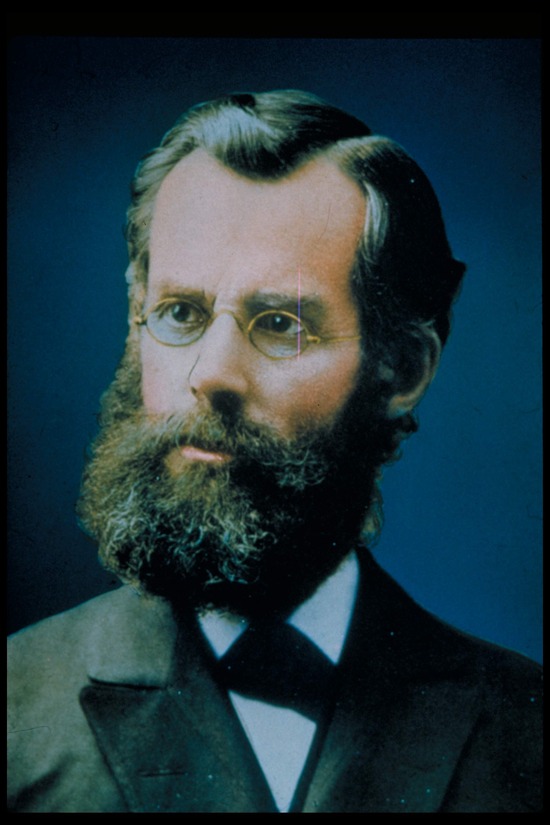
J. N. Andrews was born in Poland, Maine, on July 22, 1829. But soon after, his family moved to Paris Hill, Maine, where he grew up in a farming community.
His only record of formal schooling is six months of secondary school at age 14. But he had an appetite for learning and continued to teach himself.
By his late teens, he could read several languages and had a broad general knowledge. He also had a good understanding of Latin, algebra, and English grammar.
His aunt said that Andrews was a “fine, promising boy—a very fine scholar and strictly moral [with] first-rate common sense.”1
One of his uncles noticed his scholarly potential and offered to pay for Andrews to attend law school. But by this time, he and his family had become Millerites.
And this religious experience led him down the path that he took for the rest of his life.
Conversion and joining the Millerite Movement
J. N. Andrews traced his first religious conviction to the young age of five. That’s when he heard a sermon on Revelation 20:11 at the local Methodist Episcopalian Church.
In 1842, when he was 12, he heard Joshua Himes and other Millerite preachers teach about the Second Advent. This experience led to the day in January 1843 when he said he “found the Savior.”2
His family and several other Millerite families in the neighborhood joined together to form a congregation.
Then came the Great Disappointment of October 22, 1844.
It took a while before he could understand the experience. And he struggled to come to terms with the Disappointment.
But then, in mid-1845, he read a tract by T. M. Preble, a Seventh Day Baptist, on the sacredness of the seventh-day Sabbath. That helped convince Andrews, and he became a Sabbath keeper at the age of 17.
A few years later in September 1849, Ellen White, James White, and Joseph Bates visited Andrews in Paris Hill. They shared a new understanding of Daniel 8:14 as explained in a paper by O.R.L. Crosier, another Millerite. They said that “the cleansing of the sanctuary” refers to Jesus’ new work in the heavenly sanctuary, not His return to earth.
This explained the Millerites’ error which led to the Great Disappointment.
After learning about this new position, Andrews wholeheartedly joined Bates and the Whites in sharing it with other former Millerites.
And at a conference that month, he “felt a call to ministry.” This marked a major turning point in his life.3
From then on, he devoted his entire life and talents to spreading the gospel of Jesus Christ.
But he didn’t do this alone. His family was his great support and encouragement.
His marriage and family

On October 29, 1856, Andrews married Angeline Stevens (1824–1872).
The Stevens and Andrews families were friends in Paris Hill, and by this time, they had both moved to Waukon, Iowa.
John’s first two children were born there: Charles (1857) and Mary (1861).
In 1863, he and his family went to New York, where they had two more children, both of whom died in infancy.
Then sadly, his wife Angeline died from a stroke at age 48 in 1872. In her eulogy, John wrote, “No unkind word ever passed between us, and no vexed feeling ever existed in our hearts.”4
Andrews moved to South Lancaster, Massachusetts, where the children could stay with a family friend. He never remarried.
But despite all the personal tragedy, J. N. Andrews was a strong leader in the early days of Adventism.
J. N. Andrews’ role in the early Seventh-day Adventist Church

Photo by Hannes Wolf on Unsplash
In October 1849, at age 20, Andrews wrote a letter to James White, who was the editor of the Present Truth at the time. That letter began Andrews’ long career as a writer and editor for Adventist publications.
The first Adventist press was set up in Rochester, New York, in 1852. Andrews joined James White and Joseph Bates as a member of the publishing committee. He was only 22.
Just before that, Andrews had begun traveling in the New England area to preach and do pastoral work. Then, he was ordained as an Adventist preacher in 1853.
Because of his skill as a writer and a preacher, and because of his great love for study, he made significant contributions to the Adventist Church. He contributed to the doctrinal understanding, ministerial effort, leadership, and development of church initiatives.
Here are some highlights:
Doctrinal contributions
As mentioned earlier, Andrews was an avid scholar. And he used all his intellectual gifts to study the then-young Adventist Church’s beliefs, such as:
Sunset as the beginning of Sabbath: The Church was not settled on when Sabbath should begin. Some said Friday at midnight. Others, Saturday morning or Friday at 6 p.m.
So, he undertook intense research and published a paper in 1855 that said, according to the Bible, sunset on Friday marks the beginning of the Sabbath.5
Defense of Sabbath’s observance throughout history: In 1861, he published his most prominent book, The History of the Sabbath and the First Day of the Week, which traced the Sabbath throughout history.
Tithing system: He also led a biblical study of systematic benevolence in 1858. It’s what led to the Adventist Church’s current tithing plan.
Health reform: He helped introduce new health reform ideas to the Adventist community during the early 1860s.6 His teachings were based on his and his son’s experiences with health challenges.
Defense of Ellen White’s ministry: As editor of the Review, he wrote an article entitled, “Our Use of the Visions of Sr. White.” In it, he showed from the Bible the place of spiritual gifts in the church and supported the ministry of Ellen G. White.7
Prophetic interpretation of Revelation 13: He pointed out the connection between the two-horned beast of Revelation 13 and the United States of America.8

State of the dead: After the Civil War, Andrews wrote on the doctrine of the non-immortality of the soul.9 This was to help answer questions on life after death and the state of the dead.
And this wasn’t even all he did. He also held leadership positions and spearheaded various initiatives.
Church leadership and organization
Andrews was generally a dedicated hard worker. And if there was something that needed to be done or a role that needed to be filled, he never hesitated to help out.
He served in several capacities in the church. His positions included:
- Organizer of the denominational publishing house (1860)
- Co-founder of the New York and Minnesota conferences (1862)
- Organizer of the General Conference of Seventh-day Adventists (1863)
- Registrar of the denomination so it could own property legally (1863)
- Creator of the Church organization’s bylaws and constitution (1863)
- Advocate of the non-combatant status for Adventist draftees in the Civil War in Washington D.C. (1864)
- Third president of the General Conference (1867–1869)
- Editor of the Review and Herald after James White and Uriah Smith (1869–1870)
And throughout his years in leadership, he put evangelism at the forefront. Let’s look at that next.
Evangelism
When Adventists decided to have annual evangelistic meetings called “camp meetings,” Andrews hosted the very first one in the fall of 1868.
And he proved to be a very gracious host. It’s reported that every night, he went from tent to tent, asking the attendees, “Are you all comfortable for the night?”10
Andrews also pioneered new evangelistic methods. For example, he started long-term pastoral mission efforts in some places, instead of the typical two- or three-week evangelistic meetings.11
Eventually, his love for evangelism took him across the ocean as a missionary.
J. N. Andrews as the first Adventist overseas missionary

Photo by Katherine McCormack on Unsplash
Photo by Katherine McCormack on Unsplash
J. N. Andrews became the first missionary to be sent overseas by the Adventist Church. Together with his teenage children, he left New York for Neuchatel, Switzerland, in September 1874.
This was in response to calls for a minister to be sent to a group of Sabbath keepers that had come together in Switzerland seven years earlier.
Besides his excellent scholarship, evangelistic experience, and love for the gospel, he was chosen for this assignment for two reasons:
- He had been corresponding with this group for more than three years.
- He could read the Bible in French, which was an important language in Europe.
Ellen White was confident of Andrews’ suitability for the task and wrote to church leaders in Europe saying, “We sent you the ablest man in our ranks.”12
He worked to unite the Sabbath-keeping group and organize the mission field.
Then, he established an Adventist publishing press in Basel, Switzerland, and started a French evangelistic periodical called Les Signes des Temps. This was the French version of Signs of the Times, which was published back on the American Pacific coast.
In all this, his children were his support and helpers in the printing and publishing work. The family decided to speak only French at home (except for an hour a day). And in a short while, Mary became the copyeditor and proofreader for the French periodical.
Andrews also led in efforts to:
- Train leaders and young men for evangelistic outreach
- Establish Basel, Switzerland, as the mission base for the rest of Europe
- Convene with the General European Conference at Tramelan (near Basel), Switzerland, along with J. N. Loughborough and other delegates
- Form foundational policies for overseas mission work for the Adventist Church
- Shape and establish the future of Adventist work across national and cultural boundaries by showing the importance of adapting mission efforts to local circumstances
However, due to overwork, an inadequate diet, and poor sanitation, John developed pneumonia, and Mary developed tuberculosis.
In the fall of 1878, John went back to North America to attend the General Conference Session. He took Mary with him in hopes she could receive treatments and recover at the Battle Creek Sanitarium. But she died on November 27, 1878.
Heartbroken again, Andrews returned to Europe.
And after nine years of service in Europe, he died in 1883 at the age of 54. His body was buried in Basel, Switzerland.
But even though he died young, he left a telling legacy.
J. N. Andrews’ legacy

J. N. Andrews was a Seventh-day Adventist minister, pioneer missionary, evangelist, writer, editor, and scholar.
He had a gifted intellect, which he used to advance Adventist theology and minister to others. It is reported that later in life, he was fluent in seven languages and had memorized the whole of the New Testament and parts of the Old Testament.
His book History of the Sabbath and the First Day of the Week continues to persuade thousands about the Sabbath truth to this day. And his writing and evangelism led many to the truth and continue to nurture the Church in North America, Europe, and North Africa.
To honor his contribution to Adventist scholarship and global mission:
- John Nevins Andrews School in Takoma Park, Maryland, was named after him in 1907
- Andrews University in Berrien Springs, Michigan, was named after him in 1960
- A sculpture of John, Mary, and Charles was unveiled in front of the Andrews University Pioneer Memorial Church in 1993
But beyond his achievements, John N. Andrews left us an example of a life of wholehearted service to God, the church, the community, and the world. In his life, we see zest for the gospel and an unwavering love for God.
To learn more about the inspiring lives of others in the Adventist Church,
Related Articles



- Persis Sibley Andrews Black Diary (PSABD), October 8, November 9, 1843, Maine Historical Society, Portland Maine. [↵]
- White, James, “John Nevins Andrews,” The Health Reformer, April 1877, p. 98. [↵]
- White, Ellen, Spiritual Gifts, vol. 2 (Battle Creek, MI: James White, 1860), p. 117. [↵]
- “Death of Sister Andrews,” ARH, April 16, 1872, 124. [↵]
- White, Ellen G., Testimonies for the Church, vol. 1, p. 116. [↵]
- The Health Reformer, June 1877, p. 161. [↵]
- Review and Herald, February 15, 1870. [↵]
- Andrews, J. N., “Thoughts on Revelation XIII and XIV,” Second Advent Review and Sabbath Herald, vol. 1, May 19, 1851, pp. 81–85.[↵]
- Pamphlets such as Thoughts for the Candid (1865), Samuel and the Witch of Endor (1866), Departing and Being With Christ (nd), and The Wicked Dead: Are They Now Being Punished? (1865). [↵]
- Spalding, Arthur W., Origin and History of Seventh-day Adventists, vol. 2 (Review and Herald Publishing Association, 1962), p. 12. [↵]
- Andrews, J. N., “Labors in Maine,” Advent Review and Herald, October 31, 1865, p. 173. [↵]
- White, Manuscript Releases, vol. 5, p. 436. [↵]
More Answers

Mikutano ya Injili ya Waadventista ni Nini?
Kanisa la Waadventista wa Sabato linaweka mkazo mkubwa katika kushiriki injili kupitia uinjilisti, yaani kushiriki injili kupitia mahubiri, mafundisho, na ushuhuda.
Joseph Bates y su papel en la Iglesia Adventista del Séptimo Día
Joseph Bates y su papel en la Iglesia Adventista del Séptimo DíaJoseph Bates fue un marinero que se convirtió en predicador, se unió al Movimiento Millerita y esperó que ocurriera la Segunda Venida de Jesús en 1844. A pesar de sentirse decepcionado cuando esto no...
Joseph Bates e Seu Papel na Igreja Adventista do Sétimo Dia
Joseph Bates foi um marinheiro que se tornou pregador, juntou-se ao Movimento Millerita e esperou pela Segunda Vinda de Jesus em 1844.

¿Los Adventistas del Séptimo Día celebran las fiestas?
¿Los Adventistas del Séptimo Día celebran las fiestas?¿Te preguntas si tu compañero de clase o de trabajo adventista celebra las mismas fiestas que tú? Tal vez quieres incluirlo en algunas festividades, pero también deseas respetar sus creencias. Entonces, no estás...
Os Adventistas do Sétimo Dia Celebram Feriados?
Está se perguntando se seu colega de classe ou de trabalho adventista celebra os mesmos feriados que você?

The Barren Fig Tree Parable: What It Means to Bear Fruit
Find out what the Parable of the Barren Fig Tree really means.
¿Qué son las reuniones evangelísticas adventistas?
¿Qué son las reuniones evangelísticas adventistas?La Iglesia Adventista del Séptimo Día pone un gran énfasis en compartir el evangelio mediante la evangelización, o compartir el evangelio a través de la predicación, la enseñanza y el testimonio. Una de las formas en...
O que são os Encontros Evangelísticos Adventistas?
O que são os Encontros Evangelísticos Adventistas?A Igreja Adventista do Sétimo Dia dá grande ênfase ao compartilhamento do evangelho por meio da evangelização, ou seja, compartilhar o evangelho através da pregação, ensino e testemunho. Uma das formas de realizarmos...

O Que os Adventistas Acreditam Sobre Fé e Obras?
O Que os Adventistas Acreditam Sobre Fé e Obras?Os adventistas acreditam que somos salvos pela fé, que é a crença e confiança que temos em Jesus Cristo para nos salvar dos nossos pecados. Jesus, então, nos capacita a viver em harmonia com os mandamentos de Deus e a...
¿Qué creen los Adventistas sobre la fe y las obras?
¿Qué creen los Adventistas sobre la fe y las obras?Los adventistas creen que somos salvos por la fe, que es la creencia y confianza que tenemos en Jesucristo para salvarnos de nuestros pecados. Jesús, entonces, nos capacita para vivir en armonía con los mandamientos...
Je, Ninahitaji Kuwa Mwadventista Ili Niokolewe
Je, Ninahitaji Kuwa Mwadventista Ili Niokolewe?Jibu la swali hili ni rahisi, “hapana.” Linapokuja swala la wokovu katika Yesu Kristo, kinachohitajika kwa mtu ni kukiri dhabihu ya Yesu kwa ajili yetu, kuamini kwamba Ametuokoa, na kudai zawadi ya bure ya wokovu ambayo...
¿Necesito ser adventista para ser salvo?
¿Necesito ser adventista para ser salvo?La respuesta a esta pregunta es simplemente, “no.” Cuando se trata de la salvación en Jesucristo, todo lo que se requiere de una persona es reconocer el sacrificio de Jesús por nosotros, creer que Él nos ha salvado y reclamar el...
Preciso ser Adventista para ser salvo?
A resposta para essa pergunta é simplesmente: “não.”

Lo que la Biblia dice sobre la Segunda Venida de Jesucristo
¿Tienes curiosidad sobre lo que la Biblia dice acerca de la Segunda Venida de Jesucristo? Cubriremos los versículos clave y su significado.

¿Quién fue Mateo, el apóstol, en la Biblia?
En el primer libro del Nuevo Testamento, encontramos la historia del Evangelio desde la perspectiva de Mateo.
2 Corinthians: An Overview of Paul’s Most Personal Letter
Discover Paul’s lessons on forgiveness, reconciliation, generosity, and more. It’s all in the book of 2 Corinthians!
Quem Foi Mateus, o Apóstolo, na Bíblia?
Quem Foi Mateus, o Apóstolo, na Bíblia?No primeiro livro do Novo Testamento, encontramos a história do Evangelho sob a perspectiva de Mateus. Ele era um coletor de impostos judeu de Cafarnaum, no primeiro século d.C., e provavelmente era desprezado pelos outros judeus...
The Pharisee and the Tax Collector Parable: Its Meaning Made Simple
The Meaning of the Pharisee and the Tax Collector ParableIn Luke 18:9-14, Jesus told a parable about two men who went to the temple to pray. One was a Pharisee and the other a tax collector. The Pharisee prayed (well, bragged) about his own good works compared to the...
Biblia Inasema Nini Kuhusu Ujio wa Pili wa Yesu Kristo
Unajuliza Biblia inasema nini kuhusu Kurudi kwa Yesu Kristo Mara ya Pili? Tutajadili aya kuu na maana zake.

The Story of the Widow’s Mite—What It Really Means
The Story of the Widow’s Mite—What It Really MeansPeople often assume bigger is better, but the Bible turns this concept on its head with the story of the Widow’s Mite. Of all the donations Jesus sees at the temple, the gift that draws His attention is not the...

Consejo de Elena G. de White sobre la Educación Universitaria
Consejo de Elena G. de White sobre la Educación UniversitariaElena G. de White, una cofundadora importante del Adventismo, es conocida a menudo por su orientación práctica y espiritual para la educación infantil adecuada. Pero también estuvo significativamente...
Mathayo Alikuwa Nani Katika Biblia?
Mathayo Alikuwa Nani Katika Biblia?Katika kitabu cha kwanza cha Agano Jipya, tunapata simulizi la Injili kutoka kwa Mathayo. Alikuwa mtoza ushuru Myahudi kutoka Kapernaumu katika karne ya kwanza MK, na huenda alichukiwa na Wayahudi wenzake kwa kuchagua kazi hiyo....

¿Cuáles son los beneficios de vivir en el campo?
¿Cuáles son los beneficios de vivir en el campo?Visitar el campo puede ofrecer un descanso muy necesario del típico ajetreo y bullicio de la ciudad. Muchos incluso han decidido mudarse a zonas rurales para disfrutar de un ritmo más lento, espacios amplios, aire...
Quais São os Benefícios de Viver no Campo?
Visitar o campo pode oferecer uma pausa muito necessária do típico agito da cidade.

¿Qué significa la parábola de la perla de gran precio?
Esto es lo que Jesús enseñó sobre el reino de los cielos a través de esta breve parábola sobre un comerciante que encuentra una perla invaluable.
O Que Significa a Parábola da Pérola de Grande Valor?
Aqui está o que Jesus ensinou sobre o reino dos céus por meio desta parábola curta sobre um comerciante que encontra uma pérola inestimável.

Por Que Muitos Adventistas Querem Viver no Campo
Por Que Muitos Adventistas Querem Viver no CampoViver em áreas rurais é algo que os adventistas têm valorizado historicamente, embora as necessidades da vida moderna nem sempre tenham tornado isso possível. Convenhamos, as vantagens da vida na cidade são bastante...

Uma Visão Geral de Romanos: Fé, Justiça, Relacionamentos
Uma Visão Geral de Romanos: Fé, Justiça, RelacionamentosO livro de Romanos é uma das 21 epístolas, ou cartas abertas, do Novo Testamento. E embora seja um texto bíblico antigo, ainda tem uma relevância significativa (até surpreendente) para nossas vidas hoje. O...

Jesus é o Mesmo Ser que Miguel, o Arcanjo?
Jesus é o Mesmo Ser que Miguel, o Arcanjo?Muitos cristãos têm se perguntado sobre a misteriosa identidade de Miguel, o Arcanjo. Desde os primórdios do cristianismo, muitos interpretaram Miguel como o Messias identificado com a figura do Anjo do Senhor. O reformador...
Didn’t find your answer? Ask us!
We understand your concern of having questions but not knowing who to ask—we’ve felt it ourselves. When you’re ready to learn more about Adventists, send us a question! We know a thing or two about Adventists.