
Ever had a dream you couldn’t remember? You know it was disturbing, but the details escape you. Ugh, the frustration!
The book of Daniel in the Bible tells us about King Nebuchadnezzar of Babylon, who had a dream he couldn’t remember. The only person who was able to help him remember it—plus tell him what it meant—was the Jewish captive Daniel, who asked God to reveal the dream to him.
And God did.
Daniel received a vision from God, showing him what Nebuchadnezzar’s dream was about—a 60 cubit by 6 cubit statue, made up of 4 different metals (a gold head, silver chest and arms, bronze belly and thighs, iron legs, and a clay and iron mix for its feet), and it was eventually destroyed by a stone that grew into a mountain that covered the earth.
And God gave him the meaning, too: that each metal represented a different kingdom in power.
So, let’s learn what it means for ourselves. We’ll cover:
- The background of Nebuchadnezzar’s dream
- The parts of the statue and their meaning
- Why the dream is important
But before we jump into the meaning, let’s get an overview of the situation.
The background to Nebuchadnezzar’s dream
The whole chapter of Daniel 2 gives us the backstory to the dream (verses 31–35).
King Nebuchadnezzar of Babylon woke up one morning, disturbed by a dream he couldn’t remember. He had to know what it was—it seemed significant.
Because dreams can be so chaotic, we usually don’t make much of them today. Why was he so bothered?
See, people in the ancient world believed that dreams were messages from the gods. The last thing the superstitious king wanted was to miss an important message or omen.
So, he called for his wise men, magicians, and astrologers to recount and interpret it. After all, they claimed to be connected with the gods.
When they couldn’t, he was furious and ordered all of his wise men killed.
But there was one wise man the king hadn’t consulted: Daniel.
Daniel was a captive from Judah who had been brought to serve in the king’s court. As soon as he discovered what was going on and that a death decree was hanging over his head, Daniel went to the king and asked for time. With their lives at stake, Daniel gathered his friends and earnestly prayed for God to reveal the king’s dream to him.
And God did—through a vision.
Daniel returned to the king and told him:
“You, O king, were watching; and behold, a great image! This great image, whose splendor was excellent, stood before you; and its form was awesome. This image’s head was of fine gold, its chest and arms of silver, its belly and thighs of bronze, its legs of iron, its feet partly of iron and partly of clay” (Daniel 2:31–33, NKJV).
Daniel also explained that a stone hit the image’s feet and broke the whole thing into pieces, sweeping it away. That stone became a great mountain that took up the whole world.
But what did it all mean?
The parts of the statue and their meaning
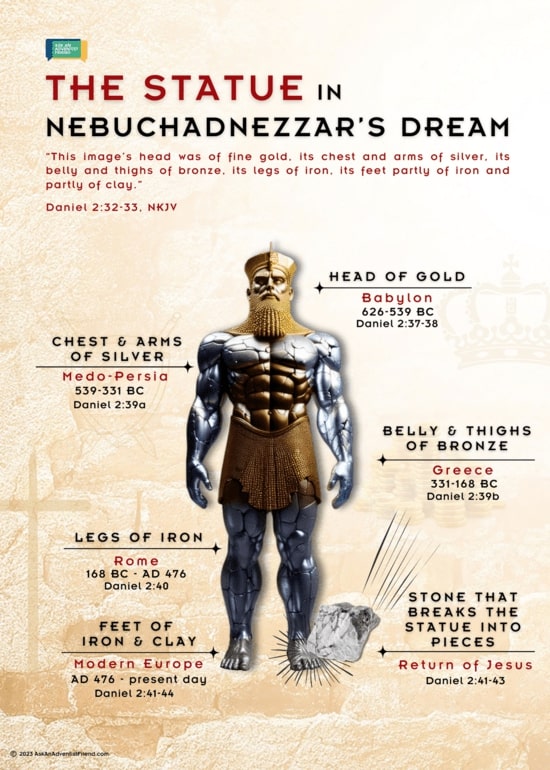
The great statue had five parts, each made of different metals. Beginning at the statue’s head, each piece represented world kingdoms in chronological order down to our time.
Adventists interpret the statue as symbolic of historical events from the time of the prophecy down to Jesus’ second coming. We use this method, called the historicist method, because that’s the way Daniel interpreted the dream to the king (Daniel 2:36–45).
Let’s take a look at each of these parts:
- The head of gold
- The chest and arms of silver
- The waist and thighs of bronze
- The legs of iron
- The feet of iron and clay
- The stone
The head of gold
The head of gold represents the Babylonian Empire, as Daniel told Nebuchadnezzar (Daniel 2:37–38).
The statue’s head is likely made of gold because of Babylon’s economic power.
Babylon was a kingdom of tremendous wealth. Its ancestors, the Sumerians, had laid its foundations by inventing writing, developing codes of law, and establishing a city-state.1 This rich culture provided the Babylon of Daniel’s era with the means for extreme prosperity. Nebuchadnezzar, especially, was responsible for revamping the nation to greater splendor than in previous dynasties.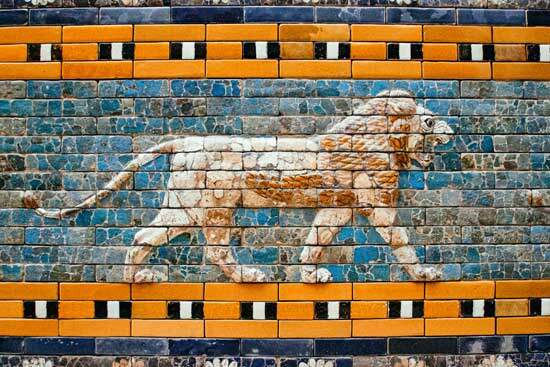
The Babylonians, also known as the Chaldeans, used gold everywhere. Statues of their gods. Temples and shrines. And even the walls around their city.
All its riches prompted the prophet Jeremiah to call Babylon a golden cup (Jeremiah 51:7).
But no kingdom is safe forever.
Babylon found this out. It was in power from 626 to 539 B.C. before another kingdom conquered it.
The chest and arms of silver
The next part of the statue was its chest and arms of silver. They represent the Medo-Persian Empire, which conquered Babylon in 539 B.C. and lasted until 331 B.C..
Silver, a method of exchange and a value standard in the ancient world, was used to denote Medo-Persia because this kingdom derived its power from money. Using an intricate system, it taxed its vassals and collected that money to fund the empire’s luxuries, military progress, and other projects.2
Even in Daniel’s lifetime, this prophecy was being fulfilled. When he was an older man, he witnessed the capture of Babylon by Darius the Mede (Daniel 5:28–31). Historical sources confirm this invasion happened in 539 B.C..3
This victory spelled freedom for the Israelite captives. As recorded in Ezra and Nehemiah, King Cyrus allowed the Hebrews to return to their native land and rebuild their cities, towns, and temples.
Medo-Persia was a kingdom founded on a partnership. The Medes and Persians united in 550 B.C. to conquer the surrounding nations and rule as one kingdom.4
It’s possible God used the two arms to represent these two kingdoms that merged.5
Persia strengthened with its successive kings. But later, one king, Xerxes, began a campaign into Greece, which proved to be Medo-Persia’s undoing.
The waist and thighs of bronze
The bronze waist and thighs in the statue represent Greece (331–168 B.C.), the third kingdom to conquer the Middle East.
Bronze was an important part of Hellenistic (Greek) culture and was used in many sculptures of the time.6 The Greeks also made many of their weapons from bronze, including their famous shields.7
And they needed a lot of weapons to conquer the world.
Greece didn’t start out as a mighty country. For centuries, it had been a small collection of city-states, which frequently squabbled among themselves. When the Persians began to sweep westward into Greece, the Greek states put aside their differences and united to fight the Persians and defeat them in four different battles.8
But the Greeks didn’t immediately turn around and conquer the world. They had to first work out their internal discord—during the Peloponnesian Wars—before they were united under Phillip II of Macedon.9
When Philip’s son Alexander the Great came to the throne, he began a full-scale invasion of Persia in retaliation for their attacks of previous years.10 This invasion led him across Asia Minor all the way to India before he died.
Greece was the new world empire—exactly what Nebuchadnezzar’s dream predicted (Daniel 2:39).
After Alexander’s death, Greece was divided into four parts, each ruled by different men. The four rulers quarreled until two major parts emerged: Ptolemy of Egypt and Seleucid.
Some think this is why Greece was given the midsection and thighs in the statue: One kingdom was split into two major parts.
Greece was eventually defeated by the statue’s legs of iron: Rome.
The legs of iron
The Roman Empire (168 B.C-A.D 476) was well-deserving of its spot as the fourth kingdom of the statue. Its nickname, the “iron monarchy,” validates Daniel’s statement that characterizes Rome “as strong as iron, inasmuch as iron breaks in pieces and shatters everything; and like iron that crushes, that kingdom will break in pieces and crush all the others” (Daniel 2:40, NKJV).
This empire eventually dominated the whole known world,11 and it was the ruling power during the time of Jesus (Luke 2:1). It was also the power the Jews hoped the Messiah would free them from.
The Roman Empire viewed war as the way to justify its power.12 So, it was constantly fighting with other empires and pushing its borders.
How did it accomplish its victories?
One way was through its iron implements. Iron is stronger than other metals, making it a great material to create weapons with (we make steel from it, which is used today in constructing buildings).
The two legs of Rome are also appropriate because the empire split into the Eastern and Western Empires in A.D. 286.
Because of constant wars, skirmishes, and eventual internal decay, Rome became weak. In A.D. 476, Germanic tribes from the north swooped down and sacked the city, ending the Western Empire.
The feet of iron and clay
The feet of Nebuchadnezzar’s statue were a strange mixture of iron and clay, representing the modern nations of Europe. Iron and clay don’t mix well. And neither would the nations of Europe, which arose from the fragments of Rome and the barbarian tribes of Europe—the iron and clay.
They would try, though. Many times, different European countries schemed together to build unbreakable bonds, such as through royal intermarriage. Daniel mentions this:
“As you saw the iron mixed with soft clay, so they will mix with one another in marriage, but they will not hold together, just as iron does not mix with clay” (Daniel 2:43, ESV).
For generations, princes and princesses of one country (England, for example) were married to princes and princesses of another country (say, Germany or France). This practice was meant to keep the bloodline pure and secure peace between those countries.
But this practice didn’t stop wars. Queen Victoria was known as the Grandmother of Europe because her children married so many different members of other royal families.13 Yet just a few years later, Europe exploded into the First World War.
Europe has tried other measures to stay united, from the League of Nations and United Nations to the common currency of the Euro. But each country still retains its own culture and beliefs that will never fuse together, no matter how similar they are to any neighboring country. Some will always be weaker (like clay), and some stronger (like iron).
The stone

Image by Jeff Jacobs from Pixabay
The stone was “cut out by no human hand” and shattered the statue’s feet and body, sweeping it away like chaff (Daniel 2:34, ESV). It represents Jesus Christ’s kingdom, which is not of human origin.
How do we know this? First of all, Daniel points it out in the interpretation:
“The God of heaven will set up a kingdom which shall never be destroyed; and the kingdom shall not be left to other people; it shall break in pieces and consume all these kingdoms, and it shall stand forever” (Daniel 2:44, NKJV).
Also, the Bible repeatedly refers to Jesus as a rock or stone. Paul echoes Old Testament prophets in calling Him the chief cornerstone in Ephesians 2:20 and a spiritual Rock in 1 Corinthians 10:4. Peter writes in his first epistle that Jesus was a “living stone, rejected indeed by men, but chosen by God and precious” (1 Peter 2:4, NKJV).
This kingdom will not simply replace the other kingdoms; it’ll be entirely different.
Daniel said the stone would grow into a mountain covering the whole earth. And since the rock destroys the other metals, it signifies that the kingdom of God is stronger than the other kingdoms.
But not in force or power.
Unlike human kingdoms that are built off selfish ambition, His own kingdom will build on selfless love that will reign eternally.
It will bring an end to sin, power games, and violence.
The reason is that sin, the breaking of God’s law of love, is ultimately self-destructive and can’t exist where God’s kingdom of love rules.
And we can be truly thankful for that! Someday, if we choose, we can live in that world—free from the selfish principles that characterize much of our world today. It’ll be a place of pure peace, gentleness, and selflessness.
Now that we know what the statue’s parts signify, let’s look at why the dream itself is important.
Why the dream is important
Nebuchadnezzar’s dream was important to both the King and Daniel. It showed both of them that God was not only communicating with them, but also, He was showing them that even the greatest earthly kingdoms will someday fall. But the dream is also important because it applies to all people. It shows us several important things about God and His plan for us, including:
- The reliability of His Word
- A biblical way to understand symbols in Bible prophecy
- The nearness of Jesus’ return
Here are the details.
Reliability of God’s Word
Photo by Aaron Burden on Unsplash
Fulfilled Bible prophecy is one way the Bible authenticates itself and shows us its reliability.
Think of it this way:
If a new friend promises to meet you at a certain time and follows through on that promise, you are more likely to trust her with other promises she makes. Repeated reliability increases your trust in her.
The Bible is the same way.
Nebuchadnezzar’s dream prophesied four successive world empires that would be followed by a divided kingdom, and each one of those has come true in history—from Babylon to the multitude of European countries.
If we can trust this part of the prophecy, we can trust that the last part will happen too. Fulfilled prophecy gives us a basis for trusting other aspects of the Bible and its prophecies that haven’t yet come to pass.
A biblical way to understand symbols in Bible prophecy
Bible prophecy is full of symbols. As with the big statue, the Bible writers use symbols like rocks, metals, and animals to refer to future times, places, and entities.
The interpretation of the statue that God gave to Daniel helps us know how the Bible wants us to understand symbols in other prophecies—they coincide with events throughout history.
In fact, Daniel 2 lays the foundation for a timeline of earth’s history that is repeated with other symbols throughout the book. It comes up again in Daniel chapters 7 and 8.
The nearness of Christ’s return
Daniel 2 gives us the big picture of what will happen at the end of time. As we’ve seen, most of the prophecy has already come to pass: Babylon, Medo-Persia, Greece, Rome, and Rome’s division into many European countries.
We are living in the toes—the end of time.
This means Christ is about to return and reign forever!
We can have hope knowing that all the violence and sin of the present earthly kingdoms will end soon. Jesus will come with glory and joy to set up His kingdom that we, as His followers, will enjoy for eternity.
And just before He returns, the Bible tells us that God’s people will have a special message to give to the world.
Choose an Online Bible Study
Want to keep learning? Find out more about Jesus, humanity, the plan of salvation, and how God loves you enough to sacrifice everything, just to give you a chance to choose Him.
Sometimes it can be hard to know where to start, that’s why we offer free, user-friendly, online Bible study options you can do anytime, anywhere, and at your own pace.
This online Bible school will take you through the major themes of Scripture, breaking down the Bible’s complex concepts into bite-sized pieces, which can lead you toward the answers of life’s more challenging questions.
- “Babylonia,” Britannica.com. [↵]
- Ibid. [↵]
- Nijssen, Daan, “Cyrus the Great,” World History Encyclopedia. [↵]
- Showers, Renald, “Babylon and Medo-Persia,” Israel My Glory. [↵]
- Ibid. [↵]
- “Bronze Sculpture of the Hellenistic World,” National Gallery of Art. [↵]
- Markowitz, Mike, “Types of Weapons Used by Ancient Greece,” Warfare History Network. [↵]
- Mark, Joshua, “Ancient Greece,” World History Encyclopedia. [↵]
- Ibid. [↵]
- Ibid. [↵]
- “The Rise of the Roman Empire,” TimeMaps History Encyclopedia. [↵]
- Moscato, Christopher, “The Iron Age in the Roman Empire: History and Conquest,” Study.com. [↵]
- “Queen Victoria,” English Heritage. [↵]
Related Articles


More Answers
Quem Foram os Juízes de Israel no Antigo Testamento?
Quem Foram os Juízes de Israel no Antigo Testamento?Tempos de crise exigem homens e mulheres de ação. Os israelitas, recém-estabelecidos na Terra Prometida, encontraram-se nesses tempos. À medida que nações inimigas atacavam e oprimiam as tribos, eles clamavam a Deus...

¿En qué se diferencian los Adventistas del Séptimo Día de otros protestantes?
¿En qué se diferencian los Adventistas del Séptimo Día de otros protestantes?Como denominación cristiana protestante, la Iglesia Adventista del Séptimo Día considera la Biblia como la regla suprema de fe y a Jesucristo como el único camino a la salvación. Tenemos...
Como os Adventistas do Sétimo Dia São Diferentes de Outros Protestantes?
Como os Adventistas do Sétimo Dia São Diferentes de Outros Protestantes?Como uma denominação cristã protestante, a Igreja Adventista do Sétimo Dia considera a Bíblia como o guia supremo e vê Jesus Cristo como o único caminho para a salvação. Temos algumas diferenças...
O que é ASI (Associação de Empresários e Profissionais Adventistas)?
O que é ASI (Associação de Empresários e Profissionais Adventistas)?ASI, que significa Associação de Empresários e Profissionais Adventistas (tradução adaptada), é uma organização baseada em associação que oferece apoio aos membros adventistas (profissionais...
Jesús y la Mujer en el Pozo: Derribando Barreras
El encuentro de Jesús con la mujer en el pozo revela su sentir por las personas heridas y su deseo de derribar prejuicios. Esta página analiza cómo Jesús se acercó a ella.

Revealing The True Meaning of The Parable of The Rich Man & Lazarus
Learn the real point behind one of Jesus’ most vivid parables.
O que são as Bem-Aventuranças (E o que significam)?
O que são as Bem-Aventuranças (E o que significam)?As Bem-Aventuranças, encontradas no início do Sermão da Montanha de Jesus no Evangelho de Mateus, são o manifesto do reino de Jesus. Elas descrevem a maneira como Seu reino funciona e o que significa ser um de Seus...
Líderes de la iglesia: ¿Cuál es el rol de un pastor Adventista?
Líderes de la iglesia: ¿Cuál es el rol de un pastor Adventista?¿Cuál es el rol de un pastor en la iglesia Adventista? La posición en sí misma, al menos en lo que respecta a una congregación local, no es muy diferente de la de los pastores en otras denominaciones...
ASI ni Nini (Huduma na Viwanda vya Waadventista vya Kibinafsi)?
ASI ni Nini (Huduma na Viwanda vya Waadventista vya Kibinafsi)?ASI, ambayo inayofupisha maneno (Huduma na Viwanda vya Waadventista vya Kibinafsi), ni shirika la uanachama linalotoa msaada kwa wainjilisti wa Kiadventista (wataalamu wa Kanisa la Waadventista wa Sabato...

Ellen White Alisema Nini Kuhusu Unabii wa Nyakati za Mwisho?
Tunaweza kusoma katika Maandiko kuhusu mfululizo wa matukio na dalili zinazoongoza hadi Ujio wa Pili wa Yesu Kristo.

Safari na Utume wa Ellen G. White Ulimwenguni
Safari na Utume wa Ellen G. White UlimwenguniIngawa Ellen White, mwanzilishi mwenza wa Kanisa la Waadventista wa Sabato, anajulikana zaidi kwa huduma yake nchini Marekani, pia alisafiri kwenda nchi nyingine kumi na mbili katika maisha yake—hili lilikuwa jambo kubwa...
Yote Kuhusu Wainjilisti wa Vitabu wa Kiadventista
Kanisa la Waadventista wa Sabato hutumia mbinu mbalimbali kusambaza tumaini la injili duniani.
¿Qué es ASI (Servicios e Industrias de Laicos Adventistas)?
¿Qué es ASI (Servicios e Industrias de Laicos Adventistas)?ASI, que significa Servicios e Industrias de Laicos Adventistas, es una organización basada en membresía que brinda apoyo a los laicos adventistas (profesionales Adventistas del Séptimo Día que no son...
¿Qué dijo Elena G. de White sobre la profecía de los últimos tiempos?
¿Qué dijo Elena G. de White sobre la profecía de los últimos tiempos?Podemos leer en las Escrituras acerca de la serie de eventos y señales que conducen a la segunda venida de Jesucristo. Y suena bastante intenso, por decir lo menos. La naturaleza simbólica del...
O que Ellen White disse sobre a profecia dos tempos finais?
O que Ellen White disse sobre a profecia dos tempos finais?Podemos ler nas Escrituras sobre a série de eventos e sinais que antecedem a segunda vinda de Jesus Cristo. E, para dizer o mínimo, isso soa bastante intenso. A natureza simbólica da linguagem da profecia...

Meaning of the Parable of the Two Sons in Matthew 21
Meaning of the Parable of the Two Sons in Matthew 21The parable of the two sons in Matthew 21:28-32 is about a father who instructs his sons to work in the family vineyard. The first son refuses to work but later has a change of heart and obeys. The second son says...
Viagens e Missão Mundial de Ellen G. White
Viagens e Missão Mundial de Ellen G. WhiteEmbora Ellen White, cofundadora da Igreja Adventista do Sétimo Dia, seja mais conhecida por seu ministério nos Estados Unidos, ela também viajou para outros doze países durante sua vida — uma grande conquista no século XIX,...
Joseph Bates na Nafasi Yake katika Kanisa la Waadventista
Joseph Bates na Nafasi Yake katika Kanisa la WaadventistaJoseph Bates alikuwa baharia aliyegeuka kuwa mhubiri ambaye alijiunga na Harakati ya Miller na kusubiri Ujio wa Pili wa Yesu kutokea mwaka 1844. Licha ya kukatishwa tamaa wakati hili halikutokea, Bates...

Je, Wasabato Husherehekea Sikukuu?
Je, Wasabato Husherehekea Sikukuu?Je unajiuliza ikiwa mwanafunzi mwenzako au mfanyakazi mwenzako Mwadventista husherehekea sikukuu kama wewe? Labda ungependa kumshirikisha kwenye sherehe fulani, lakini pia unataka kuheshimu imani yake. Kwa hiyo, huna uhakika wa jinsi...
O Que a Bíblia Diz Sobre a Segunda Vinda de Jesus Cristo
Curioso para saber o que a Bíblia diz sobre a Segunda Vinda de Jesus Cristo? Vamos abordar os versículos-chave e o que eles significam.

Waadventista Wanaamini Nini Kuhusu Imani na Matendo?
Waadventista Wanaamini Nini Kuhusu Imani na Matendo?Waadventista wanaamini tunaokolewa kwa imani, ambayo ni imani na tumaini tulilonalo kwa Yesu Kristo kutuokoa kutoka dhambini. Yesu, basi, anatupa uwezo wa kuishi kwa utii wa amri za Mungu na kuwahudumia wengine kwa...
Todo sobre los colportores Adventistas del Séptimo Día
Todo sobre los colportores Adventistas del Séptimo DíaLa Iglesia Adventista del Séptimo Día utiliza una variedad de métodos para difundir la esperanza del evangelio al mundo. Una de estas formas es a través del colportaje, también llamado “venta puerta a puerta” o...
Tudo Sobre Colportores Adventistas do Sétimo Dia
A Igreja Adventista do Sétimo Dia usa uma variedade de métodos para espalhar a esperança do evangelho ao mundo.
Los viajes y la misión mundial de Elena G. de White
Los viajes y la misión mundial de Elena G. de WhiteAunque Elena G. de White, cofundadora de la Iglesia Adventista del Séptimo Día, es más conocida por su ministerio en los Estados Unidos, también viajó a otros doce países durante su vida, un gran logro en el siglo XIX...

Mikutano ya Injili ya Waadventista ni Nini?
Kanisa la Waadventista wa Sabato linaweka mkazo mkubwa katika kushiriki injili kupitia uinjilisti, yaani kushiriki injili kupitia mahubiri, mafundisho, na ushuhuda.
Joseph Bates y su papel en la Iglesia Adventista del Séptimo Día
Joseph Bates y su papel en la Iglesia Adventista del Séptimo DíaJoseph Bates fue un marinero que se convirtió en predicador, se unió al Movimiento Millerita y esperó que ocurriera la Segunda Venida de Jesús en 1844. A pesar de sentirse decepcionado cuando esto no...
Joseph Bates e Seu Papel na Igreja Adventista do Sétimo Dia
Joseph Bates foi um marinheiro que se tornou pregador, juntou-se ao Movimento Millerita e esperou pela Segunda Vinda de Jesus em 1844.
¿Los Adventistas del Séptimo Día celebran las fiestas?
¿Los Adventistas del Séptimo Día celebran las fiestas?¿Te preguntas si tu compañero de clase o de trabajo adventista celebra las mismas fiestas que tú? Tal vez quieres incluirlo en algunas festividades, pero también deseas respetar sus creencias. Entonces, no estás...
Os Adventistas do Sétimo Dia Celebram Feriados?
Está se perguntando se seu colega de classe ou de trabalho adventista celebra os mesmos feriados que você?
Didn’t find your answer? Ask us!
We understand your concern of having questions but not knowing who to ask—we’ve felt it ourselves. When you’re ready to learn more about Adventists, send us a question! We know a thing or two about Adventists.