
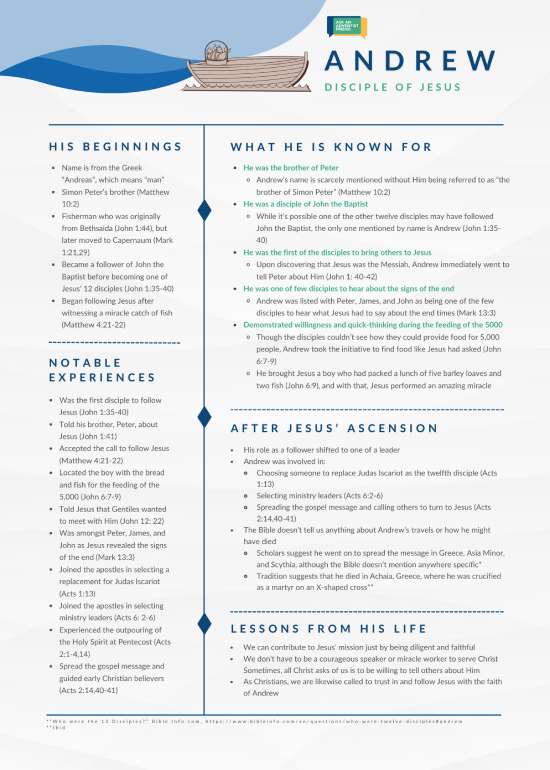
Andrew was Jesus Christ’s first disciple (John 1:37-40) and the first to recognize Him as the Messiah.
With this discovery, Andrew invited his brother, Peter, to come meet Jesus for himself.
Though little is known about Andrew, the details we find in the New Testament show that he played a valuable role in Jesus’ ministry.
Let’s look at some of Andrew’s most memorable moments in Scripture.
We’ll cover:
- Andrew’s beginnings
- What Andrew is known for in the Bible
- Andrew after Jesus’ ascension
- What we can learn from his life
First, some background information…
Andrew’s beginnings
Little is known about the apostle Andrew, since Bible writers didn’t often provide background details about people who weren’t immediately pertinent to the story at hand. But the Bible does give us an overview of who Andrew was and where he came from.
Andrew had a Greek name that comes from the word “Andreas,” which simply means “man.”1
He was the son of a Jewish man named Jonah or John (different versions translate the name differently) and a brother to the well-known disciple Peter (John 1:42; Matthew 10:2).
Like his brother, Peter, and his fellow disciple, Philip, Andrew was originally from Bethsaida in Galilee (John 1:44), though he later moved to Capernaum (Mark 1:21, 29).
Andrew and Peter both worked as fishermen (Mark 1:16), but Andrew was the only one said to have been a follower of John the Baptist (John 1:35-40). And it was the decision to follow John the Baptist that first led Andrew to Christ.
According to the Gospel of John, Andrew heard about Jesus when John the Baptist announced Him as the Lamb of God (John 1:35-40). Immediately, Andrew and another one of John’s disciples followed after Jesus and ended up spending the day with Him (John 1:38-39).
Evidently impressed by his encounter with Jesus, Andrew went to tell Peter he had met the Messiah (John 1:41). He even brought Peter to Jesus.
And this wouldn’t be the last time they saw Jesus.
They would later be called by Him to spend the rest of their lives following Him.
The calling of Andrew

Though Peter and Andrew met Jesus, the official “call” to discipleship was recorded when Jesus found them fishing (Mark 1:16).
The Gospel of Luke tells us that crowds of people had gathered near the Lake of Gennesaret to hear Jesus speak (Luke 5:1). But instead of speaking to them from the land, Jesus decided to speak to them from one of the fishermen’s boats nearby.
He had seen Andrew and Peter’s boat, and they agreed to let Him climb aboard.
From there, Jesus began teaching the crowd (Luke 5:2-3). Afterward, He turned to Peter and told him to release his nets into the water (Luke 5:4).
Peter responded by telling Jesus that they hadn’t been able to catch any fish, even though they’d been fishing all night long (Luke 5:5). And yet he agreed to cast their net one more time (Luke 5:5).
The Bible tells us:
“And when they had done this, they caught a great number of fish, and their net was breaking. So they signaled to their partners in the other boat to come and help them. And they came and filled both the boats, so that they began to sink” (Luke 5:6-7, NKJV).
It was then, in the face of a miracle, that Jesus called Andrew and his brother Peter to become His disciples.
“Then He said to them, ‘Follow Me, and I will make you fishers of men’” (Matthew 4:19, NKJV).
And without any hesitation, Andrew and Peter accepted His offer and decided to follow Jesus (Matthew 4:20).
The story of Andrew’s calling tells us a little bit about the kind of person he was: a faithful, dedicated individual. When convinced of Jesus’ messiahship, he couldn’t help but tell others, and he readily left behind his job, family, and hometown to become a loyal follower of Jesus.
What is Andrew known for in the Bible?
The most well-known detail about Andrew is that he became Jesus’ first disciple.
However, a couple more things set him apart from the other disciples:
- He was a confirmed disciple of John the Baptist (John 1:35-40): While it’s possible that a few more of the 12 disciples also followed John the Baptist, the only one mentioned by name is Andrew.
- He was the first of the disciples to bring others to Jesus (John 1:40-42): Upon discovering that Jesus was the Messiah, Andrew immediately went to tell Peter about Him.
- He may have been one of the few disciples to hear about the signs of the end (Mark 13:3): Though Jesus loved all of His disciples, He became especially close to Peter, James, and John. On this occasion, however, Andrew was included in this “inner circle” of disciples when they asked Jesus about signs of things to come. And so Andrew was listed among them as being one of the few disciples to hear what Jesus had to say about the end times.
- He was the brother of Peter (Matthew 10:2): Aside from James and John, Peter and Andrew were the other set of brothers among the disciples. Between these two, the Bible writers talked a lot more about Peter. In fact, Andrew’s name is scarcely mentioned without him being referred to as “the brother of Simon Peter.”2
But being well-known is not the primary measure for being a good disciple and one we can learn from. Even from the little information Scripture gives us, we can tell that Andrew was a competent disciple who was quick to do the work he was called to do. That simple quality—willingness—is invaluable, especially for a follower of Christ.
We see this willingness demonstrated in how he worked with his fellow disciples and other people he ministered to.
For example, there was one occasion when a group of Greeks came to Philip asking to see Jesus (John 12:20-21).
Philip turned to Andrew with the request, and together they brought the request before Jesus (John 12:22).
(Whenever in doubt about how to respond to a situation, it’s always a good idea to turn to Jesus.)
This situation also demonstrates how willing Andrew was to introduce others to Jesus Christ. He didn’t seem to care that they weren’t Jews, but rather left it up to Jesus to decide how to proceed.
Andrew demonstrated that same willingness and quick thinking when he ministered to the crowds following Jesus.
One time, a group of 5,000 people were following after Jesus, and everyone ran out of food (John 6:2). Testing the disciples, Jesus asked them where they could go to find food for the people (John 6:5-6).
Though the disciples didn’t see how they could provide for 5,000 people, Andrew took the initiative to find food like Jesus had asked (John 6:7-9).
He brought Jesus a boy who had packed a lunch of five barley loaves and two fish (John 6:9).
And while he didn’t understand how that would be enough to feed the crowd, he offered it up to Jesus anyway. He did what he knew to do, given the circumstances.
Though the Bible doesn’t often address Andrew’s role in Jesus’ ministry, the occasions it does mention him point to his continuous dedication to Christ.
What did Andrew do as an apostle, after Jesus’ ascension?

Photo by Hans Reniers on Unsplash
While we know little about Andrew’s specific role when he was a disciple to Jesus, even less is recorded about his life after Jesus’ ascension back to heaven.
Like the rest of the disciples, it’s very likely he took up Jesus’ call to spread the Gospel around the world (Acts 1:6-8).
Some scholars suggest he went on to spread the message in Greece, Asia Minor, and Scythia, although the Bible doesn’t mention any specific locations.3
Tradition also suggests that Andrew died in Achaia, Greece, where he was crucified as a martyr.4 Unofficial records claim that Andrew asked to be crucified on an X-shaped cross out of respect for Jesus’ own crucifixion.5 This idea has become so popular that X-shaped crosses are now referred to as St. Andrew’s crosses.6
However, it’s worth noting that the Bible doesn’t tell us anything about Andrew’s travels or how he might have died.
Instead, the book of Acts tells us how Andrew’s role as a follower had shifted to one of a leader, as all twelve apostles were called to make administrative decisions and teach early Christian believers while Christ was in heaven.
The Bible tells us Andrew was involved in:
- Choosing someone to replace Judas Iscariot as the 12th disciple (Acts 1:13)
- Selecting ministry leaders (Acts 6:2-6)
- Spreading the Gospel message, and calling others to turn to Jesus (Acts 2:14, 40-41)
While these may not be roles or jobs that get much attention, they are similar to the kinds of tasks that are consistently important in ministry today, whether in a small church, large congregation, or discipleship group.
What can we learn from the life of Andrew?
Andrew’s life and ministry teach us that we can contribute to Jesus’ mission just by being diligent and faithful and maintaining a state of readiness and receptiveness to be used by God.
There wasn’t anything remarkable about Andrew from an earthly perspective.
He was a poor fisherman, and unlike his brother Peter, he didn’t end up becoming one of the most well-known apostles.
But Andrew was no doubt an invaluable member of the 12.
It was Andrew who brought Peter to meet Jesus.
It was Andrew who led Gentiles to Jesus when others might have turned them away.
It was Andrew who hadn’t given up on the feeding of the 5,000.
And it was Andrew who first sought after Christ.
He had an incredible faith and was passionate about bringing others to Jesus.
As Christians, we are likewise called to trust in and follow Jesus with the faith of Andrew.
His example also shows us that we don’t have to be courageous speakers or miracle workers to serve Christ. Sometimes, all Christ asks of us is that we be willing to do what needs doing and to always point back to Jesus.
In the end, that’s our goal as Christians—to bring others to Christ like Andrew did.
Want to continue learning about the disciples?
Related Articles





- “What was it Like Being Jesus’ Disciple and Apostle?” General Conference Corporation of Seventh-day Adventists, [↵]
- Matthew 4:18; Matthew 10:2; Mark 1:16; John 1:40. [↵]
- “Who were the 12 Disciples?” BibleInfo.com, [↵]
- Ibid. [↵]
- Ibid. [↵]
- Ibid. [↵]
More Answers

Quem Foram os Juízes de Israel no Antigo Testamento?
Quem Foram os Juízes de Israel no Antigo Testamento?Tempos de crise exigem homens e mulheres de ação. Os israelitas, recém-estabelecidos na Terra Prometida, encontraram-se nesses tempos. À medida que nações inimigas atacavam e oprimiam as tribos, eles clamavam a Deus...

¿En qué se diferencian los Adventistas del Séptimo Día de otros protestantes?
¿En qué se diferencian los Adventistas del Séptimo Día de otros protestantes?Como denominación cristiana protestante, la Iglesia Adventista del Séptimo Día considera la Biblia como la regla suprema de fe y a Jesucristo como el único camino a la salvación. Tenemos...
Como os Adventistas do Sétimo Dia São Diferentes de Outros Protestantes?
Como os Adventistas do Sétimo Dia São Diferentes de Outros Protestantes?Como uma denominação cristã protestante, a Igreja Adventista do Sétimo Dia considera a Bíblia como o guia supremo e vê Jesus Cristo como o único caminho para a salvação. Temos algumas diferenças...

O que é ASI (Associação de Empresários e Profissionais Adventistas)?
O que é ASI (Associação de Empresários e Profissionais Adventistas)?ASI, que significa Associação de Empresários e Profissionais Adventistas (tradução adaptada), é uma organização baseada em associação que oferece apoio aos membros adventistas (profissionais...
Jesús y la Mujer en el Pozo: Derribando Barreras
El encuentro de Jesús con la mujer en el pozo revela su sentir por las personas heridas y su deseo de derribar prejuicios. Esta página analiza cómo Jesús se acercó a ella.

Revealing The True Meaning of The Parable of The Rich Man & Lazarus
Learn the real point behind one of Jesus’ most vivid parables.
O que são as Bem-Aventuranças (E o que significam)?
O que são as Bem-Aventuranças (E o que significam)?As Bem-Aventuranças, encontradas no início do Sermão da Montanha de Jesus no Evangelho de Mateus, são o manifesto do reino de Jesus. Elas descrevem a maneira como Seu reino funciona e o que significa ser um de Seus...

Líderes de la iglesia: ¿Cuál es el rol de un pastor Adventista?
Líderes de la iglesia: ¿Cuál es el rol de un pastor Adventista?¿Cuál es el rol de un pastor en la iglesia Adventista? La posición en sí misma, al menos en lo que respecta a una congregación local, no es muy diferente de la de los pastores en otras denominaciones...
ASI ni Nini (Huduma na Viwanda vya Waadventista vya Kibinafsi)?
ASI ni Nini (Huduma na Viwanda vya Waadventista vya Kibinafsi)?ASI, ambayo inayofupisha maneno (Huduma na Viwanda vya Waadventista vya Kibinafsi), ni shirika la uanachama linalotoa msaada kwa wainjilisti wa Kiadventista (wataalamu wa Kanisa la Waadventista wa Sabato...

Ellen White Alisema Nini Kuhusu Unabii wa Nyakati za Mwisho?
Tunaweza kusoma katika Maandiko kuhusu mfululizo wa matukio na dalili zinazoongoza hadi Ujio wa Pili wa Yesu Kristo.

Safari na Utume wa Ellen G. White Ulimwenguni
Safari na Utume wa Ellen G. White UlimwenguniIngawa Ellen White, mwanzilishi mwenza wa Kanisa la Waadventista wa Sabato, anajulikana zaidi kwa huduma yake nchini Marekani, pia alisafiri kwenda nchi nyingine kumi na mbili katika maisha yake—hili lilikuwa jambo kubwa...

Yote Kuhusu Wainjilisti wa Vitabu wa Kiadventista
Kanisa la Waadventista wa Sabato hutumia mbinu mbalimbali kusambaza tumaini la injili duniani.
¿Qué es ASI (Servicios e Industrias de Laicos Adventistas)?
¿Qué es ASI (Servicios e Industrias de Laicos Adventistas)?ASI, que significa Servicios e Industrias de Laicos Adventistas, es una organización basada en membresía que brinda apoyo a los laicos adventistas (profesionales Adventistas del Séptimo Día que no son...
¿Qué dijo Elena G. de White sobre la profecía de los últimos tiempos?
¿Qué dijo Elena G. de White sobre la profecía de los últimos tiempos?Podemos leer en las Escrituras acerca de la serie de eventos y señales que conducen a la segunda venida de Jesucristo. Y suena bastante intenso, por decir lo menos. La naturaleza simbólica del...
O que Ellen White disse sobre a profecia dos tempos finais?
O que Ellen White disse sobre a profecia dos tempos finais?Podemos ler nas Escrituras sobre a série de eventos e sinais que antecedem a segunda vinda de Jesus Cristo. E, para dizer o mínimo, isso soa bastante intenso. A natureza simbólica da linguagem da profecia...

Meaning of the Parable of the Two Sons in Matthew 21
Meaning of the Parable of the Two Sons in Matthew 21The parable of the two sons in Matthew 21:28-32 is about a father who instructs his sons to work in the family vineyard. The first son refuses to work but later has a change of heart and obeys. The second son says...
Viagens e Missão Mundial de Ellen G. White
Viagens e Missão Mundial de Ellen G. WhiteEmbora Ellen White, cofundadora da Igreja Adventista do Sétimo Dia, seja mais conhecida por seu ministério nos Estados Unidos, ela também viajou para outros doze países durante sua vida — uma grande conquista no século XIX,...
Joseph Bates na Nafasi Yake katika Kanisa la Waadventista
Joseph Bates na Nafasi Yake katika Kanisa la WaadventistaJoseph Bates alikuwa baharia aliyegeuka kuwa mhubiri ambaye alijiunga na Harakati ya Miller na kusubiri Ujio wa Pili wa Yesu kutokea mwaka 1844. Licha ya kukatishwa tamaa wakati hili halikutokea, Bates...

Je, Wasabato Husherehekea Sikukuu?
Je, Wasabato Husherehekea Sikukuu?Je unajiuliza ikiwa mwanafunzi mwenzako au mfanyakazi mwenzako Mwadventista husherehekea sikukuu kama wewe? Labda ungependa kumshirikisha kwenye sherehe fulani, lakini pia unataka kuheshimu imani yake. Kwa hiyo, huna uhakika wa jinsi...

O Que a Bíblia Diz Sobre a Segunda Vinda de Jesus Cristo
Curioso para saber o que a Bíblia diz sobre a Segunda Vinda de Jesus Cristo? Vamos abordar os versículos-chave e o que eles significam.

Waadventista Wanaamini Nini Kuhusu Imani na Matendo?
Waadventista Wanaamini Nini Kuhusu Imani na Matendo?Waadventista wanaamini tunaokolewa kwa imani, ambayo ni imani na tumaini tulilonalo kwa Yesu Kristo kutuokoa kutoka dhambini. Yesu, basi, anatupa uwezo wa kuishi kwa utii wa amri za Mungu na kuwahudumia wengine kwa...
Todo sobre los colportores Adventistas del Séptimo Día
Todo sobre los colportores Adventistas del Séptimo DíaLa Iglesia Adventista del Séptimo Día utiliza una variedad de métodos para difundir la esperanza del evangelio al mundo. Una de estas formas es a través del colportaje, también llamado “venta puerta a puerta” o...
Tudo Sobre Colportores Adventistas do Sétimo Dia
A Igreja Adventista do Sétimo Dia usa uma variedade de métodos para espalhar a esperança do evangelho ao mundo.
Los viajes y la misión mundial de Elena G. de White
Los viajes y la misión mundial de Elena G. de WhiteAunque Elena G. de White, cofundadora de la Iglesia Adventista del Séptimo Día, es más conocida por su ministerio en los Estados Unidos, también viajó a otros doce países durante su vida, un gran logro en el siglo XIX...

Mikutano ya Injili ya Waadventista ni Nini?
Kanisa la Waadventista wa Sabato linaweka mkazo mkubwa katika kushiriki injili kupitia uinjilisti, yaani kushiriki injili kupitia mahubiri, mafundisho, na ushuhuda.
Joseph Bates y su papel en la Iglesia Adventista del Séptimo Día
Joseph Bates y su papel en la Iglesia Adventista del Séptimo DíaJoseph Bates fue un marinero que se convirtió en predicador, se unió al Movimiento Millerita y esperó que ocurriera la Segunda Venida de Jesús en 1844. A pesar de sentirse decepcionado cuando esto no...
Joseph Bates e Seu Papel na Igreja Adventista do Sétimo Dia
Joseph Bates foi um marinheiro que se tornou pregador, juntou-se ao Movimento Millerita e esperou pela Segunda Vinda de Jesus em 1844.
¿Los Adventistas del Séptimo Día celebran las fiestas?
¿Los Adventistas del Séptimo Día celebran las fiestas?¿Te preguntas si tu compañero de clase o de trabajo adventista celebra las mismas fiestas que tú? Tal vez quieres incluirlo en algunas festividades, pero también deseas respetar sus creencias. Entonces, no estás...
Os Adventistas do Sétimo Dia Celebram Feriados?
Está se perguntando se seu colega de classe ou de trabalho adventista celebra os mesmos feriados que você?
Didn’t find your answer? Ask us!
We understand your concern of having questions but not knowing who to ask—we’ve felt it ourselves. When you’re ready to learn more about Adventists, send us a question! We know a thing or two about Adventists.